Showing posts with label soredia. Show all posts

Sunday, January 08, 2023

Not a layer cake.

Lichens are so confusing! If they would only grow in separate patches, like the rows of beans and carrots in a garden ... But no, they scramble themselves together, on top of, underneath, in the middle of each other.

Like yesterday's puzzle piece. Here it is, again.

Two lichens; identified as a Parmelia sp. and a Hypogymnia sp.

This was a photo taken by my hobby microscope, looking at a twig I'd brought home from the woods.

My twiggy lichen "bouquet"

Just the left-hand twig with its burden of 4 lichens.

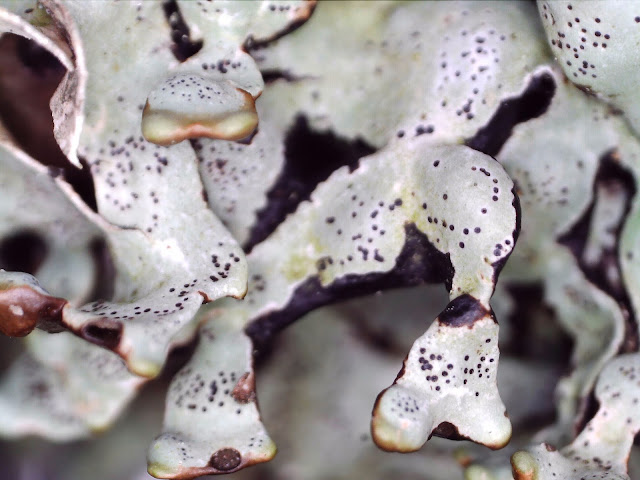
One of the lichens is a leafy species; this would be one of the Parmelia spp.  The upper surface is pale greenish-grey, the lower surface, in part, black or dark brown. The edges of the lobes carry tiny soredia, reproductive bodies that look like black specks.

Curly edges of the lobes, with their soredia.

More soredia. Many more.

The underside of one lobe.

The second lichen is a Hypogymnia spp., one of the bone lichens.

The tip of that same twig.

Again, the upper surface is green, the bottom black. But these are long lobes, bone-shaped.

The tip of one of the "bones".

And here, you can see those black patches that are on the two lower layers of the first photo. The upper layer is clear on top, but on the underside it has these root-like structures, holdfasts, called rhizines, which identify this layer as a Parmelia.

Here, so you don't have to scroll back up, is that first photo:

Three layers.

And thanks to the experts on Field Naturalists of Vancouver Island for their help in solving this mystery.

There were 4 lichens on these twigs. The other two, I'll leave for tomorrow.

~~~~~~~~~~~~~~~~~~~~~~~~~~~~~~~~~~~~
¡Los líquenes son tan complicados! Si crecieran por separados, algo así como las lechugas y las zanahorias en un jardín, ... pero, no; tienen que crecer todos amontonados, uno encima, abajo, adentro, en medio del otro.

Como los de la foto que subí ayer. Aquí la subo otra vez.

Fotos:
  1. Son dos líquenes, una Parmelia y una Hypogymnia. Esta fue una foto hecha por mi microscopio "hobby" viendo una ramita que me traje del bosque.
  2. Las dos ramitas en un recipiente.
  3. La ramita de la izquierda con su mezcla de 4 líquenes.
  4. Una de las ramitas es un liquen folioso, de las especies Parmelia. La superficie superior es de un verde grisáceo; la parte inferior tiene manchas café oscuros o negros. Y los bordes de los lóbulos llevan unas bolitas negras, cuerpos reproductivos llamados soredia.
  5. Otra foto con soredia.
  6. La parte inferior de un lóbulo.
  7. El segundo liquen es una Hypogymnia, uno de los llamados líquenes de hueso. Los lóbulos son largos, con forma de hueso.
  8. Esta foto muestra la punta de una rama, y se ven las manchitas negras que también se ven en los dos niveles de la foto primera.
  9. Que se repite aquí por conveniencia. Se ve que el liquen superior es sin manchas en la parte superior, pero debajo lleva estas estructuras parecidas a raices, "agarraderas", o rizinas, los cuales identifican este liquen como Parmelia.
Muchas gracias a las peritas del grupo Facebook Field Naturalists of Vancouver Island por su ayuda con la identificación.

Había 4 líquenes en esas ramitas. Dejo los otros dos para mañana.


Sunday, January 16, 2022

Lichens, writ large

I give up. The more I try to identify these lichens, the more muddled I get. So here are three photos from the microscope, unidentified.

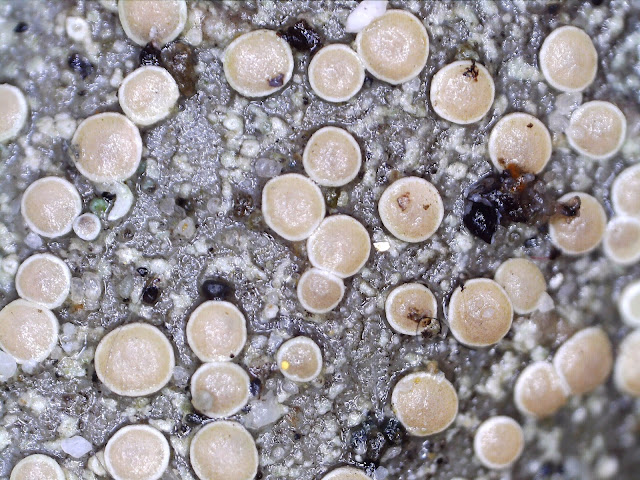
A leaf lichen on a Douglas fir twig. The round purplish dots are reproductive structures.

There are three main types of reproductive structures; one, pieces that break of the parent form new lichen clones, second, reproductive structures that are basically fragments containing both the algal or cyanobacterial and the fungal components of the lichen, and third, spore production. In this case, only the fungal spores are disseminated, and to produce a new lichen, they have to meet up, by chance, with the appropriate alga.

The asexual reproductive structures are:
Soredia (singular: "soredium") are small groups of algal cells surrounded by fungal filaments that form in structures called soralia, from which the soredia can be dispersed by wind. Isidia (singular: "isidium") are branched, spiny, elongated, outgrowths from the thallus that break off for mechanical dispersal. (From Wikipedia)

And the sexual structures:
Apothecia are usually cups or plate-like discs located on the top surface of the lichen thallus. When apothecia are shaped like squiggly line segments instead of like discs, they are called lirellae. Perithecia are shaped like flasks that are immersed in the lichen thallus tissue, which has a small hole for the spores to escape the flask, and appear like black dots on the lichen surface.(Wikipedia)
And in each lichen, the shapes and colours are different. Do you see why I'm confused?

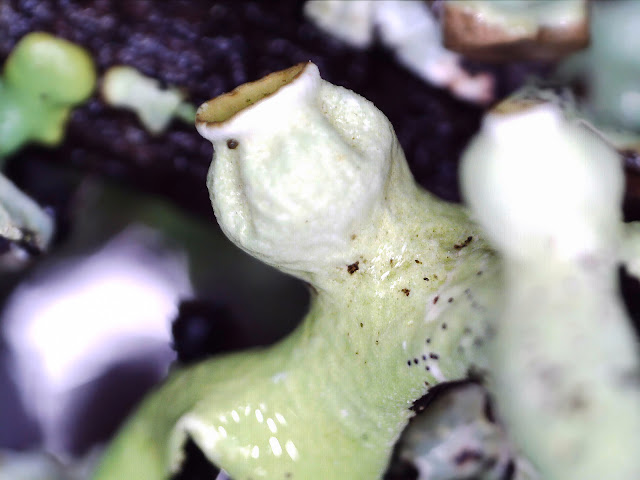
On that same lichen, there are these little barrel-shaped things.

On yesterday's alder branch: little buttons, with no leaf structures.

Tomorrow, if it doesn't rain too much, I'll go looking for Cladonia lichens to pop under the microscope.

~~~~~~~~~~~~~~~~~~~~~

Me rindo. Por más que trato de identificar estos líquenes, más me deja sin entender. Así que aquí hay tres fotos de líquenes bajo el microscopio, sin identificación.


Primera foto: un liquen folioso sobre una ramita de abeto de Douglas. Los puntitos morados son estructuras reproductivas.

Un liquen se reproduce en varias maneras, principalmente de tres tipos. La reproducción vegetativa se lleva a cabo cuando fragmentos rotos del liquen se establecen en otro sitio, y forman una unidad nueva; esta es un clon del original.

La reproducción asexual ocurre por medio de estructuras que contienen tanto células del hongo como del alga o cianobacteria que componen el liquen.

Y en la reproducción sexual, el hongo produce esporas, a estos se las lleva el viento. Para formar un nuevo líquen tienen que encontrar, por azar, un alga del tipo compatible.

Las estructuras reproductivas asexuales son:
... estructuras especializadas llamadas soredios (que a su vez están agrupados en soralios) e isidios. Un soredio es una agrupación de hifas del hongo rodeando a unos pocos elementos algares que se desprende de la superficie del talo liquénico para ser diseminado bien por el viento, bien por salpicaduras de lluvia ...​ Los isidios ... son porciones de talo que se desarrollan en la superficie conservando la estructura en capas y córtex y que pueden desprenderse con facilidad. (de Wikipedia)

Y las sexuales:
Las esporas sexuales formadas en ascomicotas se encuentran característicamente en peritecios y apotecios; ... las estructuras producidas en el himenio se diseminan en busca en un nuevo fotobionte .... La estructura reproductora asexual más común es el picnidio, receptáculo abierto o cerrado con forma de copa o de esfera que contiene en su interior gran cantidad de conidióforos productores de conidios. (Wikipedia)
Y en cada líquen, las formas y colores son distintos. ¿Ves porqué estoy perpleja?

Segunda foto: en la misma liquen foliosa, existen estos barrilitos.

Tercera foto: estos botoncitos estaban en la rama del aliso.

Para mañana, si no llueve demasiado, iré en busca de unos líquenes Cladonia para mirar bajo mi microscopio.


Saturday, January 16, 2021

Floury buttons

Last month I brought home a piece of bark with a good growth of leafy lichen and left it on a table outside my door. Yesterday I brought it in to look at it in detail.

Hyphenated ribbon, Ramalina farinacea

It's hard to really see these lichens; each lobe branches and twists and entwines itself among the others. The eyes rebel. But this time, I noticed the round buttons; what are they?

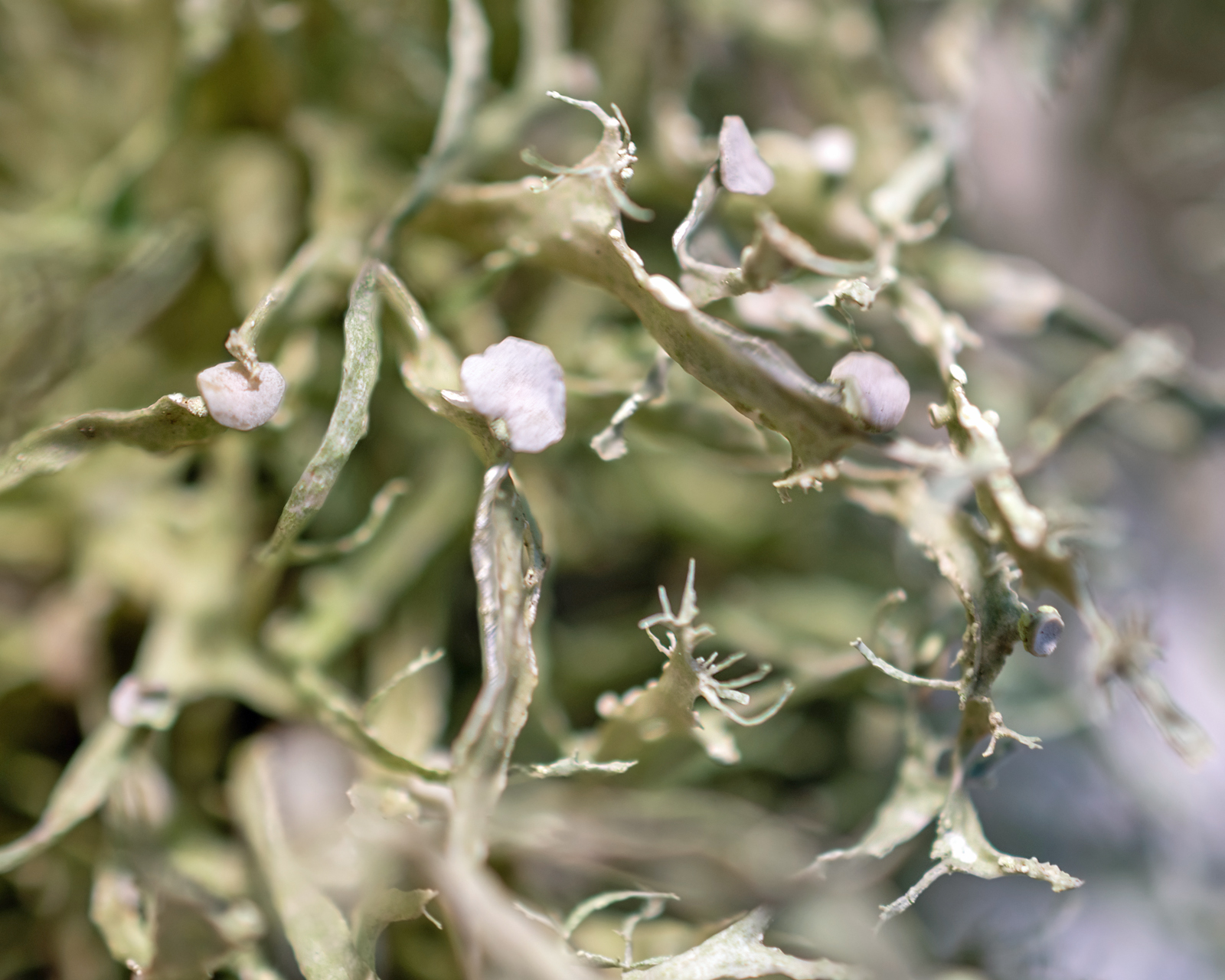
Soralia, bearers of soredia, the lichen's reproductive structures.

Soredia are powdery propagules composed of fungal hyphae wrapped around cyanobacteria or green algae. These can be either scattered diffusely across the surface of the lichen's thallus, or produced in localized structures called soralia. (Wikipedia)

There are two look-alike common species of leafy lichens in this area; the Antlered Perfume, and this, the Hyphenated Ribbon. I had assumed that this lichen was the Perfume, but then I went looking for photos with those flat plates. Hundreds of photos later, I found them on the Ribbon. (Hyphenated: I like that name!) iNaturalist calls them Farinose Cartilage Lichen. They do have a tough, cartilagey texture.

I got out the microscope:

Two soralia on a lobe.

The Latin name, farinacea, means "floury", referring to the texture of the top of these structures.

Another one. The white blobs are also reproductive structures.

One more. It stands up like a cake plate from the green thallus.

~~~~~~~~~~~~~~~~~~~~~~~
Hace más o menos un mes, me traje a casa un pedazo de corteza caída, donde crecía unas ramas de liquen folioso. Lo dejé en una mesa afuera de mi puerta.

Ayer, lo recogí para examinarlo con cuidado. Es difícil ver claramente estos líquenes; los lóbulos se dividen, se tuercen, se enredan con los otros. Mis pobres ojos se rebelan. Pero esta vez vi esos botones blancos; ¿Qué serán?

Talo fruticuloso de color gris verdoso formado por lacinias colgantes estrechas, acintadas y provistas de numerosos soralios ovales en los márgenes, que nacen todas de un único punto de fijación al sustrato. (Descripción por Miguel Varona, "Cuaderno")
Son soralios, estructuras reproductivas, donde se producen los soredios, la materia reproductiva, que consiste en hifas (algo así como raices) del hongo envolviendo una cianobacteria o un alga verde.

Hay dos especies de líquenes por este rumbo, casi idénticas; La Evernia prunastri, (aquí la llamamos la cornamenta perfumada), y la Ramalina farinacea, a la que le llamamos el listón con guiones. Creía que este liquen era la perfumada, pero después de mirar fotos, cientos de fotos, buscando estas estructuras, las encontré en el listón. En el sitio de iNaturalist, le nombran este liquen como el liquen de cartílago harinoso. Sí, tienen una textura algo tiesa, medio dura, como el cartílago, y la superfice de los soralios parece estar cubierta de harina. (De ahi viene el nombre científico, farinacea.)

Las examiné bajo el microscopio. Aquí se ven estas estructuras, algo levantados de la hoja en un pedestal, con el soralio encima. Hasta parece un postre en su soporte de pastel, ¿no?


Powered By Blogger