Showing posts with label lichen reproduction. Show all posts

Monday, February 05, 2024

Palest green knots

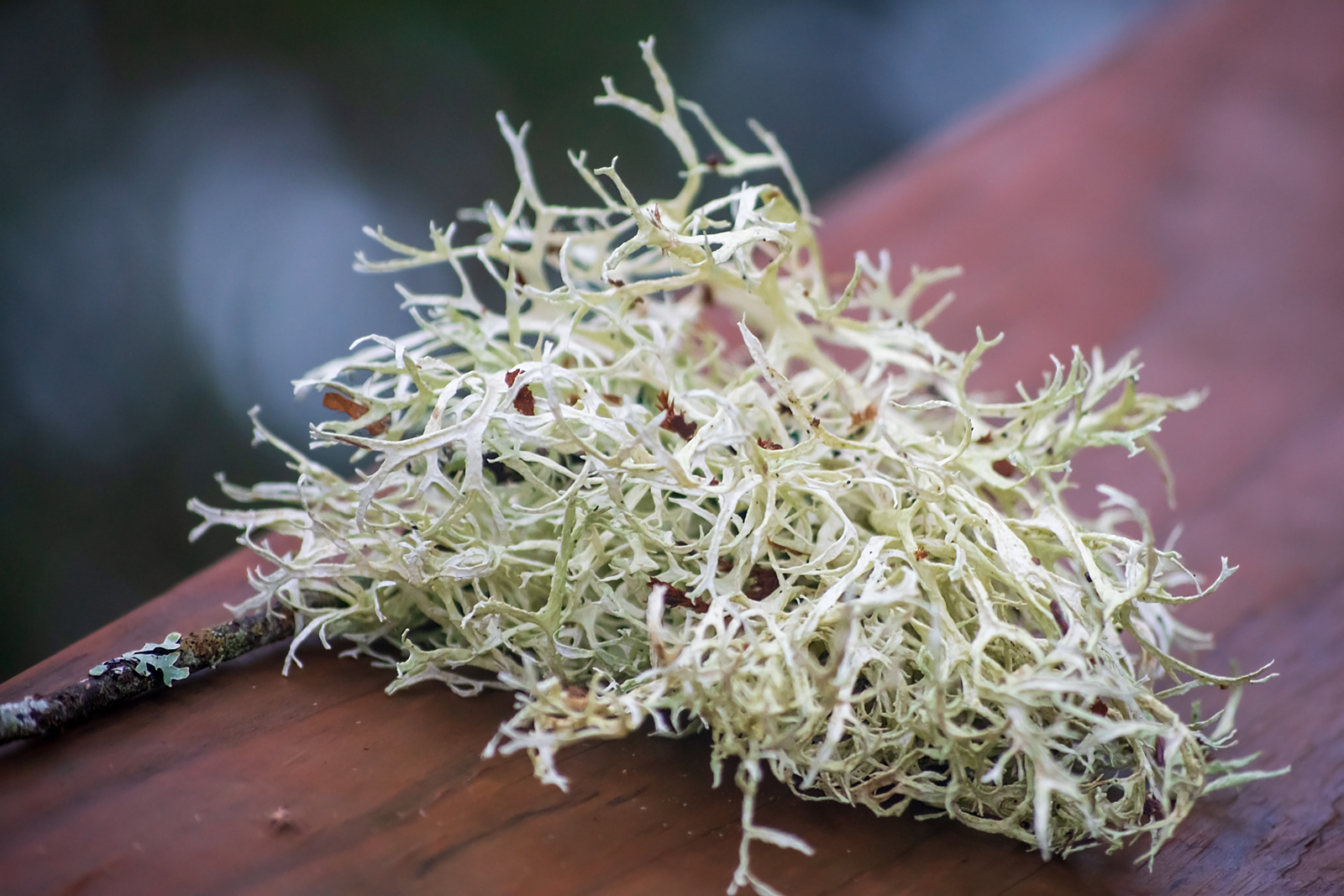
Of beards and antlers and fat little monks, hanging from trees and sometimes blowing in the wind. Lichens, of course.

I picked these up off the ground on the trail beside the river.

Usnea longissima, Methuselah's beard lichen on a bed of wet leaves.

An easy lichen to recognize; it hangs from branches in long streamers, somewhat like an old geezer's beard. And found on the ground, we can do a simple test; pull on two ends; it stretches. The whitish central cord is elastic. This elasticity is unique to the Usnea genus.

Lichens reproduce in a variety of ways; through fragmentation, or from dispersal of spores or clusters of algal cells enveloped in fungal threads. For Usnea sp., fragmentation is more productive.
In usnea, spore-producing structures are considered very rare, so wind, rain, animals—especially birds and squirrels—and trees rubbing together break off bits that may attach to other substrates, primarily the bark of trees. (SNJ Today)
Since lichen grows on the surface of the trees, with no root-like structures inside the wood, in contrast to the shelf fungi, when a wind-blown piece hangs up on the next tree, it quickly makes itself at home; it has no torn roots to replace.
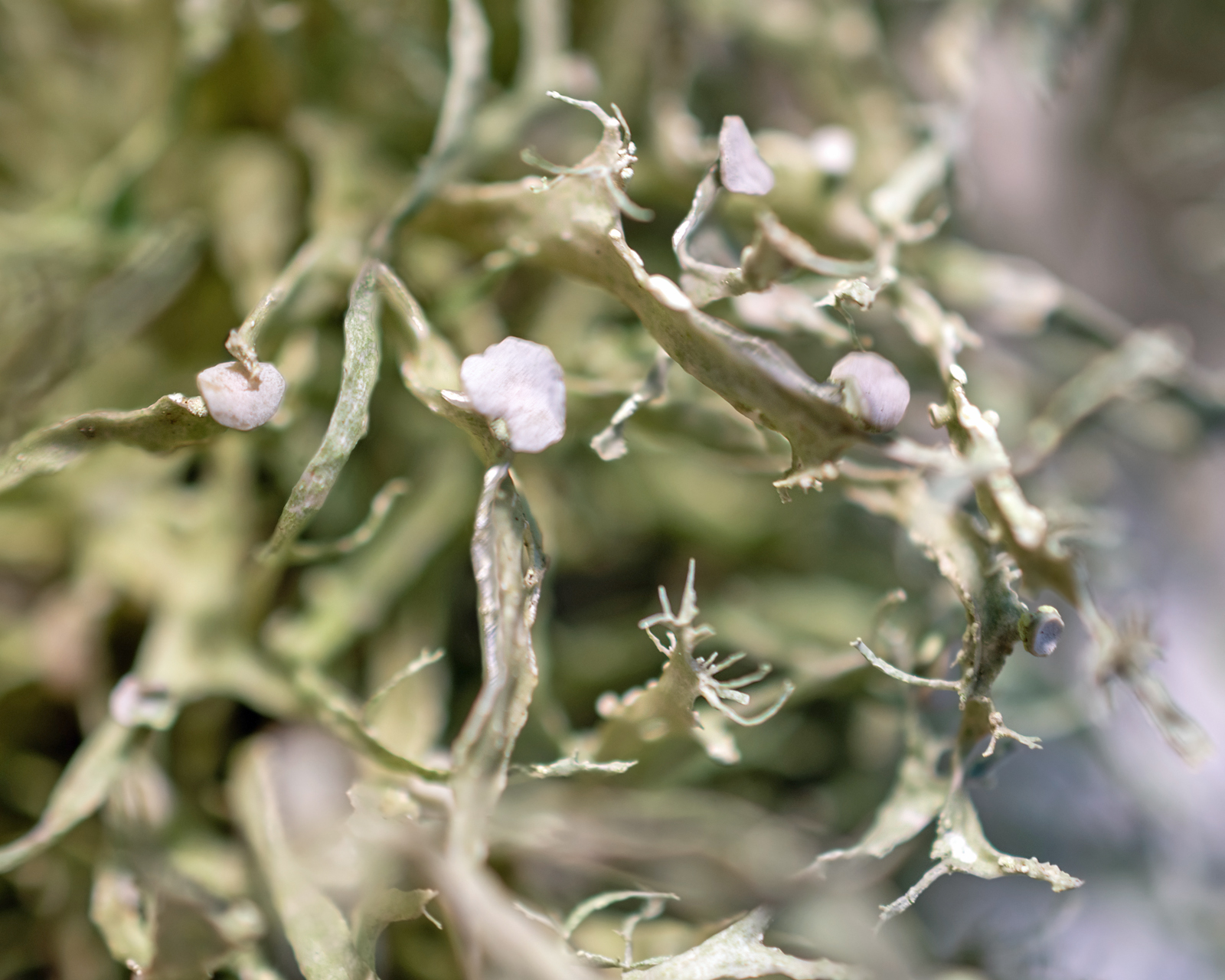
Two lichens: Antlered perfume, Evernia prunasti, and Monk's-hood, Hypogymnia physodes.

Like the beard lichens, these two also lack holdfasts (rhizines), so are easily blown from tree to tree.

~~~~~~~~~~~
Acerca de barbas y cornamentas y monjes gorditos con capuchones, colgados de los árboles o flotando en el aire; me refiero a los líquenes, claro.

Estos tres los encontré caídos en el sendero al borde del rio

Foto: Usnea longissima, llamado en inglés, barba de Metusalén.

Este liquen es fácil de identificar; se cuelga de las ramas en cordones largos. En el suelo, hay una prueba que es definitiva: si se tira suavemente desde ambos extremos de un hilo, se estira. El centro del cordón central es elástico, una característica única de este género.

Los líquenes se reproducen por medio de una variedad de estrategias: o se rompen, o producen esporas, o sueltan pequeños grupos de células de algas rodeadas de las hifas del componente fúngicos. Para los líquenes del género Usnea, fragmentarse resulta ser más productivo.
En los Usnea las estructuras que producen esporas se consideran raras, por lo tanto el viento, la lluvia, los animales —especialmente los pájaros y las ardillas— y los árboles que se rozan entre sí, rompen pedazos que pueden adherir a otros sustratos, principalmente la corteza de los árboles. (SNJ Today)
Porque el liquen crece en la superficie de los árboles, sin tener estructuras similares a las raices dentro de la madera misma, en contraste con los hongos, cuando un pedazo del liquen llevado por el viento se encuentra en un sitio nuevo, se siente inmediatamente en casa; no ha perdido raices (rizonas); no sufrió ningún daño.

Foto: dos líquenes: Evernia prunasti, llamado cornamentas perfumadas, y Hypogymnia physodes, capuchón de monjes.

Al igual que los líquenes Usnea, estos dos no tienen rizonas, y fácilmente se desprenden de sus sitios originales.


Thursday, February 23, 2023

Ma Nature wields a paintbrush

In a shady forest, many of the rough-barked trees look as if they had been painted. Slap-dash painting, mostly down the shady side of the trunk, in shades of pale green to bluish or greyish green, to almost (but not quite) white. Up close, the paint looks grainy; there are no leafy structures, no tiny stalks. Just this dried-on ghostly powder.

It's another lichen, a simple one (as if anything in nature were really simple, but some things pretend to be); the dust lichen produces no fruiting bodies, no spore-tossing structures, no little packages of spores.

Reproduction occurs entirely through the dissemination of the powdery granules. (Plants of Coastal BC)

The main vegetative body (thallus) is made of patches of soredia (little balls of algae wrapped in fungus). ...There are no known mechanisms for sexual reproduction, yet members of the genus (Lepraria) continue to speciate. (INaturalist)

A minty-green specimen.

On a Douglas-fir; this one's blue-green.

The little pocket camera got in closer. Lime-green, with bits of moss.

Another part of that patch. "Powdery granules."

Stepping back. A "painted" trunk. This one's blue-green.
The genus Lepraria ... appears to contain several species as yet undescribed and unnamed. (Plants of Coastal BC)
And it continues to speciate, no-one knows how!

~~~~~~~~~~~~

En un bosque sombreado muchos de los árboles de corteza áspera parecen estar pintados. Un pintor algo desordenado; pinta parte del tronco, más bien en el lado en sombra, y luego se cansa y se va. Usa pinturas de colores pálidos, verde, gris o azul con un tinte verde, o casi blanco. Desde cerca, se ve que la pintura es granosa; no hay más que esos granos; no hay ni hojas, ni tallos, solamente ese polvo fantasmagórico, reseco y duro.

Es otro liquen, uno muy simple (como si algo en la naturaleza fuera de alguna manera sencillo, pero hay cosas que fingen sencillez). Este liquen de polvo no produce cuerpos reproductores, ni estructuras para la diseminación de esporas, ni paquetitos de esporas.

La reproducción se lleva a cabo completamente por medio de la diseminación de los gránulos de polvo. (Plants of Coastal BC)

El cuerpo vegetativo principal (el talo) se compone de parches de soredias (bolitas de algas envueltas con hongo). ... No se conocen mecanismos para la reproducción sexual, sin embargo los miembros del género (Lepraria) siguen formando nuevas especies. (INaturalist)

Fotos:

  1. Un liquen de color verde menta.
  2. En un abeto de Douglas. Este tiene un tinte azul.
  3. La camarita de bolsillo se acercó más. Liquen color limón, con un poco de musgo.
  4. Otra sección del mismo tronco. Se ven los gránulos polvorientos.
  5. Alejándome un poco. Un tronco pintado, esta vez de azul/verde.
El género Lepraria parece incluir varias especies todavía sin describir ni que han sido nombradas. (Plants of Coastal BC)
Y sigue creando especies nuevas ... y nadie sabe como.

Tuesday, January 10, 2023

Fractal rabbit holes

 And one more post about those two lichen-covered twigs: looking around under the microscope, chasing a hurrying springtail, (which I never managed to catch up with) I stumbled over a wide-open apothecia on a bone lichen.

Apothecia on its stalk.

The apothecias are cup-shaped structures that release sexually produced spores. (The lichens and fungi all have several different reproductive strategies; not keeping all the eggs in one basket.) On the Hypogymnia spp., the bone lichens, they are "... located over upper surface, often stalked/stipitate, disc usually concave, brown;..." (E-Flora)

Those words! "Stipicate"; I had to look it up. It means having a stipe. Which is a stalk, especially of seaweeds or fungus or a fern frond. Like, for example, the long, long stipe of a bull kelp.

"Apothecia" comes from the Greek apothḗkē "storehouse, repository". The bottom, or floor of this cup is the fertile part of the apothecium, and is lined by a spore-bearing layer called the "hymenium", visible here as that brown carpet. And that is ... but my microscope won't go there, so I won't either.

Top view of the apothecium.

Looking again today at this, I see that it has expanded into a funnel shape, and now is 8 mm. across.

Trying to identify this lichen, I've been reading species descriptions of the ones known in this area, and I think it's probably the "forking bone", Hypogymnia inactiva. One description mentions and has photos of occasional perforated lobe tips so I went down another rabbit hole, looking at all the tips on my twigs, finding 4 perforated lobes. And there's a happy long, worm-like insect racing around; now I'll have to try and get a photo of this. And maybe the springtail, too.

There's no end to the complexity. Life is fractal.

~~~~~~~~~~~~~~~~~~~~~
Y ahora otro post acerca de esas ramitas cubiertas de líquenes. Examinándolos bajo el microscopio, persiguiendo a un colémbolo que corría y corría, y que no logré enfocar, me di con un apotecio bien abierto sobre un liquen "hueso".

Foto #1: El apotecio, visto de lado.

Los apotecios son estructuras en forma de tazón, los cuales sueltan esporas producidas sexualmente. (Cada liquen u hongo tiene varias maneras de reproducirse, asegurándose suerte de una manera u otra.) En los líquenes "hueso", estos apotecios se erigen sobre estípites, y el disco generalmente es de color café.

¡Esas palabras! "Estípite" — la tuve que buscar en el diccionario. Es un tallo, sea de alga marina, de hongos, o de helechos. Como por ejemplo, el estípite del quelpo gigante, que mide metros y metros.

La palabra "apotecio" viene del griego, apothḗkē, que quiere decir, almacén, depósito. El fondo, o el suelo de este tazón es la parte fértil de esta estructura, cubierta de una capa productora de esporas, llamada el "himeneo". Y el himeneo es ... Pero mi microscopio no me lleva tan adentro, así que yo tampoco sigo.

Foto: #2: El apotecio visto desde arriba.

Mirándolo otra vez hoy, veo que se ha abierto aun más, y ahora tiene forma de un cono, midiendo 8 mm. de diámetro.

Tratando de lograr una mejor identificación de este liquen, he estado leyendo descripciones de varias especies de la región, y creo que será el "hueso divergente", Hypogymnia inactiva. Una descripción menciona las puntas de los lóbulos, que a veces pueden ser perforados, y me llevó en otro desvío, mirando todas las puntas, encontrando 4 perforadas. Y también descubrí un insecto largo, como un cienpiés miniaturo; ahora tendré que tratar de sacarle una foto. Y tal vez encuentre de nuevo al colémbolo.

De lo complejo, no hay término. La vida es fractal.


Sunday, January 16, 2022

Lichens, writ large

I give up. The more I try to identify these lichens, the more muddled I get. So here are three photos from the microscope, unidentified.

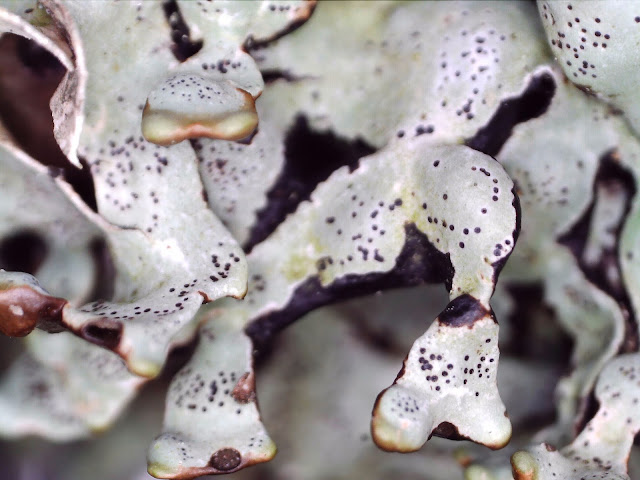
A leaf lichen on a Douglas fir twig. The round purplish dots are reproductive structures.

There are three main types of reproductive structures; one, pieces that break of the parent form new lichen clones, second, reproductive structures that are basically fragments containing both the algal or cyanobacterial and the fungal components of the lichen, and third, spore production. In this case, only the fungal spores are disseminated, and to produce a new lichen, they have to meet up, by chance, with the appropriate alga.

The asexual reproductive structures are:
Soredia (singular: "soredium") are small groups of algal cells surrounded by fungal filaments that form in structures called soralia, from which the soredia can be dispersed by wind. Isidia (singular: "isidium") are branched, spiny, elongated, outgrowths from the thallus that break off for mechanical dispersal. (From Wikipedia)

And the sexual structures:
Apothecia are usually cups or plate-like discs located on the top surface of the lichen thallus. When apothecia are shaped like squiggly line segments instead of like discs, they are called lirellae. Perithecia are shaped like flasks that are immersed in the lichen thallus tissue, which has a small hole for the spores to escape the flask, and appear like black dots on the lichen surface.(Wikipedia)
And in each lichen, the shapes and colours are different. Do you see why I'm confused?

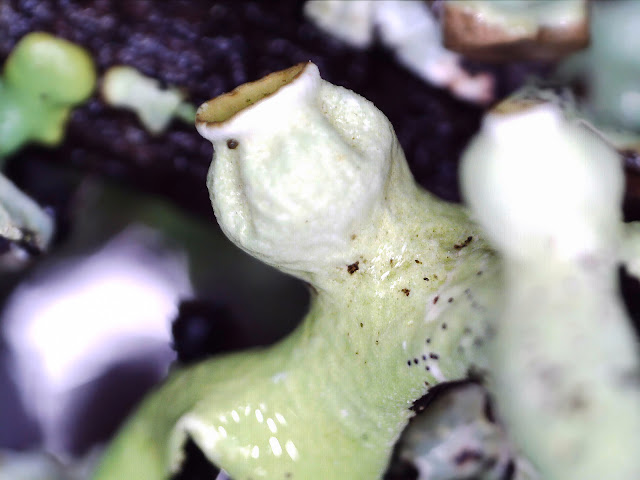
On that same lichen, there are these little barrel-shaped things.

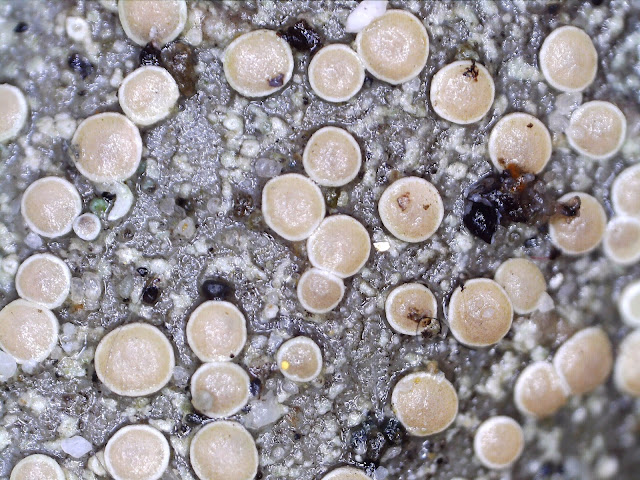
On yesterday's alder branch: little buttons, with no leaf structures.

Tomorrow, if it doesn't rain too much, I'll go looking for Cladonia lichens to pop under the microscope.

~~~~~~~~~~~~~~~~~~~~~

Me rindo. Por más que trato de identificar estos líquenes, más me deja sin entender. Así que aquí hay tres fotos de líquenes bajo el microscopio, sin identificación.


Primera foto: un liquen folioso sobre una ramita de abeto de Douglas. Los puntitos morados son estructuras reproductivas.

Un liquen se reproduce en varias maneras, principalmente de tres tipos. La reproducción vegetativa se lleva a cabo cuando fragmentos rotos del liquen se establecen en otro sitio, y forman una unidad nueva; esta es un clon del original.

La reproducción asexual ocurre por medio de estructuras que contienen tanto células del hongo como del alga o cianobacteria que componen el liquen.

Y en la reproducción sexual, el hongo produce esporas, a estos se las lleva el viento. Para formar un nuevo líquen tienen que encontrar, por azar, un alga del tipo compatible.

Las estructuras reproductivas asexuales son:
... estructuras especializadas llamadas soredios (que a su vez están agrupados en soralios) e isidios. Un soredio es una agrupación de hifas del hongo rodeando a unos pocos elementos algares que se desprende de la superficie del talo liquénico para ser diseminado bien por el viento, bien por salpicaduras de lluvia ...​ Los isidios ... son porciones de talo que se desarrollan en la superficie conservando la estructura en capas y córtex y que pueden desprenderse con facilidad. (de Wikipedia)

Y las sexuales:
Las esporas sexuales formadas en ascomicotas se encuentran característicamente en peritecios y apotecios; ... las estructuras producidas en el himenio se diseminan en busca en un nuevo fotobionte .... La estructura reproductora asexual más común es el picnidio, receptáculo abierto o cerrado con forma de copa o de esfera que contiene en su interior gran cantidad de conidióforos productores de conidios. (Wikipedia)
Y en cada líquen, las formas y colores son distintos. ¿Ves porqué estoy perpleja?

Segunda foto: en la misma liquen foliosa, existen estos barrilitos.

Tercera foto: estos botoncitos estaban en la rama del aliso.

Para mañana, si no llueve demasiado, iré en busca de unos líquenes Cladonia para mirar bajo mi microscopio.


Saturday, January 16, 2021

Floury buttons

Last month I brought home a piece of bark with a good growth of leafy lichen and left it on a table outside my door. Yesterday I brought it in to look at it in detail.

Hyphenated ribbon, Ramalina farinacea

It's hard to really see these lichens; each lobe branches and twists and entwines itself among the others. The eyes rebel. But this time, I noticed the round buttons; what are they?

Soralia, bearers of soredia, the lichen's reproductive structures.

Soredia are powdery propagules composed of fungal hyphae wrapped around cyanobacteria or green algae. These can be either scattered diffusely across the surface of the lichen's thallus, or produced in localized structures called soralia. (Wikipedia)

There are two look-alike common species of leafy lichens in this area; the Antlered Perfume, and this, the Hyphenated Ribbon. I had assumed that this lichen was the Perfume, but then I went looking for photos with those flat plates. Hundreds of photos later, I found them on the Ribbon. (Hyphenated: I like that name!) iNaturalist calls them Farinose Cartilage Lichen. They do have a tough, cartilagey texture.

I got out the microscope:

Two soralia on a lobe.

The Latin name, farinacea, means "floury", referring to the texture of the top of these structures.

Another one. The white blobs are also reproductive structures.

One more. It stands up like a cake plate from the green thallus.

~~~~~~~~~~~~~~~~~~~~~~~
Hace más o menos un mes, me traje a casa un pedazo de corteza caída, donde crecía unas ramas de liquen folioso. Lo dejé en una mesa afuera de mi puerta.

Ayer, lo recogí para examinarlo con cuidado. Es difícil ver claramente estos líquenes; los lóbulos se dividen, se tuercen, se enredan con los otros. Mis pobres ojos se rebelan. Pero esta vez vi esos botones blancos; ¿Qué serán?

Talo fruticuloso de color gris verdoso formado por lacinias colgantes estrechas, acintadas y provistas de numerosos soralios ovales en los márgenes, que nacen todas de un único punto de fijación al sustrato. (Descripción por Miguel Varona, "Cuaderno")
Son soralios, estructuras reproductivas, donde se producen los soredios, la materia reproductiva, que consiste en hifas (algo así como raices) del hongo envolviendo una cianobacteria o un alga verde.

Hay dos especies de líquenes por este rumbo, casi idénticas; La Evernia prunastri, (aquí la llamamos la cornamenta perfumada), y la Ramalina farinacea, a la que le llamamos el listón con guiones. Creía que este liquen era la perfumada, pero después de mirar fotos, cientos de fotos, buscando estas estructuras, las encontré en el listón. En el sitio de iNaturalist, le nombran este liquen como el liquen de cartílago harinoso. Sí, tienen una textura algo tiesa, medio dura, como el cartílago, y la superfice de los soralios parece estar cubierta de harina. (De ahi viene el nombre científico, farinacea.)

Las examiné bajo el microscopio. Aquí se ven estas estructuras, algo levantados de la hoja en un pedestal, con el soralio encima. Hasta parece un postre en su soporte de pastel, ¿no?


Tuesday, January 05, 2021

Caribou lichen?

On mossy ground where the trees overhead don't cut out too much of the light, reindeer lichen makes fluffy mounds and carpets.

Reindeer lichen on a log with pixie cup cladonia.

By a path through the Oyster Bay woods, I stopped to look more closely at broken pieces.

Probably Cladonia portentosa pacifica.

A closer look.

Lichens come in three or four basic shapes: crusts, leaves (foliose), upright or dangling structures (fruticose), and scaly (squamulose). Reindeer lichen start out as tiny scaly or leafy bits (squamules), then develop the more noticeable branched tubes. In the photo above, some of the basic squamules are growing on the wood at the lower right.

More reindeer lichen, these from the Bella Coola valley.

Reindeer lichen, like most others, reproduce vegetatively; if a piece or a powdery soredia breaks off, it continues growing and forms a new clump. They also produce spores on the tips of the branches. In this photo (above) the spore-bearing apothecia can be seen; they're brownish dots at the tips of the branches.

Since lichens are a symbiotic association of fungus/bacteria/algae, when they reproduce vegetatively, each piece carries with it the three partners. But when reindeer lichens try to reproduce by spores, it does not go so well for them. Each spore bears only the fungal component; if it doesn't land where the needed algae are present (and they're rare on their own), they die.

Reindeer lichen and mushroom, Salmon Point.

Something I learned today: reindeer lichen weed their gardens.

Mats also limit the amounts of nutrients, water, and light available to other organisms, which prevent seeds from germinating. The few seeds that do germinate in the soil below the mat can be pulled out of the soil by the lichen as it expands and contracts due to changes in humidity. These last two actions prevent plants from colonizing the lichens’ area, which keeps the forest canopy open and allows the lichens access to sufficient amounts of sunlight. (FungusFactFriday)

 Oh, and they're called reindeer lichen because in the winter in northern Europe, they're the main food of reindeer (we call them caribou here in Canada), which dig through the snow to get them.

~~~~~~~~~~~~~~~~~~~

En terrenos cubiertos de musgos donde los árboles crecen con suficiente espacio como para permitir la entrada de sol al suelo, los líquenes de renos forman cojines y tapetes.

Primera foto: líquenes de reno en un tronco, con líquenes Cladonia.

Pasando por el bosque en Oyster Bay, me detuve a mirar algunos pedazos rotos de liquen de renos.

Segunda y tercera fotos: se ve la estructura de estos líquenes.

Los líquenes se clasifican aproximadamente como:  1) Líquenes en forma de costra (crustáceos) fuertemente unidos al sustrato. Carecen de córtex inferior y no se pueden separar del sustrato sin romperlos; 2) Líquenes en forma de hoja (foliáceos) sólo parcialmente unidos al substrato por lo que se pueden separar con facilidad de él; 3) Líquenes en forma de diminutos arbustos ramificados (fruticulosos), que sólo contactan con el substrato por una pequeña zona. (U. de Guanajuato) Aparte de esto, algunos llevan escamas, y se denominan escamosos.

Los líquenes de renos empiezan a crecer como pequeñas escamas o hojas a nivel del suelo, para luego crecer y formar los tubos ramificados que se elevan en cojines. En la tercera foto, al lado derecho, abajo, se ven algunas escamas del liquen de renos.

Los líquenes de reno, como la mayor parte de los otros, se propagan por medio de fragmentos o estructuras llamados soredios que se separan del organismo original, y que, encontrándose aislados, siguen creciendo para formar un líquen nuevo. Además, producen esporas; en los líquenes de renos, estos se forman en las puntas de las ramas. En la cuarta foto, se pueden ver como manchitas de color café.

Puesto que los líquenes son una asociación simbiótica de tres organismos; un hongo, un alga, y bacteria, cuando se propagan a base de fragmentos o soredios, cada fragmento lleva consigo los tres. Pero cuando se reproducen sexualmente, cada espora lleva solamente el hongo, y si no encuentran el alga apropriada donde llegan a dar, se mueren sin formar un nuevo liquen.

Esto lo aprendí hoy: los líquenes de reno cultivan su jardín, estirpando las hierbas ajenas:

Los tapetes también limitan las cantidades de sustancias nutritivas, de agua, y  de luz que llega a otros organismos, lo cual impide germinar a las semillas ajenas. Las pocas semillas que logran brotar pueden ser arrancados del suelo por el liquen, mientras se contrae y se extiende debido a los cambios de humedad. Estas dos acciones impiden que plantas colonizen el sitio, y ayuda a mantener el bosque abierto, proporcionando a los líquenes una cantidad suficiente de luz del sol. (FungusFactFriday)

Otra cosa: se llaman líquenes de renos porque en el norte de Europa, forman la mayor parte de la dieta de los renos en invierno. Renos, que aquí en Canadá, se llaman caribú.


Sunday, January 06, 2019

Chameleon lichen

After a few days of strong winds, the forest floors are littered with broken branches, dead leaves, conifer needles, and lichens; clumps and threads and whole branch-loads of lichens.

Two lichens; Lungwort and a beard lichen. On a Bigleaf maple mulch.

High on the trees, where the rain drains away quickly and the lichen is exposed to sunlight, the thallus is a mix of browns, from pale beige to dark chocolate brown, to a yellowish mid-brown. In the shade, where it's still dry, it's a paler greenish-grey. Tossed down here onto the wet ground, and then rained on, it turns a bright green on top, and a pale blue-grey on the underside.

The beard lichen, those pale threads mixed in with the lungwort, stay the same colour whatever the weather.

I didn't know this:

L. pulmonaria has the ability to form both vegetative propagation and sexual propagules at an age of about 25 years. ... Dispersal by vegetative propagules (via soredia or isidia) has been determined as the predominant mode of reproduction in L. pulmonaria. ...In this method, the protruding propagules become dry and brittle during the regular wet/dry cycles of the lichen, and can easily crumble off the thallus. These fragments may develop into new thalli, either at the same locale or at a new site after dispersal by wind or rain. (Wikipedia)

25 years! Lichen is slow-growing. How many years does it take to completely coat a tree, like the one I posted yesterday?


Powered By Blogger