Showing posts with label mallard behaviour. Show all posts

Sunday, January 04, 2026

While it was still 2025

Last morning of the year, on the estuary. Just birds, the mallards sleeping while the tide is high, the rest busy diving for eats.

Mallards and green-winged teals.

A female mallard. The rumpled water is where a teal just went under to grab a bite.

Another sleepy mallard.

Buffleheads. Active divers after anything that moves underwater.

In the distance, a pair of cormorants, fishing. They spent as much or more time underwater as on the surface. And a little Goldeneye; she will roll over stones underwater to find her prey.

One more post in the offing for 2025, then, finally, 2026, with today's skies and elk.

~~~~~~~~~~~~
Fue la última mañana del año 2025; en el estuario, las aves acuáticas se ocupaban según sus costumbres; los patos ánades durmiendo durante la marea alta, las demás buscando su desayuno sumergido.
  1. Ánades reales y Cercetas comunes.
  2. Una ánade real hembra. el agua agitada es donde una cerceta se acaba de sumergir buscando algún invertebrado acuático o un bocado de hierba.
  3. Otra ánade real dormida.
  4. Porrones coronados. Buceadores muy activos; comen cualquier cosa que se mueve debajo del agua.
  5. Y algo lejos, una pareja de cormoranes pescando. Pasaban tanto tiempo sumergidos que en la superficie. Y una pequeña Porrón hembra (Bucephala sp.); estos pájaros buceadores voltean piedritas en el fondo, buscando invertebrados.
Me queda un grupo de fotos de 2025, y luego, por fin, empiezo el año 2026 con vistas del cielo de hoy y algunos alces.


Wednesday, December 11, 2024

Staying dry

 I watched a mallard taking a bath.

Churning the water

Digging a hole

Making it rain

The guide books list the mallards under "Waterfowl". A misnomer, sort of; his whole life is spent keeping the water at bay. No matter how much water he splashes around, no matter how often he upends, digging a hole in the water, he stays dry. 

He preens his outer feathers, cleaning them and coating them with oil from a preen gland (the uropygial gland) near his tail, making them waterproof, as well as keeping the feather barbules interlocked, leak-proof. The inner feathers then retain air, keeping him warm even in near-freezing water, and reducing the weight/volume ratio, which gives him buoyancy. So much so, that he is forced to forage in shallow water, where his beak can reach the vegetation on the bottom without him leaving the surface. If he does manage to dive, he bounces up again in fewer than 5 seconds.

So why does he indulge in these energetic baths? To rinse off outer dust? To keep himself cool? To brighten the colours of his coat? Because it feels good? He's not telling.

~~~~~~~~~~~~
Observaba un pato ánade real bañándose.
  1. Agitando el agua.
  2. Haciendo un pozo en el agua.
  3. Salpicando.
Los libros guía clasifican estos patos como Aves Acuáticas. Que en ciertos sentidos, parece ser un error, pues pasan su vida entera protegiéndose del agua. A pesar de chapotear, salpicando abundantemente sus alrededores, a pesar de excavar pozos en el agua, sumergiendo la cabeza, se mantiene completamente seco. Acicala sus plumas exteriores, limpiándolas y cubriéndolas de aceites y ceras producidos por la glándula uropígea que se encuentra cerca de su cola; estos aceites mantienen las plumas resistentes al agua, y la acción de acicalarlas arregla las plumas, intercalando las bárbulas, evitando la filtración de agua. 

De esta manera, las plumas interiores retienen aire, ayudando a mantener la temperatura del cuerpo dentro de límites cómodos, aun cuando el agua que le rodea llega a congelarse. Además, este aire disminuye la densidad del cuerpo, aumentando la flotabilidad del pato. Tanto la aumenta, que el pato se halla obligado a buscar su alimento en aguas de poca profundidad, sumergiendo la cabeza sin poder dejar la superficie del agua. Si acaso logra bucear, solamente puede mantenerse bajo el agua por menos de 5 segundos.

¿Porqué, entonces, se divierte bañándose tan enérgicamente? ¿Para eliminar un poquito de polvo? ¿Para refrescarse? ¿Para hacer brillar los colores de sus plumas? ¿Por puro placer? No nos dice.


Wednesday, March 15, 2023

Kissing the estuary

The bird blind at Tyee Spit sits on its own mini-island, separated from the Spit by a narrow channel. On the more protected end, ducks, mostly mallards, sometimes wigeons, nap in the afternoons half-hidden among the scruffy grasses that cover the island. When I arrived the other day, the tide was lower than I've ever seen it there, and the island was now accessible on foot, if you didn't mind a bit of mud.

A few mallards were standing on the exposed slope, where they normally upend themselves nibbling on underwater grass.
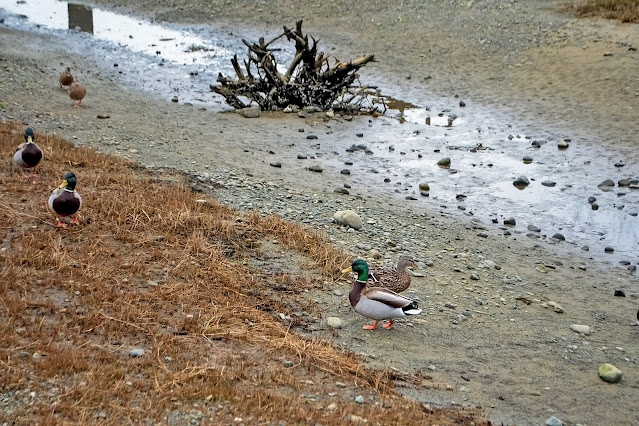
"Where did our water go?"

I crossed to the island. Nothing much to see; dead grass and gravel, nothing out on the water but a distant, drowsy boat. I returned to the Spit side and stood watching a few pigeons who had come down to look at this new site. Then I noticed the mallards marching in procession down from their sleeping quarters. Nap time was over.
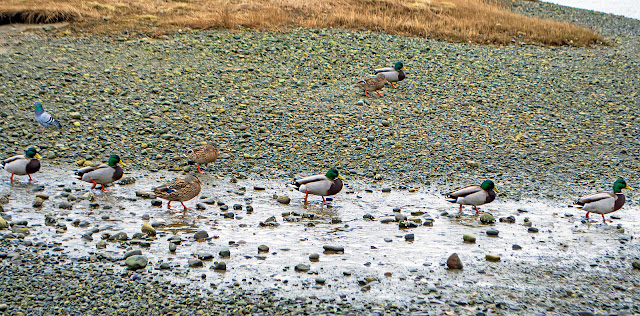
Orderly queue, with monitors.

They didn't seem to notice me, standing there pretending to be an old stump, but went on by, then angled towards the tip of the island and took to the water, one by one.

And I saw this:
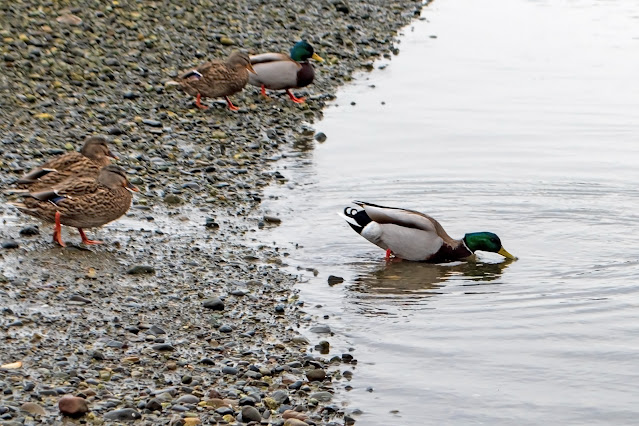
A pair, greeting the water.

Each mallard, as soon as they reached the water, dipped their bill quickly, before launching themselves belly-down into the water. Every single one: step into the water, bend over, dip the tip of their beak, then swim. They didn't slow down to nibble or dabble; it was barely a tap at the surface, as if they were kissing the water. A "Hello!" kiss.
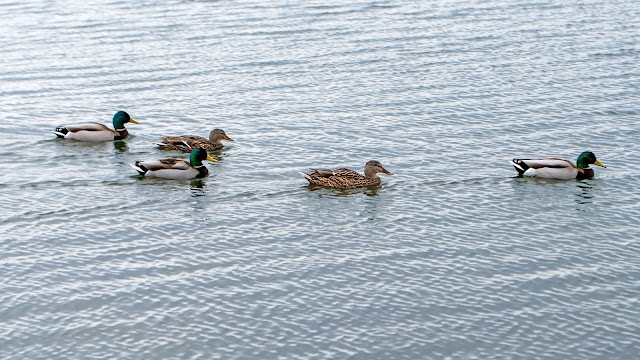
Three females, taking turns.

Another.

Tap, then lift.

The procession ended, they all swam away, out into the estuary.

Going places.

I don't remember seeing this behaviour before. Maybe I just wasn't paying enough attention.

~~~~~~~~~~~~~~~~
El puesto de observación de aves de Tyee Spit ocupa su propia islita miniatura, separada de tierra firma por un canal angosto. En el extremo de la isla más protegido, patos, por la mayor parte ánades, y a veces marecas, duermen la siesta de la tarde entre los pastos secos que les ofrecen protección y camuflaje.

Cuando llegué el otro dia, la marea estaba más baja que la he visto aquí antes, dejando la islita al alcance a pie, si no es que te molesta un poco de lodo.

Unos cuantos patos estaban parados en el declive, donde normalmente se ponen de cabeza para buscarse alimento entre los pastos sumergidos.

Foto #1: El canal, ya casi seco, con unos patos confusos.

Crucé a la islita. No hubo mucho para ver: pastos secos, grava. Nada en el agua aparte de un barquito anclado en la distancia. Regresé a tierra firma y me detuve observando unas palomas que habían bajado a inspeccionar este sitio nuevo. Y luego vi que la bandada de los patos se había despertado, y se desfilaban, bajando por el centro del canal. Se había terminado la siesta.

Foto #2: El desfile. No me miraban, yo parada allí haciendo de cuenta que era nada más un tronco viejo; siguieron adelante, luego viraron hacia el estuario y se lanzaron al agua, uno por uno.

Y vi esto:

Fotos # 3 a 6: El beso al agua.

Cada uno de los patos, al llegar al agua, antes de empezar a nadar, primero tocaba el agua con la punta del pico. Un toque breve; no iban hacia el fondo, no se detuvían a buscar comida, ni parecía que tomaban tiempo para beber; solamente tocaban el agua y levantaban de inmediato el pico, como si besaran el agua, un beso de saludo. Hecho esto se echaban a nadar.

Foto #7: El último llegó al agua. Y todos se fueron nadando hacia el centro del estuario.

No me acuerdo de haber visto este procedimiento antes. Tal vez no he estado prestando suficientemente la atención.


Powered By Blogger