Showing posts with label bees. Show all posts

Wednesday, July 30, 2025

Busy, busy, in the pink

 A couple of bees, on hardhack, at the beaver pond.

Yellow-faced bumblebee, Bombus vosnesenskii?

Very busy. So many flowers, so short a season!

There don't seem to be as many pollinators about this summer; I've yet to see a bee near my roses. But the beaver pond, a good way out of town, has quite a bit of activity; bees, dragonflies, bluets, butterflies, and hummingbirds. And mosquitos, of course.

~~~~~~~~~~~~~~~~
Alrededor de la laguna de los castores, las abejas estaban muy ocupadas con las flores de Spiraea douglasii, una planta nativa que vive a las orillas de los lagos y en los humedales, dondequiera que haya agua fresca y tranquila.

En la primera foto, el insecto es un abejorro de cara amarilla, Bombus vosnesenskii. No pude identificar con certeza la especie de la abeja en la segunda foto.

No he visto gran número de polinadores este verano; hasta ahora no he visto ni una sola abeja visitando mis rosas. Pero en la laguna de los castores, lejos del pueblo, hay bastante actividad;  hay abejas y abejorros, libélulas y caballitos del diablo, mariposas y colibríes.  Y, claro, zancudos.


Wednesday, August 28, 2024

Catching a few bees

A friend has an exuberant garden where everything grows larger than life. Taller than me, anyhow. Great masses of dahlias, towering sunflowers, hibiscus and tiger lilies. I chased bees from flower to flower; busy, very busy, they were. I managed to catch a few while they were at work.

Honeybee.

Carrying a heavy load of pollen.

Honeybee?

Sunflower overhead, with all but a piece of the petals gone. The bracts make a nice corona.
Cropping to see the star-shaped seed starters.  And the bee, of course.

And cropping again, to look at that pollen-coated bee.

I'm almost done with the Beasties Project. Two more posts, and I'll go on to look at deer and mushrooms and ... But there will always be more Beasties.

~~~~~~~~~~~~~~~~
Una amiga tiene un jardín exuberante, donde las flores me miran desde arriba. Dalias de todos colores, girasoles altísimos, hibiscos, lirios de tigre ... Entre ellas perseguí una multitud de abejas que pasaban volando de una flor a la otra, muy ocupadas en juntar polen. Algunas se quedaron quietas un instante.

Fotos:
  1. Dalia con una abeja mielera.
  2. Esta abeja ya juntó una buena cantidad de polen.
  3. ¿Otra abeja mielera? ¿O alguna otra especie de abeja?
  4. El girasol ya perdió casi todos los pétalos. Las brácteas imitan la corona del sol. Con una abeja.
  5. Recorté la foto para mirar la abeja.
  6. Y la recorté otra vez.
Casi ya termino con el Proyecto Bichitos. Subiré dos posts más, y puedo pasar a mirar fotos de venaditos y de hongos y ... Pero siempre habrá mas Bichitos.

Sunday, August 18, 2024

Tiny but mighty

 These pretty bees were foraging in the gumweed flowers in the protected Oyster Bay meadow.

Gumweed, Grindelia integrifolia, and Pebble bee, Dianthidium subparvum.

Variable Carder Bee, D. subparvum.

A closer look:

A black bee, not fuzzy, with white markings on the abdomen.

Sprinkled with gumweed pollen

I sent my photos in to BugGuide and iNaturalist. Those guys are good! BugGuide sent me off looking at pebble bees;  I'd never heard of these before. And iNaturalist brought it down to species. So helpful!

These small bees (about 5 mm.) are full of surprises. Pebble bees are a genus in the family of Leafcutter bees, those bees that carry around pieces of leaves as big as they are. The pebble bees carry pebbles, stones, mud, plant resins. Several websites mention their preference for gumweed, which, besides the pollen, produces large quantities of sticky resin (the gum), useful for making their nests.
They construct cells of pebbles glued together with resin and placed on twigs, or on roots below the soil surface, or in any available burrows or borings. (BugGuide)
Pebble bees (Dianthidium) ... line their nests with plant resins, pebbles, and other small debris to create protective cells for their offspring. Each cell contains a single egg along with a pollen and nectar mixture for the larva to consume after hatching. (ColoradoNativeBee)
The common name of this species, Carder Bee, refers to their habit of combing material together (carding) for their nests. And they're also called solitary bees; they don't live in large hives like the honeybees. No queens!
Pebble bees generally lead solitary lives, with each female building her own nest and tending to her offspring. However, some species may exhibit communal nesting behavior, where multiple females share a nesting site but maintain separate brood cells.(Colorado...)
How big a pebble can a bee carry? I couldn't find any answer to that; I'll have to search in that meadow in the spring when they're making nests.

~~~~~~~~~~~~~
Estas abejas lindas forrajeaban en las flores de Grindelia integrifolia (hierba goma) en la pradera protegida de Oyster Bay.

Fotos: Flores de Grindelia integrifolia con una abeja "de Piedritas", Dianthidium subparvum.

Envié mis fotos a BugGuide y a iNaturalist. Muy buena, esa gente, imparten información muy útil, y ¡tan rapidamente! BugGuide me envió a buscar informes sobre las abejas de piedritas; un tipo de abejas completamente nuevo para mi. Y luego en iNaturalist, me dieron la especie precisa.

Estas abejas pequeñas (alrededor de 5 mm.) son algo sorprendente. Las abejas de piedritas, Dianthidium sp., pertenecen a la familia de las abejas cortadoras de hojas, las que vuelan cargando pedazos de hojas tan grandes como ellas mismas. Las abejas de piedritas cargan con piedras pequeñas, arena, lodo, y resinas de las plantas. En varias páginas en el internet se menciona su predilección por las flores de Grindelia sp., las cuales, aparte del polen, producen gran cantidad de una resina pegajosa (la goma) que usan las abejas para construir sus nidos.
Construyen células hechas de piedritas fijadas con resinas y colocadas sobre ramitas, o en raices bajo la superficie del suelo, o en cualquier hueco o túnel disponible. (BugGuide)
Las abejas de piedrita (Dianthidium) recubren sus nidos con resinas de plantas, piedritas, y otros escombros pequeños para crear células protectoras para su cría. Cada célula contiene un solo huevo, además de una mezcla de polen y néctar como alimento para la larva cuando eclosiona. (ColoradoNativeBee)
El nombre común de esta especie, la abeja cardadora, se refiere a su costumbre de peinar (cardado) material para sus nidos. También se les llama abejas solitarias, pues no viven en grandes colmenas como las abejas mieleras. ¡No tienen reinas!
Las abejas de piedrita normalmente viven una vida solitaria, y cada hembra construye su propio nido y cuida a su propios hijos. Sin embargo, algunas especies pueden hacer sus nidos en un estilo comunitario, donde varias hembras comparten un sitio para anidar, pero mantienen sus células incubatorias por separado. (Colorado...)
¿De qué tamaño son las piedritas que cargan? No pude encontrar respuesta. Tendré que buscarlas en la pradera en la primavera, cuando es temporada de hacer nidos.

Tuesday, June 25, 2024

Looking at bees again

Once upon a time, well, back in 2008, 16 years ago, I looked at a bunch of my bee photos, trying to identify them. (Once upon a time, bees were bees) Some, I never did identify; one didn't belong here in BC. A couple were not bees at all, but bee mimics.

But that was over on the Lower Mainland*, bees and copycats seen from Reifel Island to Tsawwassen to downtown Vancouver. What about the bees that pollinate flowers here on mid-Vancouver Island?

Here's what I've come up with so far this summer.

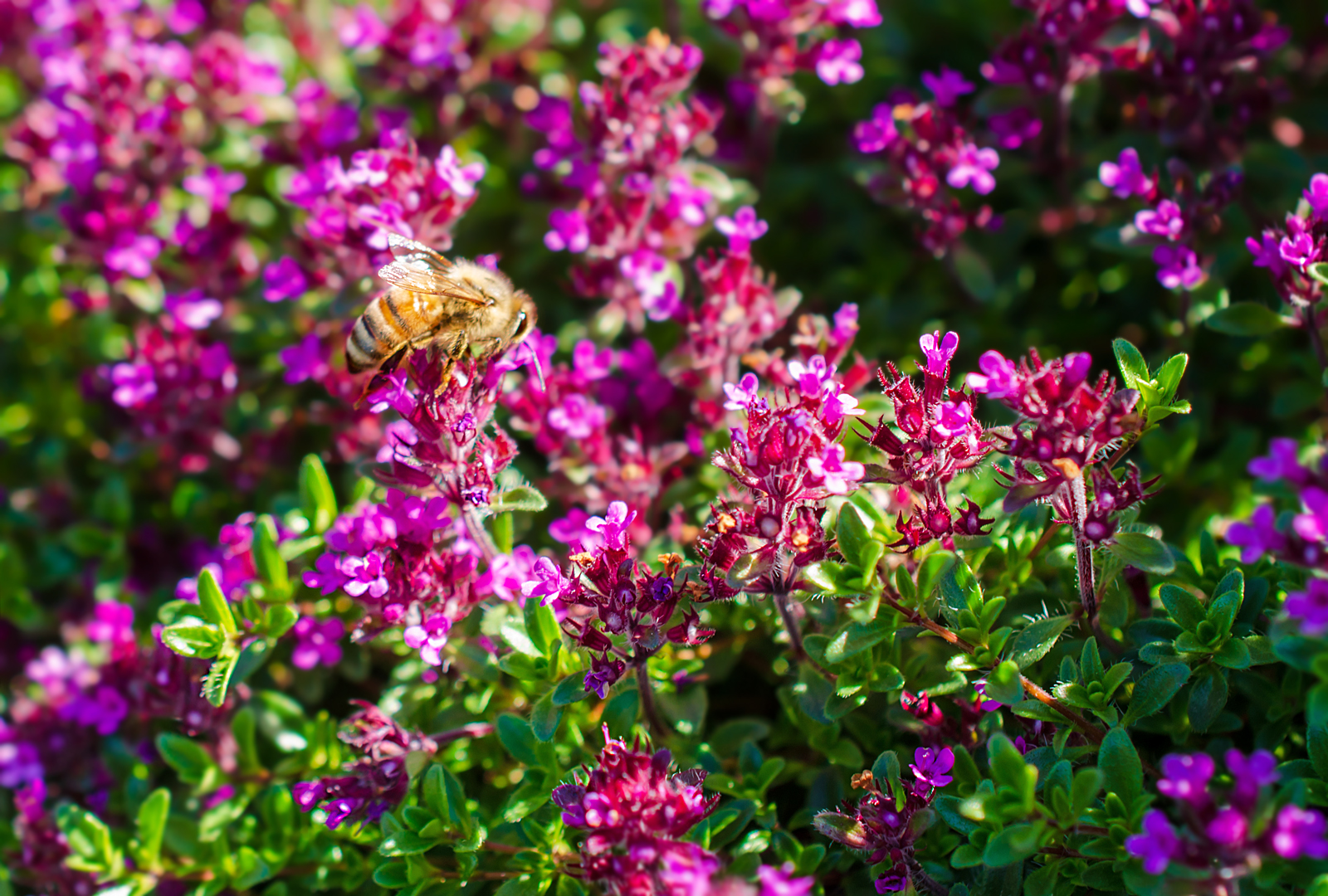
This one was easy; a honeybee, on Creeping Thyme. Next door.

Honeybees (probably Western honeybee, Apis mellifera, the most common species) have those prominent stripes on their apparently hairless abdomens. And, according to BugGuide, hairy eyes.

Bumblebee. In my garden.

The bumblebees have hairy abdomens, in a variety of colours, according to the species. Here on Vancouver Island, we have several species, among them, the Western, Bombus occidentalis and B. mckayi, the Vancouver Island Bumblebee, Bombus vancouverensis ssp vancouverensis (more name than bee!), and the Black-tailed Bumblebee, B. melanogypus

Same bee. I was trying to see if it had a black behind.

This one has a black tail. But so does the B. vancouverensis. Baikie Island.

And this one? Also on Baikie Island.

Trouble is, the colours are extremely variable. And species differenciation depends on details like the shape of sections of the wing. So, I'll go with Bumblebee, plain and simple.

I have yet to see a sweat bee or a carpenter bee here. Maybe later.

*It just occurred to me, getting ready to translate all of this to Spanish, that calling the area the "Lower Mainland" can be confusing. In reality, what we meant by this (and that's what we called it, living over there) is the lower reaches of the Fraser Valley, where the river descends from the hills and meanders down the flats to the Georgia Strait, a stretch about 70 km. long. And I just noticed that calling our place the Mainland, was a referral to the islands beyond, rather than to the rest of the continent. We islanders call the shots.

~~~~~~~~~~~~~
Érase una vez ... bueno, en el año 2008, hace 16 años, examiné muchas de mis fotos de abejas, tratando de identificarlas. (Once upon a time, bees were bees) Algunas no pude identificar, una no debería encontrarse aquí en Colombia Británica. Otras ni siquera eran abejas, sino imitadoras.

Pero eso estaba allí en el Continente*: abejas y sus imitadoras que hallamos desde la isla Reifel hasta Tsawwassen y hasta el centro de la ciudad de Vancouver. ¿Y cuáles serán las abejas que viven aquí en el centro y norte de la isla de Vancouver?

Estas son las que he visto hasta ahora en 2024.
  1. Esta fue fácil: una abeja melífera, Apis mellifera, probablemente la abeja occidental, que es la especie más común. Tienen esas bandas marcadas en el abdomen, que es casi sin pelos. Según BugGuide, también tienen pelos en los ojos.
  2. Bombus sp., abejorro, en mi jardín. Los abejorros tienen el abdomen peludo, en una variedad de colores, anaranjado, amarillo, blanco y negro, según la especie. Aquí en la isla de Vancouver, tenemos, entre otros, el occidental, Bombus occidentalis y B. mckayi, el isleño, B. vancouverensis ssp. vancouverensis (más nombre que insecto), y el de la cola negra, B. melanogypus.
  3. El mismo abejorro. Trataba de ver si tenía la cola negra.
  4. Este tiene la cola negra. Pero también el isleño puede tener el mismo color.
  5. ¿Y este?
El problema es que los colores son extremadamente variables. Y la identificación de las especies depende de detalles como la forma de las venas de las alitas. Yo, por ahora, me quedo con sencillamente "abejorro".

Hasta ahora, no he visto en la isla un abejorro carpintero, o uno de los halíctidos. Tal vez más adelante.

*Se me ocurrió mientras empezaba a traducir esto al español, que nombrar el area donde vivía antes "el Continente" puede ser algo extraño. Más sería usar el término que usan los residentes: El Continente Bajo". Se trata, en realidad, del valle del rio Fraser, desde donde desciende de los montes para vagar sobre el terreno plano hasta llegar al Estrecho de Georgia, unos 70 kilómetros de distancia. Y más, me di cuenta que al llamar el sitio "El Continente" están haciendo referencia a las islas, en vez de verse como parte de la nación entera. Nosotros, los isleños, mandamos.

Tuesday, June 04, 2024

Bees at work

 So I chased bees and chased bees and chased them some more, taking photos. And ended up with three sort of clear photos of bees on ninebark flowers. They were all in such a hurry! Time's a-wastin'!

Pacific ninebark, Physocarpus capitatus, with unidentified bee.

Two bees.

The same two bees, I think.

Look at this one's feet!

The right tool for the job.

They look like mountaineers' ice axes. How to hold on to your flower upside-down when the wind is whipping it about. Or when you're buzzing the pollen loose.

Bee on wild rose. The way most bee photos turn out.

~~~~~~~~~~~~~~~~
Perseguí unas abejas, siguiéndolas de una flor a otra, sacando un centenar de fotos. Y me resultaron tres fotos no muy buenas. ¡Tenían tanta prisa! ¡No hay que perder ni un segundo!

  1. Una abeja en flores de Physocarpus capitatus. No pude identificar la abeja.
  2. Dos abejas. Distintas especies, tal vez.
  3. Las mismas dos abejas.
  4. Y viendo esa última más de cerca. Mira esas patas; se parecen a los pioletes que usan los alpinistas para escalar montañas heladas. Justo la herramienta que se necesita para aferrarse cabeza abajo en unas flores agitándose en el viento. O cuando se necesita soltar el polen con vibraciones fuertes.
  5. Abeja en una rosa nativa. Así salen la mayoría de las fotos de abejas.


Monday, June 03, 2024

Shooting stars and busy buzzing bees

On the narrow strip of grass between the trees and the stones of the river bank, where the sun shines, but out of reach of the tide that comes up and salts the ground, bright pink specks were dancing in the wind. I had to scramble down to see what they were.

And now, I've fallen down another rabbit hole.

The flowers were shooting stars.

Shooting stars, Dodecatheon sp.

Another plant. You can see where they get their name.

Because I like those shrivelled petals and the growing seed capsules.

And now, the rabbit hole. Reading the notes on a different shooting star, in the guide book, I found this:

Shooting stars provide a good example of "buzz pollination". The anthers shed pollen into the stamen tube, from which the pollen can be dislodged by sound waves set up by the buzzing of bumblebees. (PoCBC, 1994)

Actually, this is wrong, in several ways. But it sent me to Google to find "buzz pollination".

First, now it has been established that what dislodges the pollen is the vibration of the bee's wing muscles. The sound has a minimal effect.

And how this works: the anthers, the pollen-producing (male) part of the flower, usually spread their pollen easily, by wind or water or gravity or just contact with a pollinating insect. But in some plants, like these shooting stars, or tomatoes, or rhododendrons, for example, the pollen is locked inside.
In most cases, rigid tubular structures are formed by modified anthers or groups of anthers, which only release pollen via small apertures that range from tear-shaped slits to apical pores <100 μm in diameter. (National Library of Medicine) {Microns are a length of measurement equal to one millionth of a meter. (100 µm is equal to 0.1mm.)}
Because of this shape, they are often referred to as poricidal anthers. These poricidal anthers are only able to release pollen when vibrated at a specific frequency. (Wikipedia)
A researcher at the Arnold Arboretum (Harvard), Callin Switzer, took recordings of bumblebees gathering pollen. He found "an average buzz pollination frequency of about 270 Hz. The pitch of this vibration frequency is equivalent to a C-sharp above middle C on the piano." 

The "buzz" is produced by the same muscles that power the bee's wings, but here, the wings are held still, and the body vibrates, shaking loose the pollen, which the bee then carries to the next flower. (Keeping some for herself, of course.)
In addition, flower handling, including applying a tight grip to the base of the anthers, and the curling of the bee’s body around the flower may also help in the mechanical transmission of vibrations to the flower. (NLM)

So now I have to go back and look at all my bee-chasing photos to see those curled bodies. 

Thinking about this, I remembered that I had some old (2007) photos of those enclosed anthers in rhododendrons:

Anthers and stigma.

Zooming in on the anthers. Each one has two tiny holes. The pollen inside is attached with a sticky substance, which sometimes glues the bees to the flower.

~~~~~~~~~~~~~~~
En un estrecho tramo de tierra entre el bosque y el rio, donde el sol alumbra las hierbas, y fuera del alcance de las mareas que llenan de sal el suelo, el viento hacía bailar manchitas de color rosa fuerte. Tuve que hacerme camino para ir a ver que eran.

Y por ello, fui en pos del conejo blanco de Alicia. (La del País de las Maravillas)

Las manchitas eran flores. Dodecatheon sp., conocidas como Estrella Fugaz.

Fotos #1 a 3: Las flores. Por su forma, se ve donde sacan el nombre; parecen estrellas que caen como flechas. Y me gustaron los pétalos marchitos, y las cápsulas donde se están formando las semillas.

Y ahora, la distracción. Estaba leyendo las notas en mi libro guía (Plants of Coastal BC, 1994) referentes a otra flor del mismo género, y vi esto:
Las flores Estrella Fugaz proveen un buen ejemplo de la "polinización por zumbido". Las anteras introducen su polen en el tubo del estambre, de donde se puede despegar el polen por medio de las ondas de sonido causadas por el zumbido de los abejorros. (PoCBC, 1994)

Bueno, en varias maneras, se habían equivocado. Pero sirvió para enviarme a Google, buscando "polinizacion por zumbido".

En primer lugar, ya se ha establecido que lo que libera el polen es la vibración de los músculos de las alas del abejorro. La producida por el sonido tiene muy poco efecto.

Y como funciona esto: las anteras, que son las partes masculinas de la flor y que producen el polen, en muchas plantas esparcen facilmente su polen, sea por el viento, la lluvia, la gravedad, o el contacto con insectos polinizadores. Pero en algunas plantas, como por ejemplo en estas estrellas fugaces, en los tomates y papas, en los rododendros, el polen se queda encerrado.

En la mayoría de los casos, estructuras tubulares rígidas son formadas, constituyéndose de anteras modificadas o de grupos de anteras, las cuales solamente emiten el polen mediante aperturas pequeñas que van desde rendijas en forma de gota hasta poros apicales <100 µm de diámetro. (National Library of Medicine) {El micrómetro o micrón, µm, es una unidad de longitud equivalente a una milésima parte de un milímetro.}

Por esta forma, comunmente se llaman anteras poricidas. Estas anteras poricidas solo pueden liberar el polen cuando vibran a una cierta intensidad. (Wikipedia (en))

Para aflojar el polen, la abeja se aferra a la flor y mueve rápidamente sus músculos alares, sin mover las alas. Esto produce un zumbido con un sonido característico; esta vibración afloja los granos de polen y hace que emerjan de la antera. (Wikipedia)

Un investigador con el Arboretum Arnold (Harvard), Callin Witzer, hizo videos de abejas mientras juntaban el polen. Halló "una frecuencia promedio de las vibraciónes alrededor de 275 Hz. Esta frecuencia es equivalente a la nota Do sostenido un octavo adelante del Do mediano en el piano."

Además, la manera de manipular la flor, incluyendo aplicar un control firme en la base de las anteras, y encorvando el cuerpo de la abeja alrededor de la flor, pueden ayudar con la transmisión mecánica de las vibraciones a la flor. (NLM)

Ahora tengo que mirar otra vez todas mis fotos de abejas para ver si puedo observar esa postura.

Pensando en todo esto, me acordé que tenía unas viejas (2007) fotos de las anteras encerradas de los rodendros en mi jardín de entonces.

Fotos; el centro de una flor de rododendro, y luego, viendo las anteras más de cerca. Cada antera tiene dos poros. En estas flores, el polen se detiene en su lugar con una sustancia pegajosa, con la cual, a veces, las abejas se encuentran atrapadas.


Wednesday, August 16, 2023

Five bees and a spider

 Bee balm. It's well-named; the bees love it, dashing about, burrowing deep, hurrying on to the next flower; so much delicious nectar to be harvested!

So fuzzy; bee, leaves, stems, and even the flower petals.

Big B, little B.

Such big eyes!

For variety, there's a hibiscus overhead. Can you find the spider?

Two ways to earn a living; hurry, hurry, hurry, or sit very still, waiting for food to arrive.

(I'm back; I was down with a cold that affected my eyes. Better now.)

~~~~~~~~~~~~~~
Las flores de Monarda spp. son favoritas de los polinadores. En inglés se les nombra bálsamo de las abejas. Y las mantiene bien ocupadas, apurándose a cosechar polen y nectar, volando de una hacia la próxima, y rapidamente hacia otra ... 

Fotos:
  1. Tanto la abeja como las hojas, el tallo y hasta los pétalos llevan una pelusa fina.
  2. Dos abejas, una grande, otra chiquita.
  3. Otra abeja entre las flores.
  4. Y arriba, hay un hibisco que también tiene su atractivo. Y mira con cuidado: ¿ves la araña? Dos maneras de ganarse la vida: con mucha energía, o con mucha paciencia.
(Estoy de vuelta. Estuve enferma con una gripa que me afectó los ojos. Ya pasó.)

Saturday, July 15, 2023

Bees in clover

Bycatch; I was chasing hummingbirds with the camera at its maximum reach. Instead, I got these bees on the lawn.

They love this white clover.

And her pollen bags are full.

No hummers, though. They were too fast for me.

~~~~~~~~~~~~
Captura incidental: trataba de sacarles foto a unos colibríes, pero se me escaparon. La cámara encontró estas abejas en el césped, buscando polen en las flores de trébol blanco. La segunda ya tiene sus bolsas llenas de pólen amarillo.


Friday, July 29, 2022

Curiouser and curiouser

I haven't seen many bees this summer; one or two on my roses, one checking out the nasturtiums, and that's about it. I walked down a short path by the beaver pond, past daisies, fireweed, and St. John's wort, in profuse bloom. No bees. And then there's a patch of hardhack. Swarming with bees.

I was too slow to catch the bee on this one.

Pink reflections in her eye. Only the females have those pollen baskets on their legs.

So intent on her harvesting.

A honeybee with wings like deer's ears.

Blurry wings and dangling legs.

There were many bees on a friend's lavender, too. But not on all the other flowers in her garden. Curious. Why are they limiting themselves to a few specific plants this year? I've never seen this behaviour before.

And would this have anything to do with only 2 pears on a pear tree that usually bears bags full?

~~~~~~~~~~~~~~~~~~~~~~~~

Este verano he visto muy pocas abejas. Una o dos visitaron mis rosas; había una viendo mis capuchinas, nada más. El otro dia visité la laguna de los castores, entrando por una vereda donde florecían abundantemente las margaritas, las adelfillas (hierba de fuego), y hierba de San Juan; no vi ni una sola abeja en todas esas flores. Y luego siguen los arbustos de Spiraea douglasii. Y aquí era un hervidero de abejas, de varias especies, apurándose de una rama de flores a la siguente.

Fotos: Spiraea douglasii, con abejas. Menos la primera; se me escapó la de esta rama.

Hoy había muchas abejas en la lavanda de una amiga, también. Pero las otras flores de su jardín, ni una. Esto me parece muy curioso. ¿Porqué están escogiendo solo esas plantas ahora? Nunca antes he visto esto.

¿Y será por esto que el peral este año solamente lleva dos peras?


Tuesday, July 07, 2020

Yarrow, white and pink

Just yarrow flowers. These are around Oyster Bay, in the meadow and in the little woods.

And a bee, of course.

Most of the yarrow around here is white, but there are a few pink ones here and there.

In an open spot in the forest.

In the meadow. With another bee.

~~~~~~~~~~~~~~~~~~~~

Milenrama, (Achillea millefolium), en el campo y el bosquecito en Oyster Bay, con abejas.

Wednesday, June 24, 2020

Bzzzzzzz

At least there are bees.

The news is horrific, the virus is spreading, the future seems dim. But at least there are bees.

Bee on daisy

Honeybee on Gold Star
 I've given up, for now, on trying to identify species of local bees, but at least the honeybees are distinctive.

Another bee on Gold Star

These were in the meadow beside Oyster Bay.  Every patch of flowers was busy.

And another.

I can't identify the white drooping flowers behind these Gold Stars. I was lying on the ground in the meadow, so it was a very small plant. I'll have to go back and look for these.
~~~~~~~~~~~

Por lo menos hay abejas.

Las noticias son terribles, el virus sigue aumentando, y el futuro no promete algo mejor.

Pero por lo menos hay abejas.

Estas estaban en el campo al lado de Oyster Bay. Abejas de varias especies en flores de margarita y "Estrella de Oro" (Gold Star, Crocidium multicaule).

Friday, May 29, 2020

Bees again

And more bees! These were foraging on a couple of comfrey plants on the hillside.

Comfrey; Symphytum originale.

Flower head with one bee. A female, because she's carrying those pollen pockets.

Another flower head, another bee. Same collecting posture.

This one's got her back to us. Another female.

The two tall plants were covered in happy bees. All the photos I got were of females; there are hundreds of females for each male, and the males do no work. Among the honeybees, they don't even bother to feed themselves. (Male bumblebees do feed, but don't bring food back to the hive.) Their only function is to mate with the queen.

~~~~~~~~~~~~~~~

¡Y más abejas! Estas estaban en un par de plantas de consuelda (Symphytum oficinale) atrás de mi casa.

Todas son hembras: se pueden distinguir por las canastillas para polen que traen en las patas traseras. Todas las fotos que saqué eran de hembras; hay cientos de hembras para cada macho, y los machos no trabajan. Entre las abejas melíferas, ni siquiera se alimentan por si mismos. Los machos de las abejas Bombus (abejorros) si comen, pero no traen comida a la colmena. Su única función es fecundar a la reina.


Powered By Blogger