Showing posts with label honeybee. Show all posts

Wednesday, August 28, 2024

Catching a few bees

A friend has an exuberant garden where everything grows larger than life. Taller than me, anyhow. Great masses of dahlias, towering sunflowers, hibiscus and tiger lilies. I chased bees from flower to flower; busy, very busy, they were. I managed to catch a few while they were at work.

Honeybee.

Carrying a heavy load of pollen.

Honeybee?

Sunflower overhead, with all but a piece of the petals gone. The bracts make a nice corona.
Cropping to see the star-shaped seed starters.  And the bee, of course.

And cropping again, to look at that pollen-coated bee.

I'm almost done with the Beasties Project. Two more posts, and I'll go on to look at deer and mushrooms and ... But there will always be more Beasties.

~~~~~~~~~~~~~~~~
Una amiga tiene un jardín exuberante, donde las flores me miran desde arriba. Dalias de todos colores, girasoles altísimos, hibiscos, lirios de tigre ... Entre ellas perseguí una multitud de abejas que pasaban volando de una flor a la otra, muy ocupadas en juntar polen. Algunas se quedaron quietas un instante.

Fotos:
  1. Dalia con una abeja mielera.
  2. Esta abeja ya juntó una buena cantidad de polen.
  3. ¿Otra abeja mielera? ¿O alguna otra especie de abeja?
  4. El girasol ya perdió casi todos los pétalos. Las brácteas imitan la corona del sol. Con una abeja.
  5. Recorté la foto para mirar la abeja.
  6. Y la recorté otra vez.
Casi ya termino con el Proyecto Bichitos. Subiré dos posts más, y puedo pasar a mirar fotos de venaditos y de hongos y ... Pero siempre habrá mas Bichitos.

Tuesday, June 25, 2024

Looking at bees again

Once upon a time, well, back in 2008, 16 years ago, I looked at a bunch of my bee photos, trying to identify them. (Once upon a time, bees were bees) Some, I never did identify; one didn't belong here in BC. A couple were not bees at all, but bee mimics.

But that was over on the Lower Mainland*, bees and copycats seen from Reifel Island to Tsawwassen to downtown Vancouver. What about the bees that pollinate flowers here on mid-Vancouver Island?

Here's what I've come up with so far this summer.

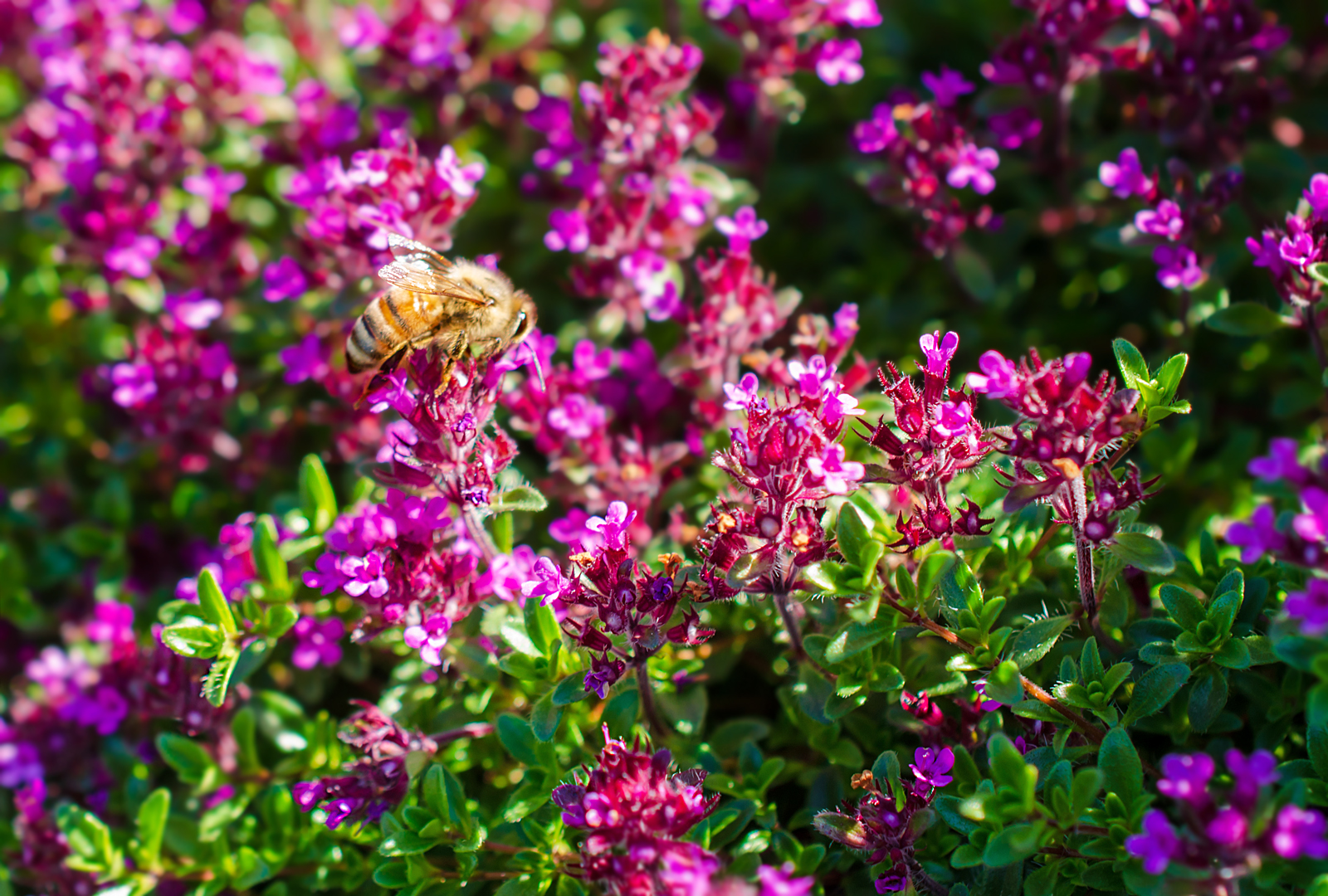
This one was easy; a honeybee, on Creeping Thyme. Next door.

Honeybees (probably Western honeybee, Apis mellifera, the most common species) have those prominent stripes on their apparently hairless abdomens. And, according to BugGuide, hairy eyes.
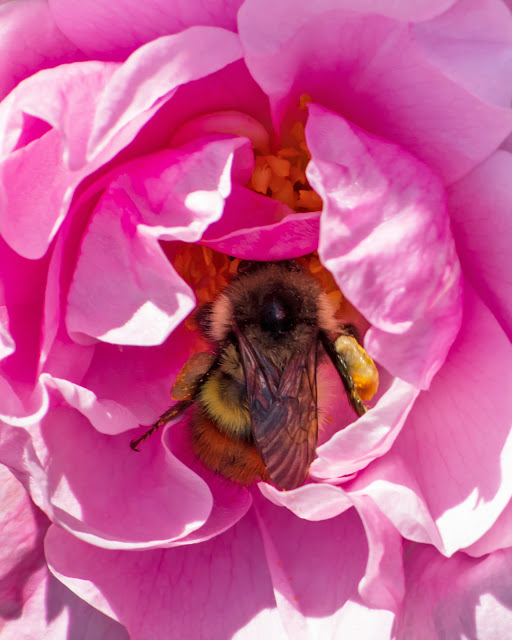
Bumblebee. In my garden.

The bumblebees have hairy abdomens, in a variety of colours, according to the species. Here on Vancouver Island, we have several species, among them, the Western, Bombus occidentalis and B. mckayi, the Vancouver Island Bumblebee, Bombus vancouverensis ssp vancouverensis (more name than bee!), and the Black-tailed Bumblebee, B. melanogypus. 

Same bee. I was trying to see if it had a black behind.

This one has a black tail. But so does the B. vancouverensis. Baikie Island.

And this one? Also on Baikie Island.

Trouble is, the colours are extremely variable. And species differenciation depends on details like the shape of sections of the wing. So, I'll go with Bumblebee, plain and simple.

I have yet to see a sweat bee or a carpenter bee here. Maybe later.

*It just occurred to me, getting ready to translate all of this to Spanish, that calling the area the "Lower Mainland" can be confusing. In reality, what we meant by this (and that's what we called it, living over there) is the lower reaches of the Fraser Valley, where the river descends from the hills and meanders down the flats to the Georgia Strait, a stretch about 70 km. long. And I just noticed that calling our place the Mainland, was a referral to the islands beyond, rather than to the rest of the continent. We islanders call the shots.

~~~~~~~~~~~~~
Érase una vez ... bueno, en el año 2008, hace 16 años, examiné muchas de mis fotos de abejas, tratando de identificarlas. (Once upon a time, bees were bees) Algunas no pude identificar, una no debería encontrarse aquí en Colombia Británica. Otras ni siquera eran abejas, sino imitadoras.

Pero eso estaba allí en el Continente*: abejas y sus imitadoras que hallamos desde la isla Reifel hasta Tsawwassen y hasta el centro de la ciudad de Vancouver. ¿Y cuáles serán las abejas que viven aquí en el centro y norte de la isla de Vancouver?

Estas son las que he visto hasta ahora en 2024.
  1. Esta fue fácil: una abeja melífera, Apis mellifera, probablemente la abeja occidental, que es la especie más común. Tienen esas bandas marcadas en el abdomen, que es casi sin pelos. Según BugGuide, también tienen pelos en los ojos.
  2. Bombus sp., abejorro, en mi jardín. Los abejorros tienen el abdomen peludo, en una variedad de colores, anaranjado, amarillo, blanco y negro, según la especie. Aquí en la isla de Vancouver, tenemos, entre otros, el occidental, Bombus occidentalis y B. mckayi, el isleño, B. vancouverensis ssp. vancouverensis (más nombre que insecto), y el de la cola negra, B. melanogypus.
  3. El mismo abejorro. Trataba de ver si tenía la cola negra.
  4. Este tiene la cola negra. Pero también el isleño puede tener el mismo color.
  5. ¿Y este?
El problema es que los colores son extremadamente variables. Y la identificación de las especies depende de detalles como la forma de las venas de las alitas. Yo, por ahora, me quedo con sencillamente "abejorro".

Hasta ahora, no he visto en la isla un abejorro carpintero, o uno de los halíctidos. Tal vez más adelante.

*Se me ocurrió mientras empezaba a traducir esto al español, que nombrar el area donde vivía antes "el Continente" puede ser algo extraño. Más sería usar el término que usan los residentes: El Continente Bajo". Se trata, en realidad, del valle del rio Fraser, desde donde desciende de los montes para vagar sobre el terreno plano hasta llegar al Estrecho de Georgia, unos 70 kilómetros de distancia. Y más, me di cuenta que al llamar el sitio "El Continente" están haciendo referencia a las islas, en vez de verse como parte de la nación entera. Nosotros, los isleños, mandamos.

Wednesday, June 24, 2020

Bzzzzzzz

At least there are bees.

The news is horrific, the virus is spreading, the future seems dim. But at least there are bees.

Bee on daisy

Honeybee on Gold Star
 I've given up, for now, on trying to identify species of local bees, but at least the honeybees are distinctive.

Another bee on Gold Star

These were in the meadow beside Oyster Bay.  Every patch of flowers was busy.

And another.

I can't identify the white drooping flowers behind these Gold Stars. I was lying on the ground in the meadow, so it was a very small plant. I'll have to go back and look for these.
~~~~~~~~~~~

Por lo menos hay abejas.

Las noticias son terribles, el virus sigue aumentando, y el futuro no promete algo mejor.

Pero por lo menos hay abejas.

Estas estaban en el campo al lado de Oyster Bay. Abejas de varias especies en flores de margarita y "Estrella de Oro" (Gold Star, Crocidium multicaule).

Friday, August 19, 2016

How old is a flower?

Bees can tell.

An older flower, and a honey bee with full bags of pollen.

And a young flower.
And this gumweed flower is half-way between the two above.

Gumweeds are composites; their flower heads contain many smaller flowers, the petal-like ray flowers around the edge, and a mass of disc flowers in the centre. The individual flowers mature first at the outer edge, then progressively inward, with the youngest flowers in the middle.

Look again at the flowers above; the younger flowers are still closed, the recently mature ones, where the bees are busy harvesting, have protruding anthers loaded with pollen, and on the outer edge, the tiny flowers are busy making seeds. Each single flower will produce one seed.

The ray flowers are sterile.

Still here. Moving on tomorrow.


Sunday, May 26, 2013

As promised: Duelling bees!

The thimbleberries are in bloom, and setting fruit. In Elgin Park, the bushes were swarming with industrious bees.

One flower seemed a bit crowded.

Two can share; there's room enough

Each to her own side of the table

"Oops! Almost fell out!"

"You're crowding me!"

Watch the changes: one has a grey jacket and frayed wings (Ms. G.). The other (Ms. Y) is younger; her jacket is yellow, and her wings are smoothly rounded.

G. "What are you doing under there? Get out!"

Y. "I'm not leaving! Stop pushing!"

Y. "I'm not putting up with this! Bug off!"

Y. "I'll fix you!" (Dive bombing Ms. G.)

G. "Oh? Well, two can play at that game! Here I come!"

Y. "You don't scare me! This is my flower and I'm staying here!"

As the squabble didn't seem to be likely to end soon, we went on our way.


Wednesday, May 15, 2013

Pollen carrier

Apis mellifera, the western honey bee, with her* bags full of pollen (not honey):


Zoom

Zoom, zoom

Quite a load she was carrying; she seemed to be flying clumsily, but she was still busy collecting more.

A honey bee moistens the forelegs with a protruding tongue and brushes the pollen that has collected on head, body and forward appendages to the hind legs. The pollen is transferred to the pollen comb on the hind legs and then combed, pressed, compacted, and transferred to the corbicula on the outside surface of the tibia of the hind legs.[3] A single hair functions as a pin that secures the middle of the pollen load. (From Wikipedia/Pollen Basket)

*Worker bees are infertile females. The males are drones; they do not fight, they do not gather pollen.

Found in the Secret Garden, Tsawwassen.

Wednesday, April 11, 2012

An embarrassment of riches

Like a busy, buzzy, fuzzy King Midas, everything he touches turns him to gold ...

He goes from one nectar-rich dandelion to the next ...

Filling his pollen baskets with a load of powdered gold ...

And getting himself gold-plated right up to the eyeballs in the process.

Honey bee, Apis mellifera, seen in Nicholson Park, Surrey. He is collecting pollen to carry back to the hive in his two big baskets on his hind legs.
A honey bee moistens the forelegs with a protruding tongue and brushes the pollen that has collected on head, body and forward appendages to the hind legs. The pollen is transferred to the pollen comb on the hind legs and then combed, pressed, compacted, and transferred to the corbicula on the outside surface of the tibia of the hind legs. A single hair functions as a pin that secures the middle of the pollen load. Honey and/or nectar is used to moisten the dry pollen, producing the product known as bee pollen or bee bread ... it takes an individual worker bee from three to eighteen minutes to complete a pollen load and return to the hive.. (From Wikipedia)

We're having warm springtime weather and everything has come alive. I'll post flower and weed photos tomorrow, a video the next day, if all goes well.


Powered By Blogger