Showing posts with label bumblebee. Show all posts

Tuesday, July 07, 2026

Berries!

Along the edges of the forest; where unfiltered sunlight reaches all the way to the ground. There the bees and other pollinators keep busy all through the long summer days. I found ripe blackberries, the native trailing ones, tiny, black, and sweet. And wild raspberries, still half-ripe; they'll turn dark wine-red soon.

Wild raspberry, Rubus leucodermis.

Ocean spray, Holodiscus discolor. Far from the ocean, but the flowers hang in foamy clusters, taking the shape of the sea foam at the tip of large waves at the beach.

Weedy.

Hawkweeds, Hieracium sp., are invasive weeds, but the bees do love them. Here, I liked the tight flower buds with their black-tipped bracts. The other weed is, I think, Wall lettuce, Latuca sp. It has tiny, white flowers.

The bee is a Yellow-faced bumblebee, Bombus vosnesenski. This is a native species, and the most common bumblebee on our west coast.

I just came in from tidying up my garden. I found some of the extremely invasive Himalayan blackberry canes hiding in the forsythia bush. Some of the berries are ripe already, and delicious. I cut down the canes anyhow. A young deer came by, looked them over, and turned up her nose. Our local bear would like the berries, but that would just help to spread the plant. Sorry, Brother Bear, but the whole batch went into the trash. 

~~~~~~~~~~~~~~~~~

En los márgenes del bosque, donde la luz del sol logra llegar hasta el suelo, se encuentran flores y frutas silvestres. Allí los abejorros y otros polinizadores se mantienen ocupados desde amanecer hasta la puesta del sol;  16 horas diarias en este mes de julio. Encontre moras maduras; las nativas, Rubus ursinus, pequeñitas pero negras y dulces. Y frambuesas silvestres, Rubus leucodermis, medio maduras; listas para comer, son de color rojo oscuro.

    1. Las frambuesas.

    2. Flores de Holodiscus discolor, rocío oceánico. Bien lejos del oceano, pero las ramas de flores colgantes se parecen a la espuma en la cresta de las olas en la playa.

    3. ¿Hierba mala? Estas flores amarillas son Hieracium sp.; una planta invasora, difícil de erradicar, pero muy apreciada por los abejorros y las avispas. En esta foto, me gustaron los botones con sus brácteas con puntos negros. Las otras flores (ya caducas) son, creo, "lechuga de muro", Latuca sp.

    4. El abejorro es un Bombus vosnesenski, el abejorro de cara amarilla. Es una especie nativa, y el Bombus más común en estas costas.

Acabo de entrar después de hacer limpieza en el jardín. Escondido entre el arbusto de forsythia, está creciendo un arbusto de la mora extremadamente invasora, Rubus discolor. Algunas de las bayas (y hay muchas) ya están maduras. Deliciosas, pero de todas maneras, corté todas las cañas y las deseché. Vino de pasada un venadito y se arrimó a mirar las ramas y hojas cortadas. Y ni siquiera las probó. Al oso que nos visita le gustarían las bayas, pero al comerlas ayudaría a esparcir las semillas. Mala idea.

Tuesday, June 25, 2024

Looking at bees again

Once upon a time, well, back in 2008, 16 years ago, I looked at a bunch of my bee photos, trying to identify them. (Once upon a time, bees were bees) Some, I never did identify; one didn't belong here in BC. A couple were not bees at all, but bee mimics.

But that was over on the Lower Mainland*, bees and copycats seen from Reifel Island to Tsawwassen to downtown Vancouver. What about the bees that pollinate flowers here on mid-Vancouver Island?

Here's what I've come up with so far this summer.

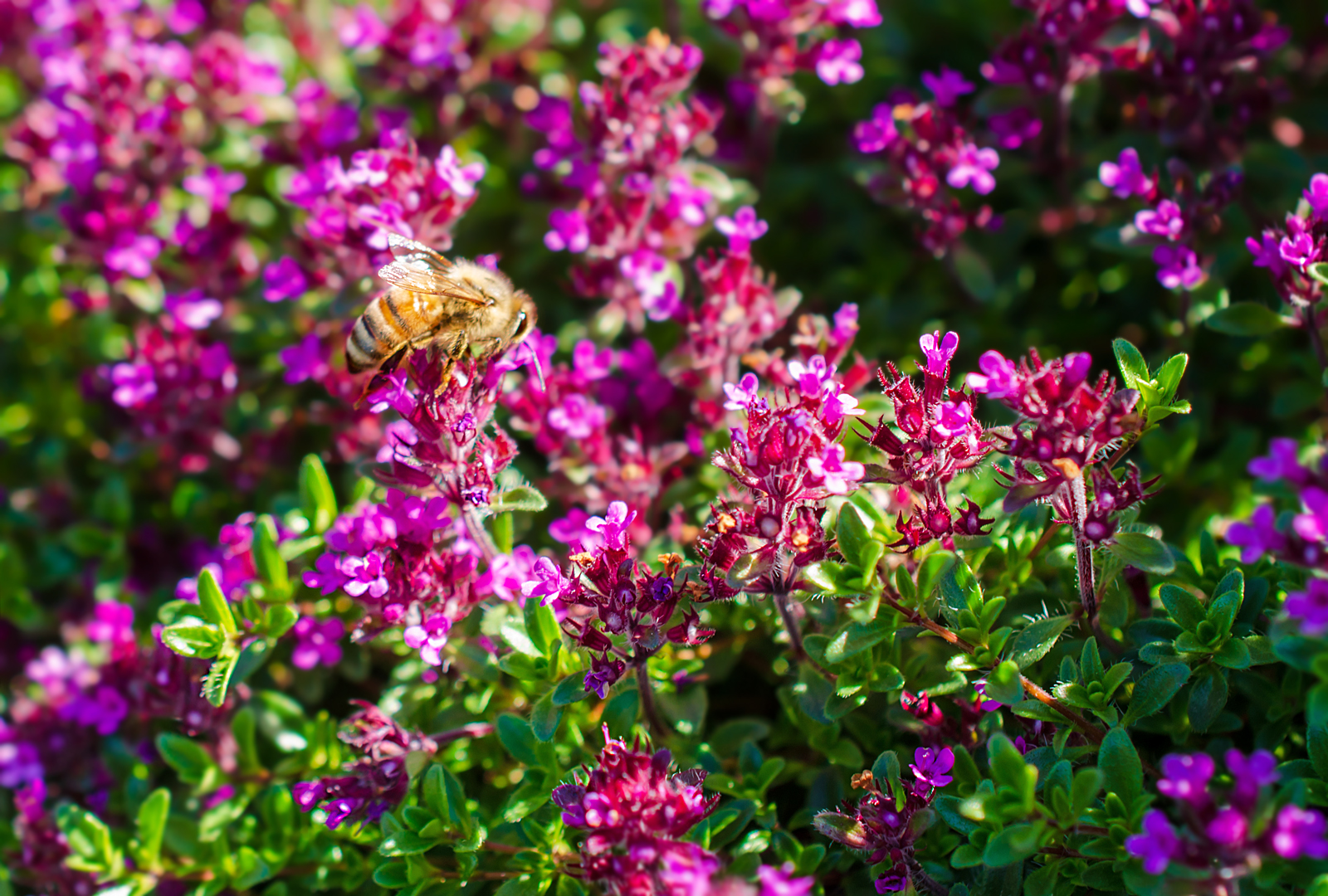
This one was easy; a honeybee, on Creeping Thyme. Next door.

Honeybees (probably Western honeybee, Apis mellifera, the most common species) have those prominent stripes on their apparently hairless abdomens. And, according to BugGuide, hairy eyes.

Bumblebee. In my garden.

The bumblebees have hairy abdomens, in a variety of colours, according to the species. Here on Vancouver Island, we have several species, among them, the Western, Bombus occidentalis and B. mckayi, the Vancouver Island Bumblebee, Bombus vancouverensis ssp vancouverensis (more name than bee!), and the Black-tailed Bumblebee, B. melanogypus

Same bee. I was trying to see if it had a black behind.

This one has a black tail. But so does the B. vancouverensis. Baikie Island.

And this one? Also on Baikie Island.

Trouble is, the colours are extremely variable. And species differenciation depends on details like the shape of sections of the wing. So, I'll go with Bumblebee, plain and simple.

I have yet to see a sweat bee or a carpenter bee here. Maybe later.

*It just occurred to me, getting ready to translate all of this to Spanish, that calling the area the "Lower Mainland" can be confusing. In reality, what we meant by this (and that's what we called it, living over there) is the lower reaches of the Fraser Valley, where the river descends from the hills and meanders down the flats to the Georgia Strait, a stretch about 70 km. long. And I just noticed that calling our place the Mainland, was a referral to the islands beyond, rather than to the rest of the continent. We islanders call the shots.

~~~~~~~~~~~~~
Érase una vez ... bueno, en el año 2008, hace 16 años, examiné muchas de mis fotos de abejas, tratando de identificarlas. (Once upon a time, bees were bees) Algunas no pude identificar, una no debería encontrarse aquí en Colombia Británica. Otras ni siquera eran abejas, sino imitadoras.

Pero eso estaba allí en el Continente*: abejas y sus imitadoras que hallamos desde la isla Reifel hasta Tsawwassen y hasta el centro de la ciudad de Vancouver. ¿Y cuáles serán las abejas que viven aquí en el centro y norte de la isla de Vancouver?

Estas son las que he visto hasta ahora en 2024.
  1. Esta fue fácil: una abeja melífera, Apis mellifera, probablemente la abeja occidental, que es la especie más común. Tienen esas bandas marcadas en el abdomen, que es casi sin pelos. Según BugGuide, también tienen pelos en los ojos.
  2. Bombus sp., abejorro, en mi jardín. Los abejorros tienen el abdomen peludo, en una variedad de colores, anaranjado, amarillo, blanco y negro, según la especie. Aquí en la isla de Vancouver, tenemos, entre otros, el occidental, Bombus occidentalis y B. mckayi, el isleño, B. vancouverensis ssp. vancouverensis (más nombre que insecto), y el de la cola negra, B. melanogypus.
  3. El mismo abejorro. Trataba de ver si tenía la cola negra.
  4. Este tiene la cola negra. Pero también el isleño puede tener el mismo color.
  5. ¿Y este?
El problema es que los colores son extremadamente variables. Y la identificación de las especies depende de detalles como la forma de las venas de las alitas. Yo, por ahora, me quedo con sencillamente "abejorro".

Hasta ahora, no he visto en la isla un abejorro carpintero, o uno de los halíctidos. Tal vez más adelante.

*Se me ocurrió mientras empezaba a traducir esto al español, que nombrar el area donde vivía antes "el Continente" puede ser algo extraño. Más sería usar el término que usan los residentes: El Continente Bajo". Se trata, en realidad, del valle del rio Fraser, desde donde desciende de los montes para vagar sobre el terreno plano hasta llegar al Estrecho de Georgia, unos 70 kilómetros de distancia. Y más, me di cuenta que al llamar el sitio "El Continente" están haciendo referencia a las islas, en vez de verse como parte de la nación entera. Nosotros, los isleños, mandamos.

Wednesday, June 24, 2020

Bzzzzzzz

At least there are bees.

The news is horrific, the virus is spreading, the future seems dim. But at least there are bees.

Bee on daisy

Honeybee on Gold Star
 I've given up, for now, on trying to identify species of local bees, but at least the honeybees are distinctive.

Another bee on Gold Star

These were in the meadow beside Oyster Bay.  Every patch of flowers was busy.

And another.

I can't identify the white drooping flowers behind these Gold Stars. I was lying on the ground in the meadow, so it was a very small plant. I'll have to go back and look for these.
~~~~~~~~~~~

Por lo menos hay abejas.

Las noticias son terribles, el virus sigue aumentando, y el futuro no promete algo mejor.

Pero por lo menos hay abejas.

Estas estaban en el campo al lado de Oyster Bay. Abejas de varias especies en flores de margarita y "Estrella de Oro" (Gold Star, Crocidium multicaule).

Friday, May 29, 2020

Bees again

And more bees! These were foraging on a couple of comfrey plants on the hillside.

Comfrey; Symphytum originale.

Flower head with one bee. A female, because she's carrying those pollen pockets.

Another flower head, another bee. Same collecting posture.

This one's got her back to us. Another female.

The two tall plants were covered in happy bees. All the photos I got were of females; there are hundreds of females for each male, and the males do no work. Among the honeybees, they don't even bother to feed themselves. (Male bumblebees do feed, but don't bring food back to the hive.) Their only function is to mate with the queen.

~~~~~~~~~~~~~~~

¡Y más abejas! Estas estaban en un par de plantas de consuelda (Symphytum oficinale) atrás de mi casa.

Todas son hembras: se pueden distinguir por las canastillas para polen que traen en las patas traseras. Todas las fotos que saqué eran de hembras; hay cientos de hembras para cada macho, y los machos no trabajan. Entre las abejas melíferas, ni siquiera se alimentan por si mismos. Los machos de las abejas Bombus (abejorros) si comen, pero no traen comida a la colmena. Su única función es fecundar a la reina.


Thursday, September 05, 2013

Warm fuzzies

Bee and flowers in the sunshine.


Moving to the next stem up . . .

I can't identify this plant. Can you? Is it a weed, or a garden escapee?


Sunday, July 21, 2013

Grappling hook feet

When you have to work upside down inside a wobbly pipe on a dancing shrub, you need good, sharp equipment. Something you can trust. Something that adjusts to the situation.

Like this:

One hook on either side.

Or on the flower next door.

Or even snagging three flowers.

Take a close look at that foot:

Four pronged to grab from any angle.


Sunday, June 30, 2013

Survivor bee

In Crescent Beach, this week, the wildflowers are showing off. Not least, the bindweed; this year its flowers are bigger than I've seen them for a long time. And the winged hordes are stuffing themselves with pollen and nectar.

This bee was too busy to notice my camera a few inches away.

"Yummy!"

But wait! There's something odd about that bee. Something not quite right.


Missing something.

Her wings are half gone. One is a mere stump; the other a tattered shred, but longer. Besides, she's long gone bald. The thorax glistens as if it had been polished, and her furry, striped behind has been trimmed by a blind hairdresser.

The hair loss is probably due to age, but something, a bird probably, broke off those wings. I wonder how she managed to fly. Surely she didn't walk to the feeding grounds?

Finished with this flower.

Turning to go, she stood facing me, as if gathering strength for the next flight. The wing stubs are clearer here.

On the lip of the bindweed flower.

A brief rest, and then she flew away. Half a wing or none, she's got work to do! She's a survivor.

Here's one of her relatives, on a mallow, for comparison:

Lots of hair, complete wings.

The bees have four wings, but the pair on each side hook together, so that they look like one. On the first bee, I see no sign of those frilly underwings.


Wednesday, May 30, 2012

Black-tailed bumblebee

Bumbling about in a rhododendron ...

Bombus melanopygus

In most of the photos I have of these native bees, it is difficult to verify that they do, in fact, have four wings; here, in spite of the interference from the rhododendron naughty bits, the second wing shows up clearly.

Another photo, showing the black tail that gives this species its common name.

I still have trouble identifying bees and bee mimics. Almost every time, I go back to my post from 2008, "Once upon a time, bees were bees ...", where I sorted some of the locals out, with the help of two experts from BugGuide. Even there, though, I have a couple of unidentified ones. I'll have to look for better specimens this summer.

Wednesday, October 05, 2011

A pair of tattered yellow fuzzies.

It's been raining off and on, and we have been staying indoors. It's a good time to work on photos, sorting, deleting, and posting.

These are from the beginning of last month:

Bumblebee on a wilting yellow aster.

It's not apparent in the first photo, but this bee has had a rough life. Look at her wings:

Something has clipped the tips off. And look again; she's carrying the tattered remnants of a spider web.

But the work must go on; there's pollen to gather, and no time to waste!


Saturday, June 25, 2011

A sticky situation

Rhododendrons have sticky sap. Especially the flower heads, even more so the aging, dying flower heads. Every time I deadhead our row of rhodos, my hands end up so caked with the glue that I have to scrub and scrape with soap and hot water several times. Last time, I used gloves; I had to throw away two pairs.

Thursday afternoon, I pruned one big rhododendron. Cleaning up the mess later, I noticed that a fallen flower had a bumblebee still working on it. "That's dedication!" I thought, and went for the camera.

Busy bee, as I found him.

But he seemed to be oddly scrunched up.

He kept his head down to the sap, antennae dancing. I figured he would leave when he was good and ready, and set the flower aside, where I wouldn't crush it doing the cleanup. Three hours later, I remembered, and went to see if he was gone. No.

He was still in the same position. I brought him inside, and we inspected him. I thought he just may have been chilled, but ...

See the problem? His head is glued to the flower.

I set him and his flower on a clean sheet of paper and we waited for him to warm up and detach himself. He tried, pulling and twisting. He got his head and front legs free, but his hind legs were firmly fastened. I teased them away from the flower stalk with a paintbrush, but over and over, just as one leg came free(ish), he panicked and twisted to grab the stalk, where he stuck again.

Head and front legs free. Unhappy bee.

Finally, I convinced him to grab the paintbrush instead. As soon as the last leg pulled away, I whipped the flower out of reach.

He was still all sticky; he kept dragging one leg under the other to clean it. As glue pulled off one foot, it stuck to the other. He walked around slowly, dragging the two back legs; he couldn't lift them off the paper. I hosed him down (well, sprayed him and the paper lightly with cool water) a couple of times. After about half an hour, he was able to walk almost normally, but he was exhausted.

Very sad bee. There's still debris glued onto the back legs.

What do you do for a depressed bumblebee? Give him something sweet! I brought him a dampened sugar cube, and he perked right up.

Drilling for sugar. You can see the tongue at the tip of the maxillae (long, tubular jaws). The hind leg still sticks to the paper.

An hour later, he was able to fly about, and anxious to be free. I noticed that he'd torn up some of the damp paper and it was attached to his feet.  Wait a bit longer, little bee! Another bath, another combing ...

Bee in glass, with paper slippers.

Eventually, I bedded him down for the night with fresh, clean paper. In the morning, I set him outside to wake up in the sunshine. When I looked again, he was gone.

'nother question; the bees are busy on the rhododendrons from dawn to dusk. Why don't they stick to the flowers like this one did?

Monday, June 13, 2011

Bee heaven

We went to Centennial Beach without checking the tide tables, and found the beach reduced to a narrow strip of stones. We turned inland and dawdled through the dunes.


This area, just south of the park area, is mostly loose sand, anchored by sea rocket and scratchy dune grasses. Here and there, low-growing purple beach peas find spots sheltered by old logs; escapees from landscaped yards, poppies, euphorbia and huge mounds of evergreen rose bushes, line the inland edge.  The sea rocket is in full bloom now, covered with small, pale flowers, their colours eclipsed by the bright yellow and orange of the bees that feed on them.

Native orange bumblebee, Bombus melanopygus*.

Another bumblebee, in yellow and black. An older bee, probably, going bald.

The flowers are productive; note this bee's full pollen sac on his leg.

A different species, probably. The abdomen is black, with faint stripes. Possibly the Eastern bumblebee?

On euphorbia, a wasp I don't recognize.

In the center of a rose, more yellow and black stripes. Another wasp?

No. This one's a honeybee, Apis mellifera.

*Note: all bee/fly/wasp IDs are tentative. I am often wrong, and appreciate corrections.
Powered By Blogger