Showing posts with label blackberries. Show all posts

Tuesday, July 07, 2026

Berries!

Along the edges of the forest; where unfiltered sunlight reaches all the way to the ground. There the bees and other pollinators keep busy all through the long summer days. I found ripe blackberries, the native trailing ones, tiny, black, and sweet. And wild raspberries, still half-ripe; they'll turn dark wine-red soon.

Wild raspberry, Rubus leucodermis.

Ocean spray, Holodiscus discolor. Far from the ocean, but the flowers hang in foamy clusters, taking the shape of the sea foam at the tip of large waves at the beach.

Weedy.

Hawkweeds, Hieracium sp., are invasive weeds, but the bees do love them. Here, I liked the tight flower buds with their black-tipped bracts. The other weed is, I think, Wall lettuce, Latuca sp. It has tiny, white flowers.

The bee is a Yellow-faced bumblebee, Bombus vosnesenski. This is a native species, and the most common bumblebee on our west coast.

I just came in from tidying up my garden. I found some of the extremely invasive Himalayan blackberry canes hiding in the forsythia bush. Some of the berries are ripe already, and delicious. I cut down the canes anyhow. A young deer came by, looked them over, and turned up her nose. Our local bear would like the berries, but that would just help to spread the plant. Sorry, Brother Bear, but the whole batch went into the trash. 

~~~~~~~~~~~~~~~~~

En los márgenes del bosque, donde la luz del sol logra llegar hasta el suelo, se encuentran flores y frutas silvestres. Allí los abejorros y otros polinizadores se mantienen ocupados desde amanecer hasta la puesta del sol;  16 horas diarias en este mes de julio. Encontre moras maduras; las nativas, Rubus ursinus, pequeñitas pero negras y dulces. Y frambuesas silvestres, Rubus leucodermis, medio maduras; listas para comer, son de color rojo oscuro.

    1. Las frambuesas.

    2. Flores de Holodiscus discolor, rocío oceánico. Bien lejos del oceano, pero las ramas de flores colgantes se parecen a la espuma en la cresta de las olas en la playa.

    3. ¿Hierba mala? Estas flores amarillas son Hieracium sp.; una planta invasora, difícil de erradicar, pero muy apreciada por los abejorros y las avispas. En esta foto, me gustaron los botones con sus brácteas con puntos negros. Las otras flores (ya caducas) son, creo, "lechuga de muro", Latuca sp.

    4. El abejorro es un Bombus vosnesenski, el abejorro de cara amarilla. Es una especie nativa, y el Bombus más común en estas costas.

Acabo de entrar después de hacer limpieza en el jardín. Escondido entre el arbusto de forsythia, está creciendo un arbusto de la mora extremadamente invasora, Rubus discolor. Algunas de las bayas (y hay muchas) ya están maduras. Deliciosas, pero de todas maneras, corté todas las cañas y las deseché. Vino de pasada un venadito y se arrimó a mirar las ramas y hojas cortadas. Y ni siquiera las probó. Al oso que nos visita le gustarían las bayas, pero al comerlas ayudaría a esparcir las semillas. Mala idea.

Tuesday, August 19, 2025

Slowpoke.

I was scanning the weeds along a trail, looking for ripe blackberries, when an oceanspray bush erupted. Bushtits! Speeding blurs, gone as soon as I saw them. One hung out a few seconds longer.

Bushtit, Psaltriparus minimus, male. (Females have light eyes.)

Just leaving. Blurry, but isn't he cute?

Oceanspray, Holodiscus discolor, gone to seed.

~~~~~~~~~~~~~
Andaba buscando zarzamoras entre las hierbas al lado de mi camino, cuando de un arbusto de rocío oceánico hizo erupción una bandada de Bushtits. Más bien, un borrón veloz, que desapareció en cuanto lo vi. Uno de los pajaritos se detuvo por un segundo ...
  1. Psaltriparus minimus, macho. Las hembras tienen ojos claros.
  2. Listo para volar.
  3. El arbusto, ya produciendo semilla. Holodiscus discolor.

Tuesday, July 02, 2019

One good thing. Two.

Blackberries, the rampantly invasive Himalayan blackberry vines that wall off our coasts and lurk along our trails, grabbing and tearing our clothes as we pass, the creeping alien in our soil, sending up its speeding, thorny shoots underneath our squash plants and tomatoes and in through the windows of our garden sheds, the swallower of more modest native plants, the aggressive colonizer of protected areas where our vigilance faltered, the ripper of hands and jabber of feet; hated and loved at the same time.

Because by mid-summer, they're loaded with delicious berries. Birds love them. Bees love them. So do ants and beetles and hover flies. Bears love them. We love them and fill our freezers and pies.

And in the spring and early summer, the flowers are so cheerful.

Usually the flowers are almost white. This one, growing onto the trail at Royston, is very pink. Colours as they came out of the camera.

A paler flower.

I found a fresh blackberry shoot under my mock orange in the garden yesterday. They never give up!

Friday, September 07, 2018

Butterfly wing petals. Five of them.

Checker mallow with hiding ant:

And blackberries, red, green and black. See the ant?

And now the ant has come out into the open. I like those shadows, too.

Taken just north of Sayward. The northernmost record E-Flora has of these is at Sayward, about an hour's drive north of Campbell River.

Sunday, August 12, 2018

By water's edge

The trail along the south side of the Campbell River is well advertised and busy, leading from just north of the townsite to Elk falls and the popular suspension bridge just below the hydro facility. On a warm weekend, foot traffic is dense with joggers and runners, chattering groups, serious hikers in boots, fisher folk coming and going from their favourite holes, and walkers like me.

I chose the almost unmarked trail along the north shore. I met no-one, heard nothing but bird calls, creaking tree branches, and the constant murmur of running water.

The hillside is steep and the trail rises and falls. At times, there is a view over the river, 'way down there, to the hills and mountains beyond.

Or the path drops to follow a stream down in the valley.

Mossy maple, towering overhead.

Quiet pool in another stream: river water taking the long way down to the estuary.

Another creek, not the main river bed.

Sunlight through trees casts green lights on the water. Another shallow creek.

In case you needed a snack; where there's water and sunlight, there are bound to be blackberries.

A ray of sunlight makes shadow patterns on a rock.


Sunday, August 05, 2018

The berry pickers

I was picking blackberries on the edges of an open field; black, juicy, and a wee bit tart; delicious! I hadn't brought a container, so I was eating as fast as I picked. I turned a corner, and met another blackberry eater.

Young deer, as surprised as I was.

Deciding I'm safe, she goes back to her meal.

I was eating berries; she was eating the leaves. Those canes have sharp spines, strong enough to tear my clothes. She doesn't seem to mind them on her back.

She was maybe a bit too tame; I'm safe, but not all people are. But she let me walk, slowly, up to a couple of metres from her. Then she turned away from the berry bushes and faced me.

"Who are you," she says, "and what do you want?"

I backed away slowly, and went back to the far side of the blackberry patch.


Wednesday, September 13, 2017

Ahhhh! Grey again!

The Vancouver Island paint box relies on blue, green, and grey. Mostly grey. But over this dry, smoking summer, that has changed. Lawns are yellow and crispy; the air has been brown, the sunshine orange. Distant mountains, instead of blue and purple, were a smudgy mud colour.

When the rains finally started last week, I went out to the woods to rest my eyes on the new greys.

From Race Point, Looking across to Quadra Island

Mist over a valley. Near Brown's Bay Road, Hwy 19.

Muted rainforest greens

"The woods were lovely, dark and deep ..." (Robert Frost)

It was pleasant there, wandering in the slow rain, under the evergreens. The air was cool and damp; it smelled of moss. The only sounds were the quiet tree conversations; creaking and whispering; and the gentle pattering of falling fir needles. Far overhead, eagles circled, crossing and re-crossing the patches of visible grey sky.

Farther north, the rain had been and gone, but the mist remained.

Deciduous trees, blasted by unaccustomed heat, basking now in a blue-grey mist.

Not everything is grey. Blackberries, still green, are red.

The blackberries this year are ripening slowly. I've tried a few ripe ones; they're acid and hard. They need water, lots of water, and sunshine; this summer has been missing both.


Saturday, July 22, 2017

Roadside delights

The weather has turned, finally. Rain has brought some relief to our burning province. Not enough to put out the fires on the mainland, but at least a hint of normalcy.

Last week, while even here on the island, even on the beaches, the air felt like the breath of an angry dragon, I headed north, hoping for a bit of coolness. I found it, up in Port McNeil; the skies were grey, the wind soft, sprinkling gentle drops of rain over the trees. Ahhh!

Partway there, between Woss and the southern tip of Nimpkish Lake, where the sun still shone, I stopped at a clearing beside the highway. A sign called it a viewpoint, but there was nothing to see but trees and cliffs. Through a gap in the trees, I caught glimpses of a pool below, too small to be called a lake, and have a name.

But there were flowers dancing in the wind, and lichen, and mosses. Who needs a view?


Daisy and grasses

It must be the wind and the clean air this far from "civilization"; there's no dust on the flowers, even just beside the highway


Pink flowers, with 6 petals, opposite, long leaves, on stems about a foot tall.

I couldn't find these flowers in either of my guides. And they're confusing: look at these others:

Much smaller flowers, but with the same configuration. Except that they only have 5 petals. The little brown spiky thing is a moss sporophyte.

These second flowers were tiny; I couldn't count the petals until I looked at the photos. And except for the size and the number of petals, they're identical to the others. A different species, or a variety of the same species?

Update: The 5-petalled variety has been identified, on Twitter, as Common centaury, Centaurium erithraea.
Salal flowers. Always so delicate!

The native trailing blackberry, Rubus ursinus. The ripe berries will be black, but small and scarce. And delicious.

I'll leave the lichen and moss, and an even tinier flower, for tomorrow.

Wednesday, June 18, 2014

Everything's hard at work ...

... and we're just idling along, watching them go at it.

Thimbleberry leaf, collecting sunlight to feed the berries.

Honeybee harvesting pollen. Note the fat pollen bags on her legs.

A small vetch (tufted vetch, maybe?) in a tangle of assorted weeds, enticing pollinators.

Syrphid fly on blackberry leaves. With grass and buttercup going to seed.

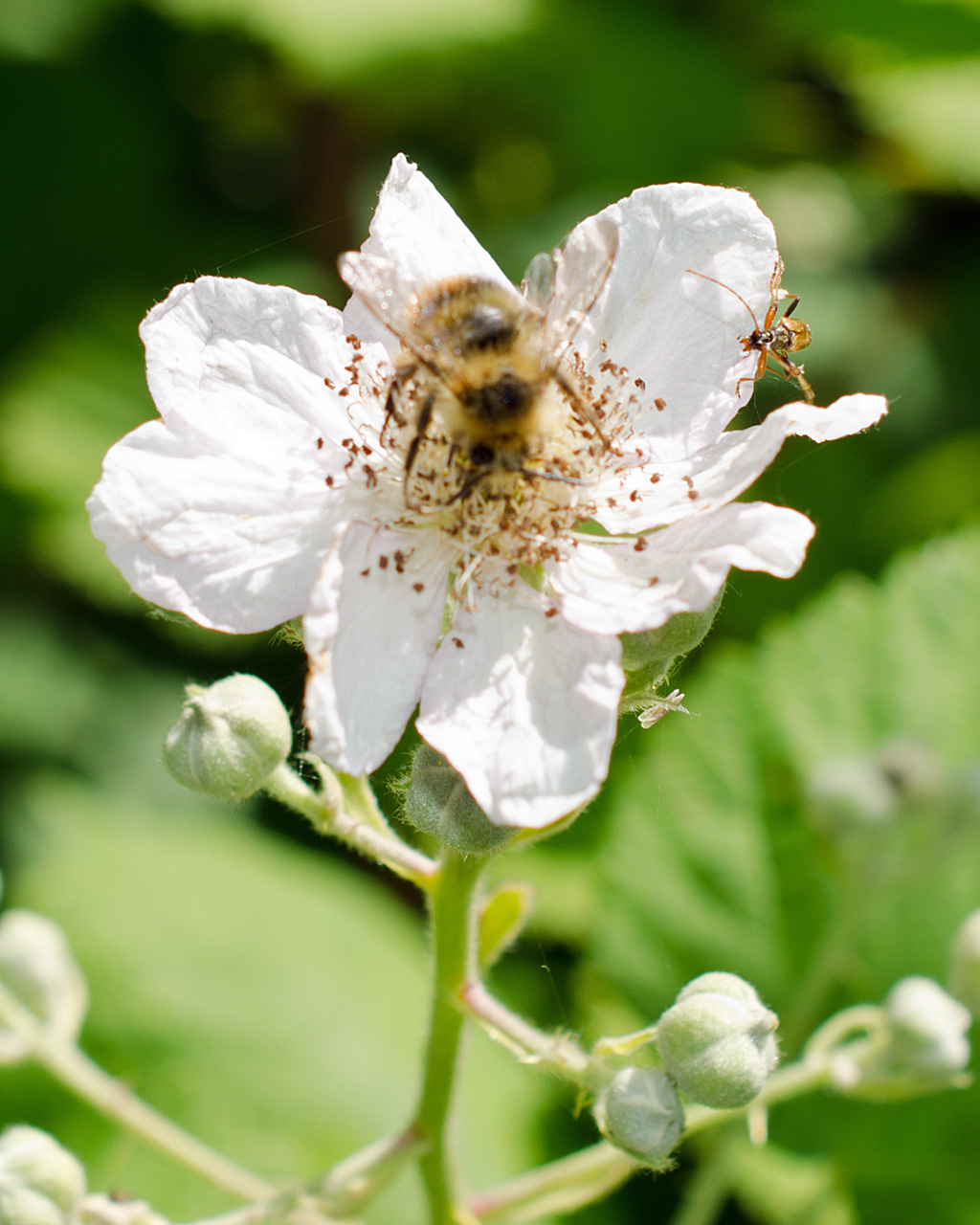
Blackberry flower, with two flying critters. Can you find the second?

Zooming in to see the shapes of the stamens (the pollen-bearing stalks) and the styles and stigmas (the short tubes that receive the pollen).

Yellow and orange fruiting bodies of a cup lichen on a tree trunk.

We were the only lazy ones there. Unless taking photos can somehow be construed as work.


Wednesday, June 11, 2014

Caution: Do Not Eat!

We went again this year to Elgin Heritage Park to look at the lupins. And they were wonderful, if a bit past their prime. But we walked on, past the lupin fields, to the riverside and the circle tour. And I started noticing pre-prime berries.

Thimbleberries, Rubus parviflorus, just starting to ripen.

Ripe, these thimbleberries will be sweet, as soft as cream pie filling, and a luscious, tempting red. But today, they're hard and hairy. And tasteless; I've tried them.

Twinberries, almost ripe.

The ripe berries are blue-black, growing in paired red calyxes. They're pretty, but I've been told the taste is vile. I haven't dared to try them.

Ripe berry, Lonicera involucrata

Half-ripe red elderberries, Sambucus racemosa.

When we had chickens, I used to harvest these berries when they were bright red; the chickens would race around carrying their prize clump, with others in hot pursuit. The mad scramble didn't die down until there was not a single berry left.

They're not people food, though; maybe not poisonous, but who would ever eat enough to find out? I've tasted one tiny berry and spit it out immediately. They're bitter.

The flowers are edible, and not so bad.

This is a tall shrub, growing up to 6 metres high.

Unidentified fruit. Cherry? Apple? Plum? Best to wait and see how it ripens.

There is a large variety of Prunus lookalikes in this area. Some are edible. Some are palatable. Some are even delicious. (Small, yellow crabapples from Reifel Island Migratory Bird Sanctuary come to mind. Try one - only one; they're for the birds - in late fall.)

Not a berry. Yet. Will be Himalayan blackberry, Rubus armeniacus.

Now, these you can eat! If you don't mind scratched arms and torn pant legs, bring a bucket and pick your winter's supply. They're plentiful and delicious.


Wednesday, August 21, 2013

Brown flowers, blue flowers, and white bird poop.

More Boundary Park photos; the details. Around the lake, first:

Cattails and stripy green water

Rushes. I used to make braids out of these, supposedly to use for something, but I never got that far.

Cross spiders use the rushes as framework for webs hanging over the water. Good mosquito control.

"Sedges have edges; rushes are round." I always have trouble sorting these out, so I was glad to run across this mnemonic, referring to the cross-section of the stems. Rush stems are also pithy, whereas sedges have solid stems.
 
Tall sedges, against the sky.

And up the hill under the trees:

On the floor of the evergreen "forest". (It's about as tiny as the lake below.)

Back yards merge gently, unfenced, into the mowed grass between the houses and the wild bush. This hydrangea is nearing its sell-by date.

Bird "whitewash" and rust spots on salmonberry leaves.

Blackberries are red when they're green. The black ones were delicious.

Powered By Blogger