Showing posts with label double-crested cormorants. Show all posts

Saturday, November 01, 2025

Grey and blue and black, with a couple of yellow rocks.

A peaceful afternoon, between rains.

Great blue heron, Oyster Bay.

Ripples and the reflections of Purple martin nest box posts.

Cormorant rock. They sit here every day, rain or shine.

Rocks, stones, and a mallard pair. Rotary Beach.

Breakwater at mid-tide, with a row of gulls at the outer edge. And a cloudy sky.

A Skywatch post.

Next; it's a crocodile.
~~~~~~~~~~~~~

Una tarde tranquila, entre lluvia y lluvia.

  1. Garza azul, Oyster Bay.
  2. Garza haciendo onditas, y reflejos de los postes que sostienen los nidos de golondrinas.
  3. Los cormoranes descansan en esta roca todos los dias.
  4. Piedras, rocas, y una pareja de patos ánades.
  5. Un rompeolas con la marea a la mitad del ciclo, con una linea de gaviotas donde las olas les salpican. Y el cielo nublado.
Mañana; un cocodrilo; el segundo que he visto aquí.


Thursday, March 28, 2019

Cormorant rock

A couple dozen or so Double-crested cormorants perch year-round on a couple of rocks just off-shore, one just south of city centre, one to the north. Both rocks are well below the low-tide line beside beaches that are too rocky for comfortable walking, but the cormorants are still easily spooked by humans.

I've attempted to tiptoe up close several times. The tide was very low a few days ago, and I tried again.

11 birds here. Several had flown away as I approached.

From a bit further away, cropped to look at the one with the white markings. The feathers have a distinct greenish cast; the orange markings around the chin are visible when the heads are turned to catch the light.

As I approached, step by cautious step, stopping every time they looked my way, a few birds left, then a few more, then finally all the rest at once.  The rock is tall, with most of it above water even at high tide. The cormorants take off downward, dropping to splash along the surface of the water before they rise into the air.

Leaving a trail across the water. Swimming, they sit low in the water.

Last nine to leave, splashing as they go.

I posted this last photo on the Worst Bird Photographs Facebook page, but I can't reisist adding it here:

The fabulous double-headed cormorants. This was taken from a greater distance, when they first started noticing my approach. 16 birds that I can see. (One is just the bill.)


Tuesday, December 05, 2017

Temporary quarters

This past week or so, the tides have been much higher than usual. The cormorants' accustomed hangout is underwater much of the time, so they've had to settle for a rock much closer to shore, near enough for me to see their feathers ruffle in the wind.

Cormorant rock, gull rock. No sharing!

Among the dozen pelagic cormorants, the one double-crested cormorant stands out; he's larger, and has a bright yellow bill and throat patch. The pelagics have thin necks, small beaks; their plumage, when the light is right, gleams with iridescent greens and purples.

Zooming in. The light was right.


Thursday, February 23, 2017

The cormorants

On a pair of rocks near the shore at the 50th parallel, a small flock of double-crested cormorants perches every day, whatever the weather. This Tuesday morning, the flock had doubled in size, and a couple had to make do with a smaller rock, just a stone's throw off the beach. I walked down, taking a couple of photos, a couple of steps, a couple of photos, a couple of careful steps ... I was quite close before they started to worry.

"Okay, that's close enough!"

And they're off.

From the street, where I see the cormorants daily as I pass by, they all look a dull crow black, but from the edge of the water, and with the sun shining, suddenly some of them acquire beautiful colours, shining purple and green.

Two are smaller, more brightly coloured, and have black faces and dark bills. Visiting Pelagics, over from Mitlenatch Island?

The double-crested cormorants have no crests at the moment. In breeding season (surely soon now?) they will develop two tufted clumps of feathers on their heads.


Friday, May 27, 2016

Rock face punctuation

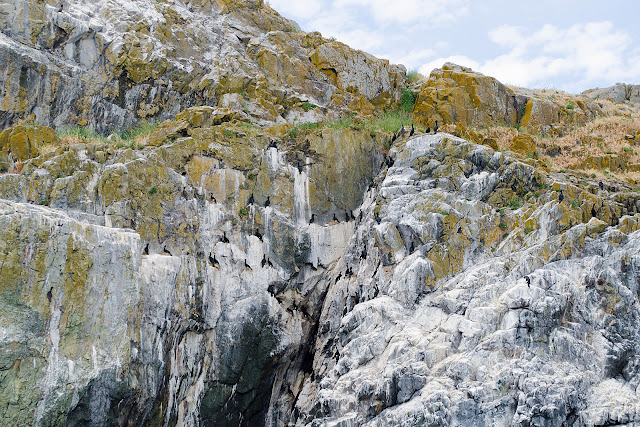
The southern coast of Mitlenatch Island is all high basaltic cliffs, streaked white by cormorant guano, painted along the upper edges with a yellow lichen that feeds on the guano. Along the top and sheer sides of the rock walls, hundreds of cormorants make their nests. From our viewpoint, down in the dinghy at a good 50 metres offshore, they seemed like punctuation marks; exclamation points emphasizing the verticalness of the rock face.

Distant view

We came in closer. The cormorants are still mere specks.

Pelagic cormorants, some with nests.

The pelagic cormorants are the smaller of the two cormorants we saw. They are a glossy black, sometimes iridescent when the light is right. In breeding plumage (like now) they have a small red patch on the throat, and two small feather crests on the head, hard to see at this distance. Breeding adults also have a large white flank patch, and these are visible, even in these small photos.

The nests here are visible as yellowish brown spots beneath some of the cormorants.

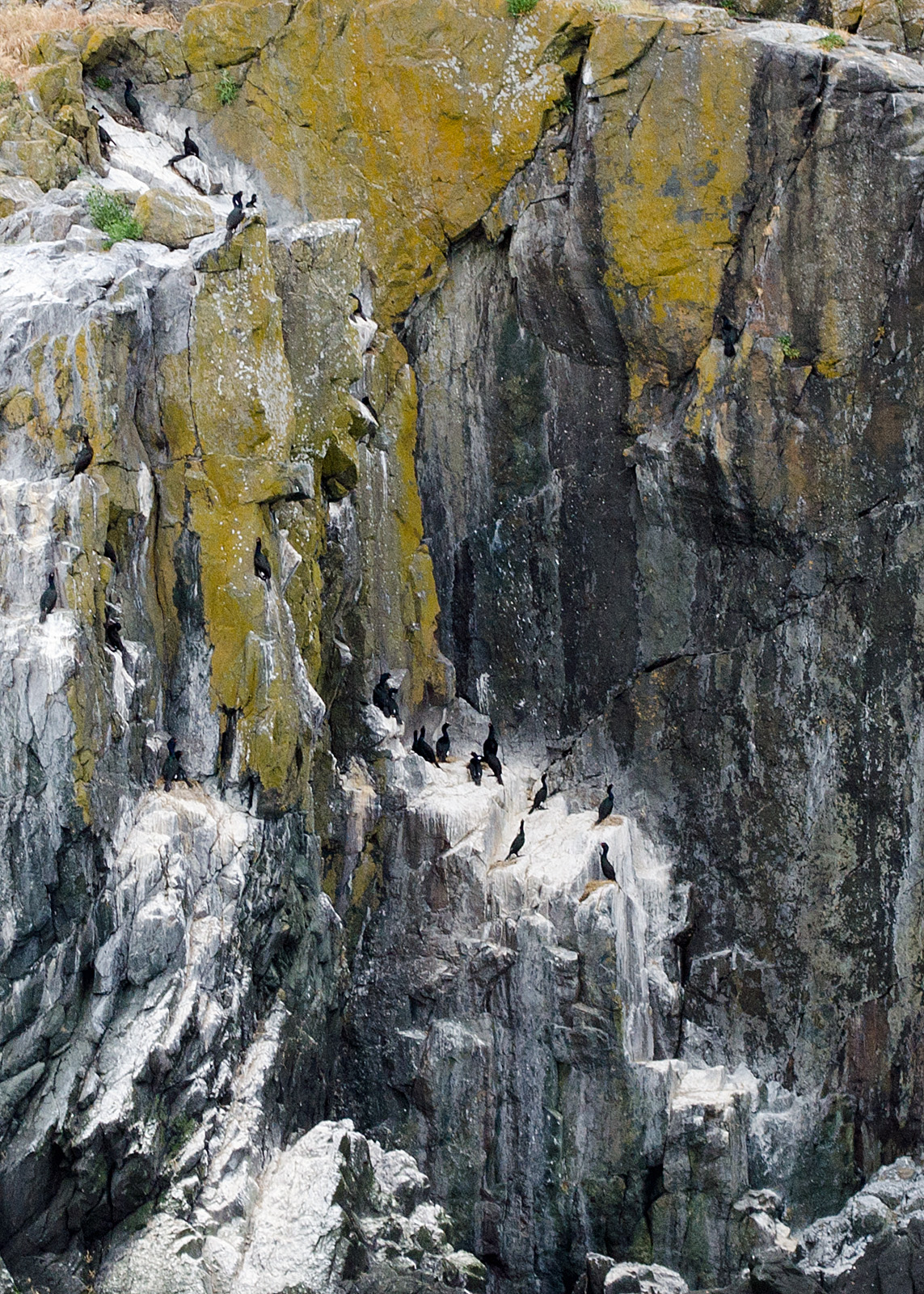
Zoomed and cropped photo. Besides the obvious nesting site, look more closely at the sheer walls. These birds nest on bumps that seem only big enough to hold their feet.

Moving on down the coast. Pelagics crowded together in the centre. On the top of the hill to the left, double-crested cormorants have their nests.

More pelagics. The white patches are visible, and with the photo at full size, a bit of the iridescence is apparent.

Skimpy nests. It's a wonder the eggs don't roll off with the merest gust of wind. But the chicks here are at least safe from predators.

Here, the only cormorants with nests are the couple of pairs part way down the cliff face, on tiny ledges. (Click for full size view.) The ones on top are nestless. On the left three juveniles are a lighter colour.

Double-crested cormorants, with their much bigger nests.

The double-crested cormorant is a larger bird than the pelagic. They are a dull black, but have a large orange or yellow throat patch, visible even from this distance without a zoom lens. In breeding season, they develop a double feather crest, larger than that of the pelagics. In this photo (click) I can see it, barely, on three or maybe four of them.

Pelagics again. A few red patches visible.

As we left the cormorants behind on our circuit of the island, we came upon the sea lions. Next.

(8th in a series of 9 Mitlenatch Island posts. #1, #2, #3, #4. #5. #6, #7.)
Powered By Blogger