Showing posts with label Big Rock. Show all posts

Thursday, December 19, 2024

Almost looks summery

 It stopped raining. The sun came out. The clouds overhead evaporated. Amazing!

I went to walk along the shore near our Big Rock.

Big Rock, little rocks.

Big Rock is a boulder 10 metres high. I searched for a weight, couldn't find even an estimate, so I calculated my own, rounding off numbers; counting it as a sphere 30 ft. in diameter, probably granite (175 pounds per cu. ft.) gives me 6,3000,000 pounds, or 3,150 tons. Or about 3,000 little cars like mine.

Cell phone photo. Tip of Quadra Island.

Looking south to Willow Point.

This is a newly-"improved" (paved, fenced) walk along the central shoreline of Campbell River. Two new additions were these driftwood birds on their nests.

Loon. I don't know who built it.

Spiky eagle.

Real, live birds were not so co-operative, and mostly far away.

Harlequin ducks, two males, one female.

And Cormorant Rock. Their usual perching place, well off-shore.

Oh, and it's raining again.

A Skywatch post.

~~~~~~~~~~~~~~
Dejó de llover. Salió el sol. Las nubes se evaporaron. ¡Maravilla!

Fui a caminar en el paseo cerca de nuestra Roca Grande.
  1. La roca, mirando hacia el sur, sobre el Estrecho de Georgia. La nombrada Roca Grande, un bloque errático glacial, mide 10 metros de altura (o diámetro, también). Se me ocurrió preguntar cuanto pesa, pero no pude hallar ni un peso aproximado. Hice mis propios cálculos: contándola como una esfera de 30 pies (porque la densidad me la dieron en estas medidas) de diámetro, probablemente de roca granítica, que pesa 175 libras por pie cuadrado, lo que me da 6.300.000 libras, o 3.150 toneladas. O el equivalente de unos 3.000 ejemplares de mi cochecito.
  2. Foto por la celular; la isla Quadra.
  3. Willow Point, hacia el sur.
  4. Este paseo lo han "mejorado" recientemente, pavimentándolo, erigiendo bardas. Añadieron dos esculturas hechas de madera flotante. Este colimbo cuida su nido, también hecho de madera y cuerdas de los barcos pesqueros.
  5. Una águila de madera flotante. No pude encontrar el nombre del creador.
  6. Los pájaros vivos todos estaban muy lejos de la playa. Estos son patos arlequines; dos machos y una hembra.
  7. Y los cormoranes en la roca donde pasan los dias.
Y está lloviendo otra vez. Como era de esperar.

Un poste de Skywatch.

Monday, December 27, 2021

Big Rock under snow

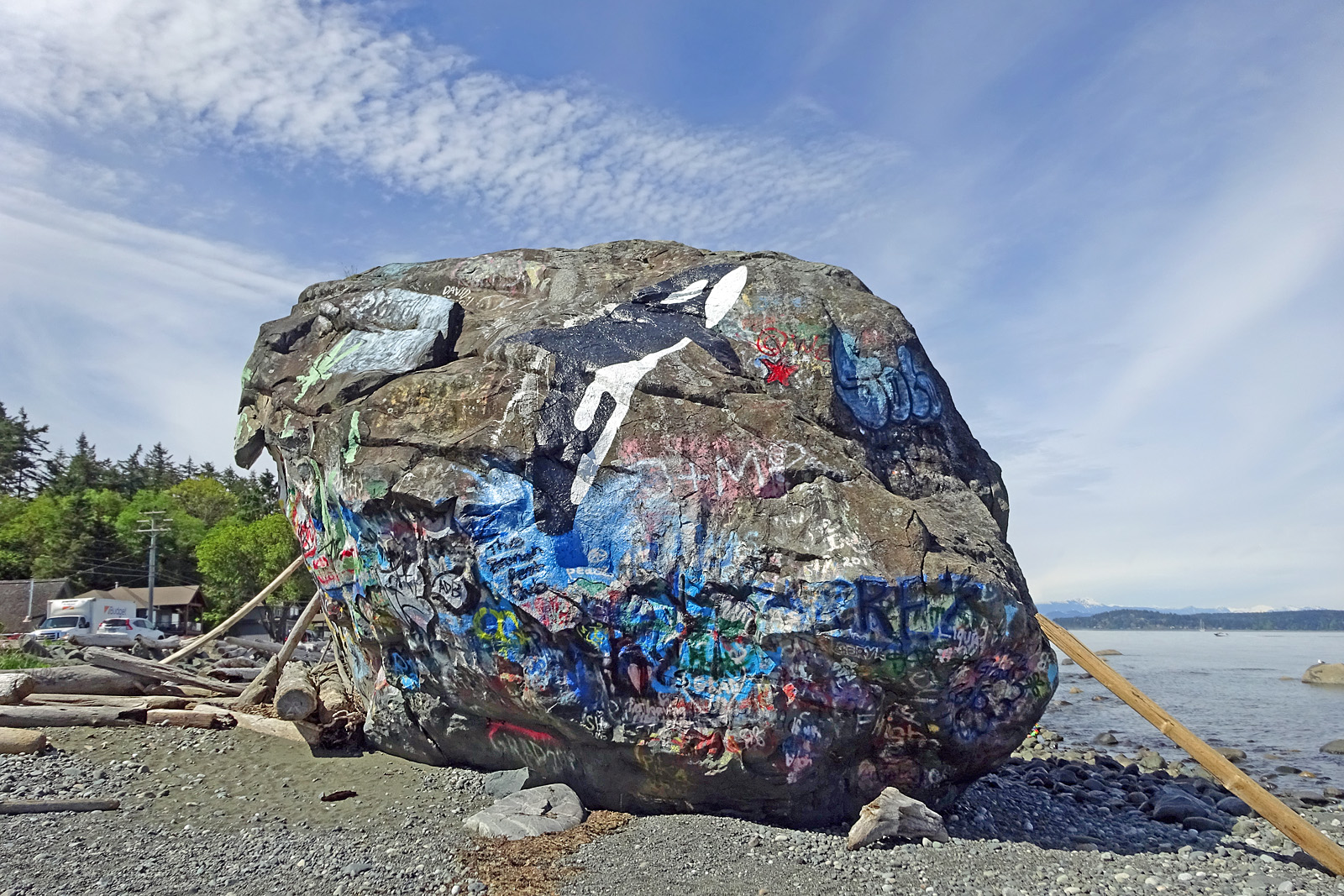
Maybe every town in glacier country has its own big rock. Campbell River has many large glacial erratics, mostly scattered on the intertidal shelf. But there is one "Big Rock". It sits at the top of the intertidal zone, about a kilometre south of the 50th parallel marker.

Usually it's covered with graffiti, with moss on top. Now it has another topper.

Big Rock from the highway, looking north.

The rock is ten metres tall, and weighs approximately 8000 tons.

A First Nations legend tells us that Mink, a young fisherman, was swallowed by a whale off Mitlenatch Island. He fought back, and won; the whale beached itself and Mink escaped. As punishment, the Whale community transformed it into a huge rock, as a reminder that we are cousins and must respect each other.

Graffiti comes and goes, but a painted whale, high on the south side of the rock, is always there.

I posted warmer weather photos of Big Rock a few years ago, here.

~~~~~~~~~~~~~~~~~~~~~~~~~~~~~~~~~~~~~

Puede ser que cada pueblo en tierra de los glaciares posee su propia "Roca Grande". Aquí en Campbell River, tenemos muchos bloques erráticos, por la mayor parte abandonados en la zona intramareal. Pero hay una que merece el nombre de "Roca Grande". Se sitúa en el borde superior de la zona intramareal, aproximadamente 1 km. al sur del monumento que identifica el paralelo 50.

Casi siempre está cubierta de grafiti, y lleva un poco de musgo encima. Ahora tiene un gorro invernal.

Foto: "Roca Grande" desde la carretera, mirando hacia el norte.

Roca Grande mide diez metros de alto, y pesa aproximadament 8.000 toneladas (8.000.000 kg.).

Una leyenda de los indígenas (mejor llamados las "Primeras Naciones") nos cuenta que una ballena capturó y se tragó un joven pescador, llamado Mink, cerca de la isla Mitlenatch. El joven luchó contra la ballena, y logró escapar, resultando en que la ballena se quedó encallada en la playa. Como castigo, la comunidad de las ballenas la convirtió en una roca enorme, como recordatorio de que somos primos y nos debemos respetar.

El grafiti cambia, pero la roca siempre lleva una ballena pintada en lo alto del lado del sur.

Hace unos años, subí fotos de la roca en dias de más calor. 


Friday, May 26, 2017

Erratic

We call it Big Rock. Of course; the first thing we notice about it is its size: huge. It sits at the top of the beach, looming. 10 metres high, and wider than it is tall; it probably weighs around 8000 tons.

The south face. The poles have been left by climbers and graffiti artists. Every so often, someone erects a driftwood sculpture on the top.

I have been driving by the rock several times a week for two years now, and had never stopped before to look at it properly until a couple of days ago. High time.

North face. Current graffiti includes a dragonfly and umpteen "We were here" messages.

Some 10 to 15 thousand years ago, most of Vancouver Island was weighed down by ice up to 2 kilometres thick, so heavy that it pushed the land down under the sea. And for those thousands of years, the ice collected rock and debris from the mountains and dragged or pushed it down towards the sea.

The ice melted finally, the land rose, and Big Rock was left stranded on the shore, probably hundreds of kilometres from its source. (A glacier moves about 30 cm. per day: calculate that over 1,000 years!) Geologists call these glacier leftovers "erratics".

Grass and moss growing on the inland top side.

A landmark so obvious is bound to collect legends. Some First Nations stories explain the rock as a grizzly that tried to jump over from Quadra Island and didn't make it; others say it's a beached whale, condemned to stand on the shore forever as punishment for swallowing a fisherman off Mitlenatch Island.

Graffiti comes and goes, but the painting of the whale is always renewed.

Lichen on the shoreward side, above the reach of salt water.

I had read that there is a benchmark embedded in the rock. I walked around the rock, searching carefully; on the third circuit, I found it, a metal plaque, about 3 inches across, half hidden under several layers of paint. (I tried to scrape off the red paint with a stone, and just exposed the blue underneath. I gave up.)

I can't read what it says. The horizontal line marks sea level.

(Now that I know where it is, I can see it in the second photo above; low down on the sunny side, near the logs, just under a white curve. All around the rock, the graffiti is faded below this line; it's underwater at high tide.)

Under a rock overhang, I found this perfectly preserved crane fly, in a skimpy spider's web. The sharply pointed tip of the abdomen identifies her as a female.


Powered By Blogger