Showing posts with label First Nations legends. Show all posts

Friday, April 17, 2026

Little Bear Quinny and the Forest Guardian

Another Little Bear. Quinny is his name. He sits on a stump beside a bridge over the Campbell River.

Quinny with Forest Guardian.

A trusting look.

And a benevolent smile.

These two driftwood creatures are the work of Alex Witcombe. I've posted his work before. This one is an ambitious creation, with Quinny meeting various wise forest people in sites near the river. This one, he calls the Forest Guardian.

I had forgotten Quinny's name, so I went back to look at the signs again. This was one of them.

"Secrets of the Forest"

Text of the sign:
Learning from the Liǧʷiłdax̌ʷ
Secrets of the Forest
The Liǧʷiłdax̌ʷ tell of baḱʷəs (pronounced "book-wuss"), a shy wild man who dwells in an unseen forest and survives on ghost food, mainly cockles.When someone passes away, baḱʷəs tries to coax their spirit to come live with him in the forest. If the spirits eat any of his ghost food, they become trapped there and cannot return.
Bears hold immense meaning as symbols of strength and protection to Liǧʷiłdax̌ʷ peoples. Thought to be dreaded by even the most skilled hunters, the bear remains a powerful guardian of the household. The Liǧʷiłdax̌ʷ family crests are often seen on house posts, on totems, and on masks, which are worn during dances in the big house.
Fun Fact ... Spruce pitch - Gʷəlikasa ?əliwas ("gwul-eek ah-eel") can be applied to scrapes and cuts to encourage healing. Liǧʷiłdax̌ʷ Elders and hunters both speak of seeing animals who've rubbed injuries against spruce pitch.
The Liǧʷiłdax̌ʷ are the First Nations people who have lived in the Campbell River and Quadra Island area for thousands of years. They are a group in the Kwakwala'wakw (who spead - wakw - the language of the Kwak'wala tribes.)

I thought, at first, that the Forest Guardian was a Sasquatch, and so he has been called by other visitors.  Now, going by the sign, I got the idea that he was a baḱʷəs, maybe tempting Little Bear Quinny with some "ghost food". It seems that other people have come to that conclusion; a photo from last December shows him holding out an apple. Today, he held out a casino chip to Quinny. 

But he's really a Forest Guardian. Alex Witcombe says so, and he should know. He built him.

~~~~~~~~~~~
Aquí hay otro osito. Este se llama Quinny, y lo encontré junto a un puente que cruza el Rio Campbell.

    1. Quinny y el Guardián del Bosque.

    2. Una mirada llena de confianza.

    3. Y una sonrisa cariñosa.

Estas dos esculturas de madera de deriva son obra de Alex Witcombe. He subido fotos de sus criaturas antes. Esta fue una creación ambiciosa, en la cual Quinny se encuentra con varias gentes del bosque en sitios cerca del rio. Esta, la ha llamado el Guardián del Bosque.

Se me había olvidado el nombre del osito, y regresé para examinar los letreros informativos otra vez.  Este (sin el nombre) era interesante.

    4. Letrero; "Los Secretos del Bosque".

Texto del letrero:
Aprendiendo de los Liǧʷiłdax̌ʷ
Secretos del  Bosque
Los Liǧʷiłdax̌ʷ cuentan del baḱʷəs (que se pronuncia como "buk-wass"), un hombre silvestre tímido quien vive en un bosque escondido y se alimenta de comida de fantasmas, por la mayor parte, almejas. Cuando alguien "pasa", baḱʷəs trata de persuadir su espíritu a que venga a vivir con él en el bosque. Si los espíritus comen de su comida de fantasmas,  quedan atrapados allí y no pueden regresar.
Los Osos poseen gran significado como símbolos de fuerza y protección para los Liǧʷiłdax̌ʷ. Se cree que hasta los cazadores más hábiles los temen, y el oso permanece como guardián poderoso del hogar. Los tótem familiares de los Liǧʷiłdax̌ʷ se encuentran frecuentemente en los postes enfrente de sus casas, en los postes totémicos, y en máscaras  que se llevan durante las danzas en la casa grande.
Dato Divertido ... La resina de los Abetos - Gʷəlikasa ?əliwas ("gwal-ik ah-il") se puede aplicar a heridas y raspaduras para estimular la sanación. Tanto los Ancianos de los Liǧʷiłdax̌ʷ como los cazadores cuentan de haber visto animales que frotaban sus heridas contra la resina de los abetos.
Los Liǧʷiłdax̌ʷ son gente indígena que han vivido alrededor de Campbell River y de la isla Quadra durante miles de años. Son un grupo de las tribus de los Kwakwala'wakw (que hablan - wakw - el idioma de los Kwak'wala.)

Pensé, al principio, que el Guardián del Bosque era un Sasquatch, y así lo han llamado otros visitantes. Ahora, viendo el letrero, llegué a creer que era un baḱʷəs, y que tal vez estaba tentando Osito Quinny con comida de fantasmas. Parece que otras personas también han entendido lo mismo; en una foto del diciembre pasado está ofreciendo una manzana al oso. Hoy, le trataba de persuadir con un ficha de casino. 

Pero en realidad, es un Guardián del Bosque. Así lo afirma Alex Witcombe, y él debe saber, pues él lo creó.

Thursday, December 15, 2022

Mouse tails

 Just a Douglas-fir cone fallen on the snow. I liked how it shows all those mouse rear-ends so clearly.

Surrounded by droppings from an alder tree.

Indigenous legend in the Pacific Northwest tells that a long time ago there was a great fire in the forest. All of the animals were fleeing before the encroaching flames. However, the tiny mice with their short little mouse-legs were not quick enough to outrun the fire. In danger of being engulfed in the flames, they asked the strong and stoic Douglas-fir trees for help. The trees were inclined to be friendly to the mice, and allowed them to climb up their thick, fire-resistant trunks and hide themselves in their fir cones. The mice gladly took shelter inside the cones, and survived the terrible fire. And even today – if you examine the cones of a Douglas-fir closely – you can see the little hind feet and tails of the mice sticking out from beneath the scales of the fir cones. (From Heart of the West Coast.)

~~~~~~~~~~~~~~~~~~~~~~~~~~~~~~~
Una piña de abeto de Douglas que cayó en la nieve. Me gusta la foto porque muestra tan claramente las colitas y patitas de los ratones.

Foto: la piña y conos de alisos también caídos.

Una leyenda indígena del la región Pacífico del noroeste cuenta que hace mucho hubo un gran incendio en el bosque. Todos los animales huían de las llamas amenazantes. Sin embargo, los ratoncitos con sus patitas ratoneros tan cortos no podían correr tan rápido, y el fuego se les acercaba. En tan gran peligro de ser consumidos por las llamas, les rogaron a los abetos de Douglas, tan fuertes, tan impasivos que les ayudaran. Los árboles eran amistosos y permitieron a los ratones que se treparan a los troncos grandes y resistentes al fuego, y esconderse dentro de las piñas. Los ratones felizmente se refugiaron dentro de las piñas y así pudieron sobrevivir ese incendio terrible. Y hasta el dia de hoy, si examinas con cuidado las piñas de un abeto de Douglas, podrás ver las patitas traseras y las colas de los ratones que sobresalen por debajo de las escamas de las piñas. (De Heart of the West Coast)


Monday, December 27, 2021

Big Rock under snow

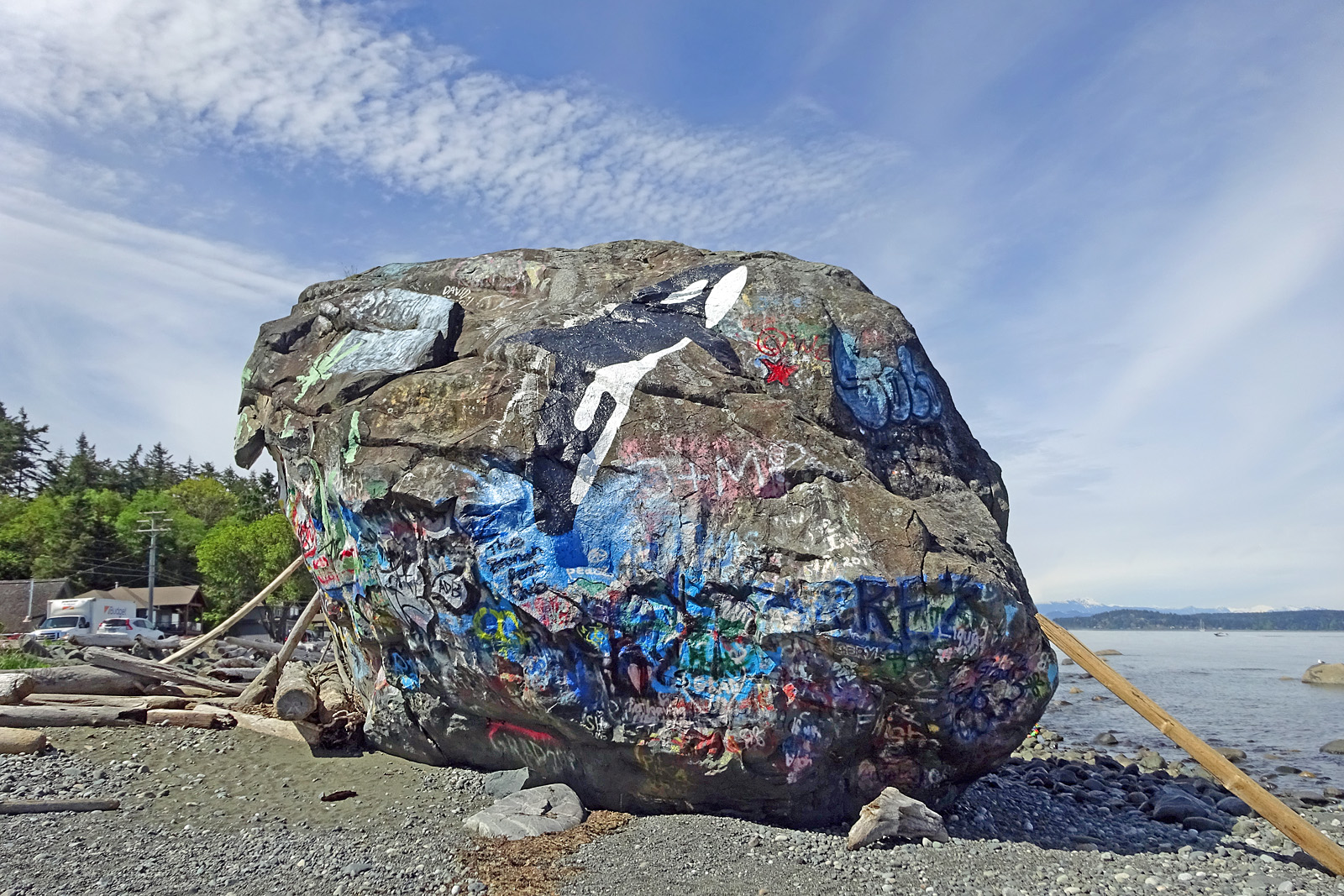
Maybe every town in glacier country has its own big rock. Campbell River has many large glacial erratics, mostly scattered on the intertidal shelf. But there is one "Big Rock". It sits at the top of the intertidal zone, about a kilometre south of the 50th parallel marker.

Usually it's covered with graffiti, with moss on top. Now it has another topper.

Big Rock from the highway, looking north.

The rock is ten metres tall, and weighs approximately 8000 tons.

A First Nations legend tells us that Mink, a young fisherman, was swallowed by a whale off Mitlenatch Island. He fought back, and won; the whale beached itself and Mink escaped. As punishment, the Whale community transformed it into a huge rock, as a reminder that we are cousins and must respect each other.

Graffiti comes and goes, but a painted whale, high on the south side of the rock, is always there.

I posted warmer weather photos of Big Rock a few years ago, here.

~~~~~~~~~~~~~~~~~~~~~~~~~~~~~~~~~~~~~

Puede ser que cada pueblo en tierra de los glaciares posee su propia "Roca Grande". Aquí en Campbell River, tenemos muchos bloques erráticos, por la mayor parte abandonados en la zona intramareal. Pero hay una que merece el nombre de "Roca Grande". Se sitúa en el borde superior de la zona intramareal, aproximadamente 1 km. al sur del monumento que identifica el paralelo 50.

Casi siempre está cubierta de grafiti, y lleva un poco de musgo encima. Ahora tiene un gorro invernal.

Foto: "Roca Grande" desde la carretera, mirando hacia el norte.

Roca Grande mide diez metros de alto, y pesa aproximadament 8.000 toneladas (8.000.000 kg.).

Una leyenda de los indígenas (mejor llamados las "Primeras Naciones") nos cuenta que una ballena capturó y se tragó un joven pescador, llamado Mink, cerca de la isla Mitlenatch. El joven luchó contra la ballena, y logró escapar, resultando en que la ballena se quedó encallada en la playa. Como castigo, la comunidad de las ballenas la convirtió en una roca enorme, como recordatorio de que somos primos y nos debemos respetar.

El grafiti cambia, pero la roca siempre lleva una ballena pintada en lo alto del lado del sur.

Hace unos años, subí fotos de la roca en dias de más calor. 


Friday, May 26, 2017

Erratic

We call it Big Rock. Of course; the first thing we notice about it is its size: huge. It sits at the top of the beach, looming. 10 metres high, and wider than it is tall; it probably weighs around 8000 tons.

The south face. The poles have been left by climbers and graffiti artists. Every so often, someone erects a driftwood sculpture on the top.

I have been driving by the rock several times a week for two years now, and had never stopped before to look at it properly until a couple of days ago. High time.

North face. Current graffiti includes a dragonfly and umpteen "We were here" messages.

Some 10 to 15 thousand years ago, most of Vancouver Island was weighed down by ice up to 2 kilometres thick, so heavy that it pushed the land down under the sea. And for those thousands of years, the ice collected rock and debris from the mountains and dragged or pushed it down towards the sea.

The ice melted finally, the land rose, and Big Rock was left stranded on the shore, probably hundreds of kilometres from its source. (A glacier moves about 30 cm. per day: calculate that over 1,000 years!) Geologists call these glacier leftovers "erratics".

Grass and moss growing on the inland top side.

A landmark so obvious is bound to collect legends. Some First Nations stories explain the rock as a grizzly that tried to jump over from Quadra Island and didn't make it; others say it's a beached whale, condemned to stand on the shore forever as punishment for swallowing a fisherman off Mitlenatch Island.

Graffiti comes and goes, but the painting of the whale is always renewed.

Lichen on the shoreward side, above the reach of salt water.

I had read that there is a benchmark embedded in the rock. I walked around the rock, searching carefully; on the third circuit, I found it, a metal plaque, about 3 inches across, half hidden under several layers of paint. (I tried to scrape off the red paint with a stone, and just exposed the blue underneath. I gave up.)

I can't read what it says. The horizontal line marks sea level.

(Now that I know where it is, I can see it in the second photo above; low down on the sunny side, near the logs, just under a white curve. All around the rock, the graffiti is faded below this line; it's underwater at high tide.)

Under a rock overhang, I found this perfectly preserved crane fly, in a skimpy spider's web. The sharply pointed tip of the abdomen identifies her as a female.


Powered By Blogger