Showing posts with label evergreen forest. Show all posts

Sunday, September 28, 2025

View from the forest understory

So, in an on-again, off-again gentle rain, I was sitting on a mossy hummock on the forest floor, poking through the duff, looking for beasties and mushrooms, following spiders and peering into lichen "gardens". Looked up, stretching, resting my eyes and my back, saw the forest around me.

Salal, moss, and evergreen trunks. And a huckleberry growing on a stump.

Up-ended roots of a fallen evergreen.

Dead hemlock, growing lichens, still carrying seed cones.

Moss on a small fallen tree.

Dead leaf on top of a stump.

And the wood of an old, dried-out stump.

Log end, bracket fungi, and wet salal leaves.

Yes, there were beasties. And mushrooms and lichen ... Next.

~~~~~~~~~~~~~~~

Llovía. Una lluvia tenue, intermitente. Estaba sentada en el musgo en el suelo del bosque, examinando la hojarasca, buscando animalitos y hongos, sacando fotos de arañas y "jardines" de líquenes. Descansando, estirando para aliviar los ojos y la espalda, alcé la vista y vi el bosque alrededor.

  1. El sotobosque. Salal (Gualtheria shallon), los troncos de árboles,  y un tocón  viejo con su arbusto de "huckleberry" (Vaccinium parvifolium).
  2. Las raices de un árbol recién caído.
  3. Un árbol muerto,  Tsuga heterophylla, ahora sirviendo de sostén de líquenes, pero todavía deteniendo sus  conos de semilla.
  4. Musgos en un tronco caído.
  5. Una hoja muerta encima de un tocón podrido.
  6. Detalle de madera seca.
  7. El extremo de un tronco cortado, con sus hongos políporos, y hojas mojadas de salal.
Sí, encontré los animalitos, los hongos y muchos líquenes. Los dejo para mañana.

Sunday, January 22, 2023

Nose to the bark again

I was a kid growing up on the far west coast of this island, back in the days when little of it was logged off. All around us were the dense, green forests. Evergreens: hemlock, Douglas-fir, cedar. On the hill across the channel there was a stand of maple. Mom used to love those when they turned red in the fall; they reminded her of home in Ontario, she said. But we never went over to look at them more closely.

What I knew were the evergreens. I knew the way the cedars drape their branches to leave a dry hideaway underneath. I knew the taste of hemlock branch tips in the spring. I knew the smell of fresh-cut firewood and the spicy aroma of the huge Christmas tree in the hospital lounge. And the mossy silence under the giants. And the way the darkness of the shadows between the trunks beckoned me. Beyond that, not much. My curiosity led me down other paths, had me turning over stones on the beach and diving under the wharf. 

So when, years later, on drier shores, I learned that deciduous trees (like maples, not fruit trees; they were special, right?) produced flowers, I was astounded. I thought flowers were things that grew on the ground or on shrubs, like daisies and thimbleberries. And even now, in the spring when the maples and red alders dangle their catkins and blossoms, I am filled with that same sense of wonder.

And the wonder goes on; the more I look at the trees, the more amazing they become. Hence, looking at bark. How it works, how it changes, how it lasts. And what it looks like on individual trees.

Here are more nose-level tree trunks, these decorated with dust and crust lichens. All of these are in the lawns around the Campbell River museum.

Douglas-fir with green dust. It always looks like old paint.

This is a maple, and there are two lichens; the dry, crusty whitish patches, and a tiny leafy lichen colonizing the cracks in the bark.

I can't identify this tree; not even when it was in leaf. Spruce, maybe? It's painted top to toe with this green lichen.

Maple, with whitish patches. And I liked the extra pattern from the sun peeking through the leaves overhead.

Another Douglas-fir, I think, with just a light dusting of green lichens.

And I've been told to look at other details, the trunk flair, the buds, the cones. So many fractal levels! So I'll go back again soon, and again in the spring, when the leaves start to show.

~~~~~~~~~~~~~~~~~~~~~~~~~~~~~~~~
Yo era una niña que vivía entre los bosques en la costa del oeste de esta isla, en los años cuando todavía no se habían cortado tanto. Nos rodeaban esos bosques, verdes, tupidos. Siempre verde; eran tsugas (hemlock), cedros, abetos de Douglas. En la cara del cerro al otro lado del estrecho frente a nuestra casa crecía una arboleda de arces; a Mamá le gustaba cuando se volvían rojos en el otoño; le recordaban su casa en Ontario, decía. Pero nunca fuimos a mirarlos más de cerca.

Lo que yo conocía eran los árboles perennes. Sabía como cuelgan las ramas los cedros, dejando un escondite en seco junto al tronco. Conocía el sabor de las ramitas nuevas de tsuga en la primavera. Conocía el olor de leña recién cortada, y el aroma picante del gran árbol de Navidad en la sala de estar del hospital. Y es silencio bajo los gigantes, todos los sonidos del munído exterior apagados por el musgo. Y como la oscuridad entre los troncos me llamaba. Más de eso, no sabía gran cosa. La curiosidad me llevaba por otros caminos, volteando piedras en la playa o buceando debajo del muelle.

Así fue que cuando, años más tarde, en tierras secas, descubrí que los árboles de hoja caduca (no los frutales; ellos eran algo especial ¿no?) producían flores, me quedé atónita.  Hasta entonces, pensaba que las flores eran cosas que crecían en tierra, o en arbustos frutales, como por ejemplo las margaritas y las moras. Y hasta ahora, cuando en la primavera veo las flores y candelillas de los arces y los alisos rojos, me llena un asombro vivo.

Y sigue ese asombro; entre más observo los árboles, tanto más fascinantes son. Y por lo tanto, aquí estoy mirando cortezas, preguntando como es que funciona, como cambia, como perdura. Y como se ve en cada árbol individual.

Aquí subo más troncos vistos a nivel de mis ojos, todos creciendo en los jardines del museo de Campbell River y llevando líquenes de polvo o crustosos.

Fotos:
  1. Abeto de Douglas con liquen de polvo verde. Siempre se ve como si se hubiera tirado pintura.
  2. Un arce, con dos líquenes, uno duro, seco, blanquisco, el otro muy pequeño, folioso, creciendo entre las grietas de la corteza.
  3. No puedo identificar con certeza este árbol. Picea, tal vez. El liquen lo cubre desde arriba hasta abajo.
  4. Arce, con liquen blanquisco. Y me gustó el diseño de sombras formado por el sol entre las hojas.
  5. Otro abeto de Douglas con solo una salpicadura de liquen verde.
Y me han dicho que hay que ver otros detalles, o sea el ángulo de la base del tronco, los botones, las piñas. ¡Tantas capas de detalles que hay! Iré de vuelta pronto a visitarlos, y otra vez en la primavera, cuando empiezan a aparecer las hojas nuevas.

Thursday, September 15, 2022

Sideways sunlight

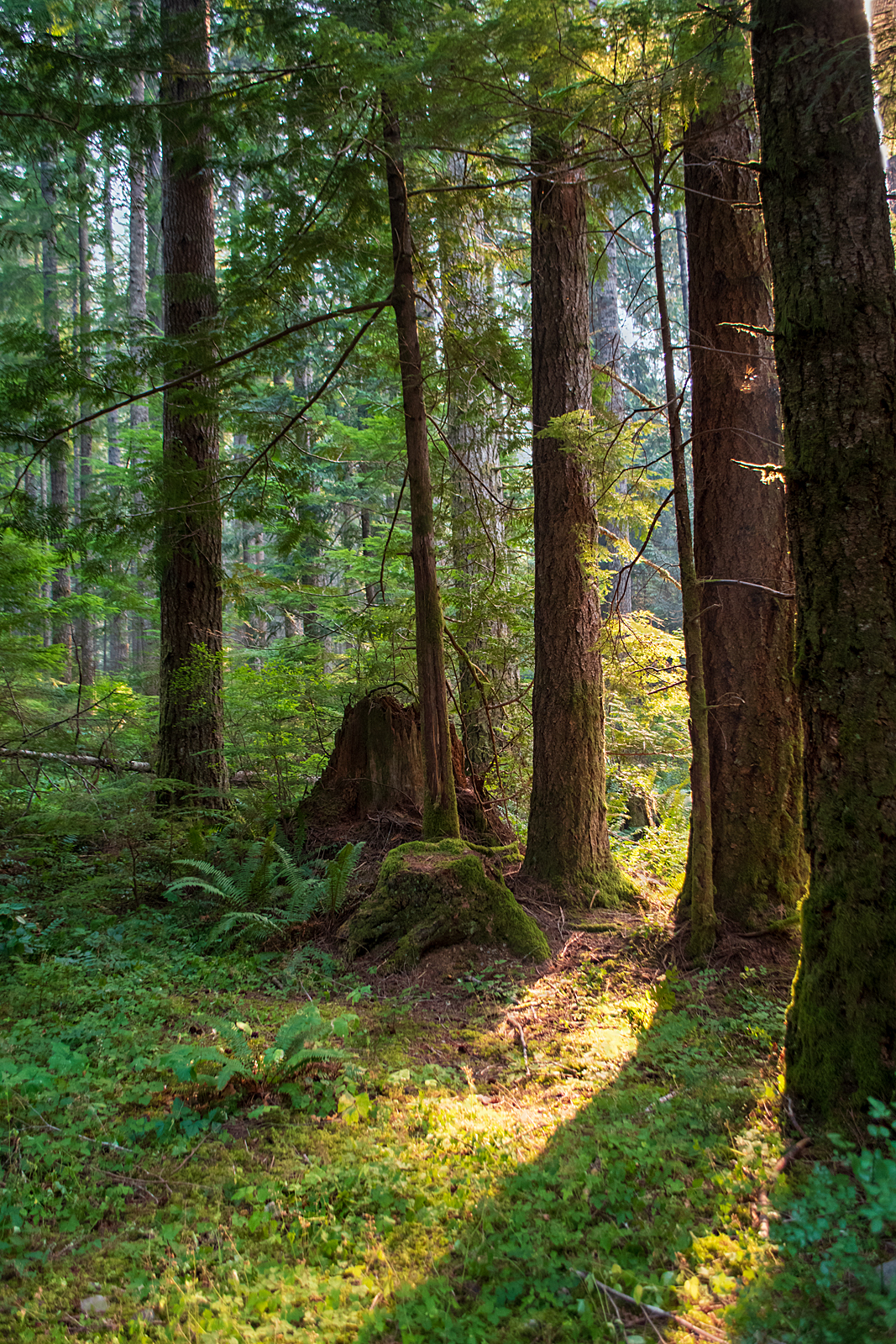
Under the evergreens, the canopy shades the strongest light in the middle of the day, keeping the ferns and moss underneath in the deep shade they love, but as the sun drops toward the horizon, its rays manage to penetrate between the trunks here and there. 

These photos are from the top of the trail down to Roberts Lake. Lower down, the mountains across the lake block more of the light; it's damper down there, and the ferns grow more abundantly, the moss is thicker.

Just after 4 PM. Sunset is around 7:30 these days.

Huckleberries grow often on stumps, where they capture more sunlight.

Our days are shrinking, but we still have, today, 12 hours and 40 minutes of sunlight. Tomorrow we lose another 3 minutes.
~~~~~~~~~~~~~~~~~~~~~~~~~~
Bajo los abetos, el dosel arbóreo impide la entrada de la luz al suelo a mediodía, manteniendo los helechos y musgos en la sombra que les gusta, pero en la tarde, cuando el sol baja hacia el horizonte, algunos rayos de su luz llegan a penetrar entre los troncos.

Estas fotos muestran el bosque en el sendero hacia el lago Roberts, en el nivel más alto del monte. Bajando el declive, hay más sombra; el bosque es más húmedo, los helechos son más abundantes, el musgo más hondo, ya que aquí la montaña al otro lado del lago bloquea la luz.

Esto fue un poco después del 4 de la tarde; la puesta del sol aquí en esta temporada es a las 7:30.
Segunda foto: los arándanos rojos crecen muchas veces sobre troncones, donde les llega más de la luz del sol.

Los dias se hacen cada vez más cortos, pero todavía tenemos doce horas con cuarenta minutos de sol. Mañana perderemos otros tres minutos.


Thursday, July 15, 2021

Leaky

Many small injuries cause trees to ooze sap, usually in small quantities. This one, though, is weeping from top to bottom.

A cascade of white, sticky sap.

I'm wondering what caused this; a major injury far above, too far for me to see it? A flock of enthusiastic sapsuckers, making holes all the way down?

Poor tree doesn't look happy!

~~~~~~~~~~~~~~~~~~~~~~~~~~

Muchas veces una trauma pequeña les hace llorar savia a los árboles. Normalmente, se limita a la región del daño hecho. Pero este pobre árbol llora desde arriba entre las ramas, hasta la raiz.

Me pregunto que lo habrá causado; ¿una herida grande, allá arriba entre las ramas, fuera del alcance de mi vista? ¿O una bandada de pájaros chupasavias, haciendo sus pocitos a todo el largo del tronco?

El pobre árbol parece estar triste.


Thursday, April 09, 2020

So black!

In a damp spot near the bottom of the hill in yesterday's bit of forest, on a knee-high alder stump completely encased in moss, I found these tiny black mushrooms.

Black earth tongues in Oregon beaked moss.

Growing in rows a couple of inches tall.

Skinny, pimply, with clipped, sometimes split tops.

They're earth tongues, but I couldn't determine the species. I've looked at hundreds of photos in the family Geoglossaceae, and all the ones I've seen have a sort of spoon-shaped tip, most smooth, some hairy. None that looked like these.

Here's a collection on INaturalist: Family Geoglossaceae.

On the side of the stump. One has a cozy leaf blanket.

I looked at other heaps of moss in the vicinity; I didn't see any others.

~~~~~~~~~~~~~~~~

En una parte húmeda del bosquecito de ayer, encontré un tronco corto de aliso, más o menos de la altura de mis rodillas. Está completamente envuelto en musgo (Kindbergia oregana), creciendo en medio del musgo, estos honguitos negros.

Son "lenguas de tierra", de la familia Geoglossaceae, pero no pude determinar la especie.

Busqué alrededor, pero estos eran los únicos visibles.

Tuesday, April 02, 2019

New white trilliums

Spring. There are flowers everywhere, yellow, pink, purple. Under the trees in the shady woods at Kitty Coleman Park, a short drive south of here, white trilliums were joining in.

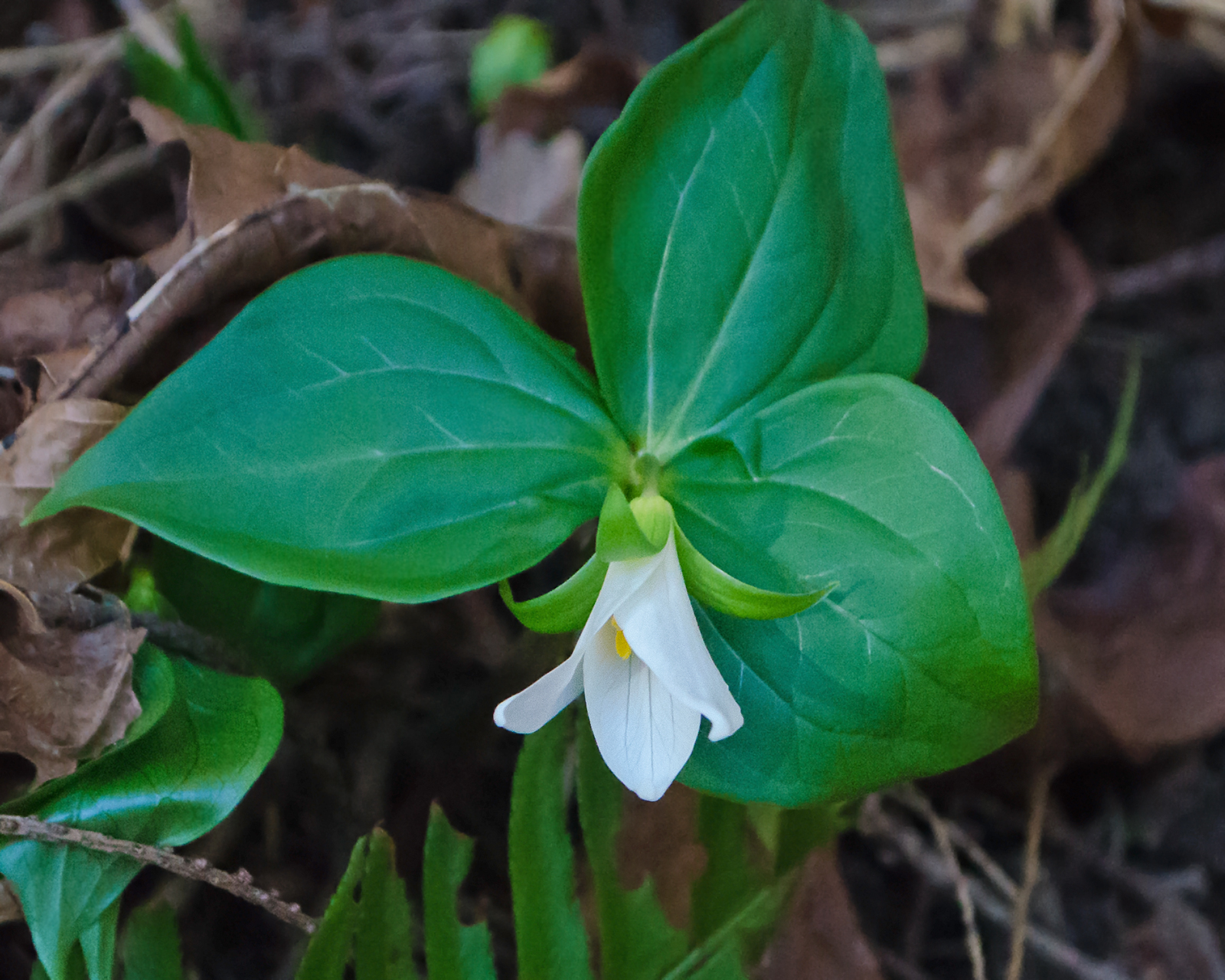
Trillium ovatum, the Western trillium. White when they're new, turning pink as they age.

Most were still barely open.

Fully open, these will spread the three petals almost flat.

This is an "ant plant". My guide book, Plants of Coastal British Columbia (Mackinnon and Pojar), explains:

"Each seed has a little, oil-rich appendage that is attractive to ants.The ants lug the seeds back to their nests, where they eat the appendages or feed them to the larvae and then discard the remaining seeds on their rubbish piles. This is a reasonably effective mechanism for seed dispersal, especially for plants of the dim, becalmed forest floor. Ants disperse up to 30% of the spring-flowering, herbaceous species in the deciduous forests of eastern North America. Our forest flora is less dependent, but we do have several spring-flowering "ant plants", including bleeding heart, inside-out flower and wild ginger, as well as trilliums."

The Kitty Coleman forest is mostly evergreen; cedar, hemlock, old-growth Douglas fir, and sword fern, with a few red alders to provide more shade in the summertime. I didn't see any ants.


Powered By Blogger