Showing posts with label sunlight. Show all posts

Thursday, September 15, 2022

Sideways sunlight

Under the evergreens, the canopy shades the strongest light in the middle of the day, keeping the ferns and moss underneath in the deep shade they love, but as the sun drops toward the horizon, its rays manage to penetrate between the trunks here and there. 

These photos are from the top of the trail down to Roberts Lake. Lower down, the mountains across the lake block more of the light; it's damper down there, and the ferns grow more abundantly, the moss is thicker.
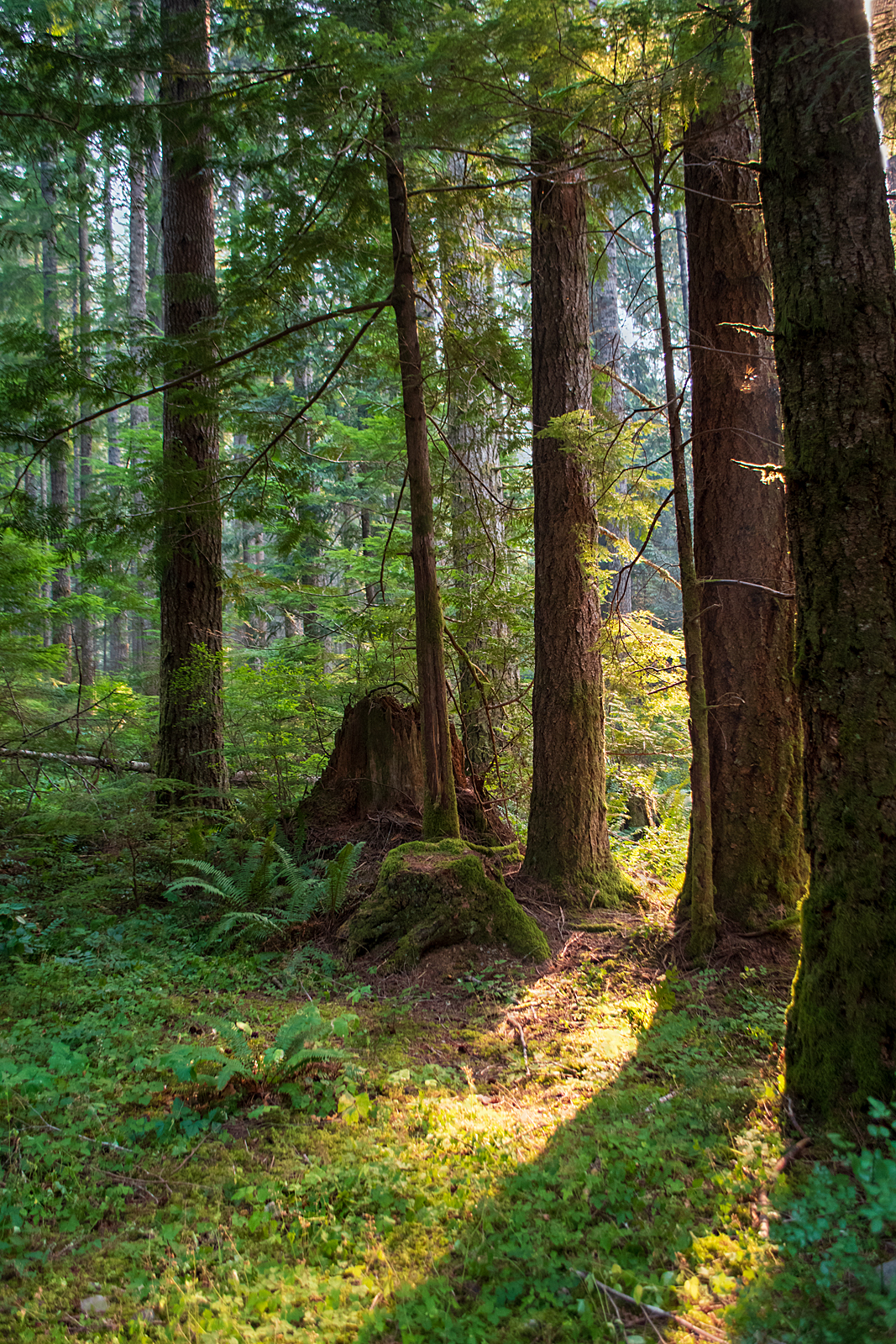
Just after 4 PM. Sunset is around 7:30 these days.

Huckleberries grow often on stumps, where they capture more sunlight.

Our days are shrinking, but we still have, today, 12 hours and 40 minutes of sunlight. Tomorrow we lose another 3 minutes.
~~~~~~~~~~~~~~~~~~~~~~~~~~
Bajo los abetos, el dosel arbóreo impide la entrada de la luz al suelo a mediodía, manteniendo los helechos y musgos en la sombra que les gusta, pero en la tarde, cuando el sol baja hacia el horizonte, algunos rayos de su luz llegan a penetrar entre los troncos.

Estas fotos muestran el bosque en el sendero hacia el lago Roberts, en el nivel más alto del monte. Bajando el declive, hay más sombra; el bosque es más húmedo, los helechos son más abundantes, el musgo más hondo, ya que aquí la montaña al otro lado del lago bloquea la luz.

Esto fue un poco después del 4 de la tarde; la puesta del sol aquí en esta temporada es a las 7:30.
Segunda foto: los arándanos rojos crecen muchas veces sobre troncones, donde les llega más de la luz del sol.

Los dias se hacen cada vez más cortos, pero todavía tenemos doce horas con cuarenta minutos de sol. Mañana perderemos otros tres minutos.


Tuesday, February 27, 2018

Under a glaring sun

Where the intertidal flats are mostly flat slabs of sandstone, critters that usually hide in the sand under rocks when the water recedes, quickly burrowing deeper when their rocks are flipped, either just put up with unfiltered sunlight, or cling tightly to the underside of what few stones are available. There's nowhere to run.

A half-dozen hermit crabs and a Wosnesenski's isopod struggle to stay in the shade of a trio of mussels. I replaced their stone roof gently where I found it.

The sand is a thin dusting on the sandstone. There's no shelter for the critters that can't run and hide elsewhere.The anemones here are under about a half-inch of water.

The green algae, the red seaweed, and the anemones don't mind the sunlight. Even at full tide, they're exposed to it, just slightly shaded by the clear water.
This green algae is probably the same one that pollutes my aquarium, always growing first on the walls closest to the light. The pink-tipped green anemones also benefit from sunlight; they do not photosynthesize, being animals, but carry symbiotic algae in their tissues; these algae produce enough food for themselves and some over for the anemone that hosts them.

Monday, February 12, 2018

Round trip

Third sunny day in a week!

I went to Salmon Point and walked the beach, looking for whelk shells for my hermits, who are growing out of the last batch. An hour of difficult walking, casting up and down the slope, over loose sand, round rocks, tossed-up logs. On the way back, I took the path through the small forest, looking at moss and lichens, and past Woodhus Slough, keeping an eye out for waterfowl, following side trails to look at the water.

I'm not used to it, after this rainy winter  (and a leg injury, to boot); I came home, dropped the shells into the tank, and limped into the bedroom. Woke up 6 hours later, stiff and sore.

And one of the hermits is wearing his nice, new, white shell!

I saw a flicker, a raft of buffleheads, a flock of Canada geese, mallards sleeping and flying, all far across the fields and the slough. My photos will end up posted on the Facebook page, "The worst bird photographs ever."

Well, maybe you can forgive me a photo of the flicker.

Basking in the sunshine

I took one step closer, and he flew away.

Woodhus Slough, glittering in the unaccustomed sunlight. No birds here.

All in all, totally worth the sore leg!


Monday, September 12, 2016

Oh, so blue!

When I set my photo processing program to the sunlight setting, it adds a yellow or reddish tinge to everything. Why, then, when the sun shines brightly, are we surrounded by blue?

Taking the dog for a paddle. Saratoga Beach

I switch back to "as shot". Sea and sky play with blue. The reds and yellows can stay on dry land.

Bare rock mini-islet somewhere out in the channel.

The sun sends us white light, a blend of wavelengths, visible and invisible (to our eyes; birds and bugs see things we can't.) The gas molecules in the atmosphere ignore the long wavelength rays, like red and yellow, letting them pass by on their way to land, and grab onto the blues and bounce them all over the sky. So we see the blue everywhere when we look at the sky.

Just before sunset, last February.

Near the horizon the light has travelled further to reach us, and some of the blue has been scattered off in other directions, so the sky looks paler. At sunset, pollutants and salt crystals (over the ocean) filter out even more of the blue.

Quadra Island lighthouse, July. The mountains in the distance are blue, too.

I always thought the sea just reflected the sky. Or vice-versa, maybe. I was wrong. The sea processes light differently. The water absorbs the warmer colours, and rejects the blue, bouncing it back into our eyes.

Rainy day over Tyee Spit. What little warmth arrived in the light that has percolated through the clouds highlights the dry grass.

The evergreens that cover our hills produce aromatic terpenes that form small particles in the atmosphere, and these also scatter blue light, seen better from a distance. (Up close, the trees are green.)

Saratoga Beach, with distant kayakers. Blue sky, blue mountains, blue water. Red kayaks.

Kite, over Tyee Spit last week. Looking almost straight up, the sky becomes deep, deep blue.

Something to ponder: when I look at the water, from the docks, for example, it is usually blue or blue-silver. But if I'm looking straight down into the water, it is often a deep green. Why is that?

A helpful article on this topic is "Why is the Sky Blue?" by Philip Gibbs. Also, see a briefer explanation on Scientific American.

A Skywatch post.


Thursday, January 07, 2016

Good morning!

Morning sun on the African violet on my windowsill.

It may be freezing on the other side of the glass, but here, it's summer!

Glittery petals


Tuesday, December 08, 2015

Makeover

It's as if she's objecting to the extra attention her rival got last week. Val, the big burrowing anemone, has been open to her fullest extent, waving her tentacles about, grabbing everything that passes, all week, ever since I reported on the plumose anemone's adventures.

And she's dressed herself up in a new batch of multicoloured seaweeds, pink and tan, yellow and green. And dyed her tentacles pink.

Nice jacket, Val!

Up to now, she has usually shown up in ghostly tones of blue and grey, with a slightly green disc and mouth. But now her colours are stronger, and she's picked up a hint of pink. This is encouraging; in the wild, these anemones are more colourful, and even though she was badly damaged when I rescued her, she was pink and green back then.

Here she is, just a small blob, healing, September of 2012.

In the tank, she gradually lost her colour. I did everything I could to help; provided lots of light, since she was found on an open, sunny beach. It seemed to make no difference. I gave her a variety of good food, live and preserved; I surrounded her with assorted seaweeds, red and green. And she seemed healthy and hungry, but as pale as a medieval maiden languishing in a tower.

And now, she's slightly pink. And definitely green.


Wide, green mouth. And even in bright light from two flashes, the hint of pink is there.

I think the difference is that here, in her new location, the aquarium is directly beneath a big, sunny window. Back in Delta, the window faced north into a row of evergreens; the sun never reached the window, and the tank was on the far side of the room. There was twice the amount of artificial light, but something must have been missing.

I wonder what she'll be like once the days are longer and the sun is farther north.


Saturday, May 23, 2015

Morning light

This time of year, the morning sun shines on my deep shade garden briefly, spotlighting here and there for a moment, then moving on. If I'm quick, I can even get a photo or two.

Two steps from my door. Clematis, Dutchman's breeches, London Pride, and distant rhododendrons.

And when the sun has moved elsewhere for the rest of the day, there's always flash.

Clematis, with flash.


Powered By Blogger