Showing posts with label environment. Show all posts

Thursday, July 27, 2017

Pet peeve

Every time I walk along a trail near a main road, I come across one or more of these, and go on my way ranting.

Dog poop in a conscientiously selected, carefully tied plastic bag, left beside the trail.

Text of usual rant:

"Look, I see that you're trying to be a responsible pet owner, but think! Use your head for a change!

Your dog's doings will biodegrade, and quickly. One good rain, and they're gone. A hot day, and they'll crumble into dust. But the plastic bag will be there when your remote descendants pop down from Mars to show the kids the old ancestral home. That stuff is forever!

If you don't want to carry the doggy-do out, (and I understand that), carry a pooper-scooper. Or use a handy stick. Be a good neighbour, and remove your dog's contribution from the trail; don't bag it up, but push it away under a handy log, or in the middle of a weed patch. Bury it in the sand, if you will (but not where kids play, but I don't have to tell you that, do I?)

Skip the plastic altogether; why add to all the tons already lying around? Why tempt the birds with what looks so fresh, so delicious? Why?

Need a bag for your dog's leavings? Bring a paper bag. It won't biodegrade as fast as dog poop, but it will be gone by next year, anyhow. Your plastic bag won't.

But whatever you do, don't bag up the stuff and leave it behind to pollute the park!"

End of rant. Until the next neat bag of poop.


Saturday, April 06, 2013

Bouncing off the moon

I have to pass this on . . .

From CBC (Canadian Broadcasting Corp.):
The Barenaked Ladies, a children's choir, and the commander of the International Space Station. Put them together and what do you get? The first space-to-earth musical collaboration.
The song, "I.S.S. (Is Somebody Singing) was commissioned by CBCMusic.ca and The Coalition for Music Education with the Canadian Space Agency to celebrate music education in schools across Canada.


The lyrics:

On solid fuel and wires
Turn the key and the light the fires.
We’re leaving Earth today
The rockets burning bright
We’ll soon be out of sight
And orbiting in space
Pushed back in my seat
Look out my window
There goes home
That ball of shiny blue houses everybody anybody ever knew 
So sing your song I’m listening out where stars are glistening
I can hear your voices bouncing off the moon
If you could see our nation from the international space station
You’d know why I want to get back soon (get back soon) 
Eighteen thousand miles an hour
Fueled by science and solar power
The oceans racing past
At half a thousand tons
Ninety minutes Moon to Sun
A bullet can’t go half this fast 
Floating from my seat
Look out my window
There goes Home (There goes home)
That brilliant ball of blue
Is where I’m from, and also where I’m going to 
So sing your song I’m listening out where stars are glistening
I can hear your voices bouncing off the moon
If you could see our nation from the international space station
You’d know why I want to get back soon (get back soon) 
All back and white just fades to grey
Where the sun rises sixteen times a day
You can’t make out borders from up here
Just a spinning ball within a tiny atmosphere (atmosphere) 
Pushed back in the seat
Look out my window
Here comes home (ho-ho-home)
What once was fueled by fear
Now has fifteen Nations orbiting together here. 
So sing your song I’m listening out where stars are glistening
I can hear your voices bouncing off the moon 
If you could see our nation from the international space station
You’d know why I want to get back soon (get back soon)
You’d know why I want to get back soon (getting back to you)
You’d know why I want to get back soon 
Source: LYBIO.net


Sometimes I get so discouraged, watching how we are so busy fouling our nest; carving out more roads for more unneeded merchandise, across irreplaceable wetlands, river banks, farmlands; hauling trainload after trainload of coal that will poison the air; laying leaky oil pipelines from the wasteland we have created on bird flyways, across still-green mountainsides to pristine waterways; heating and lighting ever larger houses for fewer people. And on and on, the list grows.

So I turn to the small, the close to home, the tiny beauties. There, I can forget, for a time. There, life goes on as always; there, I can make things better than I found them.

This video turns my eyes the opposite way, zooming out from the piles of gravel and clatter of heavy machinery, to see the earth from a different perspective.
"You can't make out borders from up here
Just a spinning ball within a tiny atmosphere."
We've got a long way to go, but this gives me hope. We can work together, we can learn to see beyond our noses. We can make things better, even the big things. Give us time!

A Skywatch post.

Wednesday, December 19, 2012

Baby turtle release

It's been snowing here, half-heartedly. There's maybe half an inch of snow melting on the lawn.

Meanwhile, in warmer climes . . .  My son and his family are travelling in Mexico, on their way south. A couple of days ago, in Copala, Guerrero, they were present to watch newborn sea turtles make their way down the perilous sand to the water. These are my daughter-in-law's  photos, posted with permission.

A bowl of new hatchlings.

These are Olive Ridley sea turtles. Every year, thousands of females arrive on appropriate beaches along this coast to lay their eggs, about 100 or more in each nest. The nests are covered with sand and left to hatch, incubated by the warmth of the sun, for about 6 to 10 weeks, depending on the temperature.

This hidden life is not without its perils. Storms and high tides may wash the eggs out of the nests. New waves of females looking for a handy nesting spot often disrupt an established nest. And many animals, from crabs to snakes to foxes, and even humans, dig these eggs up for food. Recently, they are even imperilled by tourists, who dig them out of curiosity.

Known predators of olive ridley nests include raccoons, coyotes, feral dogs and pigs, opossums, coatimundi, caimans, ghost crabs, and the sunbeam snake. Hatchlings are preyed upon as they travel across the beach to the water by vultures, frigate birds, crabs, raccoons, coyotes, iguanas, and snakes. In the water, hatchling predators most likely include oceanic fishes, sharks, and crocodiles. Adults have relatively few known predators . . . Humans are still listed as the leading threat to L.olivacea, . . . (Wikipedia)

The turtle is listed as vulnerable, and several agencies, governmental and non-g. are working together to preserve them. One of the methods used is to collect the eggs from the nests and incubate them in protected hatcheries. When the baby turtles hatch, they are released on their home beach that same day, usually in late afternoon or evening. The youngsters hurry down the beach to reach the sea, as they would have if they had hatched alone. But they are shielded by the human observers from their usual predators, and survive the trip.

Releasing the turtles.

Beginning the trek. Note the legs; they're shaped more like fins, more adapted for swimming than for crawling. The turtles paddle down the beach rather than running.

They're tiny; about three inches long

It's a long way to go, but the end is in sight.

Almost there!

When they reach the water, they pause for a moment, waiting for the next wave, which washes them out to sea.

The hatchlings begin their climb out of the nest in a coordinated effort.  Once near the surface, they will often remain there until the temperature of the sand cools, usually indicating nighttime, when they are less likely to be eaten by predators or overheat.  Once the baby turtles emerge from the nest, they use cues to find the water including the slope of the beach, the white crests of the waves, and the natural light of the ocean horizon.  Artificial beachfront lighting can be a major problem because it attracts these tiny creatures inland away from the water. . . . 
If the hatchlings successfully make it down the beach and reach the surf, they begin what is called a “swimming frenzy” which may last for several days and varies in intensity and duration among species.  The swimming frenzy gets the hatchlings away from dangerous nearshore waters where predation is high. (From SeeTurtles.org)

I would be tempted to "help out" by releasing them a few inches above the water line, but it may be that the initial scramble helps to get their systems working, possibly like the cry of a newborn human is essential to fill the lungs with air. (Just a wild guess, not a hypothesis of any sort.)

My grandsons watching the last few turtles heading for the light across the water.

There's a video that shows the paddling motion of the turtles feet quite clearly, here.

Photos by Angela Bernaldez.

Tuesday, December 18, 2012

The lustre of mid-day

Just a thought:
No matter what we do to ruin things, Ma Nature quickly gives it a beauty treatment.

Clear-cut logging scar, somewhere up north, 1988. Film camera.

*Afterthought:
But she won't correct the damage we do to ourselves. Or return things to their previous state, no matter how we beg of her.

**After-afterthought:
And it doesn't give us an excuse to go about messing things up.

***Title from T'was the Night Before Christmas.
The moon on the breast of the new-fallen snow
Gave the lustre of mid-day to objects below.


Thursday, December 22, 2011

Empty beach

Yesterday morning dawned clear and cold; there was ice on the birdbath again, but by noon the sun had banished it and the breeze was warm. A perfect day to go to the beach.

We hadn't been to White Rock since the day after the storm, back in November, the day I had collected the water that I believed had poisoned my aquarium. It was time to put unhappy memories behind us. We went to our usual spot on the White Rock beach.

A calm, sunny day. Setting sun warms the brown goldenrod heads.

We watched the train go by, I fed another bag of dry bread to shrieking gulls, we watched a kayaker or two. Then I went to the spot where I'd collected the last bottle of water, and started flipping rocks just below the high tide line. I wanted to either discard or confirm my conclusion about the water. Had the animals here suffered the same fate as mine at home?

There were no crabs under any of the rocks I flipped. No hermit crabs. No snails. No limpets. No worms. A few of the higher intertidal amphipods that always swarm on the bottom of these rocks. Just a few.

I walked west, flipping a few more rocks after every couple of steps. Nothing was alive but the amphipods.

I had covered about 150 metres when I found one tiny limpet and an anemone. A bit farther on, there were two limpets, one mussel, and a very small snail, small enough to have washed in after the tides had cleaned the area.

After this, the population of amphipods was denser. Then I found three more limpets, and one miniature hermit. No crabs, though.

Just before the 300 metre mark (measured on Google, at home), one of the stones sheltered a handful of baby crabs, about 1/4 inch across the back. That was reassuring. And a couple of dozen steps further on, I up-ended a large rock, and startled a crowd; too many crabs to count before they scuttled off, a half-dozen small hermits, a mediium periwinkle snail, and a number of black "pinhead" snails, like crawling grains of coarse sand, and under, over and around them all, a mass of slithering amphipods. Yay!

From here on west, just off-shore, a flock of goldeneyes were diving for supper. There had been no birds near the dead zone, except the gulls that mobbed me for my bread, and left as soon as the bag was empty.

So it seems that I was correct: something in the water was probably the culprit. Next time, I'll search in the opposite direction, to see if I can estimate the size of the affected area.

Rocks at the shore, and Common goldeneye.


Friday, August 12, 2011

Oil, 30 years ago

I've been working hard, tweaking the html on my family website, and was struck, once again, by the timeliness of my mother's poetry. This was written over 30 years ago, in 1980:
OIL PUMPS 
Up and down
like giant carrion in the fields,
they suck the blood of prehistoric forests
and rotting dinosaurs.
Between their claws they spew and spit
the foul black mucus
into troughs and tubes
that bear it to the flames
that heat the blood of pale and fearful man,
who cries for "More!"
struggling to survive
upon a dying earth. 
©Lorna Whitelaw/Anderson, 1980
I don't think I can add anything to that.

(Link to her poems, (at least, the ones on my site) here. Oil Pumps is on the page, "This Dying Earth". Please excuse any wonky formatting; I'm re-doing everything.)

Wednesday, December 15, 2010

The price of convenience

Warning; this post may give you bad dreams. Read it anyway; it's important.

Every so often, we come across an unpleasant sight on our beaches. A dead seabird, usually a gull. We always take photos, but at home, I delete them; they are too sad to share. I changed my mind; here is a gull we found a couple of days ago.

Found just above the high tide line. No visible injury.

Recently dead; the eye is still bright, the surrounding flesh, pink.

I have seen a few live gulls with broken wings or injured feet, but the ones we find dead have uniformly seemed uninjured. What killed them?

The most likely culprits are the plastic bags and/or other plastic debris left on the beaches by human beach visitors. As I walk on the beach, we collect any bags we see, and take them to the nearest - accusingly near! - trash can. This last time, I filled a grocery bag (also found on the sand) with other bags, plastic cups, and even a broken toothbrush.

Gulls are particularly vulnerable to this abandoned trash. When I was a kid, I watched a gull on our beach down a huge pile of fish guts. The mass was all connected, and the gull had to struggle and strain to get it all down. I was astounded when he succeeded. Even an entire grocery bag is more maneuverable and smaller than that; the sheer difficulty of swallowing it would not be a deterrent. Lying in water, half-buried in sand, the bags look surprisingly like bits of fish skin, or jellyfish. They even smell like food, as often as not.

All this is well known; entering "Gulls plastic bag die" into Google brought up over 73,000 sites. One of the first was this; "Gulls can't read ...", incorporating this video.


(One of the comments on YouTube asks why the photographer didn't stop this. The answer is in the post: "He was in an elevated postion and was unable to go the herring gull's resuce - but the reality of what was unfolding before his eyes meant he kept his camera on.")


Researchers estimate that around 95% of all sea birds have eaten plastic litter. (Here, here, and here.) Worse still, is the multiplying lethality of these bags; after a killed gull rots away, the plastic, still intact, is released into the sea to lay in wait for another luckless bird or other animal (a turtle, a whale, etc.) And again, and again. The bag will last for centuries. (Even a so-called "bio-degradable" bag will remain intact for a long, long time. And once it has broken down, the plastic is still there, just in tiny pieces. It can still kill; it just won't choke a gull.)


Thanks for watching and "listening". You know what to do.

Sunday, March 08, 2009

"Grand, awe-inspiring" insanity

What do you do on a windy Saturday when it threatens to snow -- again! --? We went to the Surrey Art Gallery. The exhibition that drew us was Edward Burtysnky's "An Uneasy Beauty - Photographs of Western Canada". From Wikipedia:
Burtynsky's most famous photographs are sweeping views of landscapes altered by industry: mine tailings, quarries, scrap piles. The grand, awe-inspiring beauty of his images is often in tension with the compromised environments they depict.
"Sweeping views" doesn't do justice to the photographs. These were huge, detailed photos, maybe 3 or 4 feet long. Railway and road cuttings (some locations I recognized; a wire net holding the rock face on the Hope-Princeton highway, for example), homesteads, in all their grunginess, a copper mine. These were from the 1980s. Peaceful, and at the same time, disturbing; the stark beauty of our interior cluttered with our machinery.

The display is laid out in a U. The second leg is dedicated to Alberta's oil sands. An online gallery includes the ones we saw, and a few more. (Click on "Oil", then on "Oil Sands".)

The photos are heartbreaking, horrifying. Look at this one. Imagine yourself a waterfowl, on your way North, looking for a place to get a bite to eat, spend the night. Imagine seeing this shiny lake and landing, only to find that the water is poisonous. I read just last week about a flock of 500 ducks dying this way last May. (Story on CTV, stoptarsands, The Star ...) From the Star story:
And they warn the number of bird deaths will jump dramatically as more heavy oil plants are built unless governments bring in tougher environmental rules, including how to deal with billions of litres of poisonous sludge the plants produce.
I was planning to post some cheerful photos of spring flowers from the Art Gallery courtyard, but I don't have the heart for it after looking at the oil sands photos again, even the small versions on the web.

Burtynsky's webpage has more, much more; Eastern Canada, Australia, the US, China, India, Spain, etc. Go see. But be warned; it's not easy viewing.

.

Monday, February 09, 2009

Vote for Tomorrow

Out for a quick walk around the block, I looked across the street to the vacant lot. This fall, someone had brought in machinery and levelled the south half of it, stripped it down to the bare gravel, abandoned a bucket there, and disappeared. The bare earth has been sitting there, ever since, staring bleakly at the sky.

But on the far side, a few trees provide habitat for crows:


Lookout and nest.

I noticed their reflections in some newish puddles, and we walked over to look.


The ground underfoot was a mix of fairly solid gravel, and soft mud. Some of the grasses are beginning their work of reclamation. Again.


Oak leaf on mud-stained, wind-blown paper.


The bucket of the backhoe, rusting out.

And in the biggest of the puddles, (still only a few inches deep) a pair of mallards rested:


"Not much to eat here, but at least we have it to ourselves."

At the end of this puddle, there is a message.


"Vote for tomorrow. Vote Green."

Unfortunately, no-one was listening.

.

Thursday, February 05, 2009

Fishing hole

The Fraser is a busy river, has been since before the white man found it, in the days when war and trade canoes plied the waters from the coast to the canyon. Back then, of course, the shoreline was green. These days, except for a few park reserves and housing development frontages, both shores (all 4 shores, sometimes, where there are islands) from Mary Hill to Steveston and Ladner are piled with storage containers, choked with log booms, busy with factories and warehouses and shipping yards and repair garages and junkyards, scattered with the leavings of a century of industry; smoky, greasy, grungy, rusty; the bird songs overpowered by miscellaneous beepings, tootings, rumblings, clankings.


A nest of rubber and plastic "snakes".

We drove down River Road, dwarfed among all those trucks, to see if the river still lives. And in between industrial sites, we found this:


A short trail leads to a fishing spot.


Straight across from us.


Old, waterlogged boards, and signs of a recent visitor.


Rocks and drowned grasses.


Grass still holding its own.


The spit at the end of Huston Road. Pier belonging to a construction company.


A tiny sandy beach. Fine, clean sand.


Not all the sand is on the shore.


Behind the beach, scrubby bush has captured water-borne logs. Moss covers the oldest. Here, a small fern has found a foothold.


Tiny white shelf mushrooms.


And a pair of mallards.

.

Friday, January 16, 2009

Heron condos

If the city of Delta is a lumpy old boot, Brunswick Point is the heel, the Reifel Migratory Bird Sanctuary the spurs, Tsawwassen the ball of the foot, and Point Roberts is the toe. (See the Wikipedia map.)

The entire sole area, spurs to toe, is prime bird and marine habitat. Smack in the middle of this are the ferry terminal and Deltaport, with their high-traffic highways. And at the corner where the ferry causeway leaves the mainland, a large, glassy condominium complex glares out at the bay.


Tsatsu Shores was controversial from the first planning stages; it was expected to be an evironmental disaster. It is the only multi-unit housing on that coast, which otherwise is limited to single-family dwellings, farm land, or wildlife preserves. And there it sits, like a sore thumb on the beach, at the bottom of a cliff where herons and eagles nest.


From the front of Tsatsu Shores.

At least they haven't "improved" the beachfront too much; birds still have it more or less to themselves.


A glimpse of part of the front aspect.

We went there looking for herons. We would have climbed down the steps at Fred Gingell Park, as usual, but the weather was iffy, and I wanted to be closer to the car. We parked in a pot-holed clearing the other side of a blackberry patch, and took the trail through to the beach.

And, at Tsatsu Shores, there were the herons!


Roof decoration. And wall decorators.

I counted 6 herons from the front; we saw one, later, in back. Some stood on the ridge of the roof, but the privileged ones each had their own fenced (and heated, maybe) lookout post:


Standing on a foot-warmer.

We walked down the beach in front of the cliff, scanning the trees for nests, eagle or heron. It was a dark day, with the sun barely yellowing a tiny area of the sky; not good nest-hunting light. We saw no nests.

But click on the photo above; see, through the crack in that front corner, a bunch of sticks? A beautiful spot for a heron's nest! Maybe every tower has one. It seems that the herons, at least, have adapted to the human encroachment on their land.


On guard.

I don't usually get to look at herons from this angle. I suddenly got an inkling of what it would be like to be a frog, looking up at that vicious beak, those staring eyes. Scary!

There were few other birds around. Wrong time of day, wrong tide; it was high and coming in. A seagull floated on the waves; a line of geese flew overhead. And just offshore, a cormorant sat on a barnacled rock. I think it's an immature; it's dressed in dappled browns. (We photographed it against the light, so the colour turned out spotty.)


Double-crested cormorant.

We were freezing. With two pairs of gloves on, I could barely manage the camera shutter, but my finger-tips still ached. We hurried back to the still-warmish car and went for coffee.
.

Tuesday, August 12, 2008

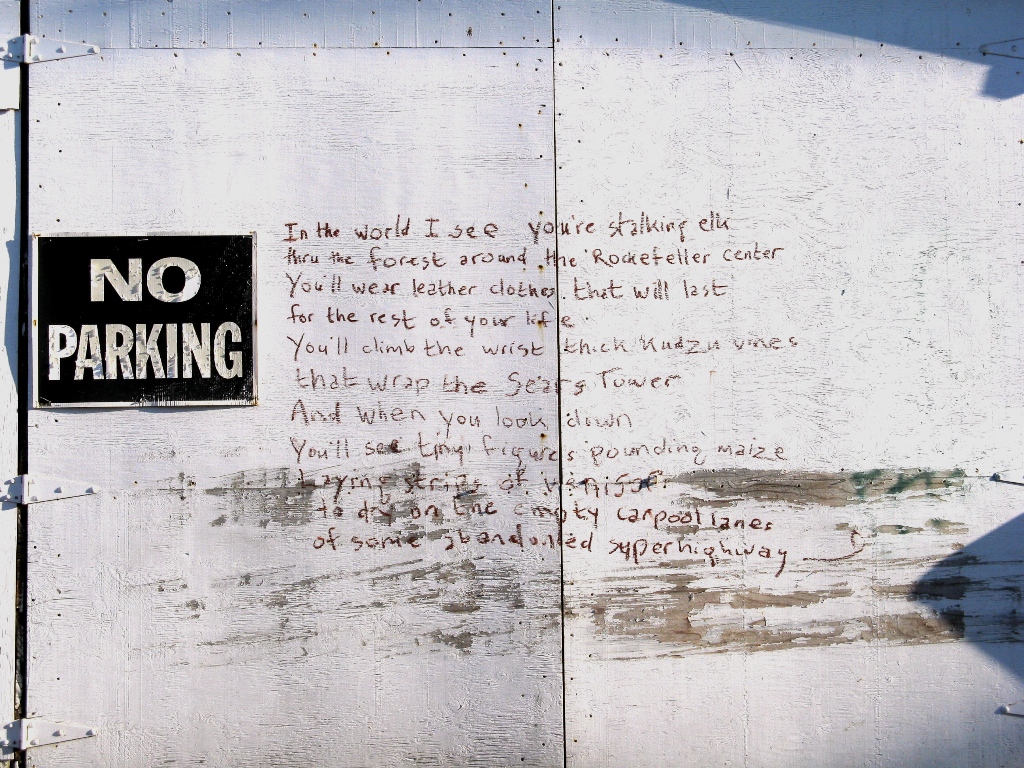
Stalking elk

Another offering of the mad poet without a blog:


In the world I see you're stalking elk
thru the forest around the Rockefeller Center
You'll wear leather clothes that will last
for the rest of your life.
You'll climb the wrist thick kudzu vines
that wrap the Sears tower
And when you look down
You'll see tiny figures pounding maize
Laying strips of venison
to dry on the empty carpool lanes
of some abandoned superhighway
Anonymous. Seen in an alley in Strathcona.
.

Saturday, February 16, 2008

Links; Birds, Water, and Contempt of Coot.

... plus a few extras.

February 15th, the first day of the Great Backyard Bird Count, turned out to be cold and rainy, so we stayed home and did our observation through the windows. Still, Laurie counted over 60 pigeons at dawn, and in the afternoon, a varied thrush, braver than he usually is, foraged in plain view at the edge of the lawn for a good 10 minutes. So we had something to submit. Tomorrow will be better.

The GBBC website has the 2008 Photo Gallery already loaded up with current submissions. One birder caught a Cooper's Hawk in an unusual pose; go look.

And on to bird blog posts:

Hugh, at Rock, Paper, Lizard, writes about The Stately American Coot, including a description and photo of "The ultimate act of coot contempt."

More not-so-polite bird antics: Julie Zickefoose tells us of The Rising of geese, and "a patter of warm goose poop."

Well, since I'm on the subject, I may as well link you to this;

from Sagehen News, a Local Mystery Solved

and this, from Hugh, again; A late winter walk to a beaver pond, with rodent droppings .

Enough? Change the subject? Ok, Snail's Tales has a series of great photos of slugs; Limax maximus mating .

Life is messy, and sometimes ewww-making. But consider the alternative; GrrlScientist reports on the findings of research scientists from OSU studying Oceanic Dead Zones off the Oregon coast.
"Thousands and thousands of dead crab and molts were littering the ocean floor, many sea stars were dead, and the fish have either left the area or have died and been washed away."
The killer? Oxygen depletion. And the cause; global warming.
"We seem to have crossed a tipping point," Lubchenco observed. "Low-oxygen zones off the Northwest coast appear to be the new normal."


Dead crabs, washed ashore.
From
Living the Scientific Life. Photo from birdologist.

And one more photo, from Water World.


"Don't let this be our future."

'nuff said.

Thursday, December 20, 2007

Like tiny Christmas trees

For quite a few years, we lived across the Fraser River, in the Burnaby/New Westminster area. We formed the habit, first separately and then together, of going down the hill to the Burnaby Fraser Foreshore Park, and following the trail along the riverbank.

In those early days, the space between the river and the main road was taken up by old farms, "weed" trees, and swampy mixed bush. There was a small "improved" area at the foot of Byrne Road, with lawn grass and picnic benches; for the rest, the main attraction was the river itself, the old cottonwoods and their bird population, and for me (and the birds), the berries; salmonberry, blackberry, serviceberry, and the occasional thimbleberry.

As for birds, the sparrows and chickadees kept up a constant chatter all year round. Robins patrolled the lawns, seagulls, geese and mallards the river. We watched goldfinches, great blue herons, buffleheads, the occasional woodpecker, once a kingfisher. On the other side, a pair of eagles had a nest, easily visible from our vantage point.

That was then. This is now.


Earth-moving machinery moved in in the last years of the old millennium. The farms were eradicated, the bush scraped away, the creeks filled with gravel and sand. The whole strip along the shore, for miles, is now industrial park.

But our benevolent government did try to soften the blow to the environment; in their bumbling bureacratic way, they widened and gravelled the trails, built cement and metal viewpoints, added signs, telling us about the "habitat" they were creating. To do this, they stripped the soil and bush from another segment of the remaining green belt, and built ponds and waterways to contain and control the creeks.

And the industries moved in across the widened road.

I remember being there one winter around the time we moved to Delta. A large pond, its edges bare mud sloped down from the road to the water's edge, and adorned by a sign proclaiming the "reclamation" effort, and those ratty orange webs they use instead of fences, was showing a bit of greenery at one end; a few reeds in orderly lines, obviously planted. A half-dozen buffleheads were diving there for something; there was hope for the future.

We don't get over there now as often as we did, but there is progress. The grass has grown; the ponds softened with a mix of vegetation. Dragonflies dance over the top. In one, we occasionally see frogs, or heron stalking them.

This spring, the frog pond had been colonized by a plant I hadn't seen before. Attractive enough; like an oversized moss growing underwater, leafing out just above the surface. Very pretty. We photographed it.

I was disappointed not to see any frogs or herons, this time. No dragonflies, either. Just the green, quiet pond.


Two days ago, on the UBC site, Botany Photo of the Day, I found this new plant. Myriophyllum aquaticum, a.k.a. Parrot feather, or Brazilian water-milfoil. And yes, it is beautiful; a commenter loves it because it looks like Christmas trees. But it is deadly.


Daniel Mosquin, of PotD, writes,
Attractive as it is, it can form a thick layer at the water surface, blocking light from penetrating deeper into the water body. Subsequent population declines in microscopic algae lead to an eventual withering of invertebrate and fish populations.
Not good news. I asked about this, wanting to confirm the ID, and Daniel wrote on to the invasive plants forum. (See the comments on the PotD page.)

No good news there, either. It possibly (not likely, looking over my photos) could be another, similar species, Eurasian watermilfoil, also invasive.

And worse; both these plants are dreadfully difficult to eradicate. Dawnh writes, on the forum,
The bad news is that it is a really nasty aquatic invasive that spreads quickly and seriously alters the physical and chemical characteristics of lakes, ponds and streams. It shades out algae that serve as the basis of the aquatic food web. And it's prime habitat for mosquito larvae.
How did it get here? Easy. It usually does not propagate by seed; most plants here are female. But it's like the invasive blackberry; a small piece of the rhizome, dumped in the water, will take root and grow. Chopping it down won't get rid of it; all those little pieces spread out and become new plants.

People use these plants in home garden ponds, in aquaria, in decorative plantings. Once trashed, if they are not completely destroyed, they can enter the water system and spread, growing so enthusiastically that it can block drainage canals, and even has been known to cause flooding.

Dawnh continues:
It's also very difficult to control. Its deep rhizomes make mechanical methods a short-term bandaid at most. Some herbicides do work to control (but not eliminate), and can also affect native aquatic flora and fauna. And that control comes at a cost: In Washington, the Longview Diking District estimates that it spends $50,000 a year on parrot feather control in drainage ditches.

The hope is that an effective biocontrol will eventually be found for this species. In the meantime, we can all help prevent the spread of Myriophyllum aquaticum by ensuring that we don't dump our aquatic plants or aquarium plants into local water sources.
Locking the stable door.

There is a modicum of hope; scientists are experimenting on various biological controls. I can just hope that, when they find one, that it doesn't turn out to be as detrimental to our local fauna and flora as this beautiful invader.

Tuesday, November 27, 2007

Follow-up on kelp crawlers

A local naturalist, in the comments to my previous post, suggested that the creatures we photographed may have been tunicates, possibly Ciona. Thanks, Hugh.


I have spent most of the evening looking at photos of tunicates of this area, and reading what I could find on their locations. Hugh could be right; Ciona looks possible.

There are five invasive species of tunicate in the area, Ciona savigny, Styela clava, Didemnum sp., Botrylloides violaceus, and Botryllus schlosseri; of these, only Ciona looks like it may match. The colour is right, the shape is almost right, and some of the groupings show circles that may be siphon mouths.

Two similar native species, Corella inflata and Corella willmeriana, are smaller and rounder. They don't match mine. Besides, Corella inflata dies within a few days if exposed to sunlight.

Many tunicates eat anenomes, but Ciona savigny is a filter feeder, eating bits of waste. There are obviously no anenomes on this kelp.

Most of the tunicates live at greater depths, out of the sunlight, but a few are found under docks and floats. Most of them, including Ciona, fasten to firmer ground, though; pilings, rocks, even mussels. These were on kelp.

A couple of the things look definitely like Melibe leonina, which is transparent and usually found on eelgrass. I found one mention of it on kelp.

Several of the other shapes could be Melibe, as well, either singly or in groups. Do Melibe hang out together in flocks? Or could this be a mixed bag, Melibe and Ciona? Do they mix?

And should I report these as invasive species? And to whom? The address I have is for across the border.

Every question leads to a list of questions, doesn't it?

Wednesday, October 24, 2007

Rocky shore, with loons

... Following along in our attempted peregrination around the Lower Mainland shoreline ...

A week ago, before the bad weather hit us, we went looking for the "1000 steps" that Cicero had told me about. Starting at the Ocean Park mall, we explored the streets to the west and south. Most end in a few blocks at big houses built right on the bluff, occasionally at wild bush hiding muddy cliff faces, unclimbable except on all fours.

But at the end of 15A Avenue, there it was; a place that looked like a parking area, with prominent No Parking signs, a trail head, and a notice; "1001 STEPS". We found parking a block up the hill, and walked back.


It was a steep climb, but didn't live up to their advertising; there were only 236 steps in all. Enough, though.


(The lighting was strange; bright, dazzling sunlight, shining straight in and reflected off the water, but deep shade under the brow of the hill. My camera couldn't handle it very well, and Laurie's seems a little off. Even my old eyes protested.)

On the slope, the trees, a mixed bag, respond to the lop-sided exposure by twisting and angling themselves into the light and out of the wind.


Almost at the bottom. Below us, just the railroad track, a short scramble over tumbled rocks, and the shore. Not a beach.


Difficult walking. But quiet, so very quiet. Just the rustling of falling leaves, and the lapping of a retreating tide.

There were only two other people on this segment of coast, a man and a small boy. They walked ahead of us, almost to Kwomais Point (marked by a heron silhouetted against the water), then crossed the track into the bush.


After they had gone, we moved away from water's edge, and tried to work our way up to the heron and a bit beyond, to be able to get a clear photograph. He sat, unmoving, until we were almost there, then squawked once and left. Oh, well.


Laurie, at the Point, wishing for a heron.

As for other live things, this shore bears a different mix than the sandy areas to the north, and around the Point into the White Rock beach. The rocks were bare, well-scrubbed. There were few crabs, no dead crab shells, no sign of seagull feeding. A few white clamshells, sun-bleached. Barnacles, small ones, at the water line. No mussels. And none of those invasive batillaria mud snails. (Yay!) The few snails among the barnacles were smooth and dark, fatter and shorter than the batillaria.


At the high tide line, dead kelp wound itself around the bigger rocks. I don't remember seeing eelgrass, and there was no sea lettuce, which shows up on every other stretch of beach in the area. But in the cracks between some of the bigger rocks at the water's edge, I found a few small clumps of these, that I had never seen before.


Deep purple seaweed. Growing only in the deep shade in cracks between the rocks. I had to put the camera right into the crack and rely on the flash to show it up; to my sun-dazed eyes, this looked almost black. When the flash was too close, edges of the weed flared orange.

Back over the rocks, we climbed to the railroad track, under a fence, and through a bit of bush, making a shortcut to the steps. Up, all 236 of them, up the hill to the car -- my legs were aching -- and back to the mall for a bite at the deli. Where the proprietess told us of another set of steps, a shorter one, that would take us to the south side of the Point.

More on how we tried to find them yesterday, in the next post.

Oh, and the loons? Here they are, doing what loons do; diving as soon as you get anywhere near, coming up 'way over in the distance.

Powered By Blogger