Showing posts with label Eastern Mud Snail. Show all posts

Saturday, April 25, 2015

Why is it

... that when the tide goes out, all the sensible little beasties head for deeper water, or bury themselves in the sand, or hide under stones and logs; anything to keep from drying out. Except the Asian mud snails; they look for places to sunbathe, high and dry.

On stones,

On logs.

Note the tidepool in front of the log; very few snails remain there, and they're scrambling for the edge. Behind the log, on higher ground, the snails are so thick that in places they hide the stones.

They do the same thing in my aquarium; they spend at least half their time clinging to the walls above the water level, and sometimes leave the tank and go for walkies on the counter. Sometimes I find one behind the tank, dry as dust, completely sealed in, looking dead. I drop him back in the water, and he wakes up - and heads for the top again.

They don't eat out of the water; just sleep.

Why?

Wednesday, December 10, 2014

Texture and pattern in the mud

The mud-coloured, mud-loving, mud-slow Asian mud snails everywhere underfoot on our beaches are usually ignored. Frankly, they're boring; billions of half-inch cones, half buried, doing nothing while the tide's out, and not much when it's in.

Occasionally, to reset my sense of wonder, I need to get down nose to nose with one or two.

Two mud snails; the foot of one, the nose of the other.

Two feet and the underside of a chin.

The third shell, on the right, is an empty, of a species not often seen here any more. The mud snails have taken over.

Saturday, September 27, 2014

Experimental aquarium photos

Taking photos of tank residents, I'm usually restricted to the first half inch or so on the other side of the glass. Beyond that, seaweed and swimmers, bubbles and shadows all get in the way. And there are already the scratches and algae on the glass itself to contend with. The photos are blurry, noisy, and dark, mostly unusable.

But the other day, I jammed the lens right up against the glass, ignored the obstructions, and aimed deep into the water. Here are the results, with just cropping and light level adjustment; I reduced the noise minimally, or not at all on some, in order to keep more of the detail.

The hermits love to climb into the anemone's mouth. They clean out detritus, and sometimes argue with her over a juicy shrimp. She doesn't seem to mind most of the time. This is one of the larger Hairy hermits, all pinkish from eating Violet Tunicates.

A smaller, blue hermit in a shell I brought from the pet store. There's a second hermit just behind a thin blade of red seaweed.

In the shadow of the eelgrass and sea lettuce.

A better view of Val's (the anemone's) side wall. I did smooth out most of the noise here, so distant detail is lost.

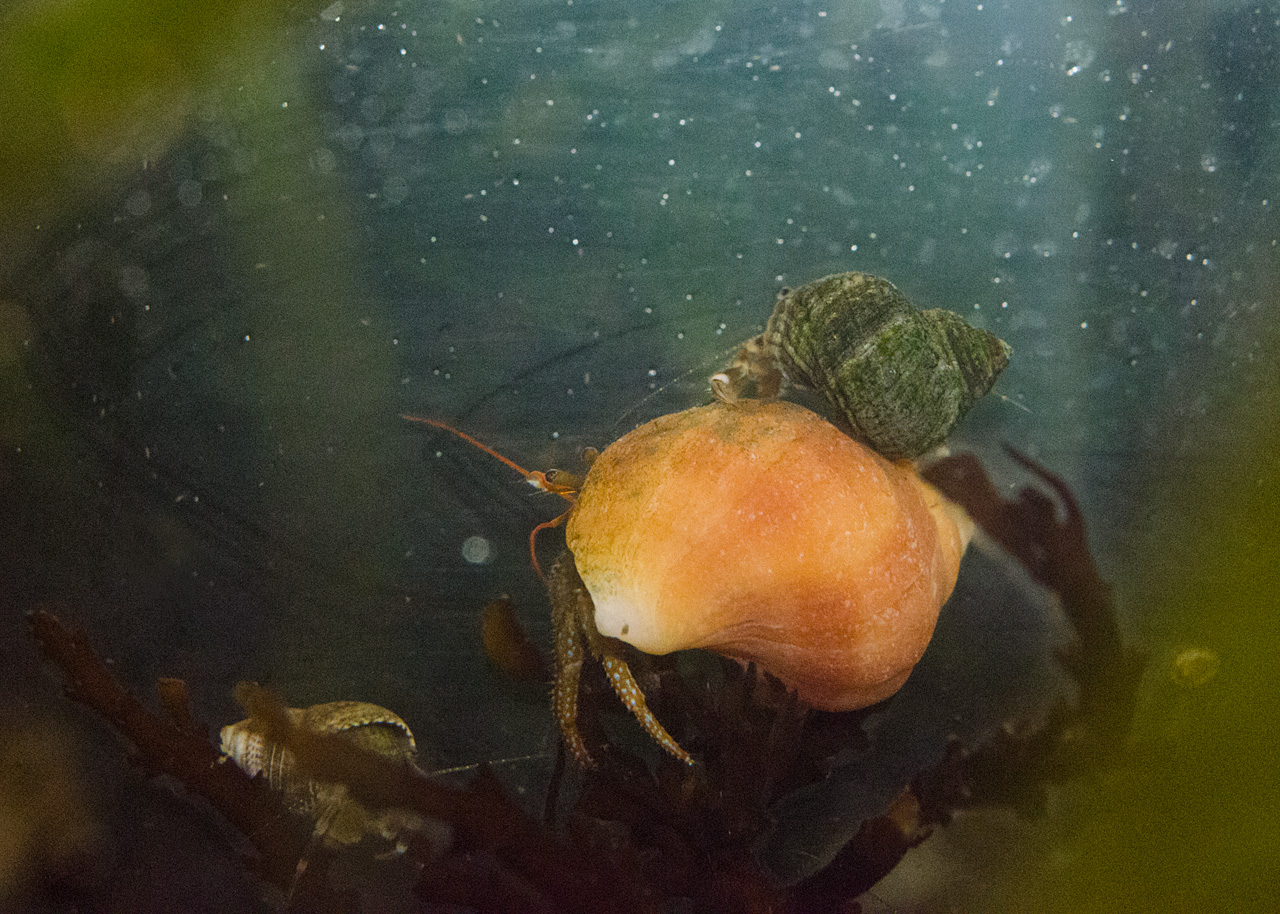
Farther back, two hermits on a dark brown, stumpy seaweed. The one in the orange whelk shell is a Grainy Hand hermit. No noise correction, no spot removal.

25 minutes later, a smaller Hairy hermit has climbed on top, for a better view.

A bit closer, on the side wall. An Asian mud snail and his reflection.

(I'm recovering from surgery, working slowly, as I can. All is well.)

Monday, December 09, 2013

I blinked first

A major part of the cleanup crew in my aquarium is made up of mudflat snails, Batillaria attramentaria, those invasive snails that crunch under our feet on the beaches of Boundary Bay. They probably would be invasive here, too, were it not that the big burrowing anemone eats all she can catch.

Most of them spend their time under the sand; when they venture out, usually to climb the walls scrubbing off the algae, all that can be seen of them are the shells and a hint of dark flesh at the lip. Rarely, one decides to look me in the eye (or camera lens). One of those curious ones was cleaning off a shell right beside the wall the other day.

Striped face, striped tentacles. And a staring eye.

These eyes can see some shapes, but they don't have a focussing lens, so things are blurred. And it seems that they don't see colours. Still, they can detect light and dark, day and night. For the rest, they don't have to chase the algae, nor could they dodge predators if they saw them; the eyes are good enough.

And they don't blink.

The three curves in the shade under the body almost look like crawly-type feet, but that effect is either from the pattern or the folding of the one fleshy foot.

Full-face view. The eyes are at the base of the tentacles, and bulge outward. The one on the right is barely visible from here.

A couple of years ago, another snail consented to be photographed. I blogged about it here.

Big foot, patterned in green and grey, folded.

And doesn't this critter, if you ignore the shell, look like a cuttlefish? Well, except that the cuttlefish eyes are on the forehead. And the nose is really a mass of tentacles. And it changes colour. And ... Well, you'll see what I mean if you look at this Common cuttle, from the Monterrey Bay Aquarium. (It's copyrighted, so I can only provide you with the link.)


Wednesday, March 06, 2013

Name this long-nosed beast!

Still learning how to manage the macro lens:

A mud snail, cleaning the glass wall.

Looking over the foot to see what that flashing light is.

That face! It looks, at this angle, as if it belongs to some large ungulate. A camel, maybe? Or a camel/zebra cross?

Friday, June 29, 2012

I promised you snail orgies.

We found the tide almost at its minimum at Crescent Beach, and I waded out through inch-deep tidepools, trying to get to the drop-off before the water rose again.
Looking back at the shore from half-way out.

The eelgrass comes in patches in this section of the beach. The sand was mostly bare, but where there was eelgrass, there were snails.

The invasive Eastern mud snails, Ilyanassa obsoleta, in eelgrass.

This snail has just about driven out our other invasive, the mudflat snail, Batillaria attramentaria, that we see in the millions on the opposite side of the bay, at Centennial Beach. I saw a couple or three only among these herds of mud snails.

"Hurry, hurry! You're late to the party!"


The snails were in full mating frenzy, piled several deep, hundreds of them to a pile, writhing and rolling, a mass of squirming black bodies and grungy shells. Every so often one flipped completely upside down, stretching out to show her white underside, waving her siphon excitedly. What with all the gunk on their shells, the stirred-up sand, and the curtain of eelgrass, it becomes difficult to distinguish individual snails.

And along with the fun, comes the work. Once they have mated, the females find a hard surface and start to lay eggs. Here, the surface is usually an eelgrass blade, where they line up the eggs in rows.

Eelgrass with snail egg "beads". And snails three-deep beneath them.

Each transparent egg capsule contains from 30 to 300 yellowish eggs. They are firmly glued to the eelgrass, and feel like a cold, hard lump of jelly.

A closer view of some eggs. The furry stuff is probably a colony of hydroids.

Close-up of some capsules I brought home in 2008, showing the individual eggs.

A couple of snail heaps were not interested in sex. No writhing, no sand-stirring, no coupling, no egg-laying; they had something else on their minds. In both cases, the molted remains of a crab lay on the sand, with a tidy mass of snails around and under it. They're algae eaters, but they also love a scavenged meal of animal flesh.

A little after-orgy snack?

Monday, July 04, 2011

An end and a beginning

Here's an update on the aquarium situation:

The three remaining hermits have died. I replaced about half the water, again, this time with an emergency mix (bottled water and sea salt), and then Sunday afternoon, with freshly collected water from Boundary Bay. The shrimps and crabs seem almost back to normal, and the anemones are tentatively opening up again.

I am grateful for the concern people have shown, and for your understanding of the analogy I presented. The life and death of a few miniature hermit crabs and amphipods seems such a small thing, almost not worth wasting time on, much less grieving over (as I have done), but it's like a trickle of sand down a steep mountainside warning us: watch out for landslides! Stop digging at the bottom!

I have been wondering what to do now. I have an almost empty aquarium. I could return the snails to their beach, with no difficulty. But I feel that I have a responsibility to my maimed crab and brain-damaged shrimps. They would not survive the challenges of the wild for very long. So I must keep the aquarium going.

On the other hand, I don't dare import more critters until the construction next door is finished. I've been thinking, though, that I've been so entertained by the more active residents that I've almost completely ignored the plodding workhorses, the snails that aerate the sand and clean the algae off the glass. Maybe this is an opportunity to learn something more about them. So for starters, meet Sir Molasses.

What's not to love about that face*?

* Well, not exactly a face; the "eyes" you see and the "whiskers" are mouth and neck features. We're looking into his mouth. I've started on a video; watching a snail eat turns out to be surprising.

Tuesday, June 28, 2011

Look me straight in the eye and say that!

The Asian mudflat snail is an invasive pest. A million or so of them make a beach crunchy; they wipe out native snails and discourage birds. It's easy to learn to grumble at them, easy to miss their beauty. To appreciate that, you have to get down, eye to eye with them, one at a time.

Mudflat snail, in a matching coat and shell, with barnacle scar cap.

Shimmering grey-green and black coat, an observant eye.

Of course, it helps if they're in a clean tank, out of all that mud.

Tuesday, June 07, 2011

How not to be supper

Crabs will eat anything, fresh or old, plant or animal. One of their favourite treats, though, is fresh snail meat, so fresh it's still squirming. My shore crabs spend a good part of their time trying to break through snail shells, not always as successfully as they'd like.

Big male, showing off his snail cracking tool.

Asian mud snails, up on the glass where the crabs can't get them.

These two snails are survivors, and bear their scars proudly. The lower one has had the worst of it; extensive damage near the lip, where the crabs prefer to start work, and a large patch taken out of the upper spiral. Lucky for her that their shells are so thick. Or rather, it's an arms race; if your enemies have humongous shell-cracking pincers, you'd better wear heavy armour and keep it repaired. Climbing walls helps, too.

The snail on the right has patched the big gap in her shell; only the scars remain.

Lips, patched and freshly broken.

The snails won this round.

Wednesday, January 26, 2011

Snail and hermit mystery

I can never keep enough small snails in the aquarium. The crabs eat them; so do the big trophon snails. I'm always bringing home a few more, and always finding only one or two actually doing their work of keeping the walls and floor clean. The rest are reduced to empty shells lying on the sand, or new outfits for the hermits.

So when we went to Boundary Bay a few days ago, I planned to pick up a good handful of snails. The mud flats around Centennial Beach are loaded with them, starting a few steps below the high tide line. They're mostly the mud-flat snail, Batillaria attramentaria, spread so thickly that at every step I can hear the "crunch!" of a few more.

But this time, for variety, we went to the south end of Beach Grove and walked down to the US border. The tide was coming in, but there was still some flat sand. But no snails. Not one. There were clams in abundance, lying in groups on the sand at the edge of rocky patches. There were worm casts and worm tubes sticking up out of the sand. No crabs, no hermits, no snails.

Just a few metres north of the border, we passed two rotting logs buried deep in the sand. Here there were barnacles and crevasses packed with mussels and mudsnail shells.

Hollowed logs make great hideouts.

Deep in a crack.
I started collecting snails. Each one I picked up, I inspected; I didn't want any more hermit crabs. The aquarium held 11 at that point, more than enough for a small tank.

And each snail, as I turned it over to look for the glossy operculum, waved hermit pincers at me. I put them back on the log, and checked another. And another, and another ... They were all hermits. All around the first log, all around the second one, down the in the innards; hermits, hermits, hermits. Finally, I found 3 very small ones that seemed to have the right dark brown glossy lid on the opening; snails, at last. I dumped them in my bottle, with a few barnacles and mussels for the trophons to nibble on, and brought them home.

And once I'd left them a few minutes in a bowl, out crawled the hermits. Out of 3 "snails", I got 5 hermits. The last two were really tiny, and must have been hitchikers on the barnacle clumps.

The more I think about this, the stranger it seems. There were no snails to be seen in the vicinity of these stumps. And all the snail shells there housed hermits. Where did they get the shells? Why did I find no surviving snails?

Did the hermits invade a colony of snails and wipe out every single one for their shells? But hermits don't usually do that; they use empty shells, or take them away from other hermits. They ignore live snails.

So did something else, crabs maybe, kill the snails and leave them piled into the logs for the hermits? Where are the crabs, then? Why only on the logs?

Or did the hermits immigrate, shells and all, from far down the beach? Why? Why were there none scuttling across the sand, or under the nearby rocks?

Hermit, one of the 11. See how his shell is broken? That's how a crab gets at the tasty snail meat.

I wish hermits could talk. We'll have to take another walk down that way next time the tide is a bit lower, to look for the missing snail population.

And now I have 16 hermits in my tank. At least the newest residents are tiny.

(More about these snails - before the hermits get them - om Dave Ingram's Island Nature blog.)

Monday, January 03, 2011

Footprints

One advantage of keeping invertebrates in an aquarium is that you get to see them from a different angle; eye to eye, down at their level. In the case of snails and limpets, as they slide across the glass, you can see their underside, where they hide even their faces.

I've been comparing the different beasties that walk my aquarium walls.

Trophon snail, about an inch long.

These are the snails that eat my mussels, clams and barnacles, and would snack on hermits if they were allowed. As long as there are sufficient barnacles, they behave. Sometimes they sit on the glass for a day or two, digesting the latest meal. Then they head back to the sand and go hunting again. Usually, this is all I see of the underside: the foot, with a bit of speckled skin around the edge.

Trophon on the move.

I caught one travelling, finally. The foot elongates, but stays rounded. If you look closely, you can see the eyes about half-way up the tentacles. These predatory snails may have fairly good eyes, compared to those of the more sedentary types. Limpets, for example, have simple cup-shaped light-sensitive areas; as the cup gets deeper and closes in at the top, it becomes a pinhole eye (like the lens on a pinhole camera; good enough to get a recognizable photo); some marine snails have eyes like this.

Nassa snail.

The Nassas are slow-moving scavengers. They seem to be almost in constant motion, either wandering around on the seaweeds or the walls, or plowing through sand. This one is taking a brief rest.

Nassa, in transit.

When they move, the foot becomes pointed at the rear, and has two sharp "horns" at the front. The eyes are on the tentacles, near the base. The dark spot towards the rear is the shadow of the operculum, the lid that closes the shell when the snail hides.

Mud snail.

This is one of the invasive Japanese mud-flat snails. The foot is more rounded than the Nassa's, and the operculum is redder. The eye is barely visible at the base of the tentacle.

No snail. Anemone (1 1/4 inch across the base), and three limpets. The brown stain is where the anemone parked until last week.

The limpets are hard to see, even though they are usually sitting still. Mostly, they look like a blob of cream flesh underneath the peaked shell.

Moving limpet.

Here's one I caught eating. The mouth is pressed to the glass, scraping off invisible bits of green algae. If you look closely, you can see the two eyes at the base of the tentacles. These eyes are mere cups lined with light-sensitive cells; they show the direction of the light, and not much more. Not a problem; the algae doesn't need to be seen, and the limpet doesn't run from predators, but just seals itself down to the glass (or rock, or shell) so tightly that it can't be pried off. I have watched crabs trying; no use.

They do have one fearful enemy, I discovered:

Trophon capturing a limpet.

Because the trophon just bores through the shell, it doesn't matter if the limpet is glued down. I've been wondering why I keep finding empty limpet shells down on the sand. Now I know.

Anemone with a mind of its own.

This anemone has been a puzzlement from the start. He grew up with a couple of dozen relatives on the far side of the tank, at water level, but soon left home and moved to the front, alone. There, he wandered about, from one spot to another, and occasionally down to settle for a few days on a stone or a shell, but always returning to the centre of the front wall. Finally he decided on a spot and stayed. There he grew, and grew. He is now five or six times the size of his largest cousin, over there on the back wall; tall, fat, and sporting long, hungry tentacles.

A week ago, he moved an inch down, then half an inch up, leaving a brown stain where he'd been attached for so long. And tonight I found him three inches away, wedged in beside the water pump, so close he can't stand straight.

Meanwhile, his rejected family sits along the water line by the window, rarely moving, peacefully catching their small meals, and not growing. I can't figure it out.

Sunday, July 18, 2010

Beach party, and why to carry a towel

A flat, sandy beach may look the same in every direction, but when you explore it, you find that it is divided into many small habitats. (In the case of Crescent Beach, "small" is probably a misnomer.)

We varied our usual route this last visit to Crescent Beach; instead of aiming southwest from our parking spot, we walked down the railway and then angled north, towards the town and the river. And we found snails. Millions of snails, trillions. I think I must have crushed thousands under my feet, even though I was being careful.

The water was a few inches deep over most of the beach, and a fine eelgrass grew thickly everywhere. On top, the Eastern Mud Snail herd was grazing, like so many sheep:


Ilyanassa obsoleta on Dwarf eelgrass, Zostera japonica


The snail bed stretches all the way to the river, in the distance. Under the carpet of eelgrass is another layer of snails, waiting to be crunched underfoot.

I had seen a few of these snails on the south end of the beach, a minority among the Batillaria zonalis, the whelks, and the periwinkles. Here, a smattering of batillaria feeds with the mud snails; I saw no others.


Snail on the move

This is not a pretty snail. The shells are almost shapeless, worn and "distressed" until they look more like dirty stones than snail shells. They range in colour from a muddy white to a dingy black. Algae and slime cover most shells. (A web page for students, describing how to examine one of these, starts off with, "Scrub its surface clean with a toothbrush.")

The body itself is attractive; the upper side of the foot comes in various patterns of black and white. The one in the photo above is speckled; others have streaks or marbling. The sole of the foot is white, maybe fringed with black. At the head are two antennae, white or black or mottled, and a long siphon, which works as a nose, sniffing out the scents of food and other snails, and bringing oxygen-laden water to the gills. And to eat, the snail extends a proboscis containing the mouth, radula (scraper) and the esophagus.


White antennae, white proboscis, siphon with black trim, and two black eyes.

Ilyanassa obsoleta, the Eastern Mud Snail, is another invader; as the name says, he came from the East coast. He was first reported in San Francisco in 1907. By 1945, he'd moved up the coast to Washington, and in 1952 showed up on Crescent Beach. He's an omnivore, living mainly on microscopic diatoms and algae, but he doesn't turn up his siphon at a spot of dead fish or crab or a sea lettuce salad. He'll take live worms and eggs of other snails. He can handle varied levels of salt in the water, and temperatures from 10 to 22 degrees C. And he may live up to 40 years. Wide, flat, rich Crescent Beach suits him fine; he's taking over.


Crab moult, with two mud snails and a Batillaria.

We had waded in the ankle-deep water through the herd for almost an hour when we stumbled on a party:


Hurrying to join the crowd.


Come on in, there's plenty of room!

We watched for a while. It was hard to follow individual snails; they twisted and writhed in a sort of rythmless dance, often in pairs, sometimes in clutches of three or more. Feet extended, grabbed the next snail and swung it around, dropped it to cling to the next. Siphons waved madly.

A mating dance, an orgy.


A mating pair, foot to foot.

It's not the first snail orgy on this beach; the eelgrass, everywhere, was spotted with snail eggs:


Each packet contains a dozen or so eggs.

There's a downside to all this happy activity; the mud snail sometimes harbours a flatworm that causes swimmer's itch in humans.

The cycle goes from eggs that hatch in seawater, into a free swimming stage which invades mud snails, either through the mouth or skin. Inside, it turns into a reproductive organ, a sporocyst, and settles down to produce more sporocysts. These, then, produce a swimming form, the cercaria, which burrows through the snail and out into the water, where it goes looking for a bird (on Crescent Beach, probably a seagull). More burrowing; through the gull's skin, into the bloodstream, and close to the intestines. There they transmogrify once more, becoming a breeding adult. They mate, the females release the eggs into the intestine, and off they go to sea again.

The problem for humans is that sometimes the cercaria finds one of us instead of a bird. It settles on our skin until it dries out, then flees the dryness into the shelter of skin, leaving a tiny pinprick to show where it entered. Mistake; we are no home for them; they die without reaching the bloodstream. But we become sensitized after the first invasion, and react with a raised, itchy spot (photos), which fades in about a week. Sometimes the itching is minor, no worse than a mosquito bite, but a large infestation can become very uncomfortable.

There is a sign at our entrance to Crescent Beach, warning of this. Prevention is simple; the cercaria don't burrow into the skin while it is wet, just as it dries. So we rinse our feet and hands with clean water, and dry them well with a towel, which removes the cercaria and kills them.

Not everyone who wades or swims is attacked, of course. Hundreds of people come to the beach on summer weekends. A study done in 2004 (Leighton et al.) turned up 44 cases in 2002, a few the year before, none before that. All the infestations were in August of both years; whether because of the warmth or the number of kids in the shallow water is uncertain. What is clear is that, if sensible precautions are taken, swimmer's itch should not be a worry for beach lovers. Just take to heart Douglas Adams' advice; always carry a towel!
"A towel, it* says, is about the most massively useful thing an interstellar hitchhiker can have. Partly it has great practical value - you can wrap it around you for warmth as you bound across the cold moons of Jaglan Beta; you can lie on it on the brilliant marble-sanded beaches of Santraginus V, inhaling the heady sea vapours; you can sleep under it beneath the stars which shine so redly on the desert world of Kakrafoon; use it to sail a mini raft down the slow heavy river Moth; wet it for use in hand-to- hand-combat; wrap it round your head to ward off noxious fumes or to avoid the gaze of the Ravenous Bugblatter Beast of Traal (a mindboggingly stupid animal, it assumes that if you can't see it, it can't see you - daft as a bush, but very ravenous); you can wave your towel in emergencies as a distress signal, and of course dry yourself off with it if it still seems to be clean enough."
*The Hitchhiker's Guide to the Galaxy
Powered By Blogger