Showing posts with label barnacle-eating nudibranch. Show all posts

Friday, March 24, 2017

Barnacles and barnacle eaters

Tyee Spit serves as a breakwater between the mouth of the Campbell River and Discovery Passage, the main sea route between Vancouver Island and the mainland. Its shores, on the saltwater side, are mostly clean pebbles, scrubbed by the fast currents racing down the narrow channel; a few miles north, at Seymour Narrows, the currents reach up to 15 knots; here at the Spit, they run around 10 knots.

Sometimes, flipping stones on that shore, I find a crab or two, sometimes a limpet. But mostly, there are just more stones.

I happened to be passing a few days ago when the tide was unusually low, and saw that the lowest level of stones were rough, barnacled. I hurried down to look.

Here's one stone, and its community.

Swarming with life. Left to right; barnacle-eating nudibranchs, hermit crabs in periwinkle shells, maybe some snails in their own shells, barnacles, egg mass, Wosnesenski's isopods, "grape" seaweed.

Zooming in on the busy end. There are a couple more nudibranchs here, too. Click to see the individual eggs in the egg mass.

Look again at those barnacles above. The small, grey ones have an oval opening, and in the large, mostly dead ones (in this photo), the opening is approximately diamond shaped.

Acorn barnacles, Balanus glandula, and Little brown barnacles, Chthamalus dalli.

The grey barnacles (Little brown) is the smallest of our acorns. They are often found on rocks at the very top of the intertidal zone, where they may only be underwater and able to feed half of the time.

The larger, lighter, almost yellowish barnacles are the ones I see most often on the beach. Look closely; the plates enclosing the mouth lock together in a wavy pattern, somewhat like a W. (Or an M, if it's facing the other way.)

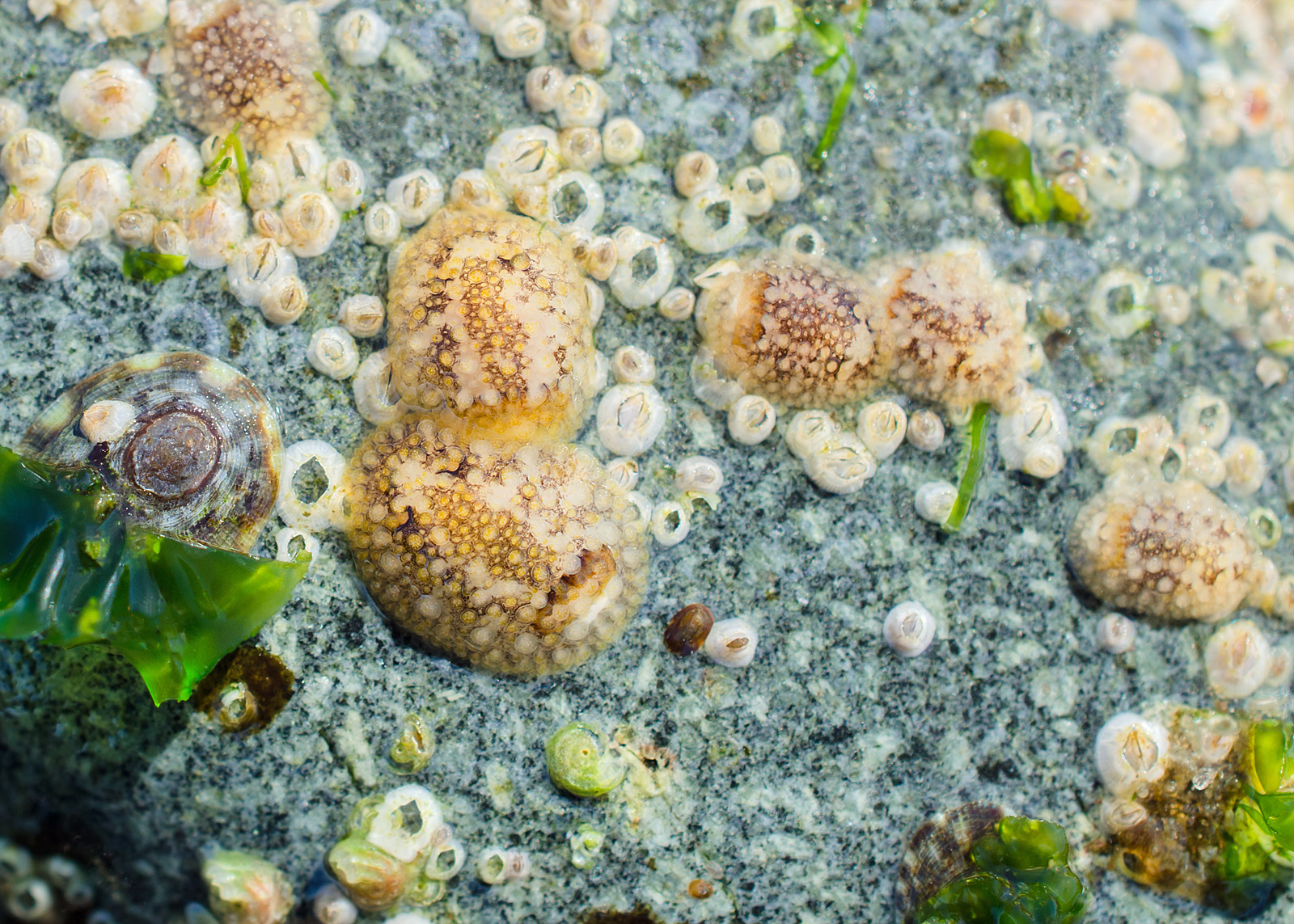
And here's one of the nudibranchs, Onchidoris bilamellata.

These tiny nudis (about as long as my fingertip is wide) eat the barnacles, drilling through the shell like a snail does. Underwater, they extend their two antennae and the feathery gills at the rear. Here, waiting for the tide to return, they are hunkered down, so that it's hard to tell which is the front end. (I think it's towards the right on this one.)

More low tide photos tomorrow.


Tuesday, May 17, 2016

Noble lemon, shaggy mouse, and little Doris

Those are all nudibranchs. Aka sea slugs. And one, the noble lemon nudibranch, was definitely sluggish when I woke her up from her afternoon nap.

Peltodoris nobilis, the noble sea lemon.

When I turned over her stone, she was just a circular yellowish blob, not moving, almost looking like a mass of eggs. I took photos of the sea cucumbers I found under her stone, and looked at crabs, then went to replace the stone. But now, she was awake, and stretching out, s l o w l y, s l o w l y.

Now I could see a bump on one end (on the right, above); one of her two sensory organs, the rhinopores, still retracted.  I waited, took photos, measured her (2 inches, still half hunched up), waited some more. Finally, the circle of gills at the back started to expand, millimetre by millimetre. I took pity on her, then, there exposed in the sunlight and air, and carefully flipped the stone back onto the wet sand. She probably went right back to sleep.

She feeds on several species of sponges, when she's awake. No rush; they're not going anywhere.

On the underside of another stone just below the mid-intertidal zone, a group of small barnacle-eating dorids were sitting around the table.

Onchidoris bilamellata, with barnacles, some already eaten. The tiny nudibranchs drill through their shell to get at the meat.

Zooming in. I don't see the two rhinopores at the front end. At the rear (lower right on the bottom nudi here), are the feathery gills. 

And I found a shaggy mouse laying eggs.

Shaggy mouse, aka shag rug nudibranch, sea-mouse, Aeolida papillosa. With eggs. Front end, lower right.

The shaggy mouse eats anemones, mostly the stinging tentacles. She doesn't get stung, but saves the stinging cells and moves them to her shaggy cerata to serve as a defense. A slow, soft-bodied, sluggish creature needs that extra bit of protection in a world full of hungry crabs and fish.


Powered By Blogger