Showing posts with label jellyfish. Show all posts

Wednesday, July 31, 2024

Lazy afternoon

 At the Brown's Bay marina, someone was gutting fish, and the harbour seals were hanging around, waiting for their share of the goodies.

Lazy afternoon. Why go fishing, when you've got humans to do it for you?

Harbour seals have no ear flaps, and the ear canal is visible behind the eye.

She is smaller than the first one, and fatter. I assume she's female; the males are larger.

This seal was resting for a while on the sea floor after the fisherfolk had finished and left; she seemed to be sleeping, but came up to look at us, then sunk to the bottom again. A harbour seal can stay underwater for up to 40 minutes.

Slightly less lazy than the seals, a number of jellies floated with the current, pulsating gently as they went, catching plankton in their stinging tentacles. 

Water jelly, aka many-ribbed medusa, Aequorea sp.

Moon jelly, Aurelia labiata. Notice the scalloped edge, and the many short tentacles.

A school of tiny fish was more active, circling and circling, sometimes breaking the surface of the water, leaving little circles of wavelets.

Herrings. Juveniles this size are known as fingerlings.

~~~~~~~~~~~~~
En el muelle de Brown's Bay, unos pescadores estaban limpiando su captura del dia, y un grupo de focas moteadas daban vueltas, esperando su parte de la bonanza.
  1. Una tarde tranquila. ¿Porqué ir a cazar cuando cuentas con humanos que comparten su pesca?
  2. Las focas moteadas no tienen orejas, y se ven los canales auriculares grandes.
  3. Esta foca es más chica que la primera, y creo que es hembra; los machos son más grandes. Descansaba en el fondo del agua después de que los pescadores habían terminado su tarea y se habían ido. Parecía que estaba durmiendo, pero subió a mirarnos por un momento; luego se volvió a sumergir. Las focas moteadas pueden quedar sumergidas por hasta 40 minutos.
  4. No tan flojas como las focas; unas medusas flotaban en la corriente, palpitando levemente, atrapando plancton con sus tentáculos. Esta es una de las "medusas de agua", Aequorea spp.
  5. Una medusa "luna", Aurelia labiata. Se notan su borde ondulado y sus múltiples tentáculos finos.
  6. Más activos: un banco de pececitos dando vueltas. A veces rompen la superficie del agua, haciendo círculos de onditas. Estos son arenques juveniles, alevines.

Monday, August 24, 2020

Tailed jellies

 The last of the under-the-wharf pics:

Part sun, part deep shade. Another plumose anemone, a bunch of algae and hydroids, more tunicates, and floating jellies.

These jellies were tiny; an inch across or so. Most of the jellyfish I see around the wharfs are larger, mostly moon jellies, Aurelia labiata, or water jellies, Aequorea spp. Some of these may be water jellies; they're too small and too indistinct to be sure.

But others seem different: 

Three species of jellyfish?

One looks like a cross jellyfish, Mitrocoma cellularia; one could possibly be a red-eye medusa, Polyorchis penicillatus, and could those tailed jellies possibly be sea gooseberries?

There's always something new.

~~~~~~~~~~~~~~~

Estas son las últimas de las fotos de las criaturas debajo del muelle.

Hay otra de las anémonas emplumadas, muchas algas e hidroides, otro grupo de tunicados. Y medusas flotando en el agua, todas muy chiquitas.

Las medusas que comunmente veo por aquí son las medusas "luna", y las "de agua". Pero son más grandes; estas miden 1 o 2 centímetros, por mucho.

Unas parecen medusas "cruzadas", una puede ser la medusa con ojos rojos (y sí, he visto estos ojitos) y tal vez, posiblemente, quizás, las que tienen las dos colas largas pueden ser Pleurobrachia bachei, que no es una medusa, sino un ctenóforo.

Siempre hay algo nuevo.


Sunday, May 24, 2020

Underwater bouquet

Off the docks at Brown's Bay the other day, the wind was brisk and the water surface choppy, but in a few sheltered spots I could see the communities living on the underside of the floats.

Giant plumose anemone, Metridium farcimen.
The floats are blue plastic. And we're lookiing through the reflections of the structures overhead.

Anemones, seaweeds, worms, and jellies. Click to view full size.

And here's the same photo, annotated. The gunk may be sponges.  But I missed a limpet. Do you see it?

Kelp, anemones, mussels, limpets, and a glowing red worm. The greenish spikes are on sea urchins.

~~~~~~~~~~~~~~~~~~~~~~~~

En el muelle en Brown's Bay el otro dia, había viento haciendo olas, pero en algunos lugares se podía vislumbrar las comunidades que viven en la parte inferior de los flotadores. (Que son de un plástico azul.)

Primero: una anémona "emplumada gigante".

La segunda foto tiene toda una comunidad. En la siguiente, los habitantes tienen nombres. Hay anémonas, lombrices "plumero" (son rojos), otros lombrices en tubos, un par de medusas, varias especies de alga marina, y una masa que probablemente consiste en diátomos o si no, de esponjas. Y se me olvidó una lapa. ¿La ves?

En la última foto, aparte de todo lo anterior, hay un grupo de erizos de mar; son los que tienen las espinas verdes.


Thursday, April 30, 2020

So small

I found a few more tinies among my forgotten photos.

A jellyfish and bubbles in fine, hair-like sea lettuce. In my tank.

On a blade of kelp, a white dot turns out to be a small colony.

Zooming in. It looks like a patch of bryozoans.

A baby grainy hand hermit, in my hand. Going by the lines on my palm, he's about 7 mm. long.
~~~~~~~~~~~~~~~~~

Entre las fotos olvidadas, encontré estas criaturas miniaturas. Primero, una medusa entre algas marinas "Ulva', en hilos finos. Luego, en una hoja de kelp, vi un botoncito blanco, que visto de cerca resultó ser un grupo de briozoos, animales que se hacen una cajita donde viven y de donde extienden sus tentáculos para capturar su comida del agua. La última foto es un ermitaño "de mano granosa", en la palma de mi mano. Mide aproximadamente 7 mm. de largo.

Tuesday, June 20, 2017

Scrambled jelly

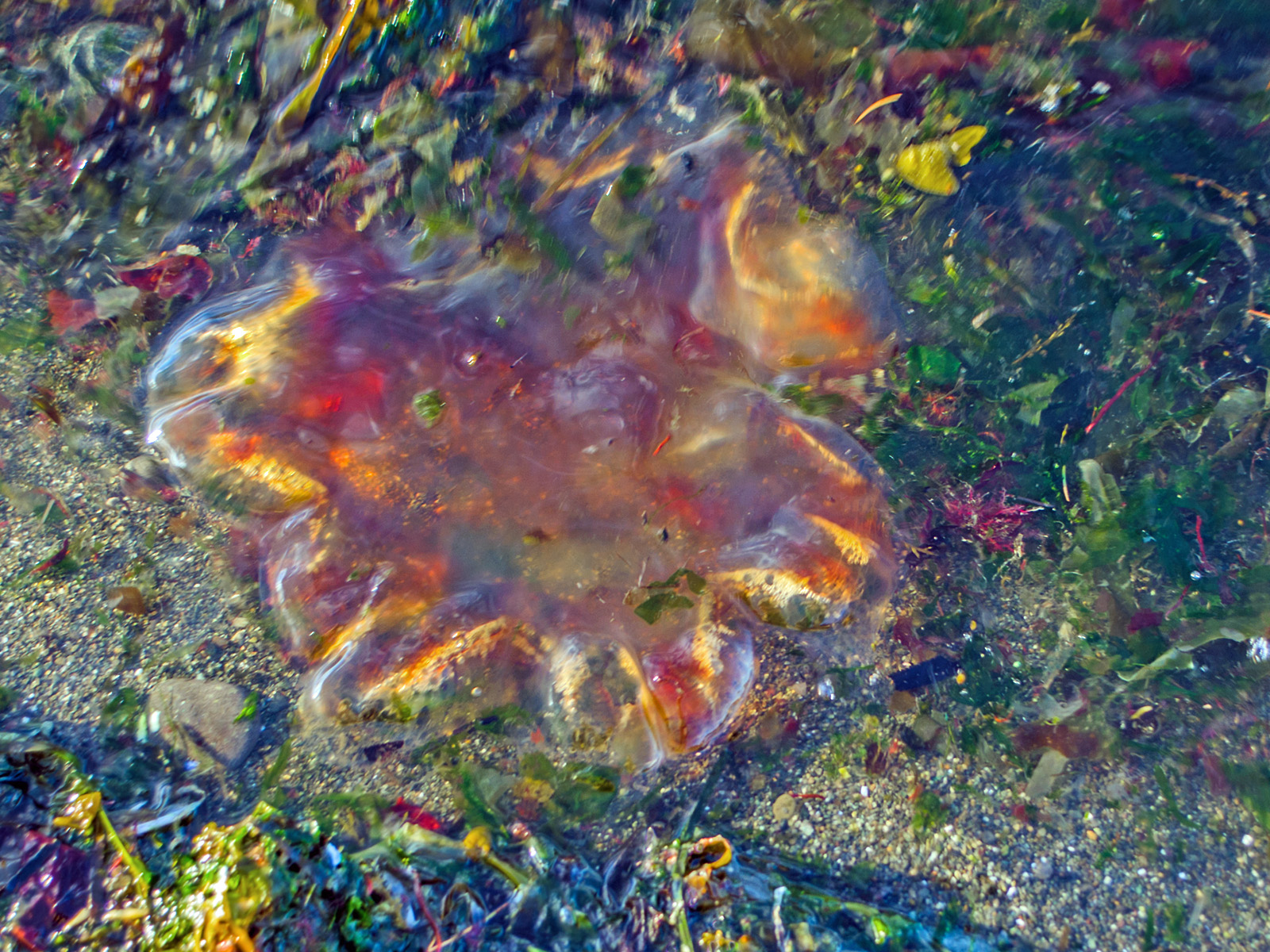
The lion's mane jellies are floating in with the tide this week. On the shore at Oyster Bay, I passed a dozen in as many minutes. This one was tumbling in a mass of seaweed fragments: eelgrass, sea lettuce, Turkish towel, sargassum, rockweed and kelp, all scrambled together: as the waves rolled in at dusk; not the best opportunity for a photo, but you never know.

I saturated the colours a bit, because of the fading light, and this turned out:

Looks like an abstract painting.

It's jelly season: I collected water for the aquarium tonight, and dozens of tiny cross jellies came with it. My anemones were eating them, last time I looked.

Sunday, November 22, 2015

Purple

Moon jelly, tossed up by the tide on Oyster Bay beach:

Aurelia labiata. The purple gonads identify this as a male.

The northernmost form, ranging from Puget Sound, Washington, to Prince William Sound, Alaska, have a pyramidal manubrium. .... The bells are peach or whitish, male gonads are dark purple, and female gonads pale brown. (From AnimalDiversity.org)

There were about a dozen of these on the beach, about 6 inches across. All of them had the four purple "horseshoes". They live only one year, but the females brood their young for a short while, so may be slightly longer-lived than the males. (Just a wild guess, trying to explain an all-male collection of a gregarious animal.)

Individuals of this species from cold waters can survive being frozen solid in ice. (From WallaWalla.edu)


Friday, April 11, 2014

Edible glass

Another forgotten photo: hydroids on eelgrass in my aquarium.

Tiny, glassy structures waving in the current. Some of the spots are bubbles, but at least a few are the new medusas just released by the hydroid parents.

Ephemeral beauty; the hermit crabs polish off the hydroids overnight, and the millimetre-wide jellies are swept into the pump and smushed into the black ooze.

The orange-brown tentacly circles are anemones on the aquarium wall.


Wednesday, March 05, 2014

Just another jelly

Looks good enough to eat!

Hydroid medusa, against sea lettuce.

Working late tonight, trying to get a decent photo of a surprising snail. Photos tomorrow, probably.

Wednesday, February 19, 2014

Learning the hard way

A hungry flatworm in my jelly and amphipod aquarium tank approaches a jelly resting on the wall:

"Mmmm . . . This looks tasty! And no hard shell to worry about!"

"Yikes! It's got stingers!"

And he backs off, in a hurry, somewhat rumpled around the edges.

He rested a few inches away the rest of the afternoon before he made another approach, with the same result. Then he hurried off to hunt something safer, even if it does have a hard shell; his boring, everyday diet of barnacles and mussels.


Tuesday, January 21, 2014

Cladonema pacificum; fuzz to jelly to fuzz

My granddaughters, 7 and 11, were peering into my aquarium as I tickled jellyfish to make them swim. "Where did you get them, Grandma?" the younger one asked.

A good place to start. With, "I don't know."

I can guess. They came from Boundary Bay, but they didn't enter my tank as jellyfish. They were probably the fuzz on sand grains, or old eelgrass blades, or maybe even hermit crab shells. The fuzz would have been about 1/2 mm high, barely enough to see. It could be the brownish stuff that coats the lower edge of the glass walls, where I don't clean as thoroughly as I do the rest of the tank.

The jellies' parents were hydroids. These ones make a creeping mat crowned by stalks, each with four tentacles. At the tip, they form into bulbs that swell into tiny medusas. When they are about 1 mm. long, they break free and swim away. (Photos, Bodegahead)

Freshly released medusa, Cladonema pacificum*

These new baby jellies have 9 canals marking the bell, a tiny hanging stomach, and 9 tentacles around the lip. Each tentacle is branched; one branch is tipped with an adhesive pad, the other holds stinging cells for capturing food.

An older jelly, in a plastic lid, showing adhesive tentacles. 4 per tentacle stem, now.

With these sticky feet, they grab onto any surface; walls, sand, eelgrass, and even the undersurface of the water. There they hang, waving the longer tentacles around, catching dinner, mainly copepods.

As the jellyfish grow, the tentacles lengthen and branch out. The older adhesive pads change, becoming chains of stinging cells.

Early development of stinging tentacles. Note the flower-like mouth at bottom left of central column.

They grow to about 3.5 mm high. I measured a large one of mine: 3 mm., not counting the tentacles, of course.

And they have more eyes than a spider, 9 in total**, although they probably only distinguish light and shadow. The jellies in my tank like to congregate near the light source in the afternoon, although earlier in the day they are usually hiding down on the sand or the eelgrass.

One red eye spot, or ocellus, at the base of each tentacle stem.

Inside view

The central column of the jellyfish contains its stomach, with the mouth at the bottom. When the jelly is feeding, copepods and other plankton are snared by the tentacles, which convulse suddenly, bringing the captive down to the lip of the jelly. The whole gastric column then swings around to eat.***

Since the jellyfish has no other opening, digested food is spit out through the mouth.  And rather quickly, too, because otherwise, it would weigh the jelly down, making it sink.

Backlit jellies. The rear one is stuck to the undersurface of the water.

In a mature jelly, the mouth hangs down (up, in this case) to just beyond the lip of the bell.

When it is full grown, the male will release sperm into the water. The female jelly develops eggs. Once they are fertilized, she releases them as planulae, flat plankton with cilia for swimming. Since these have no mouth or digestive system, they hurry to find a good spot to settle down, so they can develop into hydroids. And the cycle is complete.

*There is no common name for this genus.

**The red-eye medusa, otherwise very similar to this one, has hundreds of tentacles and over 100 eyes.

***Tomorrow, if YouTube cooperates, I will post a video of these jellies feeding.


Monday, January 20, 2014

Doing it the hard way

I was just about to post a series of photos of yesterday's jellyfish, when I double-checked the species description, and realized that my jellies were something entirely different. Oops!

Swimming baby jelly

So I've looked at dozens of sites and hundreds of photos until I found one to match, plus a whole bunch of info; this is one interesting critter!

And now it's too late; I'll have to post the series tomorrow, and the video on Wednesday.

I've corrected yesterday's post; the right jellyfish is Cladonema pacificum.


Friday, November 22, 2013

Red-eye special

My aquarium setup now includes two tanks. In one, the hermits and crabs, a big polychaete worm, four or five kinds of snails, the big (and still growing) anemone from Campbell River, and a varying assortment of temporary visitors all go about their business; eating, mating, climbing, watching me. There's a strong pump with a filter, and a bubbler; everything is constantly in motion.

The other tank is quieter. I don't stir it up; there's no filter, just a smaller bubbler. Here amphipods and copepods breed happily, without being swallowed by the filter. Here, too, the occasional miniature snail or hydroid appears, seemingly out of nothing. It's a good place for babies.

A couple of times, I've seen a transparent bubble with tentacles resting on the glass. Tiny things; I had to bring out the microscope to see the bubble part. A few days ago, I saw a larger one, and thought it might be big enough now to handle the active tank.

One of the first photos.

Here it is, from the bottom, parked on the glass, tentacles streaming in the current. The circle is about 3 mm. across. In the center (the "yolk" of the "egg") is the column, seen from the bottom. The tentacles sprout from nine radiating arms; they're beaded all along their length.

To the naked eye, the whole thing is transparent jelly; the colour comes from the lighting and the background.

Disturbed, the critter bounces away, and swims, bubble first, tentacles following behind. It's really cute to watch, almost impossible with my equipment to photograph. Imagine one of those deep, transparent umbrellas with streamers hanging from all the tips. Now, watch it swim by opening and shutting itself. With each quick closing, it zooms off in a different direction, completely unpredictable. It coasts for half a second, then opens-shuts, and it's gone.

Resting on sea lettuce. Side view, showing the bell and the central workings.

I think this is a baby Red-eye jellyfish, Polyorchis pencillatus. ( I could easily, easily, be wrong.) These are common on our coast, growing to about 3-4 inches high. They are mentioned on several sites in eelgrass beds; that's probably how they have come to my tanks, riding the eelgrass that I collect for the hermits' jungle gym.

The tentacles can shrink or stretch to much longer than the bell. I saw this happen a couple of times, when the swimming jelly miscalculated and swam into the tentacles of a small anemone on the wall. The anemone didn't try to reel it in, and after a few minutes, the jelly extricated itself, and dropped to the bottom of the tank. I thought it was dying, but it recovered right away and swam off. But for several minutes, the tentacles were shrivelled and twisted.

Look at the base of the arms; see those dark dots? They are eyespots, red when the light is right, which gives the species its English name. They don't see much, but they are light sensitive, helping the jelly to orient itself. Two similar local species do not have these spots.

Side view, showing central column.

Usually, at least when I've been looking, the central section is a column the entire height of the bell. In most photos of mature specimens, it's a tangle of organs dangling from the central top.

It's been in the big tank for 3 days now, and seems content. Right now, it's riding the eelgrass.

Sunday, September 16, 2012

Rock Flipping on the Celtic calendar


One more Rock Flipper has reported in.

Mark, at Views from the Bike Shed, realized too late that he's missed the day, and claimed international dateline interference, and then expanded that to say he was operating on the Celtic calendar, and would flip his rocks a week later.

Excuses, excuses!

I let him get away with it, partly because he'd had a very exciting, very important week, partly because I'm a softy. But he lived up to his promise, and posted his results on Google+ today.

I don't know how linking to Google+ works, so I'm reposting the conversation here.

Mark:
we flipped rocks today - loads of em on the beach at Newgale (just as I said we would) - sadly we forgot the camera!
Me:
Find anything interesting?
I'll add you to the list, whether or not. 
Mark:
Very little - more noticeable for lack of creatures, with one exception.
So we found some anemones, small blennies, a few sand shrimps, what looked like lice, some egg cases, two large whelks - barnacles, limpets and muscles of course.
The unexpected find was a single By The Wind Sailor, Jelly Fish (Velella valella) - these are rare visitors here and normally wash ashore in their millions, not in ones or twos. They are an ocean species and evidently form huge rafts in warmer waters. Last time I saw them they quite literally covered all the beaches in West Wales (hundreds of millions of them) and it required diggers to clean up the rotting mess!

And now I'll go update the list.


Friday, September 09, 2011

Tangled jelly

The tide was at its peak in Boundary Bay and had brought in a number of lion's mane jellyfish. They lay, drying and shrinking, on the roll of brown eelgrass, or disintegrated as the waves scraped them across rocks.

We found one a few feet away from the shore, apparently still alive, floating in about 6 inches of water. And I had the underwater camera with me; I held it down on the rocks to get a view of the underside of the jelly.

Lion's Mane, Cyanea capillata,  mirrored on the undersurface of the water. The upper and lower skins of the "umbrella" are visible.

The tangled mass is made up of the four oral arms (mouthparts). The stinging tentacles are thin and silvery; I barely see a hint of them here.

Top view. 

The lion's mane has eight lobes, clearly marked in this one by the pinkish Vs at the inner curves and the tips of rays at the widest points. Each of those Vs is a rhopalium:
The rhpoalia (singular rhopalium) are the small pink structures, 8 in number in our model, which can be seen located around the bell margin at regular intervals, between lappets. These are sensors. Each rhopalium contains a gravity sensor, which allows the jellyfish to tell which way is up and which way down, and to know how much its body is tilted. These organs may also contain what look like olfactory (smell) sensors and in some species each rhopalium has a tiny eye. These eyes may be simple light sensors, or they may be complex eyes equipped with a lens. Some jellyfish do not have eyes, but even these can detect light by other means. (From Cronodon.com.)
Around the center mouth is a crown-like rim. Just outside that, if you look closely (or click on the photo to see it full-size), you can see the rings of muscles that close and open the bell.

Saturday, August 27, 2011

Why sorting photos takes forever

Day Two, continued: Powell River wharf.

(This post is participating in a Pacific NorthWest scavenger hunt today. Details and links on Patricia Lichen's blog.)

The first time I saw the splotches on my underwater photos, I thought I had dirt on the lens. I wiped it (smearing the oil slick around a bit), took more photos of the same area, and the screen showed me even more spots. Dirt in the water, I figured; caught by the flash.

Spots, ruining a photo of  anemones and mussels on a pipe. (I increased the contrast and de-saturated the colours a bit, to make them easier to see.)

But why are all those dirt specks so perfectly round? Click on the photo to get the full impact; they go on and on into the background.

It wasn't until I was inspecting a photo at home, wondering if it was salvageable, that I saw a pattern in one:

A cross jellyfish, almost completely transparent. I highlighted it. .

Looking back at the previous photos, now I recognize the hints of structure in what looked, on site, like clear water. At least some of the photos may have captured jellyfish.

But we had seen none floating near the surface; last year, there were quite a few, close enough to photograph with the above-water cameras. I dug up the old photos and inspected the under-the-dock ones.*

A large anemone, and some small jellies. One, beside the stalk, looks like a moon jelly. Taken without flash.

I thought, then, that maybe most of the other circles, the ones without crosses, could also be jellies, like some we photographed last year. They showed a distinct centre circle, then a rayed "doughnut" around them, like the Aequorea species. I wrote the post up this way, then Tim came along to correct me. He said dust caught in the flash made those circular shapes, too.

Yes, but ... on some the rays were too evident to be an illusion. Or were they? I mulled it over, then tried an experiment. I filled a large black bucket with water from the tap. I didn't wash the bucket first, so it was dusty. I added a white kitchen utensil for a focal point, dunked the camera, and took a few photos.

And the "jellies" turned up there, too! So much for that. Some of the circles had the same rayed doughnut shape. None had the cross on the top, so at least those were probably really jellies.

Sample section from bucket photo.

These next photos were taken last year, with the dry-land camera. They were swimming just under the surface, in full sunlight. The water was clear, but there was a sprinkling of dust over the surface.

The cross jelly, Mitrocoma cellularia, swimming on its side. The mouth is that heart-shaped dark spot on the top of the inner surface. The band around the bottom is luminescent in darkness. It's about 4 inches across, full size for this species. (No flash on this, nor on the next two.)

A doughnut, one of the "water jellies", Aequorea spp. Look closely to see the trailing tentacles at the bottom.

Top view of a water jelly. Like the cross jelly, it is bioluminescent, giving out a green light when disturbed.

These two jellyfish are leptomedusas. ("Lepto-" means "flat"; the bell is wider than it is deep.) They spend part of their life as hydroids, fixed to a solid surface. The jelly, or medusa, is the adult stage. They reproduce by spawning eggs or sperm freely into the water; once the egg is fertilized, it sinks to the bottom and grows a new hydroid. In this stage, it is a colonial animal, where each member has its own function. Some bud; the buds sometimes develop into new medusae. When they are ready, they break off and swim away.

Anemones, June 2010. Flash used.

*How to get an underwater shot with a dry-land camera: worm yourself into a position close to the water surface and completely in shadow. Arrange it so that there is more light on your subject than on the water surface. Aim from a low angle to the surface. Don't use the flash. Don't fall in, either.


Friday, October 16, 2009

Water jelly, with food comparisons.

We got to the White Rock beach yesterday just at the top of the tide; a very high flood tide it was, too. The waves were soaking the black shreds of dried eelgrass at the rim of the intertidal zone. We were almost alone on the narrow strip of rocks, except for a flock or two of silent seagulls, waiting to follow the tide out in search of unwary clams and crabs. We walked for a long time.

On the way back, the water had receded a few inches and left a little pool in the muck. Something round and shiny caught my eye. Some sort of jellyfish.


It's completely transparent; the eelgrass underneath is all that gives it colour. Dragged out of the water, and laid out on a flat piece of driftwood, it looks like a semi-poached egg, about the right size, with a mounded "yolk" in the centre, yellowish because of the wood underneath.


Or, looking straight down on it, like a rubbery silicone gasket. The thick bell is so completely transparent that the wood grain is clear and detailed. There should be a mouth; it may be where there's a slight distortion in the upper right quadrant.

The radial canals are visible in the outer section; I counted 16 in a quarter of the circle. And there's a tangle of something else (muscle fibers? Nerves?) towards the inner edge.


I touched the top, gingerly, in case of stings. It felt like the finger Jello that I used to make for the kids, cool, firm, but with a nice "give" to it. I flipped the entire thing over; the underside looked just like the top. No stingers there, either.

View from the side: around the margin, looking at the photo full size, I can see tips of other structures, possibly tentacles.


I carried it out into the waves, and washed it off the board. It moved away quickly; it seemed to be contracting and expanding as it went. In the murky water, among swirling clouds of eelgrass dust, it looked like a whitish doughnut.


From the Encyclopedia, I gather that it is probably one of the water jellies, or many-ribbed medusas, Aequorea spp. They grow to about 7 inches across (Kozloff says the usual size is 7 cm., just under 3 inches.)
.
Powered By Blogger