Showing posts with label crustaceans. Show all posts

Tuesday, October 18, 2016

Snail on a yellow leaf

After dark this evening, in the dim light of a parking lot, a magnolia's leaves glowed so brightly yellow that I had to collect a few to bring home. A tiny snail was riding on one.

"Spot"

It was about 1/8 of an inch across, curled up in the shell, where it didn't stay long. This was a very active snail, or at least a snail in a hurry to get out of the light, constantly on the move, even seconds after I had been handling it, always waving its head from one side to the other.

I have never seen a land snail with this spotted mantle, that flows out and over the edge of the shell, like a moon snail's does, in the ocean, nor one that never extends its eyestalks and lower tentacles more than these rounded bumps. I couldn't find any snails like it on the web.

Almost a curled-up cat pose.

I subjected him to lights and house warmth for a few minutes, then took him out to the garden and the rain.

Monday, February 29, 2016

Small and smaller

Near the bottom of every marine food chain, we find copepods. In my tank, the anemones, the oysters, and the barnacles all depend on them. And I take them for granted; they're the flecks that I have to clean out of photos, the speeding speckles on the glass, getting in the way of what I wanted to see.

I went looking for them last night, instead.

The red algae provide a nice contrast, and give the copepods something to do rather than race around. This algae is growing on the big anemone's trunk. One of her tentacles is visible between the leaves.

A darker red seaweed, growing on a stone. Some, at least, of the speckles are copepods. Others are bubble; this plant collects a lot of bubbles.

Very tiny female copepod, with her egg sac. Most copepods have one red eye.

A different species, with black markings. The blue globe is her egg sac.

Another blue-green egg sac.
Copepods on the glass beside the anemone. I scrubbed this glass only three days ago, and it's already populated with assorted algae and unidentified "stuff". The copepods are busy eating it all.

One copepod on a relatively clean bit of glass. View from the underside, although they're so tiny, the innards show through from either side. Copepods without egg sacs are either males or juveniles. The males are usually smaller than females.

These were all very small copepods. Others in the tank, much more active, are twice the size. Their females carry double egg sacs, off to the sides, as in this photo from 2010:

This copepod is about 1 mm. long.

Planktonic copepods are important to global ecology and the carbon cycle. They are usually the dominant members of the zooplankton, and are major food organisms for small fish such as the dragonet, banded killifish, whales, seabirds, alaska pollock and other crustaceans such as krill in the ocean and in fresh water. Some scientists say they form the largest animal biomass on earth. ...
Because of their smaller size and relatively faster growth rates, and because they are more evenly distributed throughout more of the world's oceans, copepods almost certainly contribute far more to the secondary productivity of the world's oceans, and to the global ocean carbon sink than krill, and perhaps more than all other groups of organisms together. (Wikipedia)
The average adult right whale consumes about a ton of food a day, eating billions of tiny crustaceans called copepods that are packed with protein and calorie-rich oils. (Woods Hole Oceanographic Inst.)

Thursday, July 30, 2015

Leftover legs

A barnacle lives his entire adult life standing on his head, glued to something hopefully solid. He has one eye, which he never gets to use***, locked down there inside his castle. His two tentacles are barely there, and glued down, besides.  He never leaves home.

Barnacle community. Photo from last April.

He* does have sensitive hairs on his legs, and he waves them about in the water, so he's not completely out of the world. He has to eat, somehow.

He's a crustacean, like the crabs and my hermits and shrimp. And crustaceans molt. They discard the suit they've grown out of, and grow a whole new one. Crabs and shrimp back out of their old carapace, pincers, legs, eyestalks and all. Hermits, living in a borrowed shell, have to leave the shell first, then back out of the old skin.

But the barnacle; does he molt, down there in his dungeon? How does he manage?

Every so often, I see a transparent barnacle body floating in the aquarium. Today, one got stuck on the wall, where I could get a photo.

Shed barnacle molt

The barnacle can't back out; he's glued in place. So instead, he has pushed his outer casing off, as we would take off a pair of pants. Inside a one-person tent. Sitting on the tent floor. And once he had it off, he tossed it out the door and let the current wash it away.

And then he swells up a bit, grows a size, and somehow - explanations vary - pushes or erodes the inside of his walls to make his tent** fit until the next molt.

A crab leaves behind a recognizable crab, carapace, legs and all. A hermit molts and leaves his head and thorax and all those legs and tentacles and flags, but the abdomen is always just a shred. The barnacle's leftovers are a bit harder to identify,

This may help. Image from University of Southern California. 

The long, feathery appendages in the second photo are the legs, or cirri, which is all we usually see, waving about, fanning food bits towards the mouthparts; those smaller spiky things. The rest is body, but it doesn't conform to the usual head, thorax, abdomen; everything is simplified and rearranged. And then shredded, as the barnacle yanked it all off, splitting it open at the head end, where he is nailed to the floor.

* "He" is really s/he; a hermaphrodite. But "he" is easier to say.

** Castle, dungeon, tent, suit, trousers, nails: whatever metaphor works at the time.

*** Update: except as a sensor for his garage door opener.

The University of Puget Sound museum has a good barnacle page.


Thursday, June 25, 2015

Dotted line with eyes

I think I could spend a lifetime on one small area of our intertidal shelf, looking, looking more closely, and looking again, and never run out of something new to discover, And for each basic body plan, Ma Nature, who loves to tinker, has devised an almost infinite round of changes.

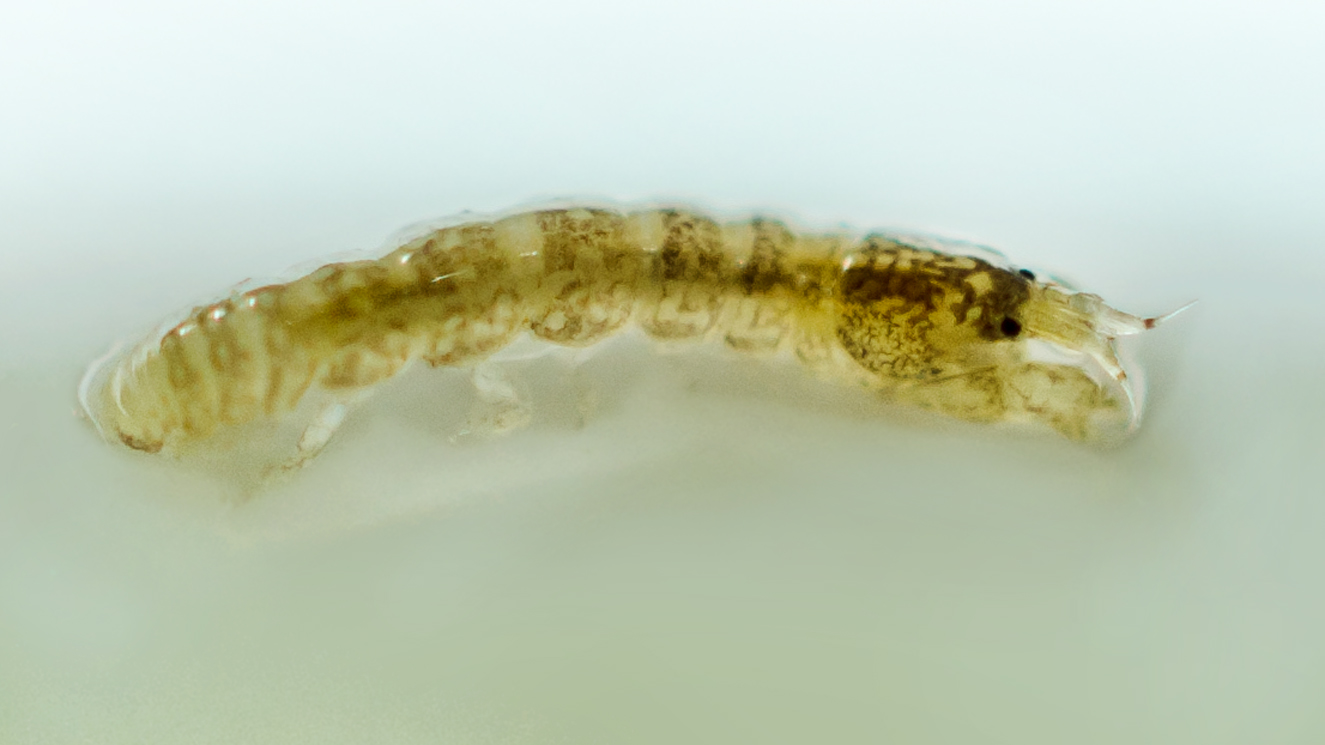
The latest critter I have found looks, at first glance, like an ironed amphipod. He has long, pointed antennae, a good collection of legs and other assorted limbs, a segmented body, prominent eyes. But he lies flat and swims in a straight line, which no self-respecting amphipod would ever do.

Tanaid, about 1/8 inch long

The last two collections of fuzzy eelgrass and clamshells from the tide flats carried dozens of these tiny beasties, all about the same size. Without a lens, they look like short dotted lines, with a darker dot at the front. ...o 

Side view. The antennae have a reddish spot halfway along their length.

I checked out all my references. I spent hours Googling. (Why, when asked for planktonic crustaceans, does Google give me umpteen photos of walruses?) I checked E-Fauna, for BC; there are 389 species of amphipods in their list, 75 species of isopods, very few with photos. But this is neither amphipod nor isopod, but something in between.

ASnailsOdyssey didn't have anything on these. They weren't in Beachwatchers. I finally found an image that led me to RealMonstrosities, and the Tanaids.  (But these aren't monstrosities at all; I think they're cute.)

Face view; breaking the surface of the water, and heading into the shadow of the camera. She didn't like the light.

Once I had a name for them, I did find some information.

There are more than 700 species of this family, several thousand of the larger order. (From Crustacea.net.)

In some areas their population size has frequently been measured at more than 10,000 individuals per square metre and, on occasion, over 100,000! In the abyssal plain they are often the most abundant crustacean and their numbers almost rival that of polychaetes. (From RealMonstrosities)

Most are very small, part of the almost invisible base of the food chain that starts with tiny swimmers and ends with us.

The abundance of tanaids is strong evidence of their ecological importance. Despite this, they have been neglected in most ecological surveys (Baldinger & Gable, 1996). This ecological ignorance of the Tanaidacea is caused by the immense difficulties associated with identifying these animals. (From Crustacea.net)

So I'm not sure of the species of these beasties. Nor of their lifestyle. Some families are tube-dwellers, others are free-living, some live in burrows. Some are filter feeders; others are predatory.

Some species are hermaphroditic. Others start out life as sexless neuters, then turn into females. After their final molt, they change into males, stop eating, reproduce, and die.

The males of many species have very large pincers, sometimes as long as the rest of the body. Here's a photo, taken on the west coast of Vancouver Island.

Dropped in my tank, the little dotted lines swam happily away to burrow into the fuzz on the eelgrass. A day later, after the hermits had eaten their fill of fuzz, there was no sign of them. A couple turned up in the filter when I cleaned it a week later; a temporary shelter for them, free from hungry hermits and dancing shrimp.


Saturday, February 08, 2014

Say, "Ahhh!"

Crustaceans have the most confusing mouths of any critter I've seen; jammed full of hairs and grabbers and feelers and assorted crunchers, and always, always, always in motion. Sometimes a crab will face the camera and stop waving assorted appendages for a second or two; hermits almost never. So I was surprised and pleased when one of the big grainy hand hermits decided to show me his "tonsils".

"Aaaahhh!"
 Zooming in:

Thank you, big guy. But I'm glad I'm not your dentist!


Sunday, October 13, 2013

"Wacky appendages"

An update on the hairy spine thingy:

In brief, it still has me (us) stumped. History, to date:

The post with the photos and description (here) was cross-posted to my Facebook timeline and my Facebook page. A friend there (JG) suggested that I try the burn test for fabric. Was it vegetable or animal? I broke off a tiny piece and burned it; it smelled of hair or feathers. Animal, then.

Another friend (Fred Schueler from the U. of T.) asked the TAXACOM list of experts for help. They came up with various suggestions, from feathers to the tip of a whale's baleen plates, to an abdominal appendage of a crab.
"Crustaceans are jam-packed with wacky appendages:" - Doug Yanega (Entomology).
They sent me off to search crustacean pleopods. Some of the images look sort of, almost, but not quite,* right.

JG then volunteered to take the photos to the Marine Biology meeting of Nature Vancouver. I took more photos for her, destroying another tiny piece of the sample to look at its "innards".

I de-haired two segments as well as I could.

It turned out to be a semi-hollow tube. Here's the inner lining.

One side has a rough section, that on closer examination looks like a groove lined with some sort of fibers.

The inside of a broken segment. This was very fragile, and snapped like a too-thin eggshell. From the inside, what looked like a dark line turns out to be transparent; the dark colour came from the inner stuff.

The Nature Vancouver marine biologists suggested e-mailing Andy Lamb, one of the authors of the Encyclopedia I use, Marine Life of the Pacific Northwest. I just now got an answer from him: he's stumped, too, and is forwarding the lot to several other people.

So that's where we are now. My next step is to go to the beach at a lowish tide and find a large, dead crab, with all his appendages, and examine them. I'll report then, or as soon as anyone else provides an identification.

A big "Thank you!" to all who have helped so far!

*Pleopod of female blue crab. Not on this coast.

Friday, April 29, 2011

Hidden harems

Each visit to the beach turns up a new mix of critters and plants to investigate. This Wednesday, we arrived at the White Rock beach just after high tide, a low high; there was plenty of barnacle-covered stony beach to keep us busy.

Stubby isopods like to hang out where the salinity is low. On this beach, that means around the openings of the culverts bringing runoff from the steep south slope of the town. Usually there are a few there, crawling around the tiny barnacles and mussels on the bottom side of the rocks.

This time, they were everywhere, in great numbers. Every stone I turned over had a busy colony.

Stubby isopods, aka Oregon pillbug, Gnorimosphaeroma oregonense. Look closely; the eyes are visible, mostly on the pale brown ones.

These isopods are very similar to the woodbugs (aka pillbugs, woodlice, roly-polies, etc.) that feed in our gardens. They grow to about 1/2 inch long at maturity, although most of the ones we saw were the smaller harem females. Like the land-based pillbugs, they roll up in a tight little ball if they are disturbed. Just brushing them off a stone will do it; they land rolling.

Pillbug "pill" on the barnacles, lower right.

It's spring; party time, time to find mates and start the next generation. For the stubby isopods, that means sex changes and harems. The baby isopod hatches as a female. She becomes a member of a harem "owned" by one male, produces one brood, then begins a series of molts which transforms her into a male, ready to find his own harem of immature, smaller females. If the harem's male is removed, or dies, the dominant female in the group becomes a male to take his place.

(Most other crustaceans that switch sexes have a reverse pattern; the immatures are male, and they become female at maturity.)

The spring population explosion will not last; crabs and hermit crabs love a snack of unrolled isopod. Like the tides, life on the beach ebbs and flows.

More info: UAS.Alaska, Protogynous Sex Change in the Intertidal Isopod Gnorimosphaeroma oregonense, WSU Beach Watchers.

Tuesday, December 07, 2010

Fourteen leggers, all

The Christmas season seems to have started. Laurie's making Christmas cards; I'm making lists.  Food, gifts to make, buy and/or wrap, seating and eating arrangements, cleaning to do, guests ... my family will be here Christmas Eve, some 25 or more of them. We probably won't be getting out much for the next two weeks.

I'll be getting my critter fix from my files; good thing there are so many!

These sea slaters were on the rocks at Oyster Bay, on Vancouver Island this summer.

The antennae look like old lead pipes.

Ligia pallasi

These isopods live just above the high tide line, hiding in the cracks of the rocks in the daytime, coming out at night to scavenge for dead plants and animals or growing algae. They can be quite large, up to about 1 1/2 inches long. Most are uniformly grey; the ones we saw at Oyster Bay had a cream-coloured dotted line down the center of the armored plates.

They are in the same sub-order as our common woodbugs or pillbugs, and look very much like one, only larger and faster-moving.

Compare:

Armadillidium vulgare, our common pillbug

And here are some intertidal isopods, also for comparison:

Intertidal isopods, next beach up. About 1/3 the size of the sea slaters.


Local eelgrass isopod. About 1/2 inch long.
Powered By Blogger