Showing posts with label greenmark hermit. Show all posts

Wednesday, March 14, 2018

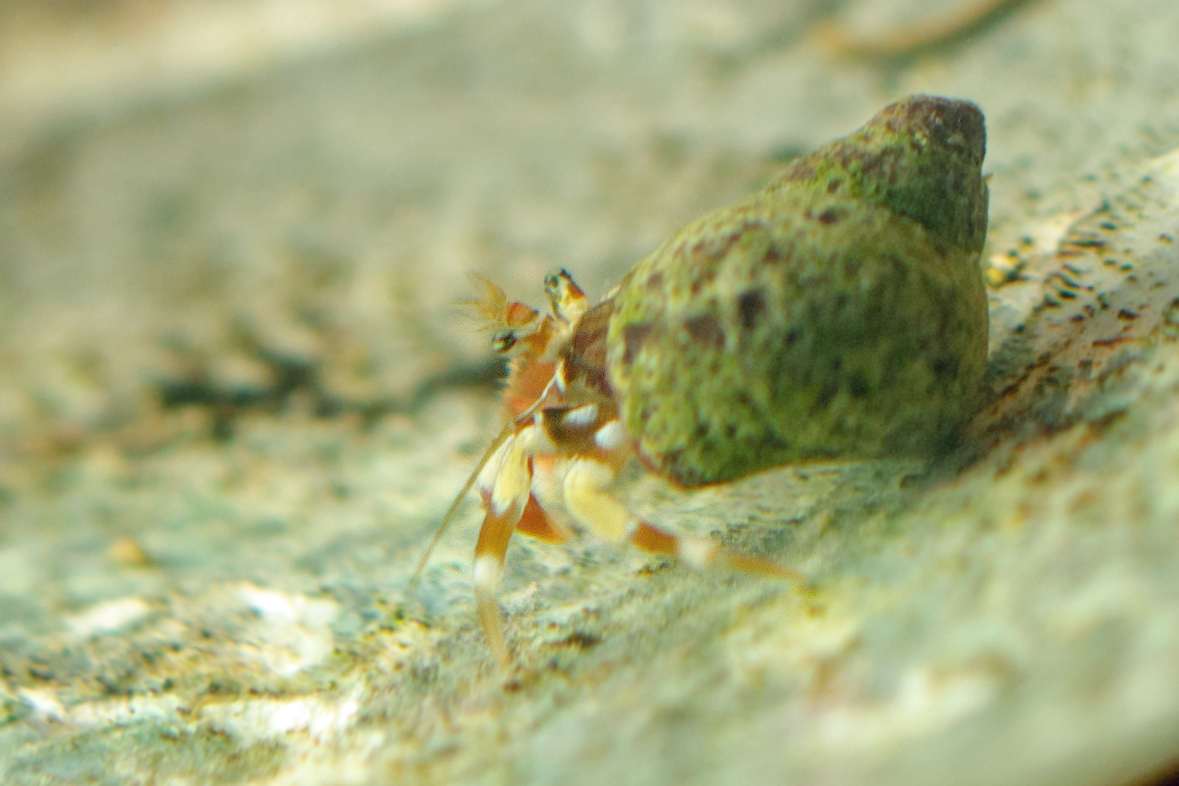
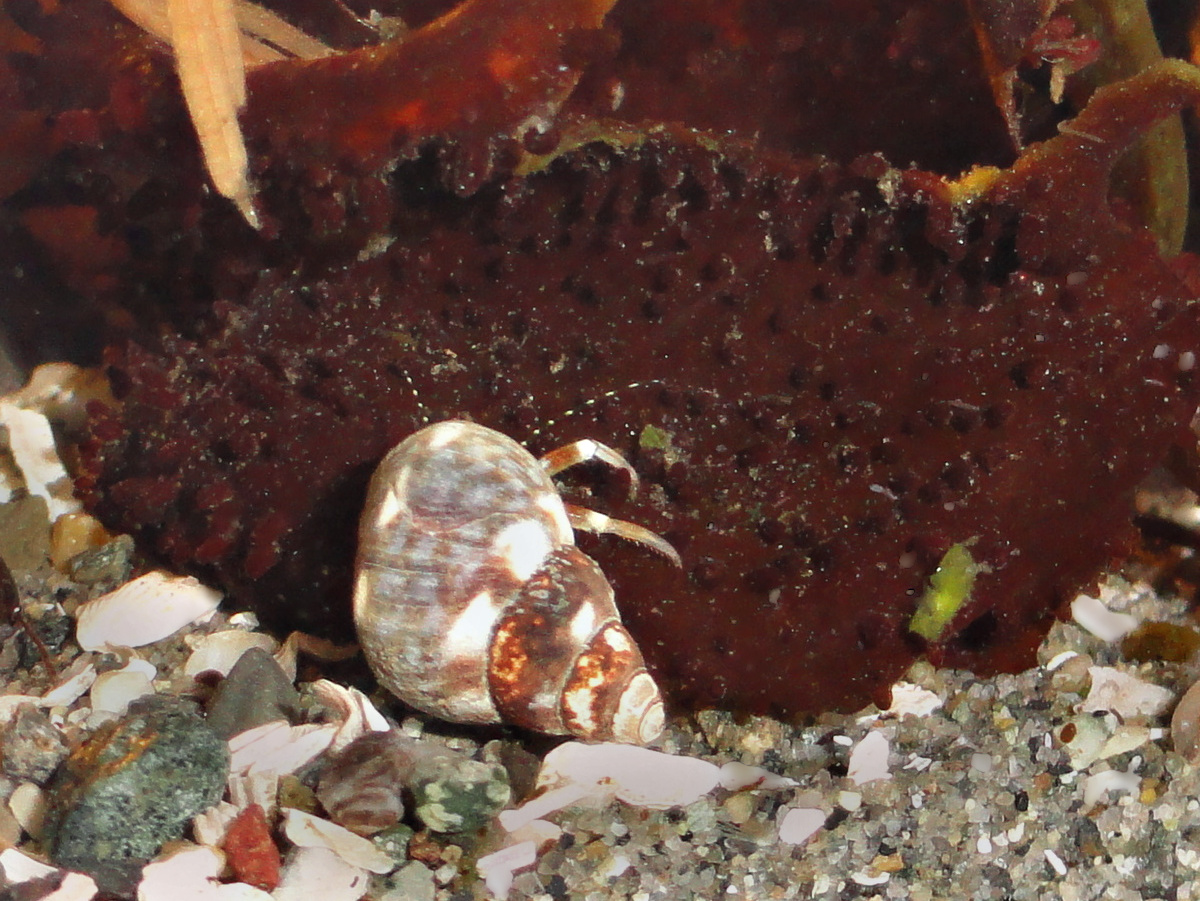
Miniature orange hermit

I bring home a handful of seaweed; sea lettuce, rockweed, maybe some Turkish washcloth, a blade or two of eelgrass; food and gym equipment for my hermit crabs. Before I add it to the tank, I wash it off in seawater, to remove any beach trash. And a sprinkling of apparent sand grains fall off, sprout legs, and race around the washbasin.

These tiniest of hermits grow to fill an approximately 1/4 inch long shell, never more. I thought at first that they might have been immature hairy hermits that would darken as they grew, but I never see them move on to larger shells.

They have orange legs with white bands. Sometimes they are big enough for me to see the antennae with the naked eye; it is green, with white bands. The legs and body are very slightly hairy.

I've struggled, over the years, to find a clear identification of these hermits. At first, I was calling them greenmark hermits, Pagurus caurinus. A sort of match, at least for the orange colour and the size. And maybe some were greenmarks. But not all.

One of the larger ones, still tiny, on an oyster shell. Not a greenmark.

The greenmark hermit sometimes has the orange legs, and are tiny, but their antennae are red and unbanded. These have green, banded antennae and white pincer tips.

I saw one out of his shell, freshly molted, and out looking for a larger (grain of rice sized) one.

Pink striped body, purplish rear end, green banded antennae. Not a greenmark. Another in the background. Their legs are always clean, the colours sharp.

I've searched everywhere I could think of; I can't find the match to this. There's another tiny orange hermit in this area, growing to 0.6 cm as an adult, the Brilliant, Parapagurodes hartae, but he is a brilliant orange all over, with little white banding. And I think, from the photos, that the antennae are orange, too.

Another. The one in the background from the previous photo.

The last crop of rockweed and a shell-full of sand brought a fresh batch to my tank. There must be at least a dozen, all racing around, climbing on and over everything. Cute little critters!

*UPDATE 7 years later! Found it! They're Pagurus holmi. Just discovered in 2009, few records available. More on this later. (2025)

Wednesday, March 20, 2013

Weight-lifting hermits

Val, the big anemone, has been eating snails. They're good workers in the aquarium, keeping the sand plowed and aerated, and cleaning up the crumbs that the crab always scatters. But they take their breaks, sliding up the glass walls, nibbling on algae, resting at the top. To get down, they  usually just let go and drop. This works fine, unless they're right above the anemone, who has now positioned herself right up against the wall. Any snail that drops in her mouth is swallowed instantly; a few hours later, she spits out a clean snail shell.

My cleaning crew was getting skimpy, so this trip to the beach, I scooped up a handful of snails, all piled together under a rock. I brought along a few small clumps of barnacles, too, to help filter the water.

I should have checked them then and there. I didn't. Careless of me.

At home, every single "snail" turned out to be a hermit. And each of the barnacle clumps was loaded on the back of another hermit. There are now about 30 hermit crabs in my tank. They don't mind the crowding; they're a gregarious bunch.

But they've set me a few puzzles, and given me a good laugh, besides. For starters, let's look at a few of those barnacle carriers:

There's a hermit under all that mass. A couple of his legs are just visible. I counted seven barnacles, plus one broken shell. On the barnacles are a few worms, some other unidentifiable critters, two colours of algae, and lots of grunge. That hole in the centre shows the central column of the snail shell, and the tip of one of the hermit's rear legs. And yes, with all that load on, the hermit can still walk. But he doesn't run very well.

An identical hermit, with just a plain, unbroken shell. He's a speedy runner.

More about this guy, later.

This tiny greenmark hermit is wearing half a snail shell; from the open end, part of his abdomen is just visible. On the left side, the shell is weighted down with one large barnacle, this one bearing three smaller ones.

And I had to laugh at this next poor beast of burden. (I know: he's not laughing. But I've given him his choice of new shells; that should make up for it.)

Chocolate, vanilla, and strawberry cone. The pink is some sort of encrusting sponge.

"Oh, my aching back!"

"Scram! I'm not a bus!"

"I never signed up for this! And they're not paying me, either!"

At one point, 3 other hermits were all crammed together on his back, picking at the algae on his cargo of barnacles. His poor legs were splayed out on the sand. He couldn't move.

I've donated a handful of clean, empty shells, in his size range, so he can abandon his pack.

The hermit puzzle, tomorrow.


Sunday, June 24, 2012

Beach assortment

We had a brief interlude of almost summer-like weather, a few hours only, so we hurried to the White Rock beach. Made in in time to see all these before the rain bucketed down again:

Eelgrass isopod and sea lettuce.

Greenmark hermit. Still no sign of a green mark.

Another three-spined stickleback, floating in the incoming tide.

A strongly marked sculpin, about an inch long.

There's at least one fish underneath this eelgrass. Can you find it?

Tidepool sculpin, almost invisible. The sand was full of them, but I never saw them until they scooted away.

Green canoe and paddlers

Gull and shady tidepool

Name this critter!

There's more; a good look at a bright pink starfish, tomorrow.

Friday, April 27, 2012

Busy beach

We've been far too busy recently. These days, it's a rare occasion when a sunny day, a low tide, and a free afternoon all happen at once. Last Monday was one of those.

We parked at the west end of the White Rock beach and walked quickly out towards Kwomais Point, at the mouth of Semiahmoo Bay. We were almost there, among the rocks, before the incoming tide forced us back.

As far as we got.

We had time to poke around a few of those rocks, looking for critters. And finding plenty. Yesterday's starfish, for example. And these ...

A baby grainyhand hermit, Pagurus granoismanus. One of the three common hermits on our beaches, recognizable by the bluish, fat, grainy, main pincer and the orange antennae (not visible here).

A reddish purple shore crab.

Patches of this breadcrumb sponge colonize the underside of many of the larger rocks. Below this one, you can see a few brown anemone, closed and hanging limply while the tide is out. 'Way down on the bottom right, there's a bit of a burrowing anemone showing.

A closer view of the sponge. It is a cream or yellow jelly-like coating on the rock, up to about a half-inch thick; these protrusions, each with an opening at the end, are out-current "chimneys". A few of the closed anemones are visible. I have not been able to identify the species. 

On the way back, we stopped to turn over some large stones. Crowds of miniature assorted critters were massed indiscriminately under each one: here's a sample:

A polychaete worm, two stubby isopods, several whelks, at least two species of hermit crabs, the red purple crab, barnacles, and Sitka periwinkles. Can you find them all?

Cropped portion of the above photo.

Look in this photo for the orange and yellow legs of the tiny greenmark hermits, Pagurus caurinus. The hairy hermits, Pagurus hirsutiusculus, are mostly larger, dark-coloured, with black and grey striped legs and striped antennae; they like to wear shells that seem far too small for them, barely enclosing their rear legs. One, at the bottom left, is in a striped mud snail shell. The greenmarks are using periwinkle shells, except for one that's in a broken white whelk shell. Some of the periwinkle shells and most of the whelk shells are still occupied by their original owners.


They look like they're all getting along nicely. Except that I wouldn't trust those beautiful whelks; they might get hungry.


Sunday, March 25, 2012

About those animal tracks ...

Maybe that was too easy; the animals that made the tracks I posted yesterday were pretty well identified just by location. Kirk weighed in with the answer before dawn.

Hermit crab tracks.

Maybe I should have asked for the species.

However obvious the track makers were, I failed to recognize them when we first saw them on the beach. Which is surprising, and a bit embarrassing; after years of interacting with hermits, and more years of following snail trails up and down the mud flats on this same beach, I had never noticed any before. My (flimsy) excuse is that my hermits were usually underwater, and the snail trails are mostly in mud, which oozes and doesn't retain those pin-prick prints. It was only in the damp, firm sand, protected from the wind in valleys between wave ridges, that the footprints stayed put long enough for us to see them. Where the hermits crossed ridges, the orderly line of many-legged travel became only a wind-blown, blurry mussing of the sand.

I discovered the source when, at the end of another trail, I picked up another small snail shell. This one had sand clumped around the opening; I gently brushed it off, until I exposed just the tip of a hermit's main pincer. Poor frightened beastie, trying to make himself invisible deep in his shell! I apologized, and replaced him in his cosy trench.

No, I don't know the species for sure, either. By the location of the tracks, the size of the shell and shape of the pincer, I think it was probably a greenmark hermit; we have found many, a bit farther down this beach.

A few days earlier, on the White Rock beach, we found another intriguing set of marks. I always notice sandstone; I love the swirling or wavy patterns preserved there. On a big sandstone rock among the rip-rap separating the beach from the railroad track something had left its mark, long ago.

Footprint or coincidental cluster of clay lumps?

This was about the size of a medium dog's paw print. In the photo, it almost looks raised, but it was a depression in the sandstone, partially filled in with a fine clay, hardened, but flaky. (The little piece of wood is sitting loose on top of the clay/stone; knowing that forces my eyes to recognize the shape as an indentation.)

And when I stepped back to leave, I realized that the print was part of a sort of track:

More indentations, in clusters about a foot apart.

Are these fossilized prints, or is it my imagination running away with me? Probably the latter, but it's fun to speculate.


Tuesday, January 03, 2012

Now that's a proper live beach!

The tide was high when we arrived at Crescent Beach on New Year's Day, so we walked along the shore watching the birds: gulls, an eagle, a flock of chattering yellowlegs, and further out, rafts of ducks, pintails, we think. The birds close to shore were feasting; we caught one yellowlegs on camera running along with something floppy and red dangling from his beak, and another bird in hot pursuit. And in our few photos (too far, too bright to take very many), I counted 10 gulls with a beak full of clam or snail.

By the shape of it, this looks like a snail.

We walked almost to the point. By then, the water had gone down enough to expose the upper intertidal zone, so I went down to the edge to flip rocks. Every stone and rock I turned exposed a mob scene, crabs and hermits, snails, isopods, amphipods, all piled higgledy-piggledy.

A pretty orange clam, burying himself as quickly as possible.

Crabs upon crabs. There are a half-dozen crabs visible in this photo. Can you see them?

At least half of the snail shells here are occupied by hermit crabs, mostly greenmarks, the tiny ones with orange marks on their legs and pincers. (I haven't seen any green marks on them yet.) But there is a larger hairy hermit near the centre, mostly hidden. The snails and snail shells are Asian mud snails (the long, striped one) and Sitka periwinkles (round, fat coils); these last always live close to the high water mark. A couple of snail shells are from Nassas. In the upper left, you can see a large rockweed isopod.

Hermits upon hermits

The large one in the center is a hairy hermit, identifiable by the black and white striped antennae. On the upper left is one of the Eastern mud snails so common lower down on this beach, and there's a pretty green Nassa at the bottom.

Isopods upon isopods

On the underside of the rocks, the animals weren't quite as crowded as on the ground underneath. These isopods are distinguishable from the eelgrass isopod, about the same size, up to 2 inches, by the rounded tail end. The eelgrass 'pod's has a concave bite cut out of it.

Splotchy isopod

The isopods come in various shades, including this mottled green, black and grey pattern. The brown, bubbly snail on its left is an oriental cecina. It likes the extreme high tide level.

Isopod, greenmark hermit, and several limpets.

The limpets belong to two different species; the larger, ridged, black and grey patterned ones, and a small orange speckled limpet, with two spiral tube worms attached. There were quite a few of these; this was the largest I saw.

The crab photo again, cropped to center on the hiding hairy hermit. The shell and eyes are well buried under other animals.

Greenmark hermit in a checkered periwinkle shell. I think the shell just above it is a wrinkled amphissa.

Not all the snail shells contain hermits; these still house the original owners.

A small starfish, about 2 inches across, has cleared an area on a stone, either by eating everything, or by scaring it away.

Blob

I don't know what this is. There is a shell similar to this in the hermit photo (scroll up three photos), but this doesn't look like a shell. It showed up in three photos from different angles; in each, it just looked like a blob. No snails in the Encyclopedia match it. Help wanted!

I made a list of the different animals found in a few minutes:
  • One whelk, one polychaete worm, one sand dollar, not shown,
  • small acorn barnacles, assorted amphipods, red encrusting sponge, shown but not mentioned,
  • orange limpets, black ridged limpets, green shore crabs, greenmark and hairy hermits, rockweed isopods, mud snails (Batillaria), Sitka and checkered periwinkles, amphissa snail, Nassa snails, Oriental cecinas, Eastern mud snails, clams, spiral tubeworms, a starfish, and the "Blob".
I was looking for flatworms, but didn't see any. I'm sure they were there, too.

Wednesday, November 02, 2011

Mussels are evil.

They are so deceptive, just sitting there, opening their mouth a bit sometimes; otherwise, just sitting. Looking harmless and innocent.

They're not.

Let me backtrack a bit here. My little aquarium is recovering nicely from the summer disaster, becoming the biodiverse environment that the animals are accustomed to. The crabs are as calm, now, as crabs get; the big anemone is feeding more often than not; the snails are plowing through the sand and polishing the walls. I have provided a variety of seaweeds for food, gym equipment, and shelter: sea lettuce, turkish towel, rockweed, eelgrass and kelp. A few tiny greenmark hermits and a pair of big isopods moved in with the last batch of seaweed. There's at least one polychaete worm in the sand. Green amphipods zip busily about.

And then there are the water cleaners. The barnacles (lots of those) and a handful of mussels.

The biggest mussel, Mytilus trossulus, on a scratchy bed.

With his mouth open, filtering the water. One of the tiny hermits watches.

Mussels are filter feeders; they don't need to move about, although they do at first, until they find a place that suits them. Then they lie there, letting the current bring them food. They capture plankton, other microscopic life, and floating leftovers from the crabs' meals or decomposing seaweed. A mussel can scrub up to two and a half litres of water per hour per gram of body weight. That's the contents of my whole small aquarium, given the handful of mussels working there.

The problem - and I never considered it in that light before - is their habit of choosing a spot and tying themselves down. A mussel excretes a liquid that hardens immediately on contact with the water, producing strong hairs, called byssal threads. At the tip of each thread is a dot of glue. Where it touches, it holds.

(Young mussels use these to "walk"; they extend a thread, let it stick and reel it in, pulling themselves up to the contact point. Then they dissolve the connection, let the thread float free, and produce another.)

These threads are incredibly tough. They are made up of a core of collagen, coated with a harder protein bonded with iron ions, (NPR), and may have the tensile strength of five of our Achilles tendons. A mussel will attach itself with 50 or more threads, enabling it to bond to rocks and other mussels. Anchored like this, it can't be swept away even by stormy seas.

The threads have another use, too. Like all creatures, mussels have predators; starfish, birds, crabs and some fish. And whelks, those voracious hole-drillers. Tying themselves down to the rocks and in large groupings helps to protect them from the birds and crabs, but whelks will attach themselves to the shell, drill into the meat and dissolve it. To stop them, a mussel will throw out a few threads, entangle the whelk, and anchor it to the rock, where it will starve to death.

I was looking for hermits, counting them to see if they had all settled in ok, when I noticed a small Nassa snail jabbed into the sand upside-down, point buried. Odd.

When I looked next, it was still there, but had moved slightly. Still alive, then. But why was it in that position?

It was jammed against a stone, still upside-down the next time I looked. In the morning it wasn't moving, so I decided to investigate; I reached in and picked it up. It came along with the stone and the mussel on top, tied down securely. When I broke the threads that held it and left it alone, it woke up and hurried away (at top snail speed). Probably hungry.

I collected all the mussels and examined them. They had glued down another snail and one of the hermits. This would not do!

Well, I can use thread, too. In a double piece of cheesecloth, I wrapped the whole clump, and tied it in a loose net. There! They have water circulation, but the snails and hermits can't get through to them.

Small handful of mussels, with two attached stones and a clamshell. More mussels have been added since, as I found them.

Biological filtration unit. Netted mussels, in the back of the tank.

So far, this has worked. Hermits pick at the cheesecloth, but then walk away, untethered.

Nassa snail, cleaning the glass.

Freed Nassa, still wearing the remains of the byssal threads and a pebble caught in the glue.

Greenmark hermit, now safe from the clutches of the mussels.


Tuesday, July 05, 2011

Crowd scene

Good news; one of my hermits has turned up alive! The last time I saw him, he was stumbling about feebly, tipping over and struggling to right himself. Then, like the others, he disappeared. (Any hermit that dies gets eaten quickly by the crabs; all that remains is an empty shell.)

Tonight he was climbing high up in the seaweed, back to his normal agile self. Yay!

We went to Boundary Bay at low tide two days after Canada Day, still part of the long weekend. Instead of meandering across the sand, poking around in the tide pools as we usually do, we walked straight out to the far edge, about one and a half kilometres from the shore. Good exercise, and very calming; nothing to see but sand and water, nothing to hear but the wind.

Looking towards Vancouver

Well, almost nothing. Far in the distance, everywhere we looked, the beach was a hive of happy activity.

Waders, walkers, diggers, and sleepers under an umbrella.

Runners and boarders.

Dogs and ballplayers and a blue kite.

Looking southeast, towards the boundary marker. Gulls and (illegal?) crabbers and a distant boat.

Zoom. I think the runner is carrying a rake of some sort.

Almost at the drop-off to deeper water, a couple of boarders prepare to come in; the tide has turned.

Clam diggers or castle builders.

Across the border, in the US, the beach goes on.

We walked in our bubble of silence, out and out and out, breathing deeply. No chemical smells, no choking smoke, just salty air - ahhh!

Three quarters of the way out, a tiny, dripping dog came to say hello and dance away again.

And then, as we reached the last sandbar, the tide began to race shoreward. We turned and hurried back. The shallow streams we had crossed on the way out were now calf-deep rivers with strong currents. The distant walkers were all heading inland, to the cars or barbecues awaiting them in the park.

We went to Tim Horton's, instead. Piping hot tea and coffee; the final touch to a healing afternoon.
Powered By Blogger