 |
| And watching me, meanwhile, making sure I keep my distance; that's HIS snack! |
Showing posts with label intertidal hermits. Show all posts
Showing posts with label intertidal hermits. Show all posts
Tuesday, December 11, 2018
Munchies
Grainy hand hermit breaking off an edge of kelp for a snack.


Tuesday, November 20, 2018
Small fry
Young hermit crabs doing what hermits do ...
 |
| Small hairy hermit, Pagurus hirsutiusculus, very happy with a brand-new shrimp pellet. |
 |
| Climbing the eelgrass. He's freshly molted; his carapace is clean and bright. It doesn't take long for algae and gunk (sometimes even baby barnacles) to begin to settle there, turning him to a dungy grey-green. |
 |
| Small and smaller. Compare the size of the sand grains. The larger of the three is checking out a new shell, but soon decided it wasn't good enough. Wrong shape, wrong weight, wrong taste? Who knows what appeals to a hermit crab? |
Monday, April 23, 2018
Muddy buddy
On a rocky, muddy beach north of the city, with the tide going out, I was flipping rocks, watching muddy crabs and snails, all in shades of brown mud, when I saw a flash of bright blue. I had to move several rocks to track it down; a hurrying hermit with a blue right hand.
At home, in a tray of seawater, he was unhappy until I gave him back the seaweed. He hid underneath it and refused to budge, not giving me a chance to look at him cleaned up.
I let him rest a while, then dropped him in the tank. He looked around for a few minutes, then charged and fought with the largest male Hairy. Because he was a different species? I had to separate them to give him a chance to settle down.
Along came a large Grainy Hand hermit; they touched antennae, ("Hi, stranger!"), sat together for a while, peacefully. But he's definitely not a Grainy Hand, not with those striped antennae, although the Grainy Hands sometimes do have a bluish tinge to their pincers.
I came back to check on him after a couple of hours. He was still in the same place, but now he has a girlfriend, a smaller Hairy hermit. He's holding her by the edge of the shell, waiting for her to molt. She seems contented enough, resting, occasionally waving her antennae at him.
So he's a Hairy hermit. With a blue pincer. And the fight with the other Hairy was adult male rivalry.
But why is that pincer so blue?
 |
| Blue knees, orange and green banded antennae. Too big for his shell. And lots of hair. |
He looked like a Hairy hermit, Pagurus hirsutiusculus, except for that brilliant blue pincer, and a distinct black square on his carapace. Hairies are usually olive green or brown, chelipeds (pincers) and all, with small blue or white spots on the knees. The carapace is often striped.
I wrapped him in wet sea lettuce and rockweed and brought him home to examine him more closely.
 |
| From the back, on my hand. That pincer is so big, it drags along underneath him when he walks. |
At home, in a tray of seawater, he was unhappy until I gave him back the seaweed. He hid underneath it and refused to budge, not giving me a chance to look at him cleaned up.
I let him rest a while, then dropped him in the tank. He looked around for a few minutes, then charged and fought with the largest male Hairy. Because he was a different species? I had to separate them to give him a chance to settle down.
Along came a large Grainy Hand hermit; they touched antennae, ("Hi, stranger!"), sat together for a while, peacefully. But he's definitely not a Grainy Hand, not with those striped antennae, although the Grainy Hands sometimes do have a bluish tinge to their pincers.
I came back to check on him after a couple of hours. He was still in the same place, but now he has a girlfriend, a smaller Hairy hermit. He's holding her by the edge of the shell, waiting for her to molt. She seems contented enough, resting, occasionally waving her antennae at him.
So he's a Hairy hermit. With a blue pincer. And the fight with the other Hairy was adult male rivalry.
But why is that pincer so blue?
Tuesday, April 03, 2018
Three hermits
There are a pair of fat, green polychaete worms in my aquarium, and a tiny, tiny, tiny crab, so small I only discovered him because he, as crabs do, lifted a shell many times his size and weight. So I grabbed the camera, set up the lights and reflectors, and spent an hour staring into the tank.
So the worms went into hiding, and the crab never came out. Never mind; the camera kept busy, anyhow.
For starters, here's a trio of hermits.
Next, I think, a passel of amphipods.
So the worms went into hiding, and the crab never came out. Never mind; the camera kept busy, anyhow.
For starters, here's a trio of hermits.
 |
| Hairy hermit, Pagurus hirsutiusculus, getting her exercise. Hermits love to climb, the more challenging the slope, the better. |
 |
| Hanging out with buddies, an anemone and a limpet, on a carpet of multicoloured algae. |
 |
| One of the tinies. About the size of a long-grained rice grain. These littles are so light, I've found them several times climbing halfway up the glass wall of the aquarium, holding on to specks of algae. |
Next, I think, a passel of amphipods.
Wednesday, March 14, 2018
Miniature orange hermit
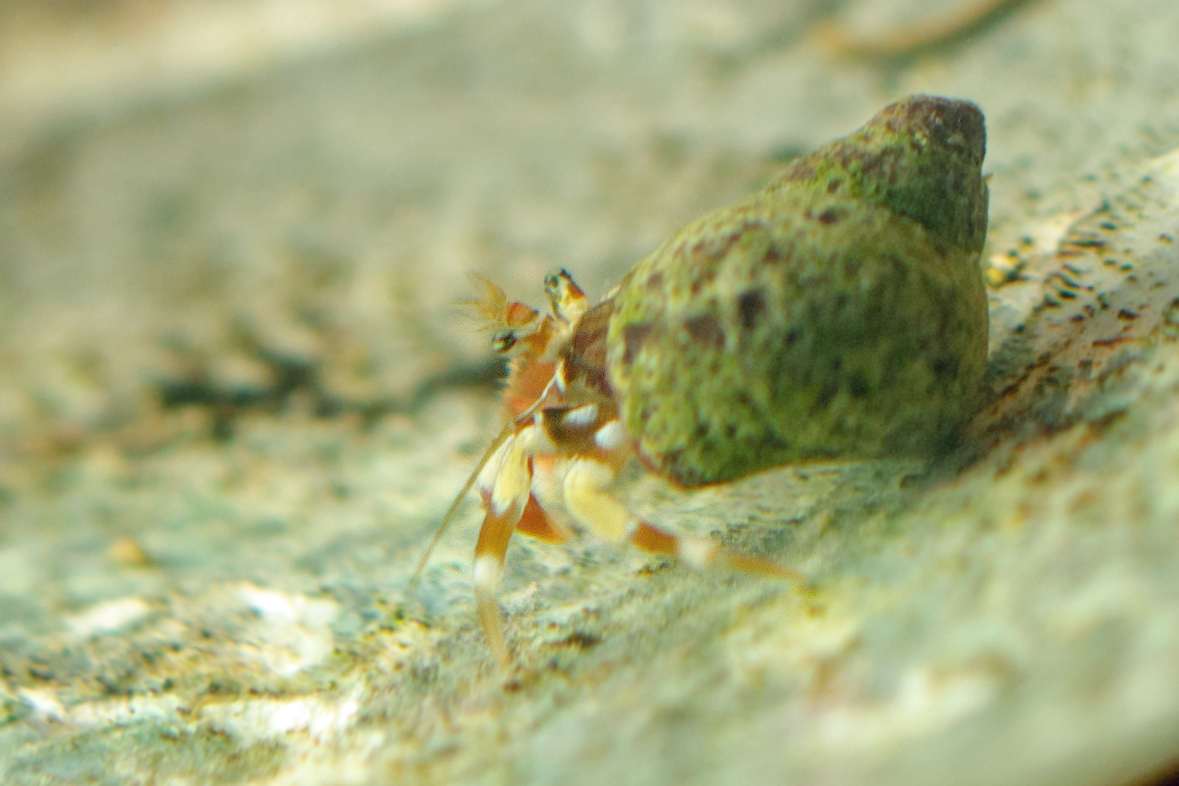
I bring home a handful of seaweed; sea lettuce, rockweed, maybe some Turkish washcloth, a blade or two of eelgrass; food and gym equipment for my hermit crabs. Before I add it to the tank, I wash it off in seawater, to remove any beach trash. And a sprinkling of apparent sand grains fall off, sprout legs, and race around the washbasin.
These tiniest of hermits grow to fill an approximately 1/4 inch long shell, never more. I thought at first that they might have been immature hairy hermits that would darken as they grew, but I never see them move on to larger shells.
They have orange legs with white bands. Sometimes they are big enough for me to see the antennae with the naked eye; it is green, with white bands. The legs and body are very slightly hairy.
I've struggled, over the years, to find a clear identification of these hermits. At first, I was calling them greenmark hermits, Pagurus caurinus. A sort of match, at least for the orange colour and the size. And maybe some were greenmarks. But not all.
The greenmark hermit sometimes has the orange legs, and are tiny, but their antennae are red and unbanded. These have green, banded antennae and white pincer tips.
I saw one out of his shell, freshly molted, and out looking for a larger (grain of rice sized) one.
I've searched everywhere I could think of; I can't find the match to this. There's another tiny orange hermit in this area, growing to 0.6 cm as an adult, the Brilliant, Parapagurodes hartae, but he is a brilliant orange all over, with little white banding. And I think, from the photos, that the antennae are orange, too.
The last crop of rockweed and a shell-full of sand brought a fresh batch to my tank. There must be at least a dozen, all racing around, climbing on and over everything. Cute little critters!
*UPDATE 7 years later! Found it! They're Pagurus holmi. Just discovered in 2009, few records available. More on this later. (2025)
These tiniest of hermits grow to fill an approximately 1/4 inch long shell, never more. I thought at first that they might have been immature hairy hermits that would darken as they grew, but I never see them move on to larger shells.
They have orange legs with white bands. Sometimes they are big enough for me to see the antennae with the naked eye; it is green, with white bands. The legs and body are very slightly hairy.
I've struggled, over the years, to find a clear identification of these hermits. At first, I was calling them greenmark hermits, Pagurus caurinus. A sort of match, at least for the orange colour and the size. And maybe some were greenmarks. But not all.
 |
| One of the larger ones, still tiny, on an oyster shell. Not a greenmark. |
The greenmark hermit sometimes has the orange legs, and are tiny, but their antennae are red and unbanded. These have green, banded antennae and white pincer tips.
I saw one out of his shell, freshly molted, and out looking for a larger (grain of rice sized) one.
 |
| Pink striped body, purplish rear end, green banded antennae. Not a greenmark. Another in the background. Their legs are always clean, the colours sharp. |
I've searched everywhere I could think of; I can't find the match to this. There's another tiny orange hermit in this area, growing to 0.6 cm as an adult, the Brilliant, Parapagurodes hartae, but he is a brilliant orange all over, with little white banding. And I think, from the photos, that the antennae are orange, too.
 |
| Another. The one in the background from the previous photo. |
The last crop of rockweed and a shell-full of sand brought a fresh batch to my tank. There must be at least a dozen, all racing around, climbing on and over everything. Cute little critters!
*UPDATE 7 years later! Found it! They're Pagurus holmi. Just discovered in 2009, few records available. More on this later. (2025)
Tuesday, March 13, 2018
Dibs
One of my largest hermits found a new shell I'd donated. He tried it on, and, as they do, fussed about for a while, squirming, disappearing into the back spirals, checking the fit and the weight. A second hermit noticed and hurried over.
Hermit crabs are usually polite. Hairy Harry, in back, waited patiently while Big Red thought it over, still holding onto the old shell, just in case. When BG decided that the new shell suited him perfectly, and wandered away, HH examined the old shell, realized that it was broken (on the far side, not visible here), and gave up.
No hard feelings.
The hermits are: Hairy Harry, a hairy hermit, Pagurus hirsutiusculus. They like smaller shells that enable them to run and climb easily: and Big Red, a grainy hand hermit, Pagurus granosimanus. They love a shell big enough to completely hide inside; they don't mind if it's heavy and awkward. They're in no hurry.
Hairy Harry is still in his old shell, waiting for me to provide another.
 |
| "If it doesn't fit, can I have it?" |
Hermit crabs are usually polite. Hairy Harry, in back, waited patiently while Big Red thought it over, still holding onto the old shell, just in case. When BG decided that the new shell suited him perfectly, and wandered away, HH examined the old shell, realized that it was broken (on the far side, not visible here), and gave up.
No hard feelings.
The hermits are: Hairy Harry, a hairy hermit, Pagurus hirsutiusculus. They like smaller shells that enable them to run and climb easily: and Big Red, a grainy hand hermit, Pagurus granosimanus. They love a shell big enough to completely hide inside; they don't mind if it's heavy and awkward. They're in no hurry.
Hairy Harry is still in his old shell, waiting for me to provide another.
Wednesday, December 06, 2017
Wise old eyes
Every week or so, I remove all my hermit crabs from the aquarium while it is being cleaned. And while they're milling about in the holding basin, I count them. I brought 19 with me from the mainland two years ago; there are 19 today. The smaller ones may or may not survive the first few months; it's a risky time, with all the molts and other growing pains. New babies arrive; some grow up. But the larger ones just keep trundling along, occasionally switching into larger shells.
Some species of hermit crabs can live up to 30 years. How old are my big grainyhand hermits? I don't know; they're not telling.
But they have wise eyes.
These are smart beasties.*
*Smarter than some humans I know.**
** At least, as far as food choices go.
Some species of hermit crabs can live up to 30 years. How old are my big grainyhand hermits? I don't know; they're not telling.
But they have wise eyes.
 |
| Ol' Fuzzy, at the front of the tank, checking me out. On red Turkish towel. |
 |
| "Waves, Hi!" |
These are smart beasties.*
The common intertidal hermit crab Pagurus granosimanus learns in one or two trials to reject an attractive, novel food (beef) when illness is induced ... Food aversion learning has never before been reported in a crustacean. (Wight, Keith, et al. “Food Aversion Learning by the Hermit Crab Pagurus Granosimanus.” Biological Bulletin, vol. 178, no. 3, 1990, pp. 205–209. JSTOR, JSTOR, www.jstor.org/stable/1541820.)
*Smarter than some humans I know.**
** At least, as far as food choices go.
Saturday, June 17, 2017
MiniHermie
I walked on the shore of Oyster Bay at low tide, collecting eelgrass for my hermit crabs. A new one came along for the ride.
I took his photo in a plastic cup 2 inches across. The circle around the centre is 5 mm. wide, which makes MiniHermie about 3 mm long, shell, extended pincers and all.
I added him to the tank, and he floated down until he reached the eelgrass, and grabbed on. I probably won't see him again until he grows up a bit.
 |
| Mini-hermit.The seaweed strand is like a fine string. |
I took his photo in a plastic cup 2 inches across. The circle around the centre is 5 mm. wide, which makes MiniHermie about 3 mm long, shell, extended pincers and all.
 |
| Orange striped legs, a bit of blue, and striped antennae. |
I added him to the tank, and he floated down until he reached the eelgrass, and grabbed on. I probably won't see him again until he grows up a bit.
Monday, September 19, 2016
Red eyes, blue eyes, twisty eyes
Grainy hand hermit crabs have red eyes.
And Hairy hermits have blue eyes.
Except when they're seen from the back of the head.
 |
| Grainy hand hermit, Pagurus granosimanus. |
And Hairy hermits have blue eyes.
 |
| With two parallel stripes. Pagurus hirsutiusculus. |
 |
| Another blue-eyed hermit. |
Except when they're seen from the back of the head.
 |
| Then they're all twisty. |
 |
| Zooming in. Brown and yellow spirals. |
Thursday, June 02, 2016
Name this hermit
Many of the beaches on the Campbell River coastline have a base of sandstone, with rocks and stones and glacial erratics scattered or piled on top. Lifting the rocks sometimes uncovers a hard, smooth, pavement-like surface. Crabs and small fish hide in the crevices in the sandstone; anemones drill small holes. But the rest of the beach fauna heads for softer spots, larger cracks, where they can burrow in comfort.
I removed a few rocks and scraped at the sandstone until I found a crack, then dug down. Not far; an inch or two, and I'd hit pavement again. I found three tiny clams and disturbed a swimmer, probably an isopod. Nothing more, except the snails, crabs, and hermits that don't mind hard floors.
When the water had cleared a bit, I took a few photos, hoping to find something too small to see there on the beach. But the camera found no worms, no soft critters, no sea urchins. Just one tiny hermit crab.
A hermit that I haven't been able to identify.
This hermit was in a shell about 1/4 inch long. He has greenish banded antennae, red/brown eye stalks, with a white vertical stripe, red "flags" with a white base. His pincers are dark, with whitish stripes. I think the white stripes on either side of his head are on his "shoulders". And the eyes seem to be patterned in a spiral or a double circle.
I've spent the evening searching for a match. The little greenmark hermit, often seen on these beaches, has red, unbanded antennae; the hairy has those green antennae, but he's a dull brown or green everywhere else, except for blue spots on his knees. I've looked at every one in the BC E-Fauna gallery and read descriptions; none are like this guy.
Compare to a couple of typical small hermits from my tank:
Does anyone recognize this? Is he just another colour morph of the hairy hermit, maybe?
I removed a few rocks and scraped at the sandstone until I found a crack, then dug down. Not far; an inch or two, and I'd hit pavement again. I found three tiny clams and disturbed a swimmer, probably an isopod. Nothing more, except the snails, crabs, and hermits that don't mind hard floors.
When the water had cleared a bit, I took a few photos, hoping to find something too small to see there on the beach. But the camera found no worms, no soft critters, no sea urchins. Just one tiny hermit crab.
A hermit that I haven't been able to identify.
 |
| Hermit, as found. I've cleaned up the background a bit; the water was still full of debris. And I deleted garbage floating over the shell. But the hermit is untouched, except for lighting. |
This hermit was in a shell about 1/4 inch long. He has greenish banded antennae, red/brown eye stalks, with a white vertical stripe, red "flags" with a white base. His pincers are dark, with whitish stripes. I think the white stripes on either side of his head are on his "shoulders". And the eyes seem to be patterned in a spiral or a double circle.
I've spent the evening searching for a match. The little greenmark hermit, often seen on these beaches, has red, unbanded antennae; the hairy has those green antennae, but he's a dull brown or green everywhere else, except for blue spots on his knees. I've looked at every one in the BC E-Fauna gallery and read descriptions; none are like this guy.
Compare to a couple of typical small hermits from my tank:
 |
| A young hairy hermit, Pagurus hirsutiusculus. As he grows older (and much bigger than the hermit above), his colours will darken to olive green or dark brown. If he eats too much red algae, he might take on a pinkish glow. Never red. The eyes are oval, with a dark centre. His "flags" (sensory antennules) have a hint of orange and blue at the tip. He does have the green or brown banded antennae. |
 |
| These I've never been able to identify reliably. Pale, banded antennae, orange and white legs. A very small hermit. They may darken to black and white. Not red. |
Does anyone recognize this? Is he just another colour morph of the hairy hermit, maybe?
Subscribe to:
Posts (Atom)
