It snowed again yesterday afternoon. Then the snow turned to rain. Our streets were black, then white, then black again. But just a few miles away, on the mainland, the black is bad news; there, it's black ice. And the snow keeps falling.
Closer to home, if I drive over the hill that borders the shore, I find snow, six inches deep, undisturbed, and frozen hard enough to walk on without leaving a mark.
 |
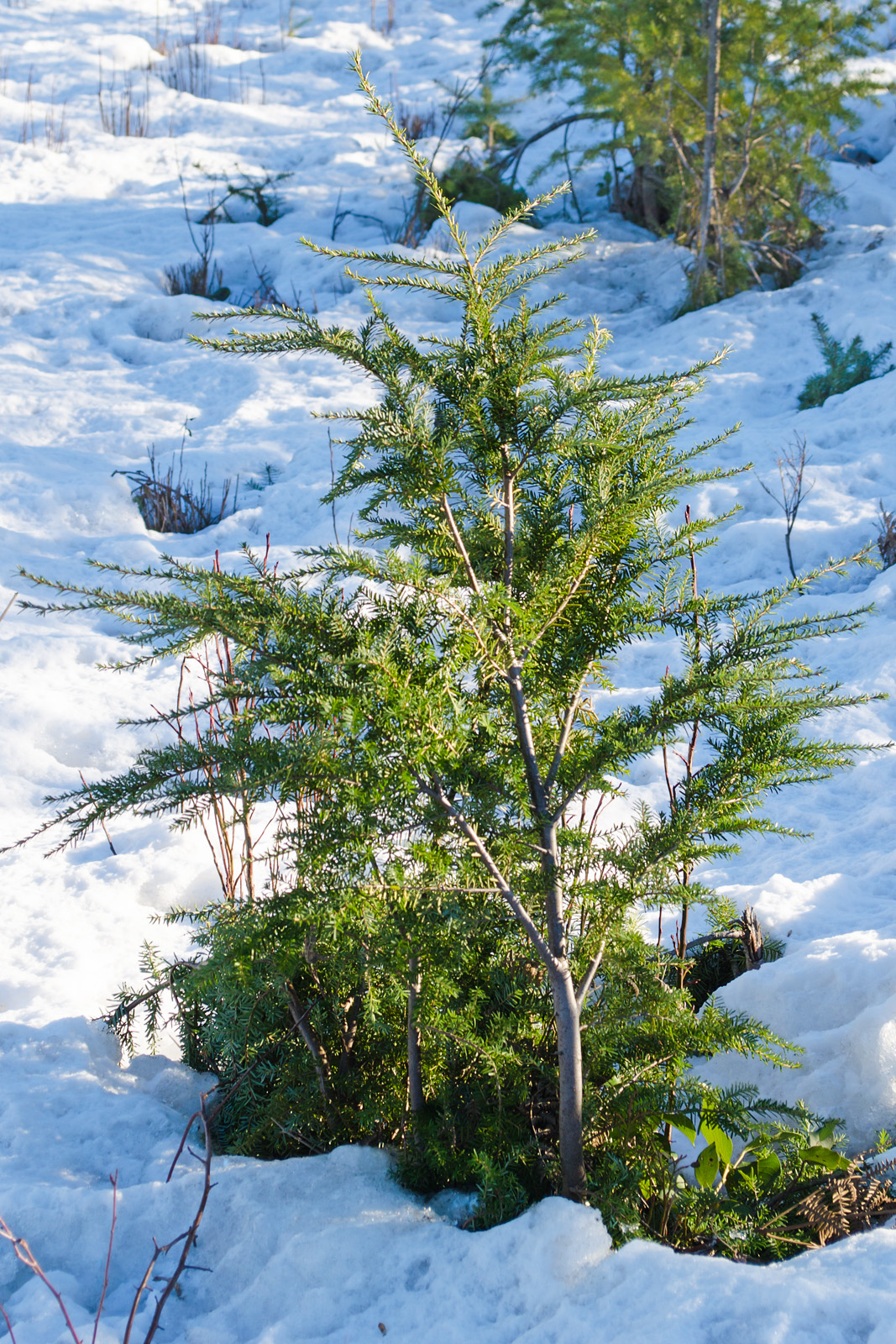
| New forest coming, under snow. |
Here on Vancouver Island, we live in a
microclimate, its temperature and humidity determined by the encircling ocean currents, northbound from the warm
North Pacific Current. Our summers are cool and wet, and our winters are usually mild (and wet; we don't tan, we rust.) Some years, there's no snow at all.
But microclimates have their own microclimates. Our shoreline strip is one. The backside of the hill is another. Forested areas have their own variants, depending on height of trees, direction of the slope, extent of logged areas, nearby rivers, roads and their traffic, and other circumstances.
And then there are the mini-microclimates. The warm zones around blades of grass, the wells at the base of stumps, hollow logs, even the ruts in old car tracks. Each imperfection in the surface shapes the wind currents, captures or blocks the sunshine, funnels off the rainwater. And in these mini-climates, plants and animals wait out the cold weather.
 |
| Baby Douglas fir and shrubs, each in its own warm well. |
Each living plant affects its climate in various ways. It absorbs sunlight, which otherwise bounces off the surface of the snow. It deflects drying winds. And its own living processes produce a minimal amount of heat. Enough to melt the snow up against the branches, and provide cover for other small plants.
 |
| An old stump in its own mini-climate, harbouring evergreen salal. |
 |
| Two more stumps. With lichen, salal, and bare twigs of deciduous shrubs. These will have an early start to their spring growth. |
 |
| A few small trees and shrubs share a warm spot. |
 |
| Even a rock can build a mini-climate. It absorbs more warmth from the sun than the surrounding earth, which is cooled by air pockets and seeping ice melt. The rock radiates this extra heat into the snow around it. |
 |
| Snow on the side of the road, tossed up by a snowplow. Even this can create a disturbance in air flow and sunlight. The lump itself, exposed to the wind, is frozen hard, but the sunny surface is slowly melting, making that icicle. |
 |
| A side road, unmarked on the map, with ruts and tracks of a dog or coyote, made before the snow froze hard. The forested and ferny areas are just warm enough to melt off the snow before it freezes. |
And there's another mini- or really, not so mini - microclimate, usually unseen. Underneath that frozen snow cover, the ground is protected from freezing winds, and stays just above freezing. And there, the little creatures wait out the winter, sleeping or burrowing deep into the warmish earth.
Back at home, a few of my spring crocuses are pushing through the wet soil, hidden in a mini-climate of their own between a wall and a staircase.