Showing posts with label wish I knew geology. Show all posts

Friday, October 23, 2026

Some rocks. And boats. And green, green water.

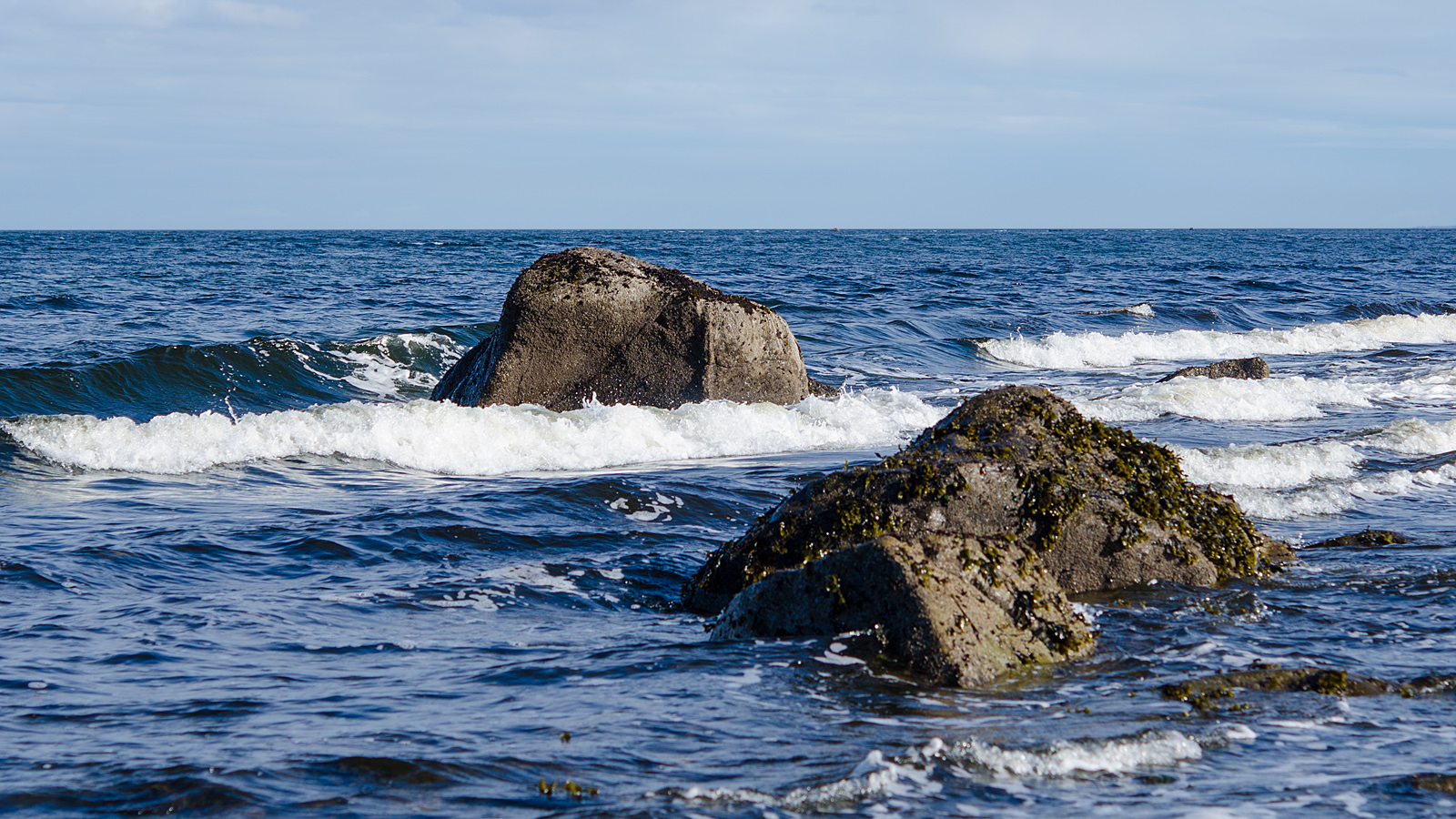
Before I was caught by those first red mushrooms, I had stopped at the end of Brown's Bay to look at water and rocks; blue-grey photos on a blue-grey afternoon, to contrast with the bright maple leaves on the hills. Well, not quite all grey; colour did sneak in here, too.

Viewing platform at the south end of Brown's Bay. End of the road. The hills are on Quadra Island.

Rocks at the end of the Bay.

More of those rocks.

These rocks always leave me wondering. Trying to imagine the forces that shaped them over the millenia; how they formed 'way back then, bubbling out of the dancing, boiling, flowing rock-building lava. What then worked them over, scratching and gouging and cracking them, tossing in bits borrowed from the mountain tops, whitish boulders that stand out against the greenish grey and rusty brown of the base rock. And then, how the rambunctious ocean current here scours them so forcefully that after all those centuries underwater, no barnacles, no mussels, no oysters have managed to get a foothold. It's all bare rock, as far down as the eye can see. With a few ambitious limpets; very few.

A floating patch of bull kelp.

Colour comes back. Canada Coast Guard boat; Sir John Franklin, Offshore Fishery Science Vessel, carrying oceanographic labs. 

The end of the end of the bay. The forest grows on a thin skin of soil atop the rock.

Mid-tide. Underwater, the rocks exposed at low tide are visible. No barnacles here, either.

Fishing boats on the far shore. The moss covering the rocks is yellow after a dry summer.

~~~~~~~~~~~~~~~~~~~

Antes de que me distrajeron esos hongos rojos, me había estacionado donde termina el camino en Brown's Bay para mirar las rocas y el agua. Pensaba sacar fotos en los colores típicos de esta temporada; gris, con un poco de azul grisaceo. Harían buen contraste con los colores de los arces de hoja grande en el bosque. Bueno; no todo era gris; siempre hay algo para alegrar la vista.

    1. La plataforma final, desde las rocas al sur. Con la isla Quadra al otro lado del estrecho.

    2. Rocas que se extienden al agua.

    3. Y más rocas.

Estas rocas siempre me fascinan. Trato de imaginar las fuerzas que las formaron durante cientos de milenios; como brotaron, burbujeando, naciendo de la lava que bailaba, hervía, y se volvía piedra. Que después las esculpían, rallando y mordiendo y rompiéndolas, añadiendo piedras ajenas, traídas desde las cimas de las montañas, piedras pálidas que se destacan contra la roca base, en tonos de verde y café oscuro, Y luego, como las corrientes bulliciosas del oceano las azotan con tanta fuerza que aun después de todos esos siglos, no han logrado establecerse ni bálanos, ni mejillones, ni ostiones. La roca permance tan limpia hoy como cuando se formó. Apenas hay una que otra lapa atrevida; muy pocas.

    4. Quelpo flotando en la superficie.

    5. Un barco de la Guardia Costera Canadiense, Sir John Franklin, un buque científico, estudiando la pesquería, llevando a bordo un laboratorio oceanográfico.

    6. El bosque crece sobre una capa delgada de tierra sobre roca limpia.

    7. Se ve en el fondo la roca que se expone a marea baja. No hay animales aquí tampoco.

    8. Barquitos pesquero en la costa opuesta. El musgo que cubre las rocas es amarillo ahora después de un verano seco.


Thursday, December 23, 2021

Walls and bubbles

 From the "just because" file:

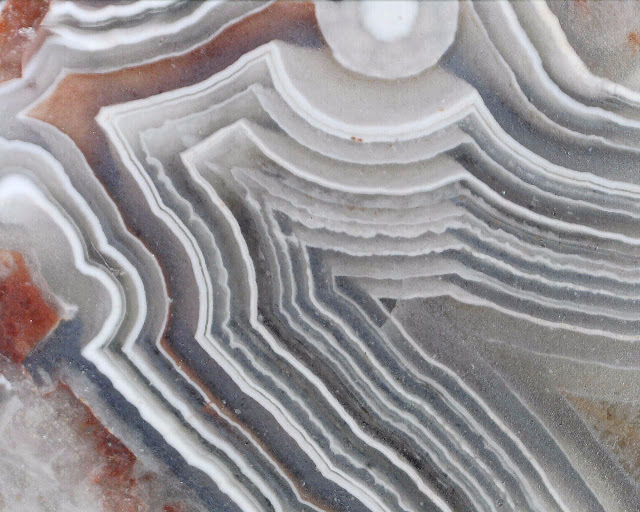
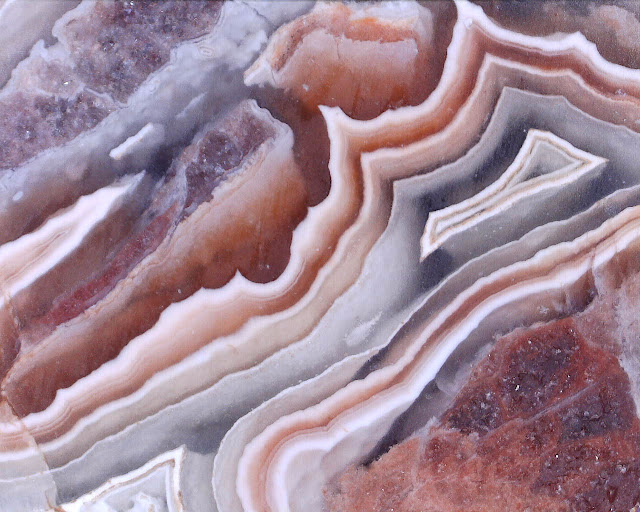
Macro photos of a slice of rock picked up in a local antique shop. The rock, at least, is antique; the slicing and polishing probably not.

Looks like walls of a maze

Trying to imagine what processes would make these patterns

Tubes in bubbles

Again, just because. I can't give a name to this piece of stone; I don't know where it originated, but it intrigues me.

UPDATE: from a comment by Peter Allen in Geology of Vancouver Island (Facebook).

Agate. Silica deposited from an aqueous solution, the lines represent changes in concentration of the solution. The solution was under high temperatures and pressures.
AND UPDATE #2: From a link on the previous comment: Origin..., pg. 19.

As explained above, the mechanism of agate growth is still a mystery to scientists. ... Agates represent one of the most impressive examples of spontaneous pattern generation in the world, and studying agate crystal growth could help explain how natural patterns like these are generated without an external template. Agates are a noteworthy case of self-organization, both texturally and compositionally, and their origin has far-reaching geochemical, crystal-growth, and petrologic implications.

~~~~~~~~~~~~~~~~~~~~~~~~~~
Del archivo llamado "porque sí": fotos macro de una rebanada de piedra que compré en una tienda de antigüedades. La piedra es antigua; dudo que lo es el trabajo de rebanar y pulir.

Porque sí. No puedo identificar este tipo de piedra. No sé de donde vino, pero me inspira curiosidad.

ACTUALIZANDO: de un comentario por Peter Allen en la página Facebook, Geology of Vancouver Island.
Agata. Sílice depositado desde una solución acuática; las lineas muestran cambios de la concentración de la solución. La solución estaba bajo temperaturas y presiones altas.
Y ACTUALIZANDO UNA VEZ MAS: de un enlace en el comentario citado:

Como se explica arriba, el mecanismo del crecimiento de $gatas sigue siendo un misterio para los científicos. ... Las ágatas son uno de los ejemplos más impresionantes del origen espontáneo de modelo mundiales, y estudiar el crecimiento de los cristales puede ayudar a explicar como es que modelos naturales como estos se generan sin una esquema exterior. Las ágatas son un ejemplo notable de organización autónoma, tanto en su textura como en la composición, y su origen lleva consecuencias importantes en los campos de geoquíica, crecimiento de cristales, y petrológicos.


Monday, April 16, 2018

And a few more rocks on the shore

They intrigue me. I wish I knew their history.

Stripes on a large rock. With tiny barnacles in the cracks.

Peeling rock.

Trying to imagine how this came about: a solid core was bathed in sediment, which hardened into a smooth coating, and now, after a pounding by waves bearing pebbles and alternately frozen and heated, the coat is peeling off. Just a guess, probably not quite correct.

The snails like to bask in the sunshine at low tide, like tourists on a tropical beach.

A small clump of sea lettuce washed up, adding a touch of softness and colour.

Seaweed on rocks that are usually underwater.


Powered By Blogger