Aphids. They're a pest. They make plants sticky and spoil the looks of flower bouquets. They drop honeydew on lawns. They attract ants. In large numbers, they suck the sap out of new plant growth. Otherwise, they're mostly harmless, but no-one seems to like them much.
But they can be interesting. And cute, too.
A handful of pearly everlasting gathered for winter blooms from the shores of Upper Campbell Lake came home with its cargo of blackish aphids.
 |
| Busy little beasties. |
The two projections, called siphunculi or cornicles, near the rear are unique to aphids. They're tubes that exude a quick-hardening defensive fluid, cornicle wax.
Most of these aphids will be females. Some will be pregnant with their daughters and granddaughters.
Aphids have been known to have what is called telescoping generations. With telescoping generations the female aphid will have a daughter within her who is already parthenogenetically producing its own daughter at the same time. (McGill university page)
While the weather is warm, aphid females go on producing generations of daughters. When the weather turns cold and food becomes scarce, males are born; both males and females born at this time may have wings. They mate and the females lay eggs which will hatch in the spring.
Some species of cabbage aphids (like Brevicoryne brassicae) reproduce rapidly during the summer. They are all females, and can produce up to 41 generations of offspring. If no aphids had died during the summer, there would be more than one and a half billion billion billion aphids (1.5 x 10²⁷) by the end of the season. (McGill)
Yikes!
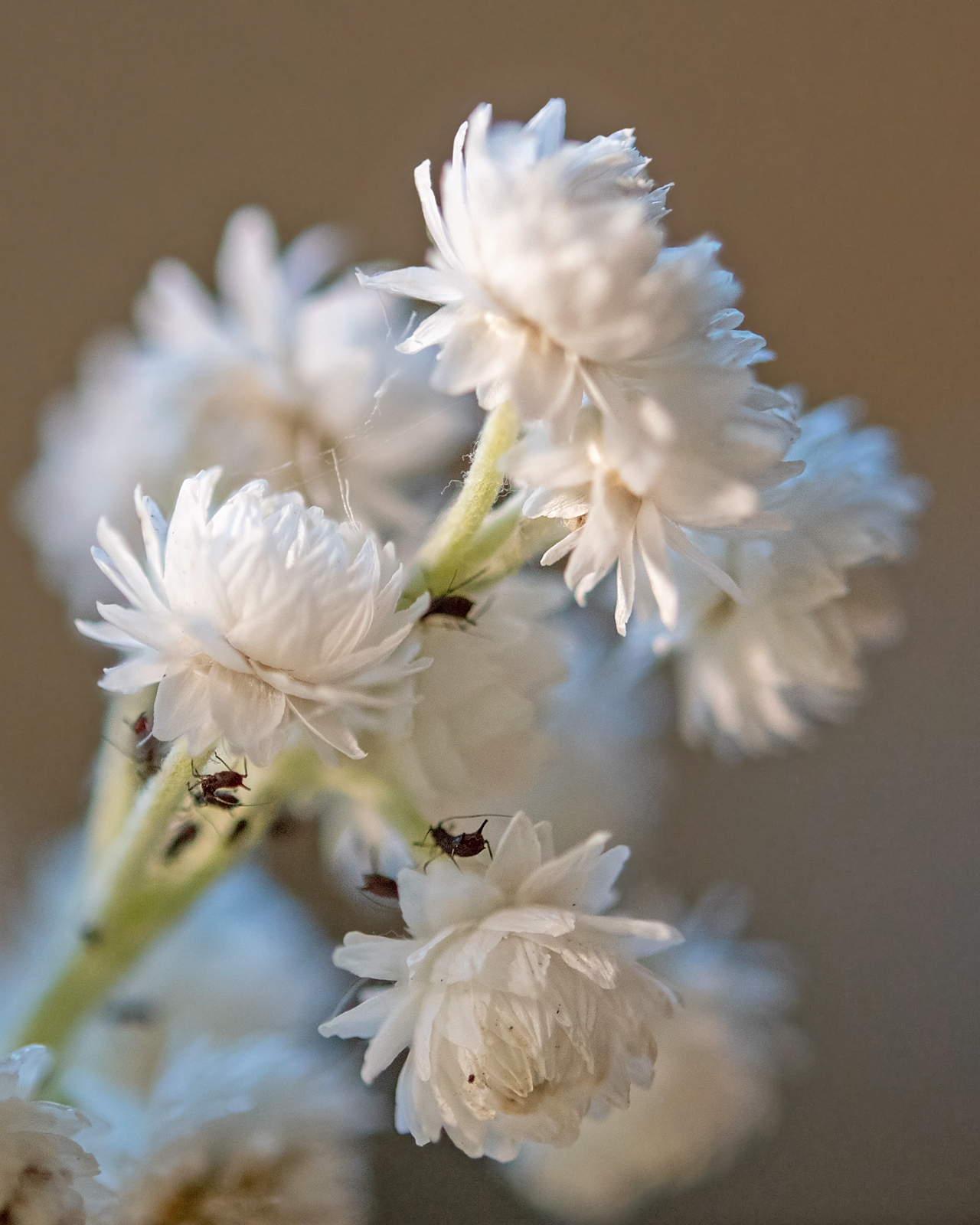 |
| All wingless still. The weather has been warm. |
 |
| What yoga position is this? |
~~~~~~~~~~~~~~~~~~~~~~
Los áfidos. Pulgones, les llamamos. Son una plaga. Vuelven las plantas pegajosas y arruinan la belleza de nuestros arreglos florales. Depositan melazo en el césped. Atraen a las hormigas. Cuando son muchos, impiden el crecimiento de las flores y fruta. Aparte de esto, no son muy dañinos, pero nadie parece tenerlos afecto.
Pero pueden ser interesantes. Y chistosos, también.
En un manojo de perlado eterno que traía a casa desde la orilla del lago Upper Campbell para hacer bouquets para el invierno, había una familia de áfidos oscuros.
Fotos: perlado eterno con sus áfidos.
Los dos apéndices hacia el posterior del insecto, que se llaman sifúnculos o cornículos, son una característica única de los áfidos. Son tubos que exudan un líquido defensivo que se endurece rápidamente, o sea cera de cornículos.
La mayoría (tal vez todos) de estos áfidos son hembras. Algunas están embarazadas. Con sus hijas y sus nietas. (Las hijas, todavía sin nacer, ya llevan adentro sus propias hijas.)
Los áfidos tienen lo que se han llamado generaciones telescópicas. Con una generación telescópica el áfido hembra traerá adentro una hembra en proceso de desarrollo, la cual también está produciendo partenogénicamente su propia hija al mismo tiempo. (de McGill U.)
Mientras el clima permanece caluroso, las hembras siguen produciendo hijas. Cuando llega el otoño y las dias de frío, nacerán áfidos machos; también tanto las hembras como los machos pueden tener alas. Se aparean y las hembras ponen sus huevos, que eclosionarán en la primavera.
Algunas especies de áfidos que viven en la col (repollo), como por ejemplo Brevicoryne brassicae, se multiplican rápidamente en el verano. Todas son hembras, y pueden producir hasta 41 generaciones de hijas. Si no se hubieran muerto ninguna durante el verano, habría más de 1.5 x 10²⁷ (15 con 26 ceros) de áfidos al final de la temporada. (McGill)
:O


