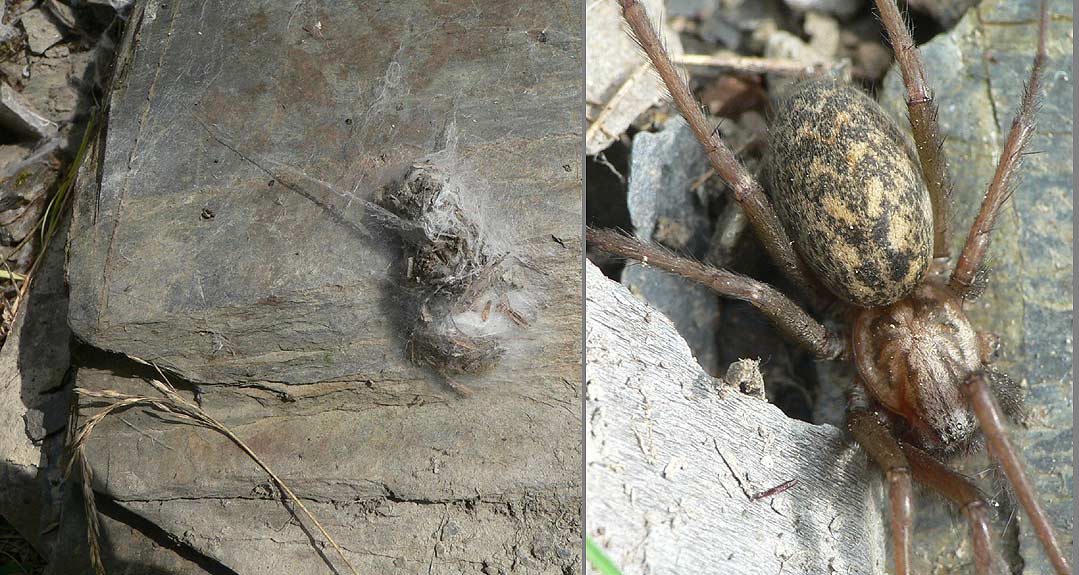
Showing posts with label Steatoda bipunctata. Show all posts

Sunday, August 18, 2019

Not a spider

So it wasn't a spider after all. I posted a photo of a spider look-alike a few days ago.

This little guy, about 3 mm. long, on gumweed.

I counted 8 legs, but I sent it in to BugGuide, and they count 6 legs and two antennae, which makes it not an arachnid.*

Ken Wolgemuth, on BugGuide, says it is "an aphid of some sort."

Interesting: I've seen many black aphids, but always in a mass covering stems and leaves of a whole plant. I've never seen (that I knew of) one out for a walk on his own.

Now this, I know for sure, is a spider:

Fat house spider, Steatoda, probably bipunctata, probably female. On the wall above my desk.

*Update: not 6 legs and 2 antennae; they're 6 legs and 2 "corniculi, a pair of tubes that come off the back of an aphid's abdomen," as Christopher Taylor tells me in the comments. He adds that they may be used to release chemical compounds.


From WikipediaThe cornicle (or siphuncule) is one of a pair of small upright backward-pointing tubes found on the dorsal side of the 5th or 6th abdominal segments of aphids. They are sometimes mistaken for cerci. They are no more than pores in some species.
These abdominal tubes exude droplets of a quick-hardening defensive fluid containing triacylglycerols called cornicle wax.
Thank you, Christopher!

Tuesday, December 22, 2015

Emergence

The spiderlings have left the nest!

Pioneer. The first out of the nest, at 9:30 in the morning.

One other spiderling joined him this morning, and they wandered about, stringing their tiny silk threads behind them. The others, more timid, waited until well after nightfall to brave the big new world out there.

10 PM. Spreading out, looking for an exit from the box.

They're lining up along the join between walls of the box. I don't think they can get through the gap, but they're trying.

These babies are not behaving like other spiderlings I've watched; usually, they hang together in a cluster for quite some time after they leave the egg sac. These are individualists from the moment they break free.

About half of them are still keeping cosy in their silk blanket. Homebodies.

The eggs in the second egg sac are on their way; I can see a hint of little legs in there now.

Egg sac # 2. Smaller, but fertile.

There's a third egg sac in the line-up, too. Brownie's not leaving anything to chance.

I'll move the box to a sheltered spot outside tomorrow, and crack the door open a bit. I don't really want the whole tribe settling down in my kitchen.


Tuesday, December 15, 2015

Dozens of little legs

Last month, my spider-in-a-box laid a clutch of eggs and wrapped them in a silk blanket. When she added a second egg sac, I posted photos here.

Steatoda bipunctata, with first batch, November 6th.
And then ...

November 14th. The eggs are a bit darker.

November 25th. Noticeably darker, and spreading out a bit.

This morning, December 14th. They seem to be moving about in there.

And tonight, 5 weeks after egg-laying. Spiderlings! Still inside the silk cocoon.

They'll be moving out of the egg sac soon, but I couldn't wait to post these pre-hatch photos.


Tuesday, November 24, 2015

Eggs in a blanket

A few weeks ago, searching for spiders for Arachtober, when we post a spider a day to the Flickr pool, I found a pretty, chocolatey cobweb spider under a brick, and brought her inside. I put her in a glass box, and she quickly made herself at home, building a messy web in the corner, and settling in to wait for sowbugs, her favourite food. I'd removed the brick, so I let her stay in the box, and have been providing her with groceries.

Two weeks ago, I found her busy making a blanket for a batch of eggs.

Steatoda bipunctata, with egg case.

If you look closely at the photo, you can see a dense white ball in the centre of the silk fluff she's making. Those are the eggs.

(The other cobweb spiders, the American house spiders, that I've watched making egg cases cover them in a brownish, rumpled, papery skin. It's impossible to see the spiderlings developing until they break out, some weeks later.) "Brownie's" silk blanket is a nice change.

After a week, the eggs were darker, and spreading out a bit.

Egg mass against the window and blue sky.

Brownie is a sleek, glossy spider, with a fat ball of an abdomen. After she laid her eggs, she was really thin, as thin as a male would be. I fed her more sowbugs, and she bulked up again. And this afternoon, when I went to see how the eggs were developing, there she was, weaving a blanket for another batch of eggs!

I left her to it; I'll pester her with a camera once she's resting.

And I'm wondering: she obviously hasn't seen a male since her last batch of eggs, locked in her box as she is. Does she save sperm for a second batch, or will these not be fertile? Will there actually be spiderlings in that second egg case?

Time will tell.

Sunday, February 17, 2013

Miss B and the new lens

Tonight, Laurie spied a spider creeping out from under a bookcase to grab a tiny fly. One of Brownie's relatives; it's been a while since I saw one. We've had a long, almost critterless winter around here.

Time to test out the new macro lens. I took a dozen shots, then she objected to the flash and went to hide under the books again.

Photo #3, unedited except for lighting, and cropped to about 1/4 the original. (Click to see full size.)

The lens has its quirks. I'll have to do quite a bit of work to learn to use its good points and compensate for the problems.

I can't crawl in too close. That's good, and not so good. I'd never have gotten an inch from Miss B, here, as I would have had to do with the old cameras. But I'm also getting a lot of background, wasted pixels.

The closest I can manage to focus is at 6 inches. And there, the depth of field is next to nil. In the photo above, the tips of her legs and the back half of her abdomen are out of focus.

Miss B's fly, very small. Only a narrow strip of carpet is in focus; a quarter inch at the most.

The camera is quick, and has VR (vibration reduction) enabled. This really helps with camera shake, a big help when I'm on belly and elbows on the floor, hand-holding the camera, stalking a critter that moves about. Only three photos out of the dozen were badly blurred, a record for me.

And the flash works consistently, without a long wait to recharge.

Focussing, even in the semi-dark, is quick and accurate. When the spider wandered off, the focus followed her.

But. I'll have to work up to manual focus, to be able to aim at the part of the spider I'm interested in. Eyes and fangs, for example. The Auto focus just says, "Small object!" and aims for the center, ending up with a knee in focus and the eyes a blur.

Note: Steatoda bipunctata (Miss B and all her kin) make very messy webs. Even to their bug tie-downs. No neat butcher's packages for them.

Also: S. bipunctata's favourite food is sowbugs. With my nose on the carpet, I could see under the bookshelf. Miss B's stash of leftover dinners is a couple or three dried sowbugs.


Thursday, July 05, 2012

Chocolate and caramel spider

Six weeks ago, a big, chocolate-brown spider, Steatoda bipunctata, was waiting for us in the hall when we came home in the afternoon.

Isn't she beautiful?

These spiders are usually quite shy, and don't hang out on walls. She must have gotten lost. I brought her in and set her up in a glass house with plenty of hiding places; three clay cups planted with ivy and creeping Jenny. She picked a spot and settled in.

Hanging belly up in her barely-there web. I love the cream and caramel swirls in her chocolate underside.

The weather was odd, and there were no bugs around to feed her, so after a week or so, I opened the lid and moved her house just outside the door, letting her go where she could find her own food.

She's still there, usually in her hidey-hole in the handle of the centre cup. The lid is still wide open, and caterpillars and pillbugs join her from time to time. I've never seen her eat one; the other day, she was busy tying up a caterpillar, but when she left it alone, it rapidly untied itself and wandered off. But she probably catches the odd pillbug and hauls it off to eat it privately; these are extremely shy spiders.

Failed food preparation.

Now I know this is irrational, but I must confess that I'm foolishly pleased that she has chosen to stay with me, in the home I provided for her.


Sunday, June 28, 2009

Brownie cooks Christmas dinner

Brownie is a Steatoda bipunctata, a two-spotted cobweb spider. I've been housing her since last November in a big glass jar. (Previous posts: Mistaken identity, twice over, and To spin or not to spin, spider #4.)


Small sowbugs make up the bulk of her diet; fortunately, they're plentiful in this wet climate. But I try to introduce a bit of variety sometimes. I read somewhere that lab Steatodas raised on boring diets don't do too well.


Brownie and patterned sowbug.

Every so often, I empty Brownie's jar to get rid of the layer of dead carcasses at the bottom, then supply her with a few fresh sticks to tie the new web to. She doesn't appreciate this. She usually spends the next few days sulking in a corner, not moving, not eating.

So yesterday was cleaning day. This time, because she somehow manages to pull down the sticks and tie them together at the bottom, limiting her mobility, I gave her a framework of leftover pipe cleaners. I hope they will be more resilient. (That's to explain the "Christmas decorations" in the next photos.)

In the evening, I found a winged ant in the garden, and brought it in to Brownie as a peace offering. It was a big one, half Brownie's length again: interesting! She forgot her snit, and stalked the ant from a distance for a full day. Tonight she caught it. And it put up a fight.


The battle.

I saw them at it, the two of them hanging in the web, vibrating. The ant kept snapping at the air, trying to turn its head to get at the spider. But Brownie had sunk her fangs into the edge of the thorax, and hung on like a bulldog. Nothing would shake her off, and the ant couldn't twist far enough to reach her.

(Usually, she bites her prey, then backs off and starts to tie it up. Looks like she's smart enough to modify her procedure when the occasion calls for it.)


She held on, never leaving that position, for over 15 minutes, until the ant was just barely kicking. Then she wrapped it and hauled it up to her new dining room.


She's been busy eating ever since. And I think she's forgiven the impertinence of her housekeeping staff.

.

Tuesday, April 21, 2009

To spin or not to spin

I will never catch up. Ever.

I've got half a dozen bugs in bottles and boxes on my desk, waiting to be blogged about; my extra hard drive is full of folders labelled, "Blog these"; I've got bookmarks, books, lists of links; the garden is growing, the bees are visiting ...

I need a week, just now and then, with 9 30-hour days in it. Please?

Or I can just get a move on. Starting with a batch of spiders.

1. I flipped a rock today. On the bottom, I found this large web:


Spider web. With average-sized dried maple leaf for comparison.

I didn't want to disturb the spider inside, but I did get a bit of her in one photo; there's a fat, round, brown and black spider body visible just under the centre, and the tip of a couple of legs on the left side.


2. On the rhododendrons along the walk, the pretty cross spiders are setting up shop. They're still very tiny; barely bright dots where the sun hits them.


Araneus diadematus.

They all, without exception, arrange their round web in front of the vegetation, and sit motionless in the centre, always with their topside facing out, head down.

3. I found this Philodromus dispar in my hallway, captured him, and photographed him in the viewing tin. He (his pedipalp has a thick, blobby end, which identifies him as male) didn't appreciate the attention, but frantically ran around and around, looking to escape, so I quickly let him go, beside the door to the outside, leaving him to make the choice; outside or inside. He chose inside.

I saw him later, roaming in the bathroom. The next day, he was on a lamp in the living room, and later on the wall over my desk. He doesn't make a web. He's a hunter, looking for a mate, probably.


Black and white running crab spider. Always recognizable, because he's lost one of his pedipalps.

4. And this is my Brownie, lurking in her jar:


Steatoda bipunctata

She makes a messy web, with lines going every which way, some sticky, some to be used as paths or signalling threads. She hangs upside-down, after the manner of a house spider, but chooses different spots according to her whim of the moment. Usually, she is under some sort of shelter; a leaf or a clump of frass. Here, she is under the thick stem of a dried leaf.

When a woodbug (her favourite food) falls into the web, she springs into action. But instead of heading directly to the bug, she climbs to the top of a thread, then angles down to reach the bug from overhead. She bites it, then ties it up with silk, using her back legs to manipulate the threads. Once it's tied up, she drags it off, and hides it under another leaf to eat later on.

5. I found this big spider on a garden wall in Tsawwassen:


Large hunter, Tegenaria sp.

Tegenarias are web spiders, but I often see them laying in wait under a bit of shelter, without a web. This one was under the overhang of the top of the wall. A couple of feet away, I found an egg mass, probably hers. You can see the individual eggs under their blanket of webbing. (Photos of egg sacs of other Tegenarias, here and here.)


Spider egg mass.

6. This is a jumping spider that I have never seen before. The usual jumpers I see are those zebra-striped ones. This was a bit bigger, a lot more curious; he kept dancing around, trying to get a good look at the camera.


See those headlight eyes! No fly can sneak by, unobserved! I have seen a jumping spider leap almost 4 inches to catch a fly in mid-air. No web is needed.


Jumper. Side view. Eyes on the top of his head. Handy.

And for a change of scenery, here's a corner of my garden.


I didn't see any spiders on this plant.

.

Monday, December 08, 2008

This is why I love blogging!

One of the reasons that I love blogging, at least.

Yesterday, I wrote about my stumbling efforts to identify a spider, and about the help I'd gotten along the way. Within hours, more help arrived, with enough info on spider anatomy to warrant another post.

Rod Crawford had identified my spider as Steatoda bipunctata. I asked about defining marks; how had he identified her, and did the name refer to the dimples on the upper abdomen? Lynette Schimming forwarded my question to him; he wrote,
There aren't any (defining marks). I identified it from the epigynum. But yes, it's probably named after the "dimples" (which actually most spiders have - they're the apodemes or attachment points for the heart muscles).
Time for some definitions:

Epigynum (or epigyne): the female genital opening in spiders. (Wikipedia) Often used to distinguish species (as in this case). Christopher Taylor says (in the comments),
If you look at the front end of the underside of the abdomen, in front of the markings, you can see a dark sclerotised structure.


The epigyne is the black thing up near her waist.

PZ has a nice diagram and an explanation of spider sex, here: Spider Kama Sutra.

Sclerotised
: hardened or toughened tissue. (Csiro)

Christopher adds,
it doesn't get sclerotised like that until they reach maturity (though a non-sclerotised epigyne may be visible in the second-to-last instar).
Question for Christopher: how do you know it's hardened from a photo? Does the colour change?

Instar: a developmental stage of arthropods, such as insects, between each moult (ecdysis), until sexual maturity is reached. Arthropods must shed the exoskeleton in order to grow or assume a new form. Differences between instars can often be seen in altered body proportions or changes in the number of body segments. (Wikipedia)

Apodeme: Ridge-like ingrowth of the exoskeleton of an arthropod that supports internal organs and provides attachment points for muscles. (WordWeb) In this case, it's the heart muscles.

I found it hard to imagine this, but Visual Dictionary Online has a good diagram:


You can see the points where the heart* (red) attaches to the exoskeleton.

And here are the dimples, on another, very tiny S. bipunctata, I found this summer. (Maybe it's Brownie, as a baby.)


And thanks, all, for your help!

*Next Valentine's Day, I'm going to make my hearts this shape; long and skinny, with spikes.
.
Sunday, December 07, 2008

Mistaken identity, twice over.

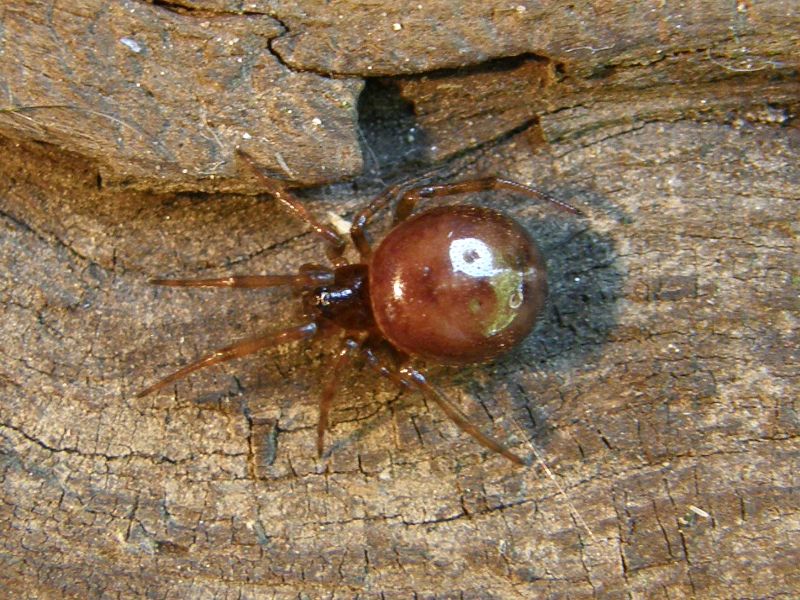
A couple of weeks ago, dragging out bags of potting soil from a corner of the patio, I surprised a pair of spiders. Fat, dark brown, glossy spiders, unlike the house spiders, cross spiders, and Tegenarias that I usually find. I captured one, and brought it inside.


Brownie, in a plastic food container.

When she (skinny pedipalps identify her as female) climbed the side of the container, I got a look at the underside. She was marked with a sort of hourglass shape.


Oh.

Black widow? Immature, because she isn't shiny black yet?

I know that black widows aren't supposed to live around here, but you never can tell; nor are Shy Cosmet moths, yet I found some. And it is late in the year to find immatures, but the climate is changing; it was mid-November, and my fuschias were still blooming. (Still are now, two weeks later.)

I had to be sure. I kept her lid on tight, and fed her moths and sowbugs. And eventually got around to sending her photo in to BugGuide.


Brownie, with a couple of tied-up moths.

Half an hour later, I had an ID. Steatoda borealis, the Northern cobweb spider. Not dangerous. But they are often mistaken for widows, so I didn't feel quite so foolish. And I could let her go. But now she had a jar full of specially-bred fruit flies; may as well let her finish them off, first.

And then yesterday, there was another note from BugGuide; Rod Crawford, Curator of Arachnology at the Burke Museum in Seattle says she is not S. borealis, but Steatoda bipunctata. Two-spotted cobweb spider? I found no common name for her, but that will do.


Steatoda bipunctata. Mistaken for borealis, mistaken for widow.

Rod Crawford says that she is "a rather recent introduction on the west coast." So I looked at the BugGuide map. Sure enough, they have sightings in Labrador and Ontario; nothing in BC until this one. Googling, I found pages of listings all over northern Europe, including the UK, but very few on this continent, and those all on the east coast. "Go west, young spider!"

S. bipunctata lives in close proximity to humans, often in sheds or basements, less frequently under bark in the forest. It makes a messy, tangled web, and hangs upside down either under the thick of it, or, as I've learned by watching "Brownie", a ways above. It eats mostly crawling insects, sowbugs and the like. It has been mentioned that ones kept in a laboratory and fed on fruit flies don't do too well. (So, either I let her go, or if I want to continue observing her habits, I find her some sowbugs.)

And they are short-sighted, discovering the presence of prey by the vibrations in the web. I saw this for myself: the first moth I introduced to Brownie's container didn't flutter, but simply walked around and around the edge. A couple of times, I saw the spider orient herself in the moth's general direction, but nothing came of it for a full day. I moved the container right beside a bright light, and woke up the sleeping moth; within a minute, Brownie had the moth tied up, and was dragging it off to the "dining room". She never had that problem with fluttery moths, whatever the lighting.


Brownie, in the middle of her messy web, eating a fruit fly.

One other thing; she isn't dangerous. (See Wikipedia: Steatoda) She probably won't bite, and if she does, it shouldn't be a problem. That's good to know.

And how to differentiate Steatoda from the widows? The belly of the widow is dark. It doesn't have the whitish line around the front of the upper abdomen. And the hourglass is always red. (Even when it doesn't look quite like an hourglass.)

.
Powered By Blogger