Showing posts with label green sea urchin. Show all posts

Sunday, June 29, 2025

10 minute tour

I had 10 minutes to kill, and there was a dock handy. A wooden dock, with wooden pilings. I got three underwater photos before my time was up.

The dock next door has metal pilings; no critters. On wood, on the very first piling there was a big kelp crab.

Between two dock sections. A giant plumose anemone, and a bunch of mystery  stuff. The red line at top left looks like the open mouth of a scallop.

Feather duster tubeworms, red and white, plumose anemones, a sea urchin, a barnacle, mussel shell, and what looks like a crab inside a clamshell. And what's that red oval? Maybe a sea cucumber?

And no styrofoam! Around the commercial docks nearby, the water is full of styrofoam shreds.

I'll be back there ASAP. For longer than 10 minutes.

~~~~~~~~~~~~~~~~~

Entre una cosa y otra, me quedaban 10 minutos libres. Y había un muelle a la mano. Un muelle de madera, con sus pilotes de madera. Y en esos 10 minutos, encontré animales en tres sitios.

  1. En el muelle comercial a poca distancia, los pilotes son de metal. Y hasta ahora no les visitan las criaturas marinas. Aquí, en el primer pilote, vi un cangrejo "kelp" grande. 
  2. Entre dos secciones del muelle. Una anémona plumosa blanca y un grupo de organismos "misterio". Creo que la linea roja al lado izquiedo es la boca abierta de una vieira.
  3. Toda una comunidad de animalitos.  Gusanos plumeros tubícolas, rojo y blanco. Más anémonas plumosas, estas color café. Un erizo de mar, un bálano grande, mejillones, y algo que parece ser un cangrejito dentro de una concha de almeja. Y esa cosa roja, creo que puede ser una cucumaria.
¡Y no hay nada de poliestireno (unicel)!Alrededor del muelle comercial el agua está llena de fragmentos de esta materia.

Regresaré muy pronto, con tiempo para verlo todo.

Friday, May 12, 2023

White crowns and purple feather-dusters

 About those purply worms ...

It was a bright, clear day, with barely a ripple on the water; just the kind of day to be poking around under docks.

Brown's Bay. The docks float on these blue tubs, a comfortable home for a variety of critters.

I like this muddled view. Dock planks, reflections of overhead structures, algaes and anemones underwater, overlaid by those reflections.

Most of the tubs carry the giant plumose anemones and a scattering of green sea urchins.

Urchins, anemones, and a wide-open scallop mouth.

The Giant Plumose anemone, Metridium farcimen, is white or brown, sometimes with a brown column and white tentacles. It can be distinguished from the Short Plumose by the lobed tentacular crown, as seen here, as well as by its size; it grows up to 1 m. tall, whereas the Shorts barely reach 10 cm. It likes low current sites, such as in this protected bay.

The scallop, probably the Giant Rock scallop, Crassadoma gigantea, (Update: Swimming scallop, Chlamys rubida) has an orange mantle, and if you look closely, a row of tiny eyes along the rim.
The abundant eyes of a giant rock scallop (Crassadoma gigantea) are backed with tiny mirrors that reflect light, unlike our eyes that use lenses to bend and focus light. The mirror in each eye has multiple layers to gather different wavelengths of light, and reflect that light onto a double-layered retina. (Jim Auzin's Photography)

Looking at me, looking at it.

And now, the worms.

Vancouver feather-duster worms, Eudistylia vancouveri, growing on a chain.

These are large tube worms, growing to 10 cm. long. In normal lighting, they look almost black, but bright sunlight brings out the purple and blue colouring.

Feathery red algaes to go along with the feather-duster worms.

A giant acorn barnacle, feeding.

In deeper water. A brown anemone with its white crown.

These long ribbed kelps attach to the tubs and float out into the sunlight.

On the way back to dry land, I leaned over the railing of the walk to look at the seaweeds growing on the sea floor. Tiny fish circled and swooped over them, echoing the flight of the swallows overhead.

Red and green algaes, eelgrass, and fish.

Next: clambering over rocks.

~~~~~~~~~~~~~
Acerca de esos gusanos plumero ...

Un dia de sol, con mucha luz y el agua casi sin olas; un dia ideal para andar rebuscando debajo de los muelles.

Foto #1: Brown's Bay. Los muelles se sostienen encima de estos botes flotantes azules, donde se encuentran comunidades de criaturas marinas.

#2: Me gustó esta foto toda revuelta, con las tablas del muelle, los reflejos de las estructuras arriba, y varios niveles de criaturas debajo, algunas vistas por medio de los reflejos.

#3: En la mayoría de los flotadores crecen las anémonas gigantes plumosas, y varios erizos de mar verdes. Aquí además hay una vieira de rocas con la boca abierta.

La anémona gigante plumosa, Metridum farcimen, es blanca o color café, a veces con la columna café y la corona blanca. Se diferencia de la anémona corta en que los tentáculos de la corona forman lóbulos, y además por el tamaño, ya que pueden crecer hasta 1 metro de largo, mientras que las otras llegan apenas a 10 centímetros. Les gustan los sitios con baja corriente, tales como esta bahía quieta.

La vieira, Chlamys rubida, tiene el manto anaranjado, y si te fijas bien, verás una hilera de ojitos en los labios.
Los ojos abundantes de una vieira de rocas (Crassadoma gigantea) tienen al fondo espejitos que reflejan la luz, en contraste con nuestros ojos que usan lentes para flexionar y enfocar la luz. El espejo en cada ojo tiene varias capas para captar la luz de distintas longitudes de onda, y reflejan esa luz hacia una retina de dos capas. (Jim Auzin's Photography)
#4: La vieira, mirándome.

#5: Y ahora, los gusanos. Son los gusanos plumero de Vancouver, Eudistylia vancouveri, y están creciendo fijados en una cadena en el agua. Estos gusanos, normalmente se ven casi negros, pero cuando la luz del sol les llega, se ven sus colores vívidos, morado o azules.

#6: En la misma cadena, unas algas rojas con filamentos finos.

#7: Un bálano gigante, buscando su comida.

#8: A la base de un pilote, las anémonas son más grandes. Aquí se ve una con la columna color café y la corona blanca.

#9: Estos quelpos se adhieren a los flotadores, y extienden sus largas hojas hacia el sol.

#10: Camino a tierra firma de nuevo, me detuve para mirar las algas al fondo del agua; algas rojas y verdes, y las hierbas Zostera. En el agua por encima, estos pececitos daban vueltas, como si copiaban los vuelos de las golondrinas en el aire arriba.

Mañana: algunas rocas.


Tuesday, June 21, 2022

Sandpaper teeth

What makes holes in rocks underwater?

Water, of course. And critters: limpets, some clams, sea urchins.

Green sea urchins, Strongylocentrotus droebachiensis, alongside (and in) a crack in the rock.

Limpets have their teeth, reputed to be the strongest biological material on earth; piddock clams have thick, hard shells with grinding ridges on the bottom. But sea urchins? A sea urchin test is fragile. Pick one up, carefully, because it will break in your hand if you squeeze it.

And yet they dig holes in the rock. With their teeth.

Sea urchin test.

The sea urchin's hard parts are made mostly of calcite. In other words, chalk. The spines are single crystals of calcite, the test is magnesium calcite; even 5 tiny grinding teeth are made almost entirely of calcite. Soft stuff. On the Mohs hardness scale, it's a 3, just harder than talc and gypsum. The soft sandstone of our beaches is a 6 or more. So how does the urchin dig its hole?

Tide pool and rock holes. With green sea urchins.

I asked Google. It had a few answers for me.

First: scientists ... "have discovered that the urchins’ secret lies in a combination of ingenious design strategies. ... The scientists found that the sea urchins’ teeth contain crystals of magnesium calcite, which are smaller, harder and denser than those of pure calcite; they are concentrated at the grinding tip of the tooth, particularly in the tip’s center, where the most force is being exerted in the course of grinding. What holds these crystals at the center of the tip is a matrix of larger and softer calcite crystals. ... The presence of magnesium calcite crystals acts like sand paper that helps to grind the rock down.

They found that all the crystalline elements that make up the tooth are aligned in two different arrays, ... interlocked ..., just at the tip of the tooth where most of the wear occurs. The scientists believe that interlocking produces a notched, serrated ridge resembling that of a carpenter’s file. This ridge is self-sharpening: as the tooth is being ground down, the crystalline layers break in such a way that the ridge always stays corrugated." (From Science Daily)

Magnesium calcite has a hardness of 4 to 4.5 on the Mohs scale. So that helps, but it's not enough, it would seem.

But then: Michael Russell at Villanova University in Pennsylvania and his colleagues studied purple sea urchins (Strongylocentrotus  purpuratus), which live along the west coast of North America. ... In the lab, the researchers placed single sea urchins on flat pieces of soft mudstone, moderately hard sandstone and tough granite. After a year, they measured the weights of the rocks, how the surfaces looked, and how much the rocks were eroded.

The sea urchins had eaten holes in all the rocks, although they made slower progress on the harder ones. Field measurements showed that holes in mudstone were about 220 cubic centimetres, whereas holes in sandstone were 63 cubic centimetres and holes in granite were just 45 cubic centimetres. (NewScientist)

 And: A pit would be formed in medium grain sandstone in less than five years, while it would take more than a hundred years to form a pit in granite. (ZMEScience)

Well, that's better. Sandpaper teeth plus patience and persistence. And then there's this:

"Some of the largest and we believe oldest red sea urchins up to 19 centimeters in size have been found in waters off British Columbia, between Vancouver Island and the mainland," Ebert said. "By our calculations they are probably 200 or more years old." (OregonStateUniversity)

Sandpaper teeth, patience, and 200 years to work at it. That would do it.

~~~~~~~~~~~~~~~~~~~~~~

¿Qué cosa hace hoyos en las piedras debajo del mar?

Bueno, el agua. Y además, las lapas, algunas almejas. Y los erizos de mar.

Foto #1: Erizos de mar verdes, Strongylocentrotus droebachiensis, al lado y dentro de una grieta en la roca.

Las lapas tienen sus dientes, los cuales tienen la fama de ser el material biológico más fuerte mundialmente. Las almejas alas de ángel tienen conchas duras y gruesas con estriaciones en la parte inferior. ¿Pero los erizos? La testa de un erizo de mar es frágil; levanta una, con cuidado; si la aprietas, se deshace.

Pero de todos modos excavan hoyos en las piedras. Con los dientes.

Foto #2: Una testa de erizo de mar.

Las partes duras de un erizo de mar están hechas principalmente de la calcita. En otras palabras, la materia con que se hace la tiza con que escriben los niños. Las espinas son cristales únicos de calcita, la testa es de calcita de magnesio; hasta los cinco dientecitos son casi por completo calcita, carbonato de calcio. Material blando. En la escala de dureza de Mohs, es un 3, apenas más dura que el talco y el yeso. La piedra arenisca de nuestras playas tiene la dureza de 6 o más. Pues, ¿cómo entonces es que el erizo se hace el hoyo?

Foto #3: Poza intramareal y hoyos en la roca. Con erizos de mar verdes.

Le puse la pregunta a Google. Y me dió algunas respuestas:

Primero: Los científicos ... "han descubierto que el secreto de los erizos reside en una combinación de diseños ingeniosos. ... Los científicos descubrieron que los dientes de los erizos de mar contienen cristales de calcita de magnesio, los cuales son más pequeños, más duros y densos que los cristales de calcita pura; están concentrados en la punta pulidora del diente, particularmente en el centro donde se ejerce la mayor fuerza en la obra de taladrar. Lo que detiene estos cristales en el centro de la punta es una matriz de cristales de calcita más grandes, más blandos. ... La presencia de cristales de calcita de magnesio funciona como papel de lija para triturar la roca.

Hallaron que todos los elementos de que consiste el diente están ordenados en dos series distintas, ... entrelazadas ... justo en la punta del diente donde ocurre la mayor parte de desgaste. Los científicos creen que al entrelazarse, se produce una cresta dentada parecida al borde de una lima de carpintero. Esta cresta se afila por sí sola; mientras que el diente se desgasta, las capas cristalinas se rompen de tal manera que la crest siempre se mantiene dentada. (Science Daily)

La calcita de magnesio tiene una dureza de 4 a 4.5 en la escala de Mohs. Ayuda, pero no parece ser suficiente.

Pero: Michael Russel, de la Universidad Villanova en Pennsylvania, con sus colegas, estudiaron los erizos de mar morados, Strongylocentrotus purpuratus, los cuales viven el las costas del Pacífico de Norteamérica. ... En el laboratorio, colocaron erizos de mar, uno por uno, encima de piezas de lodolitas blandas, de piedra arenisca de dureza mediana, y de granito duro. Después de un año, midieron el peso de las rocas, vieron la apariencia de las superficies, y notaron en cuanto se habían erosionado las rocas.

Los erizos habían hecho hoyos en todas las rocas, aunque iban más despacio con las rocas más duras. Midiéndolas, se notó que los hoyos en las lodolitas llegaban a 220 centímetros cúbicos, mientras que los hoyos en la piedra arenisca eran de 63 cc. y los del granito de 45 cc. (NewScientist)

Y: Un buen hoyo se formaría en piedra arenisca en menos de cinco años, mientras que tomaría cien años para hacer el mismo hoyo en el granito. (ZMEScience)

Bueno, eso parece más posible. Dientes de lija, además de paciencia. Y luego, hay esto:

—Algunos de los más grandes, y creemos que los más viejos erizos de mar rojos, midiendo hasta 19 cm. de diámetro se han encontrado en las aguas cerca de Colombia Británica, entre la Isla de Vancouver y el continente — dijo Ebert. — Calculamos que tienen probablemente 200 años o más. (OregonStateUniversity)

 Dientes de lija, paciencia, y 200 años en que taladrar. Eso serviría.


Wednesday, June 15, 2022

Anatomy of a lantern

Another of the hitchhikers. Last October, a tiny green sea urchin came home with me, hidden in a fold of sea lettuce. He's been with me ever since, cruising around the glass walls, scraping algae off the oyster and clam shells, sometimes sleeping for days then rousing at a touch from a crab to hurry off to the far side of the tank.

Here he is, last October. He measured about 1 cm. across back then. This is the underside, showing the mouth and the 5 teeth.

The aquarium is not an ideal habitat for these urchins. They're a gregarious species, crowding together in their kelp beds. And they eat kelp, which is hard to come by for the aquarium. But this little one did ok for a while; over these few months he grew to 3 cm. across. And then he slowed down, lost his spines, and died. (He would have died if I had left him on the beach, tossed up above the tide line, so he had a few extra months.)

And within hours, the crabs and hermits, scavengers always, had cleaned out his test. I found it when I went to add more ice to the tank. And beside the test lay the entire Aristotle's lantern, still in one piece. I collected it quickly before the crabs took it apart.

I examined it under the microscope:

Aristotle's lantern, mouth side, showing the teeth.

The whole structure is called Aristotle's lantern, apparently because Aristotle first described it. It consists of 5 jaws composed of calcium carbonate plates, linked with muscular tissue. The whole apparatus is pushed outwards to feed, opening the central gap; the teeth scrape off algae or dig holes in rock to sleep in. Closed, the mouth works itself from side to side, chewing what it has bitten off.

And this is what it looks like from the inside:

Aristotle's lantern, from the base. I had to support this on a fluffy cloth to keep it upright.

The entire structure measured 8 mm., teeth to base. And about the same in diameter. I just checked it, where I had stored it, carefully protected from movement, hoping for a more accurate measurement, and each individual plate and tooth had separated themselves, now that the remaining muscle has dried up. No wonder I never see them on the shore!

~~~~~~~~~~~~~~~~~~~~~~~~~~
Otra de las criaturas que llegaron "de pilón" al aquario. En octubre del año pasado, un erizo de mar, muy pequeño, vino a casa escondido en un doblez de alga marina, Ulva spp.. Ha estado en el acuario desde entonces, dando vueltas por las paredes de vidrio, bajando a raspar algas en las conchas de ostiones al fondo, a veces durmiendo por unos dias, despertando a un empujón del cangrejo, y corriendo hasta el otro extremo del tanque.

Foto #1: Tal como lo vi en octubre. Medía como 1 cm de diámetro entonces. La vista es de la parte inferior, mostrando la boca y los 5 dientes.

El acuario no es habitat ideal para estos erizos. Son una especie gregaria que se amontonan en gran número en sus lechos de kelp. Y se alimentan principalmente de kelp, lo que es difícil mantener en el acuario. Pero este chiquito estuvo bien por un tiempo; en estos pocos meses creció hasta medir 3 cm. de diámetro. Y luego se puso triste, perdió las espinas, y falleció. (Hubiera muerto el año pasado si lo hubiera dejado allí en la playa, aventado por las olas arriba de la zona mareal, por lo menos tuvo unos cuantos meses más de vida.)

Y dentro de pocas horas los cangrejos y los ermitaños, carroñeros siempre, le limpiaron por completo la testa. La encontré cuando fui a añadir hielo al tanque. Y al lado de la testa estaba la linterna de Aristóteles, todavía entera. La recogí de inmediato antes de que los cangrejos la desbarataran.

La miré bajo el microscopio.

Foto # 2: La linterna de Aristóteles, el lado bucal, mostrando los 5 dientes.

Esta estructura se llama la linterna de Aristóteles, parece ser porque el filósofo fue el primero en describirla. Consiste en 5 mandíbulas hechas de placas de carbonato de calcio, ligadas entre sí con fibras musculares. El aparato entero se extiende hacia el exterior cuando el erizo come; se abre el espacio central y los dientes raspan el alga que come o hace hoyos en la piedra, donde el erizo se retirá a dormir. Cuando la boca se cierra, se mueve de un lado para otro, masticando su alimento.

Foto # 3: Y así se ve desde el interior. Aquí la tuve que apoyar sobre un textil espumoso para mantenerla derecha.

La estructura entera mide 8 mm. desde la base hasta los dientes, y más o menos lo mismo de diámetro. Cuando volví a mirarla, donde la había guardada, bien protegida para que no se rompiera, ya se habían separado cada placa y diente, ya que los músculos se han secado.

Con razón nunca veo estas linternas en la playa.


Sunday, May 08, 2022

All the colours of the rainbow

Bright colours, wild and tame, from flowers to critters: I'm tidying up the "to be posted later" folder, making space for May's findings.

New grass just leaping up from under the moss.

Bleeding heart in a pot at home.

Big-leaf maple flowers

I don't know what this is, or how it got into my garden. But I love the colours.

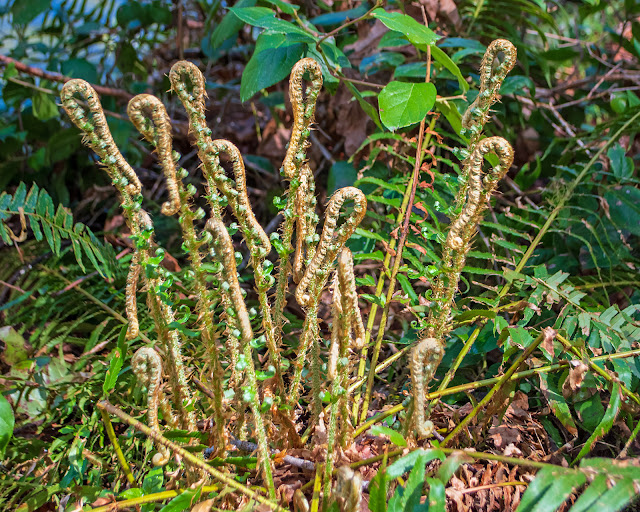
This year's new evergreen fern fronds, unrolling.

Coiled pre-fronds.

And now, the critters:

Green shore crab, with dried shrimp treat.

Close-up of the underside of a sea urchin; tube feet with cog-wheel tips, mouth, spines, and the red seaweed the urchin has decorated itself with.

Pale blues, and yellow legs. A greater yellow-legs, Tringa melanoleuca.

~~~~~~~~~~~~~~~~~~~~~~~~~~~~
Una variedad de colores brillantes, domésticos y salvajes, desde plantas a bichos: estoy organizando mi folder del mes de abril, haciendo espacio para lo que encuentro en este mes de mayo.

Fotos:
  1. Un brote nuevecito de pasto, recién surgido de debajo del musgo.
  2. Corazón sangrante, en mi jardín.
  3. Las flores del arce de hoja grande.
  4. Esta flor apareció en mi jardín, no sé de donde, ni que es.
  5. Los helechos de hoja perenne se empiezan a desdoblar.
  6. Y debajo, unas hojas todavía están enrollados.
  7. Y ahora, los animales: aquí un cangrejo verde, Hemigrapsus oregonensis.
  8. Viendo muy de cerca un erizo de mar verde; se ven aquí sus espinas, sus pies ambulacrales, con sus extremos en forma de ruedita dentada, la boca, y el alga roja con que se adorna.
  9. Azul claro del agua, y patas amarillas: un chorlo mayor, Tringa melanoleuca.


Monday, March 28, 2022

Divided by five

Thinking about echinoderms: the sea stars, the sea urchins, the sand dollars, the cucumbers that I see at low tide.

Sand dollar, alive. Dead ones lose the blackish hairs. Look closely: they move!

Green sea urchin, Strongylocentrotus droebachiensis. (What a name for a small critter!)

Everything else, the crabs and the fish and even the worms are arranged in a way that seems "normal" to us; with two similar, sometimes identical, halves: whether they have six, ten, fourteen or umpteen feet, they come arranged in pairs.

But the echinoderms are arranged with five points around a central axis. Usually; some of the sea stars may have more, from 6 up to 50. But it's usually 5.

No reason: Ma Nature does what she wants.

But reading about them on Wikipedia, I discovered this:

Although adult echinoderms possess pentaradial, or five-sided, symmetry, echinoderm larvae are ciliated, free-swimming organisms that organize in bilateral symmetry which makes them look like embryonic chordates. Later, the left side of the body grows at the expense of the right side, which is eventually absorbed. The left side then grows in a pentaradially symmetric fashion, in which the body is arranged in five parts around a central axis. (Wikipedia; Echinoderms:Anatomy and Physiology)

Ma Nature does what Ma Nature wants to.

~~~~~~~~~~~~~~~~~~

Estaba pensando en los equinodermos, tales como las estrellas de mar, los erizos, los dólares de arena y los pepinos de mar, todos los que veo en las playas cuando la marea está baja.

Fotos:

  1. Un dólar de arena, también conocido como galleta de mar. Está vivo; muertos, pierden los pelos negros rapidamente. Míralos de cerca; están en continuo movimiento.
  2. Un erizo de mar Strongylocentrotus droebachiensis. Un nombre muy largo para un animal tan chico.
Todo lo demás; los cangrejos y los pescaditos y aun los gusanos están organizados en una forma que a nosotros nos parece "normal"; con dos mitades por lo menos similares, muchas veces idénticas. Aunque tengan o seis, o diez, catorce o una multitud de patas, se organizan en pares.

Pero los equinodermos se organizan con 5 regiones alrededor de un eje central. Casi siempre; algunas de las estrellas de mar tienen más brazos, desde 6 hasta 50. Pero por regla general, tienen 5 brazos o lados o regiones.

No se puede saber el porque; la Madre Naturaleza hace lo que quiere.

Pero leyendo las páginas en Wikipedia, encontré esto:
Los equinodermos son animales originalmente con simetría radial, menos las larvas, que poseen simetría bilateral. (Wikipedia/es)

El sitio en inglés explica con más detalle:

Aunque los equinodermos adultos poseen una simetría pentaradial, o sea de cinco lados, las larvas son organismos con cilia que se organizan en simetría bilateral, lo que las hace parecer cordatos embriónicos. Más tarde, el lado izquierdo del cuerpo crece, abandonando el lado derecho, el cual finalmente es absorbido. El lado izquierdo desde entonces crece en forma de simetría pentaradial, en la cual el cuerpo se organiza alrededor de un eje central.

La Madre Naturaleza hace lo que le da la gana.


Saturday, May 08, 2021

Red, green, purple

In my posts over the last week, whatever I'm talking about, the sea urchins manage to worm their way in. They're mostly green sea urchins, although a red and a purple have shown up on the beauty bush.

Time to give them the spotlight they're begging for.

Green sea urchins, Strongylocentrotus droebachiensis, are small and gregarious. They are usually mostly green, with darker lines on the test (the round shell). Sometimes they're purplish.

Purple sea urchins, Strongylocentrotus purpuratus, are larger; their spines are green as juveniles, changing to pink, red, and purple as they mature.

Red sea urchins, Strongylocentrotus franciscanus, are the largest. They may be red, purple, pinkish, or even purple-black.

A green sea urchin on beauty bush. The test is up to about 9 cm. (2 - 3.5 inches) across.The spines are short and pale green.

The green sea urchin turned over. The central part is the mouth, with the plates that serve as teeth, called "Aristotle's lantern". More on these, later.

A purple sea urchin. This specimen measures 11 cm. across, spines and all.

The purple sea urchin's test may grow to 10 cm. (4 in.), and the spines are relatively short, usually under 2.5 cm. (1 inch) long.

And a red sea urchin.

The reds grow up to 30 cm, (12 inches) across, counting the spines, which account for half the width.

Red sea urchin, upside-down, showing the mouth.

Green sea urchins have been known to live from 20 to 25 years. Reds usually live up to 30 years, but some have been found to be 200 years old. Purples commonly live up to 70 years old.

About their behaviour and quirks, tomorrow.

~~~~~~~~~~~~~~~~~~~~~~~~~~

En mis posts durante esta última semana, sea lo que sea el tema, los erizos de mar se han hecho evidentes. Por la mayor parte, han sido los erizos verdes, pero también aparecieron sobre las algas en la playa, un rojo y un erizo morado.

Ya es hora de hacerles caso.

Los erizos de mar verdes, Strongylocentrotus droebachiensis, son pequeños y amantes de compañía. Casi siempre son verdes, con rayas más oscuras sobre la testa (la concha que cubre el cuerpo). A veces son de color violeta.

Los erizos de mar morados, Strongylocentrotus purpuratus, son más grandes; sus espinas son verdes cuando son jóvenes, cambiando a color de rosa, rojo y luego purpúra mientras crecen.

Los erizos de mar rojos, Strongylocentrotus franciscanus, son los más grandes de todos. Sus espinas pueden ser rojos, morados, color de rosa, o hasta un morado casi negro.

Fotos:

1. Un erizo de mar verde. La testa mide aproximadamente hasta 9 cm. Las espinas son cortas y de un verde pálido.

2. El erizo verde boca arriba. La parte central es la boca, con las placas que le sirven de dientes, a las que llamamos "la linterna de Aristóteles". Más sobre estas mañana.

3. Un erizo de mar morado. Este animal mide 11 cm., contando las espinas. La testa de un erizo morado puede crecer hasta 10 cm. Las espinas generalmente son cortas, menos de 2,5 cm. de largo.

4. Un erizo de mar rojo. Los rojos llegan a 30 cm., tomando en cuenta las espinas, que bien puede formar la mitad. 

5. El erizo rojo boca arriba.

Los erizos de mar verdes viven de 20 a 25 años, los rojos hasta 30 (¡pero algunos se han encontrado que tenían 200 años!), y los erizos morados viven alrededor de 70 años.

De su comportamiento y sus caprichos lo dejo para mañana.

Sunday, May 02, 2021

Contrasting textures

The sun came out. The tide went out, and so did I. Now I have a hundred photos to process.

Here's a leather star and some companions.

Demasterias imbricata, underwater

Wider view. Also present: green sea urchin, pink crustose coralline, whelks, limpets. pink branching hydrocoral, green sea lettuce.

More to come; much more.

~~~~~~~~~~~~~~~~~~~~~~~~~

Salió el sol. También la marea, y yo, siguiendo el agua mientras se alejaba. Ahora tengo cien fotos para procesar. 

Por ahora, aquí está una estrella de mar, Demasterias imbricata, a la que llamamos estrella de cuero. Con sus compañeros, un erizo de mar verde, Strongylocentrotus droebachiensis, alga coralina color de rosa, dos bocinas, unas lapas, un fragmento de hydrocoral falso ramificado, y "lechuga marina", Ulva sp.

Habrñ más, mucho más.

Powered By Blogger