Showing posts with label feathers. Show all posts

Monday, October 09, 2017

On the upper, upper beach

When I arrive at a beach, at almost any beach along our coastline, I face a series of tasks before I reach the intertidal zone. First, I have to find a passageway through the weed barrier, often infested with blackberry and other difficult plants. Then follows a scramble or climb across driftwood logs piled higgledy-piggledy at the top of the winter storm reach. Then there are rocks, sometimes small and shifty, sometimes large.  And then, the rotting eelgrass/seaweed belt.

I dislike this blue-black strip, sometimes as wide as a street; it may be dry on top, but it could be up to a foot deep, and wet, with no indication to warn me of random deep spots. My feet sink, releasing a foul odor. Flies and sometimes wasps buzz around me; the wasps follow me until I reach bare stones again. And it stinks; did I say that? It stinks of rotting vegetation, and sometimes of unidentifiable putrid carcases. I may have stepped onto or into one.

I reach the stones, rolling underfoot, but at least dry and clean. Then there's a second, narrow, line of dead seaweeds and other detritus, the leftovers of the latest high tide. That's fine; it smells of sea; if it's wet and slippery, I can just step over it.

Finally, the beach. If the tide is low, I can start exploring.

Last visit, the rising tide forced me back to the stretch between the dead seaweed belts. And I found it full of interest.

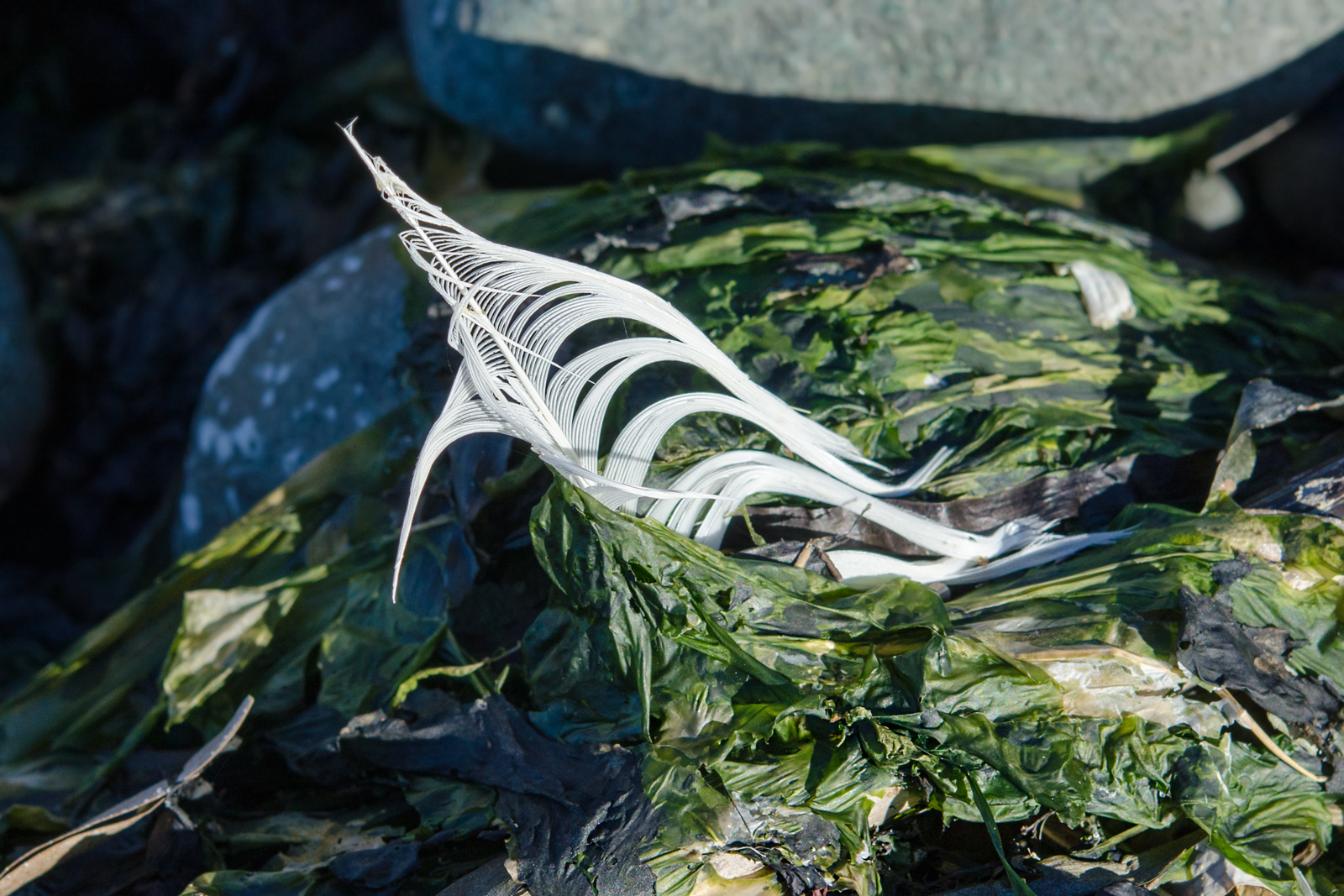
Eagle feathers. Everywhere, there are feathers.

Probably a gull feather.

Another feather. There are always more feathers.

A scrap of red coralline seaweed.

Jingle shell. This clam look-alike, or "rock oyster" (but it's not an oyster, either) has a hole in the lower shell. Byssal threads grow through this opening to attach the mollusk to a rock.

The lower (jingle) shell is thin and shiny. Tied with other jingles, it makes a nice, jingly wind chime.

Purple shore crab molt. At this level of the intertidal zone, there are no live crabs to be found, but their leftovers are scattered everywhere.

Another one, a male.

Tunnels in a strip of bark.

More tunnels, in a small piece of driftwood.

Another feather. The pale seaweed has been sun-bleached before it dried.

Two feathers, and dried eelgrass, toasted to blue-black. Sea lettuce retains its green colour until it disintegrates.

Bedraggled feather, wrapped in dried sea lettuce.

A rocky fish.

And there's always, always styrofoam. I filled my bag with a fair collection of it, a plastic water bottle, and a beer can. At least, I get a refund on the beer can.

And sho' 'nuff, there was a rotting carcasse! In the next post.

Thursday, August 29, 2013

Good excuses

Why it takes us an hour to walk one kilometre, on flat sand. It's easy going, with nothing to slow us down.

Boundary Bay, with Mount Baker, at low, low tide.

But we keep stopping to take another photo.

Clam in a tidepool, with refracted light, through a few inches of water.

Empty clamshell

Crab molt

Foot long polychaete worm, from my tank, returning to home base.

In every tidepool, hundreds of tiny, darting fish fled at our approach. These ones were "escaping" from Laurie, while I stood off to the side, without moving, except for my shutter finger.

Feather, pink and brown clam shell, worm poop, bird footprint, and a few sandy snails. As found.

Detail of feather. Worth clicking to see the tips full size.

Wave-carved sand patterns

Lugworm egg case. Most are large oval bags; this one is almost round. With worm hill and poop.

Tiny Baltic macoma shell. Most of the ones on this beach are pink. Very fragile; half the ones I bring home don't make it.

Speckled stone, with dwarf eelgrass, Zostera japonica. The stem just to the left of the stone has a row of seeds in a half sheath.


Sunday, July 17, 2011

Mallard feather

At Reifel Island.

Where on the bird was this?

The ladybug video is almost done. I'll post it tonight or tomorrow morning.

Tuesday, October 26, 2010

Four ducks and a grebe

All day, the wind has been howling down the stove vent and splatting raindrops against the windows. Outside, it blows right through my fall jacket. (Out on the water beyond the Island, they say, the waves went over 30 feet high.) It was a good day to clean house and sort out hard drives. A good evening to organize photos of calm summer weather.

These photos were among them, taken two weeks ago at Reifel Island Migratory Bird Sanctuary.


American Wigeon, female


I think she's a Mallard cross; the speculum, blue in "pure" Mallards, is brown.
Correction: female pintail. Thanks, Clare and Rebecca!


Grebe. A diver, not a duck.


Pintail.


And Mallard, being friendly.

Since she was so comfortable with me, I took a good look at her feather patterns:


Neck. The layered look.


Flank and belly.

These two really need to be seen full size. Click on them (left click for new tab) and look closely.

Thursday, January 22, 2009

Contortionist

Pintail, preening:

Reifel Island, Monday.

I'll post the rest of our Reifel birds, tomorrow.
.

Tuesday, July 10, 2007

Ouch!

A few minutes ago, I looked up from my desk, and saw a tiny bird splatted on the cement deck outside. He was on his side, with one wing off at an odd angle; he looked dead.

When I nudged him gently, though, he righted himself and pulled back the wing. Alive, at least. And quivering.
He sat like this for some few minutes, eyes closed. I finally picked him up, intending to put him in a warmer, safer spot, and he struggled, then was still. But his eyes were opening.

Five minutes of sitting like that, sheltered and warm, and he recovered:

When I opened my hand then, he flew away, blundering at first, then steadying. Good.

Look at the detail of those baby chickadee feathers:

Powered By Blogger