Showing posts with label sand configurations. Show all posts

Thursday, March 12, 2026

Just wondering. No answers.

I look at a beach and I wonder. What shaped it like this? How? And how long did it take?

Sometimes there are answers. Sometimes (usually?) they include words like "maybe", "possibly", "it has been suggested".

Wind, water, ice, (moving or still). Gravity, friction, chemistry, heat, life. And time, lots of time. Or not.

These are photos from one hour on one small stretch of beach. 

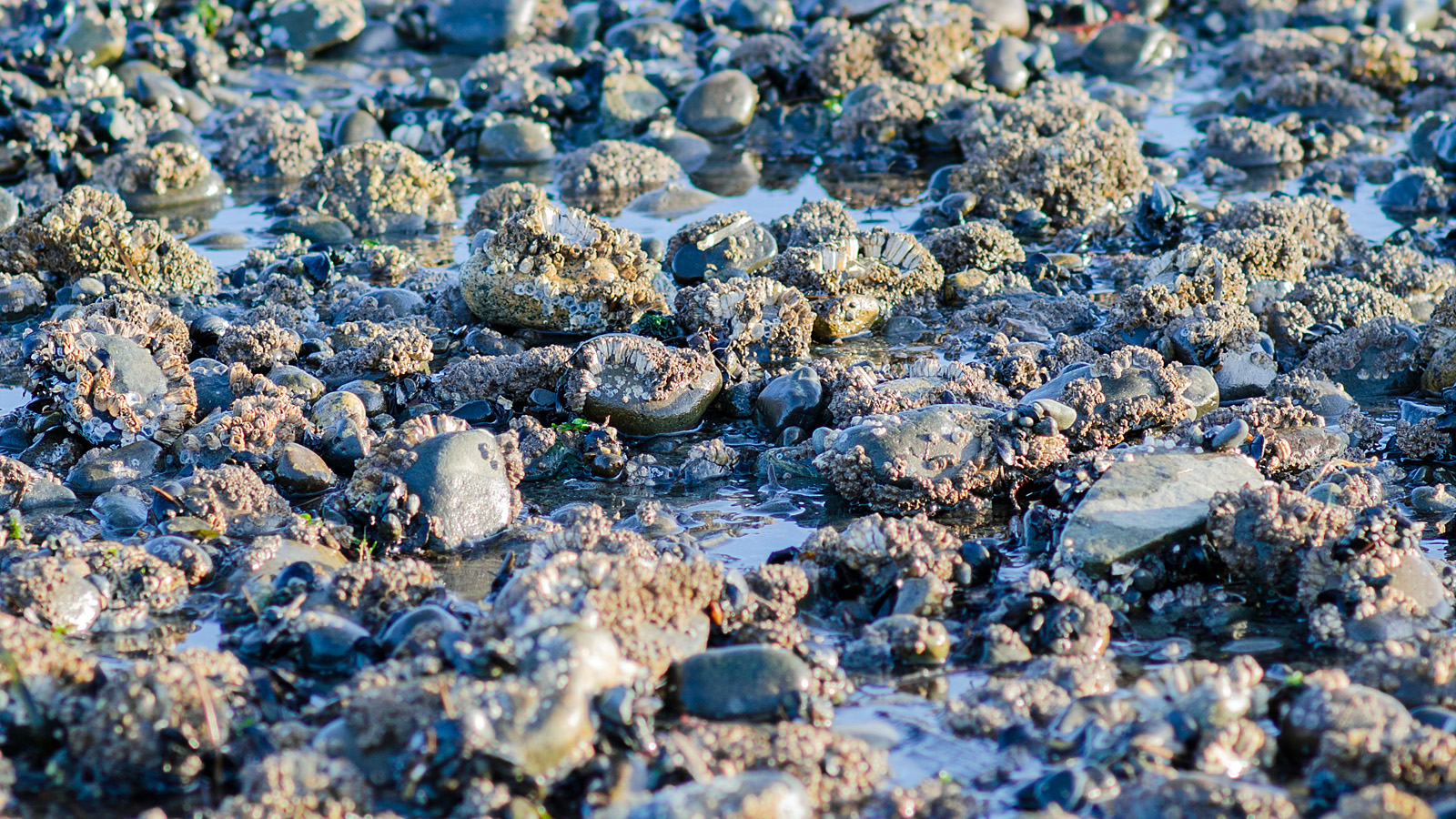
At the bottom of the intertidal zone. Soft rock, shaped by waves, currents, colonized by barnacles and oysters.The tip is probably exposed at high tide. This rock is marked on the boating map, labelled "awash rock".

Glacial erratics. Oysters, barnacles, seaweeds. Quadra Island in the background. The current in this channel runs fast and strong and sometimes chaotic.

Wide stripes, running out to the water: rocks, then flat stone or sand, then rocks, then ...

Upper beach, almost flat. Water draining from pools around rocks as the tide goes out carves lines in the sand. (Land to the right here, ocean to the left.)

A bit higher up. The tide is far out, and the sand is almost dry, but water still trickles down from the land above the tidal zone, seeping through the sand.

~~~~~~~~~~~~~~~~

Miro una playa y me pregunto: ¿Qué le dió esta configuración? ¿Cómo? ¿Y cuánto tiempo fue necesario?

A veces hay respuestas. A veces —¿Casi siempre? — las respuestas incluyen palabras como "tal vez", "posiblemente", "se ha sugerido".

El viento, el agua, hielo, tranquilos o en movimiento. La gravedad, la química, la fricción, las temperaturas, la vida. Y tiempo. Mucho tiempo. O no.

estas son fotos que saqué en un tramo pequeño de playa. 

  1. Donde termina la zona intermareal. Rocas suaves, esculpidas por las olas, las corrientes, y colonizadas por bálanos y ostiones. La cima probablemente sigue descubierta con la marea alta.  Esta roca está señalada en el mapa para navegantes.
  2. Bloques erráticos, dejados por los glaciares.  Ostiones, bálanos, algas marinas. Al otro lado del estrecho se ve la isla Quadra. La corriente en este sitio corre rápido y fuertemente, a veces en forma caótica.
  3. Franjas amplias, corriendo en dirección hacia el agua. Piedras, luego roca aplanada o arena, luego rocas, luego ... se repite.
  4. En la zona superior de la playa, casi horizontal. Agua que drena desde pozas alrededor de las rocas al salir la marea dibuja lineas en la arena. (Tierra firma queda a la derecha.)
  5. Esto está en la parte más alta de la zona intermareal. La marea ha dejado casi seca la arena, pero agua sigue escurriendo, bajando de la tierra firma.


Saturday, February 18, 2017

Immigrant stones.

It was low tide at Oyster Bay. And I looked at the ground under my feet.

Big rocks, small rocks, stones. Looking east, across to the mainland.

The rocks are rip-rap, brought in years ago to protect the bay, forming the outer leg of a U, and creating bird habitat. On the far side, the "outside", the remains of derelict ships poke through the sand below the usual low tide line.

When we first saw it, eight years ago, the fourth side of the lagoon was just a short strip of gravel, just a little serif on the U. Now, as the currents have brought around sand and even stones from the outer coast, it reaches most of the way across the entrance, apparently aiming to close off the lagoon entirely some day.

This is an old photo we took from the tip of the rocks at mid-tide, 2009. Facing the bottom of the U.

July, 2009, again. Geese  on the tip of the gravel bar.

And now, I walk where before there was only water.

Out near the new tip of the gravel bar. Barnacles and mussels cover the stones; underneath I found crabs and snails.

And on the inner edge of the bar, clean sand. Water running down as the tide retreats leaves sharply cut channels in the sand.


Thursday, May 08, 2014

Snail road maps

Satellite view:

Sand Hills National Park, trails and campsite circles.

Highway with rest area

End of the road. The Pit. Or, more pleasantly, Ye Old Watering Hole.

We got down to the beach yesterday for the first time in it seems like forever. Fresh air, empty water, blue sky: it's turned me a bit silly.

Saturday, January 25, 2014

Thursday, August 29, 2013

Good excuses

Why it takes us an hour to walk one kilometre, on flat sand. It's easy going, with nothing to slow us down.

Boundary Bay, with Mount Baker, at low, low tide.

But we keep stopping to take another photo.

Clam in a tidepool, with refracted light, through a few inches of water.

Empty clamshell

Crab molt

Foot long polychaete worm, from my tank, returning to home base.

In every tidepool, hundreds of tiny, darting fish fled at our approach. These ones were "escaping" from Laurie, while I stood off to the side, without moving, except for my shutter finger.

Feather, pink and brown clam shell, worm poop, bird footprint, and a few sandy snails. As found.

Detail of feather. Worth clicking to see the tips full size.

Wave-carved sand patterns

Lugworm egg case. Most are large oval bags; this one is almost round. With worm hill and poop.

Tiny Baltic macoma shell. Most of the ones on this beach are pink. Very fragile; half the ones I bring home don't make it.

Speckled stone, with dwarf eelgrass, Zostera japonica. The stem just to the left of the stone has a row of seeds in a half sheath.


Tuesday, March 19, 2013

Sand and water

Boundary Bay, on a sunny(!) afternoon:

Ridges and wavelets

Sand, water, sparkles. And Point Roberts.

And I found some surprising critters to bring home. Photos and story tomorrow.

Monday, March 04, 2013

Circle tour

I have a theory - in the totally non-scientific use of the word, meaning a guess about evidence badly infected with confirmation bias - that the harder it rains, the sooner it will quit. After all, raining hard will drain out all the water up there sooner, won't it? And when it does, it can't rain any more, can it?

Laurie laughs at me, but I have one more bit of "proof"; Saturday afternoon, it rained so hard that I missed my regular exit off the freeway because I couldn't see it. And a mere two hours later, the sun was shining. See?

So Sunday, the sun shone all day, from early morning till dusk. Not a cloud in the sky above us; summer blues. Beautiful!

And, of course, we went to the beach. Boundary Bay, parking in Centennial Park, and walking south on the sand, then back to the car through the streets of Beach Grove. The tide was 'way out, and the walking was easy, but the wind was vicious; in spite of the sunshine, we were bundled up to the ears.

Laurie took this directly into the sun, so it turned out like a moonlight photo.  We both loved those ripples in the sand.

Sand ripples merge into water kicked up by the wind.

There wasn't much else to see out there; seaweed, sand, blue sky, and far in the distance, the bay. Glorious, but boring, from the cameras' point of view. Four or five eagles were sitting out on the furthest sandbars, just black dots with white tops at that distance. We found more camera fodder once we returned to shore.

Heather, primulas, pansies, and tiny daffodils.

Chickweed, a couple of inches high.

Paper-white crocuses.

We were surprised to see azalea so early.

More crocuses, my favourites; purple and white striped.

The first ladybug of the year, under the watchful eye of an old log.

This bee, Bombus melanopygus, I think, was working a heather patch. I chased him down until I got one fuzzy photo. Then he disappeared. Look at that nice new paint job!  The orange belly almost looks metallic.

Laurie found this old telephone pole with a crown of old man's beard reflected in the trunk of a car.

And back to the parking lot, looking out towards the bay. It's almost supper time; the  shadows are stretching. The clouds hide our circle of mountains.

Bare tree, with trash can. I do wish they wouldn't paint them in such intrusive colours!

Then off to Tim Horton's for a warming cuppa. Afterwards, we stopped in at the nursery to buy sea soil and manure. I got a bag of primulas, yellow and white. Spring is here; the garden beckons.


Friday, January 25, 2013

Arrows pointing backwards and wavy letters

In January, when the water is too cold for wading, and the wet stones and sand are cold enough to cause a bone-deep ache in rock-flipping and sand-digging fingers, we behave more sedately than usual, walking upright on the sand, hands in gloves and pockets, eyes peeled for what we can see without stopping and getting chilled.

Sand, water and sky. Patterns in blue and grey. Laurie usually looks up to the sky and the distant snowy peaks. I'm more likely to watch what's in front of my feet.

Duck footprints. Probably mallards. Three toes, and distinct webbing.  Ducks toe in, which makes them waddle.

A duck has four toes; three facing forward, webbed, and a fourth, called a hallux. It faces backwards, is small and higher up on the leg. Sometimes it leaves a mark on the footprint. More often, it doesn't.

Gull tracks. The tip of the hallux left a mark in this wet sand. The footprint is about twice the size of the duck prints above, and the webbing isn't as marked. Like ducks, they toe in.

Heron tracks in soft sand. I don't know what makes those dotted-line furrows.

Heron track with my big boot for measurement. About 6.5 inches. (The heron's foot, not mine.) These are big birds.

Heron track on hard-packed sand. He drags that rear toenail. There is no webbing; the heron is not a swimmer.

Something different; check this out!

Just sand, sculpted by the tide.

But: this was flat, flat beach. Very flat; I want to emphasize this. But look at the photo from a bit of a distance; to me, it looks hilly. From a few steps back, the hills grow into small mountain ranges. And sometimes, when it catches my eye suddenly, I see what looks like letters among the lines. I can't read them; they morph into different shapes with the slightest head movement. (If I'm looking for them, I don't see them.)

What do you see?


Monday, April 18, 2011

Beach amusements

I've been sorting through the last of our recent beach photos. This collection, from Crescent Beach, may not be necessarily colour balanced or even in focus, but I found them interesting. Maybe you will, too.

Light:

Looking southwest, directly into the light, turns the gravel purple. 

Horizons:

I can't figure this out. Why is it that a distant horizon sometimes looks as if it were bending up at both ends ...

and sometimes it bends down, instead?

And then, sometimes it slides off to one side. (Laurie wanted all the sky and all the sand. Greedy.)

Underfoot:

Valleys in the sand. Modernistic figures, in a line-up, maybe.

A crinkly rock.

Flying things:

The ruler of the skies chases away an unwelcome airplane.

Kite above, kitesurfer below, speeding along in a stiff breeze. Heron standing still.

Your petticoats are showing!
 Rust:

Bolts on heavy driftwood planks. Because I like the texture.
Powered By Blogger