Showing posts with label clingfish. Show all posts

Monday, July 03, 2017

Where the living is green

In the intertidal zone, worms and snails live happily in sand. Crabs and fish live under rocks; limpets live on top. Crabs and  isopods like a seaweed blanket. But under a layer cake of sand, rocks, weed, it's party time; everybody mingles.

Lower intertidal zone, Simms Creek area. 

Calcareous tubeworms, spiral tubeworms, orange-legged hermit, bryozoans, limpet, assorted seaweeds, two pecies of snails, encrusting sponge.

More bryozoans, snail, hermit.

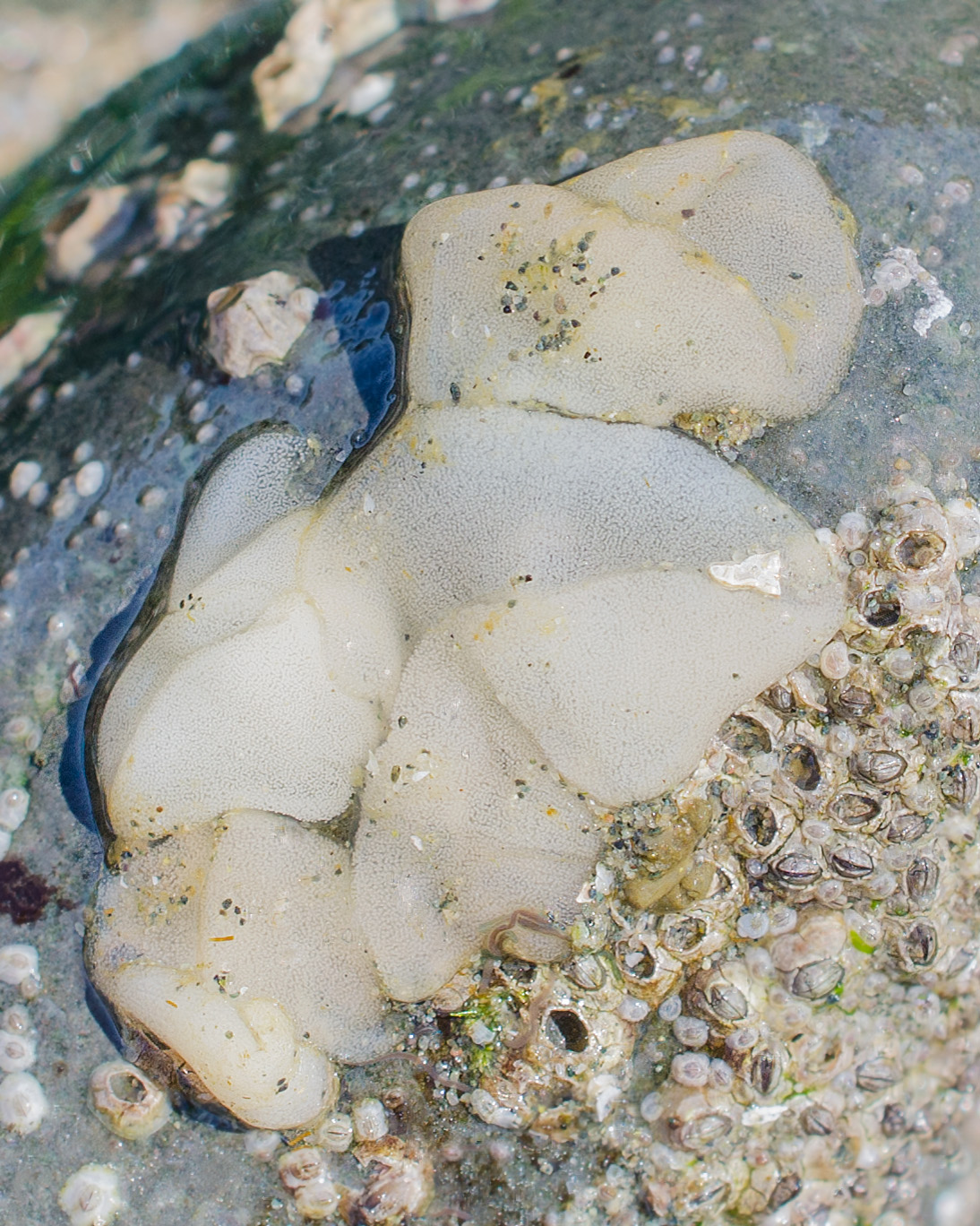
Encrusting sponge, with snails.

Grainy-hand hermit, Pagurus granosimanus.

Green mottled star, spiral tubeworms, bryozoans and sea urchin

Leather star and bryozoan. With hermit, snails, tubeworms.

Hermit (hiding), limpet, sea urchin, two kinds of snails.

Clingfish.


Friday, May 05, 2017

If I can't see you

... you can't see me, right?

"Invisible" cling fish, Gobiesox maeandricus.

I turned over a rock, and he spun and wriggled himself under another. I turned over that one, too, and he squirmed his way under the next. And when I lifted that one, he found himself this "safe" hideaway, and lay still.

Thursday, May 19, 2016

Shoulda, coulda, didn't

It's a mistake to be too easily satisfied, too quickly beguiled by the obvious. Flipping rocks at low tide, there's a tendency to say, "Look, a clingfish! Look, a pretty anemone, an angry crab!", to take a few photos and go on to the next rock without stopping to really pay attention.

And so doing, I miss out.

At least in some of my photos, taken with a wide enough view, and with a minimum of hand shake, zooming in back at home, I can discover many of the beauties I should have seen in situ.

This was supposed to be a photo of the rose anemone.

Busy scene.

Once I zoomed in, look at what I found:

You may want to click on this and enlarge it.

There's a juvenile wolf eel in there. And I had never seen one before; I wish I had noticed it while I was on the beach.

Another one; this was supposed to be a photo of the clingfish. But there's a complete brittle star, out in the open; I missed it live.

Two starfish, orange and purple, two large snails, several tiny ones, a kelp crab, two grainy hand hermits, pieces of gorgonian, pink and purple encrusting stuff, a long calcareous tubeworm, baby sea urchins, an adult sea urchin, spiral tubeworms, assorted polychaete worms, and the brittle star. Oh, and the clingfish.

About those baby sea urchins; really tiny sea urchins, barely visible in this photo, even at full zoom.

There are at least 5 sea urchin babies here, besides the medium-sized juvenile. I've saturated the red stuff, so as to highlight the pale pinhead urchins.

A purple sea urchin may live up to 70 years. The green sea urchin, a bit smaller than the purple, and more short-lived, grows about 1/2 inch per year. I found both of these, green and purple urchins, on this visit to the beach. A scuba diver told me he's seen thelarger red sea urchins here in the subtidal zone; they grow to about a foot across, counting the spines, and may live up to 200 years. I don't know what species the babies are, but they must be only a few months old.

One more photo; worms that I didn't notice, in a photo of an unco-operative gunnel.

A purple ribbon worm, three different polychaetes (one is striped, upper left), and a spaghetti worm (upper left, orange and yellow). And a four-armed green starfish, a hermit, two purple crabs, an urchin, and a brittle star.

Next visit to the lower intertidal zone, I think I'll sit me down in one spot and look at everything. Easier on my back, too.


Wednesday, May 18, 2016

Under-rock assortment

You can't flip just one. It's hard to stop at one hundred; I don't know if I could, if it weren't for the tide coming in.

Flipping rocks at low tide. Each one hides another treasure. And I stand up, holding my back and groaning, and tell myself it's time to quit. But there's a likely-looking rock in front of me. And another over there; and another ...

So here I am, a week later, still sorting photos of the one session on the beach. And the low tides in mid-afternoon are still beckoning.

Here, in no particular order, are a few of the remaining photos of under-rock critters.

Black prickleback, black blenny, Xiphister atropurpureus. The black bands with white edging behind the eyes identify it. The Rock prickleback has the same bands, but the edging is dark, the centres light.

A tiny northern clingfish, caught in a clamshell. Gobiesox maendricus.

Nudibranch egg ribbon. I'm not sure which nudibranch laid them.

Baby grainy hand hermit, in a broken baby moon snail shell.

Another grainy hand. The legs are a clear yellow when they're small.

Pink-tipped green anemone. And I think that's a nudibranch near the centre top, under the seaweed.

Unidentified chiton. This was one of a group almost hidden in the mud in a tidepool full of floating seaweed fragments. The largest was a bit over an inch long.

Another unidentified nudibranch, half-hidden under a rock and not seen until I examined my photos.

Seaweeds floating in the tide.

More goodies tomorrow. And then, a day trip to Mitlenatch Island. And a video or two. I'll never catch up!


Monday, November 22, 2010

Spinfish

Lifting seaweed and turning over rocks on the beach this summer, we often startled (and were startled by) a frantic fish, thinking we were herons, probably. Like this one:

When in danger or in doubt,
Spin in circles, scream and shout.*
 I'd never seen a fish spin like a top before. "Where's the heron? Which way should I go?"

We disturbed clingfish like this one on several beaches. Eventually, when they couldn't escape, they lay still, hoping to be invisible.

Northern clingfish, Gobiesox maeandricus. With a northern mudworm, Paranemertes peregrina.
 On their underside, they have a large suction disc, which enables them to stick to rocks even in high current areas. They are smooth, scaleless, and have no spines. (No, they are not spineless; they do have a spinal cord. The spines they don't have would be on their fins and heads. Words are tricky things, sometimes.)

Right-click on the photo to see it full size. See how smooth it is? It looks almost as if it were varnished with that thick polyurethane stuff popular a few years back. These little fish are covered with slime; it's almost impossible to get a grip on one with your hand. The harder you grab, the faster they escape.

Camouflaged sculpin
These sculpins don't panic; they rely on their cloak of invisibility.  Like most sculpins, they ambush their prey, blending in with their background until the hapless critter ventures too close.

Gunnel, captured and peaceful. I'm not a heron, after all.

The exposed beach is a dangerous place.
*Except that fish can't scream, I think. They would if they could, though.
Powered By Blogger