Showing posts with label Bull Canyon. Show all posts

Wednesday, September 23, 2015

Abandoned nurseries

Along the fence around the campsites at Bull Canyon, a small stand of aspens has sprung up. Most are still under 8 feet tall. And most, this year, are sporting lumpy blackish growths along the stems.

What lived inside this? About 2 inches across.

I broke a few off. They were all hollow and dry, as thin and fragile as eggshells. There was no sign of their previous occupants.

This one seems to incorporate a dried leaf.

I looked up aspen galls, and found leaf galls;, small blobs that grow right at the base of the leaves and twig galls; small, smooth balls lined up along a twig, but nothing like these.

Most of the galls had several holes that looked more like chickadee predation than insect exit holes. I have watched chickadees with thimbleberry galls in the winter, pounding away at them until they crack open. Somehow they know there's good meat inside that hard casing; maybe the larva inside moves around, makes some sound that we can't hear, but the chickadee can.

Tuesday, September 22, 2015

Prickly smile

If I were to choose one adjective to describe the Chilcotin, I would have to go with "scratchy". Everything seems to be sharp-edged, jagged, unforgiving. Itchy, like one of those rough wool sweaters Mom made us wear in the winter.

Even the spiders are prickly.

Spider in her web, Bull Canyon

I tried to get her to move, so that I could get a clear photo of her shape, but all she did was pull her legs in closer, even fold them across her back. Maybe, in her environment, it is wiser to look like a piece of dust than a threatening, leggy spider.

But, otherwise, she's friendly enough; do you see the smiley face on her back?

Update: She's Araneus gemmoides, the Cat-faced spider,

They come in varying colors but are easily identified by the two horn shaped growths on their relatively large abdomen. (Wikipedia)


Sunday, September 20, 2015

Bull Canyon, 2015

On my second trip across the Chilcotin, 'way back in the 1970s, I stopped for the night at the campsite in Bull Canyon. And on every trip since, except that once when the whole area was on fire, I have dropped in, if only, as on this trip, to take a few photos, pump some water, listen to the river and the wind in the aspens.

First, a bit of scenery:

Blue sky, silty green water. This is the Chilcotin River, which drains the Chilcotin Plateau, flowing from Itcha Lake, near Bella Coola, to the Fraser River, near Gang Ranch.

Mixed vegetation; soft deciduous trees and shrubs by the river, evergreens on higher ground, thinning to scattered barren slopes, rock cliffs. (Note vertical wall in background.)

The Chilcotin Plateau is old volcano country, much of it covered by the Chilcotin Group, a volcanic field of overlapping vents, and further west, the Anahim Volcanic Belt, which reaches out to sea beyond Bella Coola. For millions of years, lava spread over the surface; later, glaciers scoured the top layer, exposing the old granite to erosion; now winter ice, freezing and thawing, crumbles the old faces, leaving a skirting of scree at the base. (My old house in Bella Coola was at the bottom of one of these scree slopes.)

Driving the road, we are treated to an ever-changing view of tall mountains, odd-shaped peaks, sheer rock faces, "painted" hills, crumbling granite, cones of scree. There are lava flows and hot springs; obsidian is found in some areas. Trees cling where they find cracks in the rock; mountain goats hop up and down impossible rock faces.

Rock formation, Bull Canyon. At full size, some white spots may or may not be mountain goats.

Crumbling hill, from near the river bank.

Zooming in to show the strata. 

Not all is towering rock: in between, we find fruitful river basins, and eroded, gently-sloping grasslands. But if you scratch the surface here, you'll find the granite bones not so far underneath.

Lone tree

Coming up: Bull Canyon greens.


Tuesday, August 10, 2010

Fires in BC; final glimpse

One more post about the fires, before I move on to other things.

Friday, I drove back from Bella Coola, crossing the burning zone in daylight. This is what I saw:


Somewhere between Tatla Lake and Alexis Creek. Looks like an interface fire.

As I approached the fire zone, I came to the end of a long line of parked cars and trucks, and a flagger. The helicopters were dropping retardant on the road, he told me; we would have to wait. About an hour, he said.

Eventually, the all-clear was given, and we all drove on into the smoke.


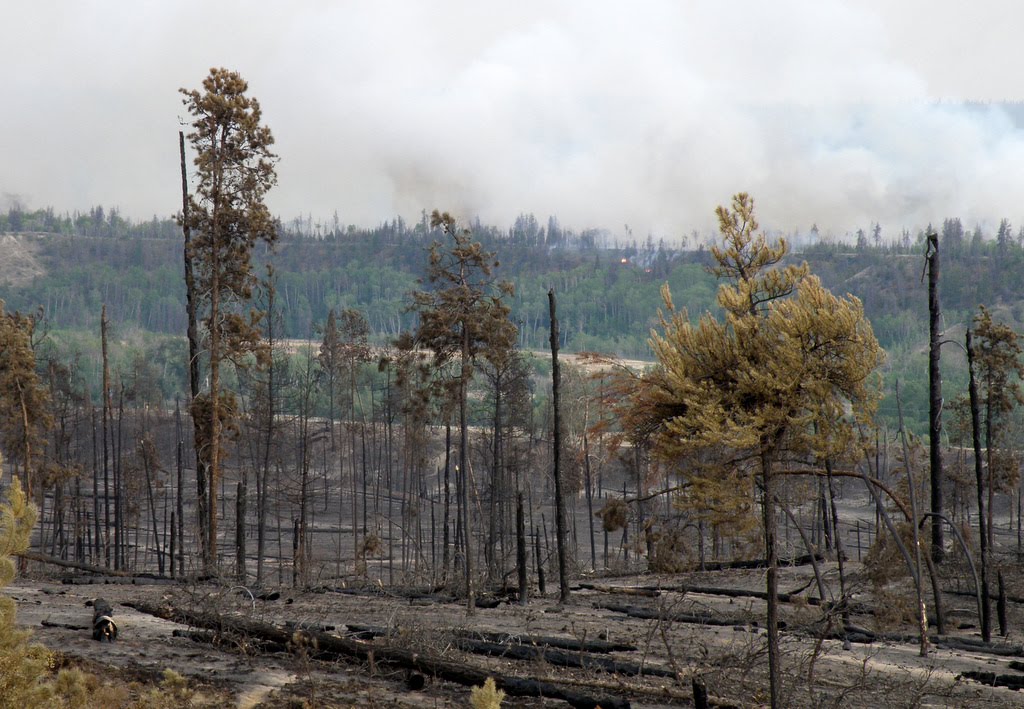
The blackened remains of a forest, with fires burning behind the next hill.


Another burnt area, the fire doused before it finished off the trees. They're dead, though. The fire is now following a side road along the ridge.


Scenic drive. Once.


Smoke from the next still-green patch.

Another line-up; another flagger. This time, we had to wait for an escort through Bull Canyon. After a while, a police car emerged from the smoke, with a string of cars behind it. The policeman saw them on their way, parked and consulted with the flagger. She waved us forward then, and instructed each one of us as we came up: "You can go on alone, but drive fast, don't slow down, don't stop, don't wait to take photos. It's hot down there!"


Down that hill is Bull Canyon. And the flagger, just around the corner.

I behaved. I so wanted to take photos; the scene was indescribable. Fires, smoke, helicopters swinging through the smoke, trailing round bags of water and retardant. Machinery and more fires, small and tall. A stage setting for Dante.

Beloved Bull Canyon, where I have so often stopped for the night, for the pleasure of listening to the river in the dark, of seeing the stars overhead as though I could reach up and pick one to take home, of watching the pistachio-green river in the morning light; now the trees are gone, the hill scorched and bare. I got a brief glimpse of the river; a muddy orange colour, half ash, half red retardant.

I remembered the pair of sassy chipmunks who stole the Rice Krispies bars we were saving for the kids' desserts; how they raced away along the fence, but soon came back to see if there was more. The present generation will be their great-great-grandkids. I wondered what happens to them in a quick fire? Do they burrow into the soil? Do they race up the trees only to be trapped, to be cooked or to suffocate? Do they run to safety? Is there safety?

Birds can fly out of danger; bears can cover an amazing amount of territory; so can the deer. I would like to think the chipmunks have a way to escape. I doubt it.

The Chilcotin is a harsh environment, beautiful but deadly, with baking summers, vicious winters, stony soil, alkali water, hordes of famished mosquitoes. And fires. I love it, but I could never live there. I greatly admire those who have the guts and strength to endure and even prosper on this land.

~~~~~~

Next: greenery and flowers. Cool rivers. Not on fire.
Powered By Blogger