Showing posts with label nurse logs. Show all posts

Friday, October 14, 2022

In the green shade

Some random shots along the lower river trail. This is below the waterfalls, where the river broadens out on its way to the estuary.

A slow stream waters a multi-species forest.

Criss-crossing mossy branches

An old nurse log feeds 4 trees.

The back side of the same group, with my back to the light.

Dried-out looking conk. Maybe a tinder polypore.

Brown mushrooms on a tree. Much lightened; in the shade, they were barely visible.

Future nurse log, with two evergreen saplings, huckleberry and salmonberry youngsters.

~~~~~~~~~~~~~~~~~~~~~~~~~~~~~~~~~~~~
Algunas fotos del sendero que sigue el rio entre el bosque entre las cataratas y el estuario:

  1. Una de las ramas del rio nutre un bosque de muchas especies.
  2. Ramas de árbol cubiertas de musgo.
  3. Un viejo tronco nodriza que sostiene 4 árboles maduros.
  4. El lado opuesto de dicho tronco, con la luz a mis espaldas.
  5. Un hongo poliporo, tal vez el poliporo "yesca".
  6. Otros hongos, en un tronco de árbol. Le añadí luz a la foto; en vida, estaba todo tan oscuro que apenas se veían los hongos.
  7. Un tronco nodriza del futuro, ahora con dos arbolitos de hoja perenne, y brotes de huckleberry y salmonberry.  


Friday, August 17, 2018

Nursery

Life goes on ...

When a tree dies, it comes alive, more so than in its life.

Living trees are made up of about 5% living tissue, but when certain species die, they become literal garden beds of new life. These otherwise “dead” trees contain five times more living matter than when they were growing upright. (Garden Collage magazine)

And its useful life can extend as long as its "live" growth period. A 100-year-old tree dies; then it invites in a host of other organisms, and stands or lies there for another 100 years, gradually disintegrating. By the time it finally disappears, it may have nurtured a small forest of its own.

In any old stand of trees in our rainforest, we find nurse logs in different stages of decay and re-incarnation.

An old forest giant. I estimated it from a distance at about 2 - 3 metres diameter. Our Douglas firs have been known to reach up to 15 feet across.

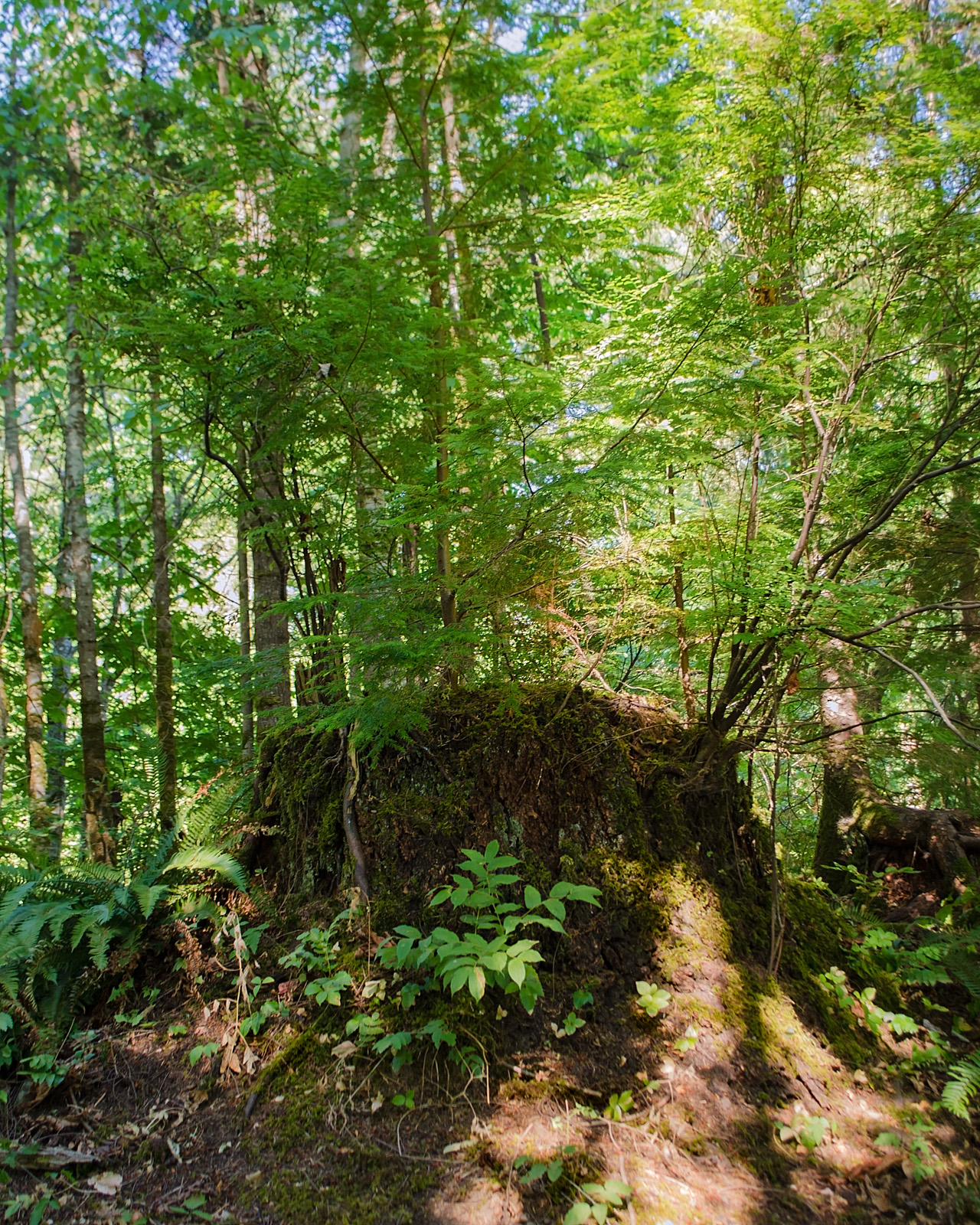
This old stump supports several small trees, maple and fir, growing from the top, plus a few huckleberry bushes and a layer of moss. On its flanks, ferns, red-berry elder and salal have taken root, as well as the ever-present moss. 

The old stump lifts seedlings above the undergrowth into the light and retains a more consistent level of moisture, winter and summer, than the forest floor. In deep forest, they may provide almost the only suitable habitat for huckleberry bushes, which need air and light.

Look to the right; there's another old nurse log, mostly gone by now; the tree grown out of it has extended its roots over the edge and down into the soil. They will support the new tree on stilts even when the nurse has disappeared.

Another, much smaller, second- or third-growth stump supports three new trees. Their roots encase the old stump, by now too fragile to hold the weight on its own. Other residents: moss and a large colony of spiders.

Three more firs on a badly-decayed nurse log. The one in back is just getting started, with its top dressing of moss, where seeds will find the perfect planting bed, warm, moist, and sunlit.


Powered By Blogger