Showing posts with label bear food. Show all posts

Friday, May 24, 2024

Consider the ant

 I had a new house guest for a few days.

Carpenter ant, Camponotus modoc.

She's* a big girl, over a centimetre long, not counting those long antennae. I saw her first here, exploring a mirror on my bedside table. Later, she was on the carpet, then on the wall; always busy, as befits a worker ant, always alone. After a couple of days, I gave her a piece of banana; there's not much to eat on my walls. She stayed with the banana for a long time. I saw her once more, and then she was gone; maybe she'd finally found the exit.

Side view.

These are the largest ants in BC. They build their homes in wood, usually tree trunks, sometimes wooden houses. There are two common species of Carpenter ants here on Vancouver Island; one with a red mid-section, C. vicinus, and C. modoc, with a black body and red legs.

*"She". Because all worker ants are adult females.

On the move
Walking the trails in the bush, I often come across old, rotting logs, torn apart. Bears, looking for these wood-burrowing ants.
"The ant season was found to occur from mid-June to mid- to late July, when berries began to ripen.  Ants and ant larvae were the main food items observed to be eaten by bears during this season.  Bears searched for ants in old logs and under stones." (E-Fauna, BC)
But the bears are so big! And the ants so tiny! How can a 200 kg. grizzly survive on these specks?
Again, from E-Fauna, BC: In most areas of the world, ants are among the most dominant of biota. But it is not in terms of diversity that they dominate, but rather in abundance, and in many areas they make up a significant portion of total biomass.
And, of course, the reason woodpeckers dig holes in standing trees and snags; they're looking for ants.

~~~~~~~~~~~~~~~
Tuve visita en casa por unos dias.

Fotos: una hormiga carpintera, Camponotus modoc.

Es una hormiga grande, midiendo más de un centímetro, sin contar las antenas. La vi por primera vez explorando un espejo en mi mesa de noche. Más tarde, andaba en el piso, luego en las paredes; muy atareada, como suelen ser las hormigas obreras, y siempre a solas. Después de unos dias, le di un pedacito de plátano; no hay mucho alimento de hormigas en mis paredes. Se quedó con el plátano por largo rato. La vi una vez más, y luego no apareció, tal vez por fin había encontrado la salida.

Estas son las hormigas más grandes en la provincia. Construyen sus galerías en madera, comunmente de árboles, a veces en casas de madera. Hay dos especies de hormigas carpinteras en la isla: C. vicinus, con el centro del cuerpo rojo, lo demás negro, y esta, C. modoc, que es negra con patas rojas.

Caminando en el bosque, muchas veces encuentro troncos viejos, podridos, que han sido destrozados. Por los osos, buscando esas hormigas excavadoras.
"La temporada de las hormigas se extendía desde mediados de junio hasta mediados de julio, cuando empezaban a madurar las bayas. Las hormigas y las larvas de hormigas fueron los alimentos principales que se observaban siendo comido por los osos en esta temporada. Los osos buscaban hormigas en troncones viejos y debajo de las piedras." (E-Flora,BC)
¡Pero los osos son tan grandes! ¡Y las hormigas tan pequeñas! ¿Cómo es que un oso gris, que pesa 200 kilos, se pueda sostener con esas motitas con patas?

Otra vez, de E-Flora, BC: "En la mayor parte del mundo, las hormigas figuran entre la biota más dominante. Pero no es por su diversidad que dominan, sino por su abundancia, y en muchos lugares constituyen una porción importante de la biomasa total.
Además, esos pájaros carpinteros que hacen las excavaciones grandes en los árboles, lo que buscan son esas hormigas carpinteras.


Sunday, September 25, 2022

Rosy scat

The trail beside the Campbell River was mostly deserted today. But a bear had been there not too long before. He left a pile of undigested rose hips on the path.

Black bear scat, with tiny rose hips, mushy leaves.

Until I downloaded the photos, I hadn't seen the fly that was waiting for us to leave.

Zooming out to include the fly.

And zooming in to look at that fly.

A rather unusual fly, with orange detailing at the top of the wings.

These rose hips are tiny, no bigger than huckleberries. There were few left on the bushes beside this trail, but I had seen them at Roberts Lake, earlier.

Baldhip roses, Rosa gymnocarpa.

"In baldhip roses, the crown of sepals falls away from the fruit early, leaving the end of the hip 'bald' (making it unique among our roses in this respect)." (Plants of Coastal British Columbia)
I am left with a few questions:

The bears eat great quantities of berries and rose hips, yet I have often seen scat with these berries entire or barely squished. Do they get any nutrients at all from them? And if not, why do they eat so many?

Does this help the roses? Are the seeds viable after they've passed through the bears digestive systems?

Why do I never see the bears?

~~~~~~~~~~~~~~~~~~~~~~~~~~~~~~~~
Hoy no había mucha gente en el sendero al lado del rio Campbell. Pero sí, había pasado por allí no mucho antes, un oso negro. Nos dejó un montoncito de escaramujos sin digerir a medio camino.

Fotos:
  1. Heces de oso, con escaramujos de rosa calva, Rosa gymnocarpa.
  2. No había visto la mosca hasta que vi las fotos en casa. Ahí estaba en una hoja, esperando a que nos fuéramos.
  3. La mosca, vista de cerca. Tiene manchas de color anaranjado en la parte anterior de las alas.
  4. Hojas y escaramujos de rosa "calva".
"En las rosas "calvas", la corona de sépalos se separa de la fruta temprano, dejando el extremo del escaramujo "calvo" (lo que la hace única entre nuestras rosas en este respeto." (Plants of Coastal British Columbia)

Me quedo con unas preguntas:

Los osos comen gran cantidad de frutillas y escaramujos, pero muchas veces he visto sus heces que contienen estas frutas enteras o apenas machucadas. ¿Les sacarán algún beneficio en absoluto? Y si no, ¿porqué comen tantas?

¿Trae esto algún beneficio para las rosas? ¿Sus semillas, siguen vivas después de pasar por el sistema digestivo del oso?

¿Y porqué yo nunca logro ver los osos?

Tuesday, June 30, 2020

I beat the bears to these

The huckleberries are ripe!

Red huckleberries, Vacciunium parvifolium

They're slightly acid, but sweet. I picked only two handfuls, leaving the rest for the bears and birds.

The bush these came from.
~~~~~~~~~~~~~~~

Los "huckleberry" rojos son una especie de arándano nativo a la costa del Pacífico. Ayer encontré un arbusto lleno de frutas.

La fruta es un poco ácido, pero dulce. Me comí dos puños de fruta, y dejé los demás para los osos y los pájaros.

Sunday, June 23, 2019

Between bee season and bear season

Bees come for the flowers. Bears come for the ripe berries. They'll be ready soon.

Thimbleberries, green, and just getting started.

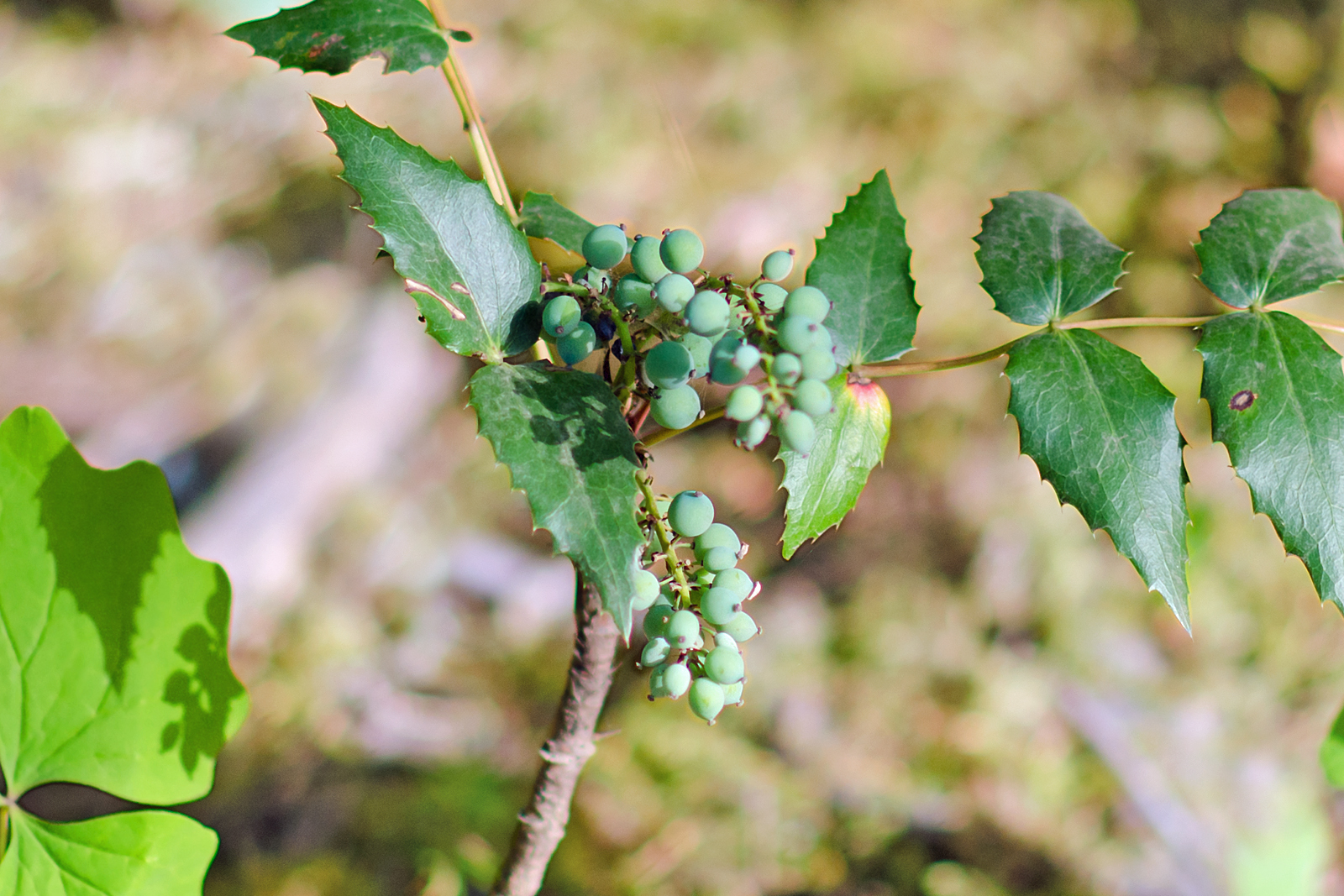
Oregon grape. The berries will be deep purple, and semi-sweet.

I haven't seen many salmonberry flowers this spring, and only one or two green berries. Many of the salal bushes are turning brown, and they have only a few flowers. It may be too hot and dry this year for these rainforest plants.

These two plants were on the side hill at Elk Falls. The whole area is brown and dry this year, the hillsides crumbling and dusty, the moss crunchy. We need rain!

Powered By Blogger