Showing posts with label rose hips. Show all posts

Wednesday, April 08, 2026

Sleepy post

Busy day today. Arguing with a computer all morning, then a happy stint in the garden, tidying, re-potting, planting, weeding, watering. Looking good! New leaves everywhere. Bleeding hearts, bluebells, and hyacinths blooming. Dandelions, too, although they weren't invited.

And then back to win that argument. Now I'm sleepy. Here's a place-holder song sparrow among old rose hips.

Fanning out his tail feathers. Very much aware of me, not worried at all.

And now, goodnight.

~~~~~~~~~~~~~~
Hoy estuve bastante ocupada: por la mañana en disputas con la computadora, pero la tarde la pasé muy bien en el jardín, limpiando, sembrando, transplantando, deshebrando, regando ... Va bien. Hay hojitas nuevas en todas partes, y el corazón sangrante, los jacintos morados y azules están en pleno florecimiento. También los dientes de león, aunque esas flores no las invité.

Ahora tengo sueño. Tengan un gorrioncito cantor entre escaramujos viejos.

Y ahora, buenas noches.


Friday, February 07, 2025

Oyster Bay, clad in grey and white.

 Oyster Bay is beautiful under snow. But perilous. See:

Somewhere in there is the path to the shore. Winding around , climbing over scattered logs. Slip at your peril.

Got there in one piece. Looking towards the north. There's even a fragment of blue sky.

Now looking south from the same spot. See the path someone trod out?

Detail of stacked logs.

A solitary Douglas-fir, heavily laden.

Sit and rest a while in the meadow. There's a good, soft cushion on the bench.

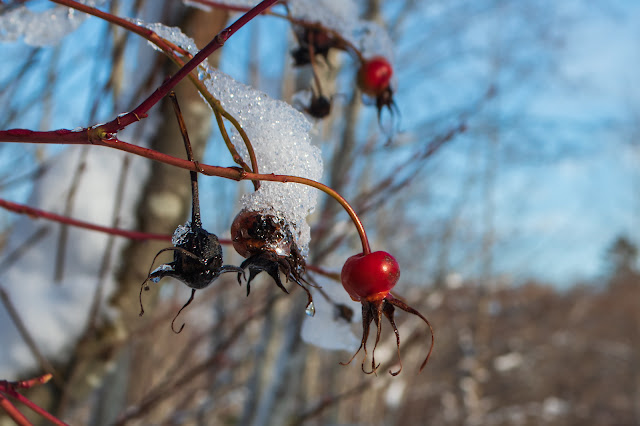
Rose bushes beside the fence, with frozen rose hips.

More photos tomorrow: life in the snow and ice.

A Skywatch post.

~~~~~~~~
Oyster Bay (Bahía de los Ostiones) es hermosa cubierta de nieve. Pero también peligrosa. Imagínate esto:
  1. Aquí se esconde el senderito que lleva a la playa. Dando vueltas alrededor de los troncos, a veces cruzándolos. ¡Cuidado: no te caigas!
  2. Y ya llegamos. Mirando hacia el norte, se ve un fragmento de cielo azul.
  3. Desde el mismo punto, mirando hacia el sur. ¿Ves el camino que alguien cortó?
  4. Detalle de una "construcción" de troncos.
  5. Un abeto de Douglas solitario, con su carga pesada de nieve.
  6. Aquí en la pradera puedes sentarte a descansar un momento; el banquito hasta tiene su cojín.
  7. Regresando al estacionamiento, pasamos los rosales, con sus escaramujos congelados.
Mañana, sigo con fotos de la vida entre el hielo y la nieve en este sitio.

Un post de Skywatch.


Tuesday, January 07, 2025

Another rainy day

It had stopped raining yesterday morning. The weather people called for sunny periods. I grabbed the cameras and hit the road. I made it half a dozen blocks from home before it was raining again. Well, that's BC weather. But the sky looked lighter towards the south, so I drove that way. And then inland, up the hill. And homeward, still with the windshield wipers going.

A long circle, but it was pleasant enough; I like driving in the rain. Everything in the distance is misty grey; trees sliding by become green, a dark, greyish green, as they come within a few car lengths. The alders are showing their first spring catkins; when the sun shines, they are pink; in the rain, the mist around the bare branches has a winy tinge. The road and the rocks alongside glisten. Park for a moment, turn off the motor, roll down the window, and listen. There's no wind, and everything rustles; raindrops falling on dead weeds, on pavement, on puddles. A car passes, spraying water; drops hit the closed window (lucky you didn't open that one!) with loud plopping sounds. Back on the highway again, the windshield wipers making a steady flap-flap-flap, splashes of puddles as the tires hit them, a smell of fresh green stuff.

Nearly home again, on the hills above the town. It had stopped raining. I parked in a half-cleared space beside a pond to drink  my coffee. With the window down, listening to silence. The wild roses beside the road were bearing rose hips and water droplets in more or less equal numbers.

Nameless pond, rose hips, Himalayan blackberries (always green).

As I drove down into town, the clouds parted and patches of blue sky peeked through. I crossed the river and went to Baikie Island; can't waste a few minutes without rain.

More rose hips, dripping wet. More puddles; my shoes were wet instantly. Off the paved path down the centre of the island, all the other trails were muddy and covered with slippery, soggy leaves.  There were clumps of mushrooms, all beaten down by the weather, shapeless. Big-leaf maple leaves hung limply in the rose and red-currant bushes. And all the colours were muted; yellowish brown grasses, pinkish grey alder branches, grey-blue-green evergreens in the distance, and the not-quite-grey sky and water. Only the mosses shone, bright and spring-time green; this is their favourite time of year.

Baikie Slough, an off-shoot of the main river.

Beside the path, the old bear bench was bluish with wet and cold. And sagging backward; the bank behind it has collapsed into the creek. Only the trees hold it in place now.

Looking almost varnished with the wet.

Next, a few birds.

~~~~~~~~~~~
Ayer, por la mañana, había dejado de llover. Y los meteorológicos decían que habría momentos cuando el sol aparecería. Recogí las cámaras y fui a buscarlo. Estaba apenas a una media docena de cuadras de mi casa cuando empezó a llover de nuevo. Bueno, así es el clima de esta isla. Pero el cielo parecía más aclarado hacia el sur, y me dirigí en esa dirección. Y luego, di vuelta hacia el interior de la isla, subí hasta la autopista y volví rumbo a casa de nuevo, con el limpiaparabrisas todavía en operación.

Una vuelta larga, pero placentera; me gusta manejar cuando llueve. Todo lo que se ve en la distancia está de un color gris nebuloso; los árboles, al acercarse, se vuelven verdes, un verde oscuro, al llegar dentro de una poca distancia de mis luces. Los alisos ya llevan sus primeras candelillas de la primavera; cuando le llega la luz del sol, se muestran color de rosa; en la lluvia y la neblina, las ramas desnudas llevan un tinte rojizo, como de vino tinto pálido. El camino y las rocas en los lados resplandecen.

Estaciónate por un momento; apaga el motor, abre una ventana, y escucha. No hay viento. Oyes un continuo susurro; gotas de lluvia que caen sobre hojas muertas, sobre le pavimiento, sobre los charcos. Pasa otro coche, salpicando, las gotas volantes pegan en tu ventana (¡que suerte que esa ventana no la habías bajado!); hacen un fuerte "pon, pon, pon". De vuelta en camino, con los limpiaparabrisas dando su "pas, pas, pas" recurrente, y las llantas chapoteando cuando pasas por los charcos; hay un olor de cosas frescas, verdes.

Casi llegaba otra vez al pueblo; andaba entre los cerros en el interior. Ya no llovía. Me estacioné en un sitio abierto, al lado de una laguna, para descansar y tomar mi café. Con la ventana abajo, escuchando el silencio. Las rosas silvestres al lado de la laguna llevaban sus frutos, los escaramujos, y gotitas de agua, en números casi iguales.

Foto: La laguna, los rosales, y mora de Himalaya (siempre está verde).

Mientras bajaba hacia el pueblo, las nubes se abrieron, y aparecieron espacios de cielo azul. Crucé el rio y me fui a la isla Baikie. No hay que desperdiciar unos cuantos minutos sin lluvia.

Más rosales empapados. Otros charcos; en instantes, mis zapatos se llenaron de agua. Fuera del camino principal, pavimentado, los senderos están llenos de lodo y cubiertos de hojas muertas, resbalosas. Hay grupos de hongos, sin forma, aplastados bajo las últimas lluvias fuertes. Hojas muertas de los arces de hoja grande cuelgan de las ramas de los rosales, flojas, parecen trapos viejos. Y todos los colores están apagados; las hierbas muertas, cafés con un tinte amarillo pálido; ramas desnudas de los alisos, grises con una sugerencia de color de rosa; los árboles coníferos en la distancia, entre gris, verde y azul; el cielo y el agua, casi, pero no completamente gris. Solamente los musgos brillan, un verde/amarillo, un verde de primavera; esta es su temporada favorita del año.

Foto: Vista desde el puente que da a la isla.

Al lado del camino, el viejo banco con los osos está azul, con el frio y la humedad. Y se ha reclinado para atrás; la tierra se ha desmoronada con la lluvia; lo único que ahora detiene a los osos en su sitio son los árboles a sus espaldas.

Foto: Los osos. Se ven como barnizados con el agua.

Siguiente: pajaritos.

Sunday, September 25, 2022

Rosy scat

The trail beside the Campbell River was mostly deserted today. But a bear had been there not too long before. He left a pile of undigested rose hips on the path.

Black bear scat, with tiny rose hips, mushy leaves.

Until I downloaded the photos, I hadn't seen the fly that was waiting for us to leave.

Zooming out to include the fly.

And zooming in to look at that fly.

A rather unusual fly, with orange detailing at the top of the wings.

These rose hips are tiny, no bigger than huckleberries. There were few left on the bushes beside this trail, but I had seen them at Roberts Lake, earlier.

Baldhip roses, Rosa gymnocarpa.

"In baldhip roses, the crown of sepals falls away from the fruit early, leaving the end of the hip 'bald' (making it unique among our roses in this respect)." (Plants of Coastal British Columbia)
I am left with a few questions:

The bears eat great quantities of berries and rose hips, yet I have often seen scat with these berries entire or barely squished. Do they get any nutrients at all from them? And if not, why do they eat so many?

Does this help the roses? Are the seeds viable after they've passed through the bears digestive systems?

Why do I never see the bears?

~~~~~~~~~~~~~~~~~~~~~~~~~~~~~~~~
Hoy no había mucha gente en el sendero al lado del rio Campbell. Pero sí, había pasado por allí no mucho antes, un oso negro. Nos dejó un montoncito de escaramujos sin digerir a medio camino.

Fotos:
  1. Heces de oso, con escaramujos de rosa calva, Rosa gymnocarpa.
  2. No había visto la mosca hasta que vi las fotos en casa. Ahí estaba en una hoja, esperando a que nos fuéramos.
  3. La mosca, vista de cerca. Tiene manchas de color anaranjado en la parte anterior de las alas.
  4. Hojas y escaramujos de rosa "calva".
"En las rosas "calvas", la corona de sépalos se separa de la fruta temprano, dejando el extremo del escaramujo "calvo" (lo que la hace única entre nuestras rosas en este respeto." (Plants of Coastal British Columbia)

Me quedo con unas preguntas:

Los osos comen gran cantidad de frutillas y escaramujos, pero muchas veces he visto sus heces que contienen estas frutas enteras o apenas machucadas. ¿Les sacarán algún beneficio en absoluto? Y si no, ¿porqué comen tantas?

¿Trae esto algún beneficio para las rosas? ¿Sus semillas, siguen vivas después de pasar por el sistema digestivo del oso?

¿Y porqué yo nunca logro ver los osos?

Saturday, January 08, 2022

Rose hips, Baikie Island

 A bit of warm colour on a cold, blue-lighted day.

Rose hips, some ripe, some past their prime.

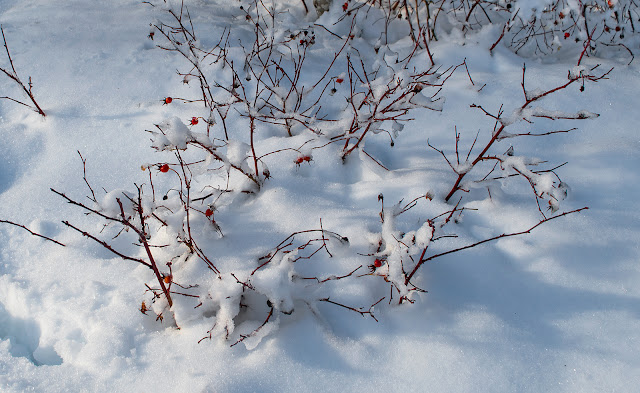
And a small wild rose bush under a foot of snow. My footprint off to the right.

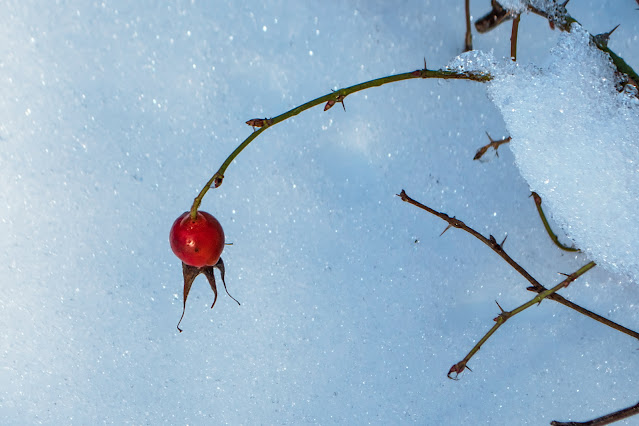
One rose hip. The stems are still green, and wearing the buds of spring leaves.

Year after year, I tell myself I'll collect a bunch to make myself some rose hip tea, a good winter drink, full of Vitamin C. And every time, I leave it for later. Some day ...
~~~~~~~~~~~~~~~~~~~~~~~

En un dia de luz azul, por la nieve, hay unas gotas de color cálido. Escaramujos, el fruto de la rosa silvestre.

Fotos:
Escaramujos en la isla Baikie, un arbusto pequeño bajo 30 cm. de nieve, y un escaramujo a solas. Se ve que el tallo sigue verde, y ya lleva los botones de donde brotarán las hojas cuando llega la primavera.


Año tras año, propongo cortar suficientes como para hacerme un buen té de escaramujo, que es una bebida muy buena en el invierno, ya que contiene gran cantidad de Vitamina C. Y año tras año lo dejo para otro dia. Algún dia será ...

Friday, January 29, 2021

Reflections on red

 View in a rose hip:

Rose hips, Oyster Bay

If you look closely, you can see the trees of the Oyster Bay little woods in the skin of the rose hip.

~~~~~~~~~~~~~~
Panorama en un escaramujo. Si miras con atención, puedes ver el bosquecito de Oyster Bay en el reflejo.


Tuesday, November 26, 2019

Winter decorations

When the deciduous trees have shed their last leaves, when their glorious reds and yellows have faded to brown on the ground, the understory puts up its bright winter lights.

Red. Wild rose hips.

Yellow. Blackberry leaves. The trees protect the plants from the first chilly nights, but once those leaves have fallen, the blackberries start to lose theirs. Some of the green leaves will persist until the first hard frost.

White. Waxberries, aka snowberries. These shrubs have lost all their leaves, but the berries are tough and will last all winter.

Common snowberry is an important browse for deer, antelope, and Bighorn Sheep; use by elk and moose varies.  The berries are an important food for grouse, grosbeaks, robins and thrushes.  Bears also eat the fruit. (Native plants, PNW)

And yes, green. The grass and next spring's flower seedlings will stay green all winter, even under the snow.

Another mushroom, like the one above, tipped over, showing its gills.

Sunday, December 30, 2018

Only in winter

It's a (leafless) jungle out there.

Winter expands my horizons, at least in the deciduous forests and shrubby fields. The concealing curtains of green have fallen, exposing the hidden scenes beyond. Creeks, only heard before, never seen, appear. There are pools and interesting logs and old bird's nests. Mushrooms in strange places, lichen mounds, wintering fruits ...

There's a downside, though. I'm usually standing on wobbly footing; a slippery log, bouncing moss cushions, a network of dead twigs. And the empty branches where the leaf curtain was are still in the way, making it difficult to approach more closely. And the wind is blowing, making the branches dance. I keep the camera on autofocus; there's no way I can keep up with the jittery scene.

Even the camera is confused. "What are you looking at? That red thing? No? That bit of green over there? That branch ... oh, it's gone ..."

And sometimes it halfway manages to find what I wanted it to see.

Rose hip, with raindrops and bokeh. And spiny branches.

Mushrooms growing out of a dead tree trunk.

Oyster Bay, from the inside of the lagoon, from the end of a trail that, in summer, is almost impassible, where the grasses and reeds tower over my head and the mud is treacherous.


Saturday, December 16, 2017

Red and blue-grey

Rose hips in the mist

This variety of roses, along the outer shore of Tyee Spit, produces very small hips.

Tuesday, December 12, 2017

Failed camouflage

Golden-crowned sparrow, with rose hips.

On Tyee Spit

For most of the year, these wild rose bushes on Tyee Spit are full of the twitterings and flittings of small birds, mostly invisible, though I stand straining my eyes to catch a glimpse of one. There are fewer in the winter; I expect most have moved inland to the backyard bird feeders. But at least those few hold-outs are visible. For now. Until it snows and fills in the gaps between branches.

Monday, November 13, 2017

Rainy day in the slough, with distant birds

The weather is going to turn rough; they're saying we'll have winds up to 100 km/h today. For now, it's just raining.

Before the rain got going in earnest, I went down the Salmon Point/Woodhus Slough trail to look for mushrooms again, with no luck. But two flocks of trumpeter swans flew overhead, discussing the weather as they went. I forgot about mushrooms.

The second group. The first group was about 60 noisy swans strong.

Heading back, near sunset (but there was no sun), I took the summer trail along the slough floor; last chance, because the water is already rising, and it will soon be covered.

The water begins to rise. Last time I was here, this was dry. In mid-winter, the water will cover all the grasses and sedges.

Slough bottom, with rose hips.

Birds forage busily among the trees here, eating old berries and rotting fruit. I saw towhees, sparrows, juncos, chickadees, bouncing happily through the tangled branches, mostly too dark to see clearly on this dark, rainy afternoon.

Junco in a tree with lichen

The water will rise soon. The berries will drown. The small birds will move to higher ground. And the mallards will move in, eating the summer vegetation, as it rots underwater.


Saturday, September 17, 2016

Baikie Island in the sunshine

On a rainy afternoon last January, I discovered Baikie Island, a half-reclaimed piece of formerly industrial land, still littered with rusting metal, assorted construction material, greasy wood. A releafing project was underway, and a couple of paths were gravelled. The birds were settling in. I promised to come back when the sun was shining.

I was almost too late. The fall rains have set in, and they've not been gentle; it's no time for walking in the rain with a camera.

But we had two sunny days this week; I hurried down to Baikie Island right away.

Yellow and brown grasshopper, (Melanoplus bivittatus) waiting for me at the entrance.

People have been hard at work this summer. The old construction material has been hauled away, even to the rusting steel embedded in the mud at the island's tip. There are new signs, and the blackberry canes trying to close the paths have been cut back. Trails, as yet unofficial, but well marked and cleared, lead to lookout points along the river bank. There are a few benches facing the water.

Now, at the turn of the seasons, a few flowers are still blooming; as long as there are sunny days and insects to pollinate them, it's worth the effort.

Some sort of pea flower, growing at the edge of the water. About 6 inches high.

A mint, possibly field mint, Mentha arvensis. At the edge of a soggy grassland.

And one wild rose, the last on the shrub.

But it's fall; time to get the seeds finished and ready to go.


Common California aster, Aster chilensis. Violet ray flowers with yellow disk flowers. At river's edge.

Most of them have gone to seed. I like the way the dying petals curl up into tight rings. Here, they're brown; in the photo above, they're purple.

Fat, red rose hips.

Snowberry. Most of these will stay on the shrub over the winter.

More snowberries. Aka waxberry. Other berries feel solid, or at least full; these are soft and dry to the touch, as if they were mostly air.

"One Stl'atl'imx story indentifies the berries as 'the saskatoon berries of the people in the Land of the Dead.'" (Plants of Coastal BC)

The old mill pond, with Canada geese. (Two groups.)

The first trail completed leads straight down from the bridge to the tip of Blaikie Island. A second trail leads from the parking lot, around the pond, and up the banks of the river as far as the highway to the north.

I can't resist a trail going somewhere new.

Here, the trees close in, creating welcome shade after a long walk on a sunny day.

Big maple leaf, caught on its way down.

Coming in closer. The light shows the needles behind the leaf.

Big maple "airplanes", almost ready to fly.

Fuzzy little shelf fungi on a dying tree.

Long pine needles. Western white pine? Needles, I think, in clumps of 5, about 4 inches long.

Map from the parking lot kiosk. I walked from the tip to the NCC Channel. Ill have to go back, next sunny day.


Powered By Blogger