Showing posts with label Campbell River trail. Show all posts

Sunday, September 25, 2022

Rosy scat

The trail beside the Campbell River was mostly deserted today. But a bear had been there not too long before. He left a pile of undigested rose hips on the path.

Black bear scat, with tiny rose hips, mushy leaves.

Until I downloaded the photos, I hadn't seen the fly that was waiting for us to leave.

Zooming out to include the fly.

And zooming in to look at that fly.

A rather unusual fly, with orange detailing at the top of the wings.

These rose hips are tiny, no bigger than huckleberries. There were few left on the bushes beside this trail, but I had seen them at Roberts Lake, earlier.

Baldhip roses, Rosa gymnocarpa.

"In baldhip roses, the crown of sepals falls away from the fruit early, leaving the end of the hip 'bald' (making it unique among our roses in this respect)." (Plants of Coastal British Columbia)
I am left with a few questions:

The bears eat great quantities of berries and rose hips, yet I have often seen scat with these berries entire or barely squished. Do they get any nutrients at all from them? And if not, why do they eat so many?

Does this help the roses? Are the seeds viable after they've passed through the bears digestive systems?

Why do I never see the bears?

~~~~~~~~~~~~~~~~~~~~~~~~~~~~~~~~
Hoy no había mucha gente en el sendero al lado del rio Campbell. Pero sí, había pasado por allí no mucho antes, un oso negro. Nos dejó un montoncito de escaramujos sin digerir a medio camino.

Fotos:
  1. Heces de oso, con escaramujos de rosa calva, Rosa gymnocarpa.
  2. No había visto la mosca hasta que vi las fotos en casa. Ahí estaba en una hoja, esperando a que nos fuéramos.
  3. La mosca, vista de cerca. Tiene manchas de color anaranjado en la parte anterior de las alas.
  4. Hojas y escaramujos de rosa "calva".
"En las rosas "calvas", la corona de sépalos se separa de la fruta temprano, dejando el extremo del escaramujo "calvo" (lo que la hace única entre nuestras rosas en este respeto." (Plants of Coastal British Columbia)

Me quedo con unas preguntas:

Los osos comen gran cantidad de frutillas y escaramujos, pero muchas veces he visto sus heces que contienen estas frutas enteras o apenas machucadas. ¿Les sacarán algún beneficio en absoluto? Y si no, ¿porqué comen tantas?

¿Trae esto algún beneficio para las rosas? ¿Sus semillas, siguen vivas después de pasar por el sistema digestivo del oso?

¿Y porqué yo nunca logro ver los osos?

Friday, May 06, 2022

Slow water, fast water, green water, blue water

It's a rain forest. Wherever you look, there's water. These are views from a short walk along the Campbell River.

Campbell River. With beaver lodge.

I hadn't seen the beaver lodge until I processed the photo. It's on the far bank, in the centre of the photo. Now I'll have to go back and take a closer look.

On the land side of the trail. Every dip in the terrain has its creek or pool.

A chunk of old root in a backwater.

Canyonview bridge.

This is the end of the trail for me, at least for now. I climbed the stairs and trail to the bridge last year and put my knee out of commission, so I turned back at the bottom this time. For now.

~~~~~~~~~~~~~~~~~~~~~~~~~~

Estamos en un bosque pluvial. Y dondequiera que miramos, hay agua. Estas fotos fueron sacadas en un tramo corto del sendero al lado del rio Campbell.

  1. El rio. Y una madriguera de castores al otro lado, en el mero centro. No la vi hasta que estaba procesando la foto en casa. Ahora tendré que regresar para verla más de cerca.
  2. Del otro lado del sendero, entre el bosque. Cada depresión del terreno tiene su riachuelo o lagunita.
  3. En un remanso tranquilo, una sección de raiz forma un túnel.
  4. El puente sobre el cañon. Para mi, ahora el final del sendero cae al pie de la escalera. Por ahora. Hice la subida el año pasado y me amolé la rodilla, así que está fuera de mi alcance. Por ahora.


Thursday, May 05, 2022

Bright green when wet

Far above my head, the branches hang heavy with lungwort. And sometimes they break off and fall on my trail.

Lungwort, Lobaria pulmonaria

It had rained recently; the upper surface is a pale grey-green when it's dry.

Although lungwort’s main photobiont is a green alga, it is also a type of cyanolichen, which means that it contains nitrogen-fixing bacteria. When these lichens fall to the ground after a storm or wind event, they decompose into the forest floor, contributing their nitrogen reserve to the soil. (from US Forest Service)
~~~~~~~~~~~~~~~~~~~~~
Muy por encima de mi cabeza, las ramas llevan grandes hojas del liquen pulmonaria. A veces rompen la rama y caen al suelo.

Foto: El liquen pulmonaria, Lobaria pulmonaria. Hace poco que llovió. Cuando se seca el liquen, la capa superior se vuelve de un color pardusco.

Aunque el fotobionte principal es un alga verde, también es un cianoliquen, lo que significa que contiene bacterias que fijan el nitrógeno. Cuando estos líquenes caen al suelo después de una tormenta o viento fuerte, se descomponen en es suelo del bosque, y contribuyen sus reservas de nitrógeno a la tierra.  (De US Forest Service)

Wednesday, May 04, 2022

Green blankets

I love moss. Good thing, because in our wet climate, it coats everything in our forests and fields, and even our towns: rocks, trees, old logs, stumps and up-turned roots, shady hillsides, old lumber, cement barriers, abandoned vehicles, roofs, wet lawns, and little-travelled roadways. These three photos are from the trail beside the river.

On a log

With a mushroom, on a log

On a stump.

I often attempt to identify mosses as to species. Usually without luck. These three remain unnamed, for now.

~~~~~~~~~~~~~~~~~~~~
Me encanta el musgo. Lo que es una buena cosa, ya que en nuestro clima tan húmedo, los musgos cubren todo, en los bosques, las praderas, y aun en nuestros pueblos: las rocas, los árboles, troncos caídos y todavía en pie, raices invertidas, laderas de los cerros, las barreras de cemento, madera de construcción vieja, vehículos abandonados, techos, el césped donde hay agua cerca de la superficie, y caminos sin mucho tráfico. Estas tres fotos son de musgos que vi al lado del sendero a lo largo del rio.

Muchas veces trato de identificar cada musgo con referencia a su especie. Casi siempre me falla. Éstos tres siguen sin identificar por ahora.


Tuesday, May 03, 2022

Shelves, bubbles, and burn spots.

Still following the trail along the river banks: a selection of fungi, mostly polypores, on trees and logs.

Red-belted polypores on the cut end of a log. With fungal duck.

More red-belted polypores, with a "weepy" fungus.

On a mossy trunk, an orange "bubble". It may be a young red-belted: knob-like when young.

This I had never noticed before: see how the light bounces off the mushroom to project a warm glow onto the bark.

Spreading the sunlight

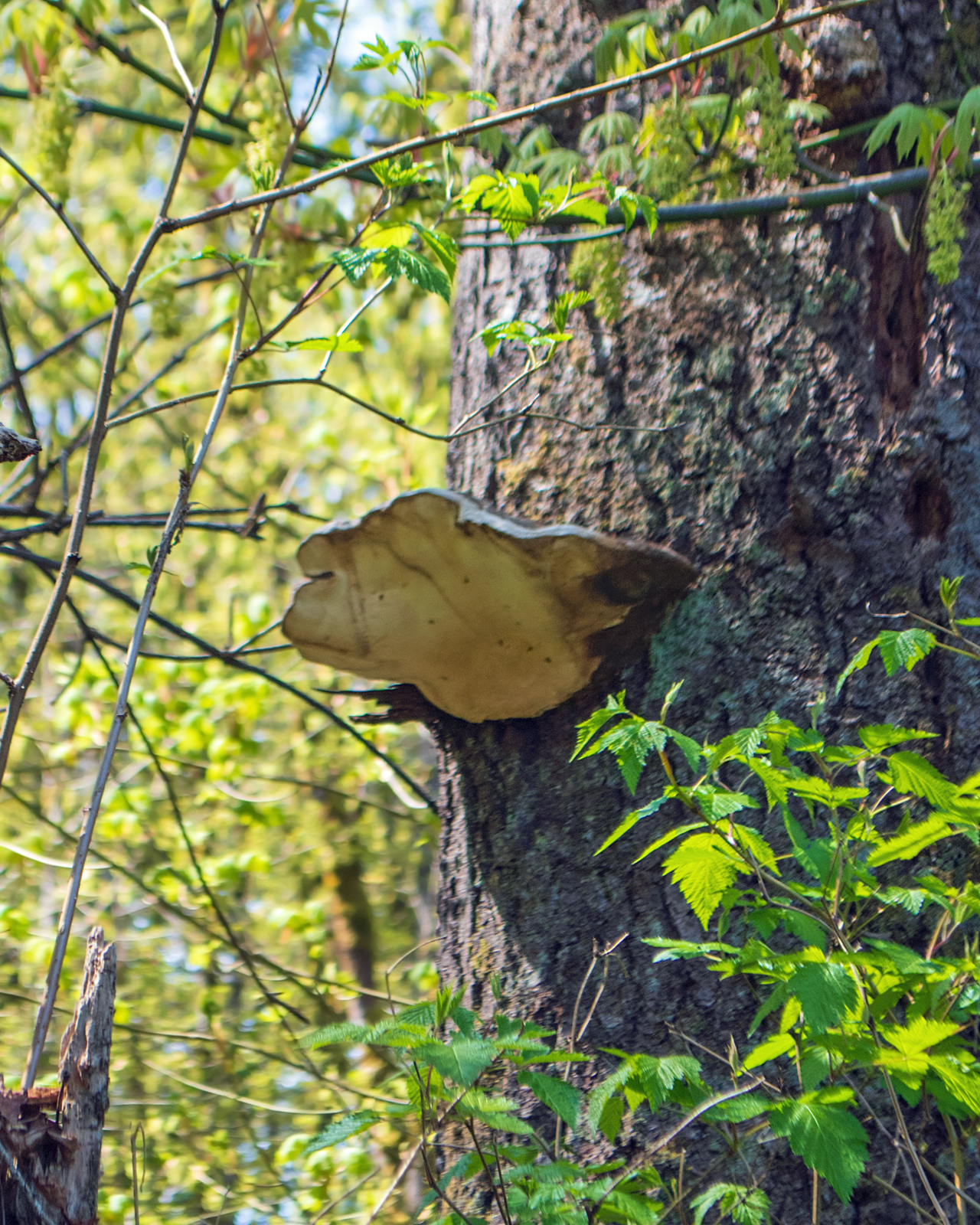
Too far up on a trunk, too far off the trail to get close, I saw a very large artists' conk. 

Side view.

As close as I could get.

These conks can get up to 30 inches across, according to my guidebook, although I have never seen one that large. I have one at home about half the size of this one; I measured it once I got home, and it's 10 inches across.

Sorocybe sp.?

This looks like a burnt patch on an old maple, slightly raised, hard to the touch. There were several spots, higher up on the trunk, all seeming to be growing where branches have broken off. I posted the photo on Field Naturalists of Vancouver Island, and am told it is a Sorocybe or similar reisinicolous fungi.

And a small stump, covered with turkey tails.

~~~~~~~~~~~~~~~~~~~~~~~~~~~~

Sigo con fotos del paseo al lado del rio Campbell; aquí unas fotos de hongos que crecen en los troncos de los árboles, o la madera cortada, por su mayor parte poliporos.

  1. Hongos Fomitopsis pinicola, el poliporo de cinta roja; este tipo de hongo también se conoce como hongo repisa. En un tronco cortado.
  2. Otros de los mismos, y con un hongo, sin identificación, con sus gotitas de sudor.
  3. Otro, éste siendo un ejemplo juvenil; toman forma de repisa al madurar. Lo que me llamó la atención, es como el hongo refleja la luz del sol, proyectando un color calientito a la corteza del árbol.
  4. El mismo, de cerca.
  5. Algo lejos del camino, y muy arriba en el tronco, vi otro hongo repisa, este del tipo hongo de artista, Ganoderma applanatum. Estos crecen hasta 75 cm de ancho, aunque no me acuerdo de haber visto uno tan grande. Pero éste es uno de los más grandes que he visto; más o menos el doble de uno que tengo en casa, que mide 25 cm.
  6. El mismo, de otro punto de vista.
  7. Este hongo negro crece en un arce de hoja grande. Es duro, no se despega, parece un quemazón. Había varios en el tronco, todos parecen estar en sitios donde se rompió una rama. Subí la foto al sitio de Naturalistas de la Isla Vancouver, y allí me dicen que es un hongo resinicolo, tal vez del género Sorocybe.
  8. Un tronco cortado, cubierto de cola de pavo, Trametes versicolor.

Thursday, April 28, 2022

All decked out in pink and green

I walked this afternoon along the trail beside the Campbell River. It's mostly deep shade, under the shadow of steep banks, covered overhead by tall evergreens. Later, it will be darker; for now, the maples are still leafless, and the forest, under the canopy, is still open. New leaves of budding salmonberry and huckleberry shrubs glow where they catch a ray of sunlight.

And the floor is patterned in pink, white, and green; the first spring flowers are blooming while there is still some sunlight. Pink fawn lilies are everywhere; there are bleeding hearts and trilliums, delicate pink and white slender toothworts, huckleberry buds and salmonberry flowers.

A mixed patch.

In this patch I see pink fawn lilies, piggy-back plants, false lily of the valley leaves, cow parsnip, fairy bells, herb robert, evergreen ferns, and one other plant that I should recognize but don't at the moment. Of these, only the fawn lilies are blooming; the others will be along soon.

Hooker's fairy bells, getting ready to flower.

Piggy-back plant, Tolmiea menziesii, in bud.

Piggy-backing leaf

Cow parsnip leaves. Below, bleeding heart leaves.

The cow parsnip will be a large plant, overshadowing the earlier-blooming flowers.

Tomorrow; trilliums and more pink fawn lilies: there are so many fawn lilies!

~~~~~~~~~~~~~~~~~~~

Caminé esta tarde al lado del rio Campbell. Este terreno está por gran parte del año en la penumbra; el cerro, muy empinado, limita las horas en que le llega el sol, y los árboles de hoja perenne, allá arribe, mantiene todo en sombra. Por ahora, los arces de hoja grande siguen sin hojas, así que dejan penetrar un poco de sol; en el sotobosque las hojitas nuevas de los arbustos de mora de salmón y de huckleberry (arándano rojo) brillan como lucecitas donde les alcanza uno que otro rayo de sol.

Y el suelo lleva un tapete de colores; blanco, verde, y color de rosa. Las primeras flores de la primavera se apuran a salir mientras todavía hay sol. Hay lirios de cervato, color de rosa, por todas partes; están en flor los corazones sangrantes y los trilios, y las tiernas flores de toothwort ("hierba de dientes") en rosa o blanco. Un poco más arriba, se ven las flores de salmonberry y huckleberry.

Fotos:

  1. Un grupo mixto de plantas: lirio de cervato, Tolmiea menziesii (piggyback plant), lirio del valle falso, pastinaca de vaca, campanas de hada, hierba roberto, helechos perennes, y una planta que debo reconocer pero en el momento se me escapa.
  2. Campanas de hada,Disporum hookeri.
  3. Tolmiea menziesii, con botones de las flores.
  4. Otra, con su hojita nueva de cuestas.
  5.  y 6. pastinaca de vaca, Heracleum lanatum.  Éste va a ser una planta grande, dejando los demás en la sombra.
Mañana habrá foto de los trilios. Y más de los lirios de cervato. ¡Hay tantos!

Powered By Blogger