Showing posts with label artist's conk. Show all posts

Thursday, April 09, 2026

Adaptable conks

The conks (polypore bracket fungi) grow with the pore side down, facing the ground. Crossways, on a standing tree, lengthwise on a fallen log. And sometimes they have to switch directions.

These artists' conks started out on a standing tree, and now grow on the rotting log. So the older portion is now vertical, the newer conks horizontal.

Can't decide which way to grow.

The vertical (now) mass on the left is the original fungus. Root end of the log is towards the left.

Here the new conks treat the original one as if it were the tree, growing out from both sides.

~~~~~~~~~~~~~~~

Los hongos de repisa (políporos también llamados hongos de corchete) crecen en forma horizontal, con la cara inferior donde se abren los poros, apuntando hacia el suelo. En un árbol vivo, se sitúan transversalmente; cuando el árbol se convierte en tronco tirado, los hongos tienen que hacer algunos cambios.

Estos conchos de artista, Ganoderma aplanatum, empezaron la vida en un árbol en pie, y ahora crecen en el tronco podrido. Así que las partes más viejas ahora quedan volteadas en 90°, y los cuerpos nuevos están alineados horizontalmente, correctamente.

  1. El grupo de hongos.
  2. El hongo vertical, nudoso y agrietado, es el cuerpo original.
  3. Aquí los honguitos nuevos crecen en ambos lados de un hongo original.


Tuesday, May 03, 2022

Shelves, bubbles, and burn spots.

Still following the trail along the river banks: a selection of fungi, mostly polypores, on trees and logs.

Red-belted polypores on the cut end of a log. With fungal duck.

More red-belted polypores, with a "weepy" fungus.

On a mossy trunk, an orange "bubble". It may be a young red-belted: knob-like when young.

This I had never noticed before: see how the light bounces off the mushroom to project a warm glow onto the bark.

Spreading the sunlight

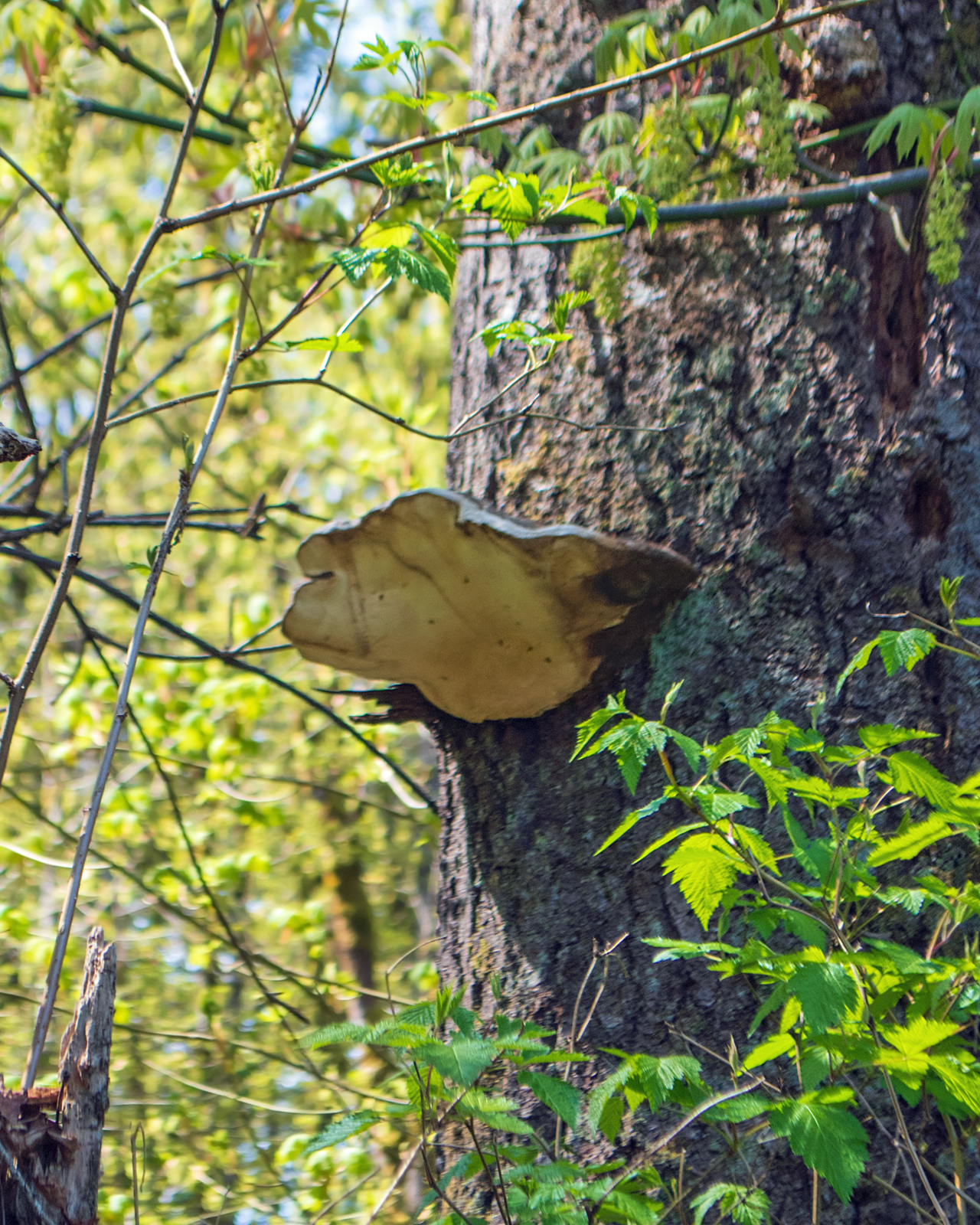
Too far up on a trunk, too far off the trail to get close, I saw a very large artists' conk. 

Side view.

As close as I could get.

These conks can get up to 30 inches across, according to my guidebook, although I have never seen one that large. I have one at home about half the size of this one; I measured it once I got home, and it's 10 inches across.

Sorocybe sp.?

This looks like a burnt patch on an old maple, slightly raised, hard to the touch. There were several spots, higher up on the trunk, all seeming to be growing where branches have broken off. I posted the photo on Field Naturalists of Vancouver Island, and am told it is a Sorocybe or similar reisinicolous fungi.

And a small stump, covered with turkey tails.

~~~~~~~~~~~~~~~~~~~~~~~~~~~~

Sigo con fotos del paseo al lado del rio Campbell; aquí unas fotos de hongos que crecen en los troncos de los árboles, o la madera cortada, por su mayor parte poliporos.

  1. Hongos Fomitopsis pinicola, el poliporo de cinta roja; este tipo de hongo también se conoce como hongo repisa. En un tronco cortado.
  2. Otros de los mismos, y con un hongo, sin identificación, con sus gotitas de sudor.
  3. Otro, éste siendo un ejemplo juvenil; toman forma de repisa al madurar. Lo que me llamó la atención, es como el hongo refleja la luz del sol, proyectando un color calientito a la corteza del árbol.
  4. El mismo, de cerca.
  5. Algo lejos del camino, y muy arriba en el tronco, vi otro hongo repisa, este del tipo hongo de artista, Ganoderma applanatum. Estos crecen hasta 75 cm de ancho, aunque no me acuerdo de haber visto uno tan grande. Pero éste es uno de los más grandes que he visto; más o menos el doble de uno que tengo en casa, que mide 25 cm.
  6. El mismo, de otro punto de vista.
  7. Este hongo negro crece en un arce de hoja grande. Es duro, no se despega, parece un quemazón. Había varios en el tronco, todos parecen estar en sitios donde se rompió una rama. Subí la foto al sitio de Naturalistas de la Isla Vancouver, y allí me dicen que es un hongo resinicolo, tal vez del género Sorocybe.
  8. Un tronco cortado, cubierto de cola de pavo, Trametes versicolor.

Thursday, October 10, 2019

Caution required

And a few more mushrooms ...

Alcohol inkies, inky cap, tippler's bane. Coprinus atramentarius.

Like shaggy manes, they turn black and oozy as they mature, but these have relatively smooth caps. These are buttons. They're edible, as long as you stay away from alcohol for two days after eating them. They deactivate a human enzyme that protects us from the effects of alcohol, so that the alcohol, not the innocent mushroom, gives us a batch of nasty symptoms; a hangover amplified.

More inkies, maturing.

An amanita button, possibly Amanita muscaria, as found, ripped up and left to die on fallen leaves.

Don't try eating these! Hallucinogenic, poisonous, sometimes lethal. They do look tasty, though!

Two flat brown shelves on a old stump. Artist's conk, Ganoderma applanatum, I think.

From my mushroom guide: "It has been calculated that a single large specimen of artist's conk can produce 30 billion spores a day during the summer months, for a total of 4.5 trillion spores annually! This is the source of the brown dust-like coating that often covers the surface of this conk.

You can try to eat these; I hear that the flavour is "mild", but really, they're tough as old-growth lumber.

Powered By Blogger