Showing posts with label growth pattern of polypores. Show all posts

Thursday, April 09, 2026

Adaptable conks

The conks (polypore bracket fungi) grow with the pore side down, facing the ground. Crossways, on a standing tree, lengthwise on a fallen log. And sometimes they have to switch directions.

These artists' conks started out on a standing tree, and now grow on the rotting log. So the older portion is now vertical, the newer conks horizontal.

Can't decide which way to grow.

The vertical (now) mass on the left is the original fungus. Root end of the log is towards the left.

Here the new conks treat the original one as if it were the tree, growing out from both sides.

~~~~~~~~~~~~~~~

Los hongos de repisa (políporos también llamados hongos de corchete) crecen en forma horizontal, con la cara inferior donde se abren los poros, apuntando hacia el suelo. En un árbol vivo, se sitúan transversalmente; cuando el árbol se convierte en tronco tirado, los hongos tienen que hacer algunos cambios.

Estos conchos de artista, Ganoderma aplanatum, empezaron la vida en un árbol en pie, y ahora crecen en el tronco podrido. Así que las partes más viejas ahora quedan volteadas en 90°, y los cuerpos nuevos están alineados horizontalmente, correctamente.

  1. El grupo de hongos.
  2. El hongo vertical, nudoso y agrietado, es el cuerpo original.
  3. Aquí los honguitos nuevos crecen en ambos lados de un hongo original.


Thursday, September 07, 2023

The intelligence of conks

Following a narrow trail through the woods beside the shore of Echo Lake, I found a smallish tree that had been felled, de-limbed, and cut into sections, as if it was prepared to be hauled out for firewood. And then forgotten. And every section of the log bore a good number of red-belted polypores.

Red-belted polypore, Fomitosis mounceae, aka  F. pinicola

The conks that we see are the fruiting body of the fungus; the threads of the mycelium that make up the mass of the fungus grow invisibly in the heartwood of the living tree. Once the tree dies, it moves into the sapwood as well, breaking down the wood, returning it to the soil.

Polypore. The word describes the fruiting body; many pores, tiny pores, some 3 or 4 to the millimetre. They face downwards from the underside of the conk; here the spores are formed and from here, they drop into the air and are carried away to find new homes. The tops of the conks are hard, often scarred or coated with moss; the underside usually looks fresh and clean; a new layer of pores grows each year.
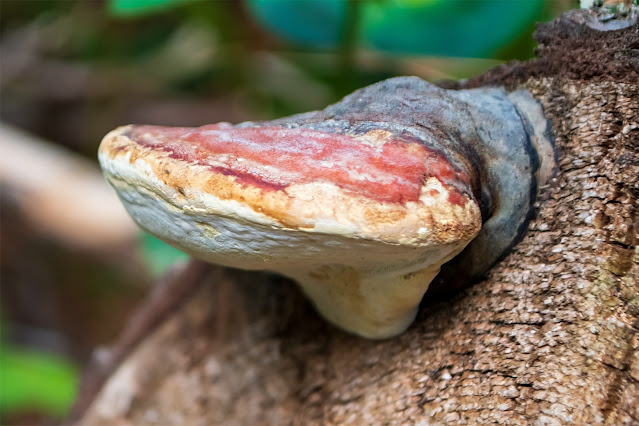
A smaller conk, growing on the side of the fallen trunk.

When the tree is standing, the pore layer faces downward along the length of the trunk. Conks that sprout on a tree lying on the ground face crosswise, usually growing on the cut ends or the downward slope of the log. The pores always open vertically. So looking at a fallen tree, you can tell if the conks are old or new.

And they can change direction if needed.
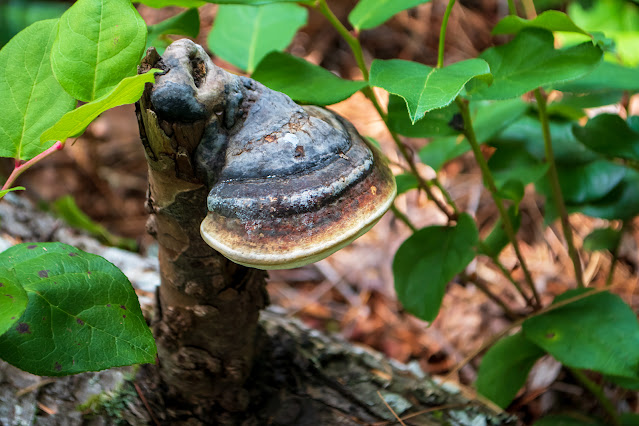
On the end of a broken branch.

It looks like this one started out on the broken end of the branch while the tree still stood, then turned to grow towards the new downside. These fungi respond to their surroundings: they're aware.

~~~~~~~~~~~~~~~~

Al lado de un senderito entre el bosque que bordea el lago Echo, encontré un arbolito que había sido talado, desnudado de sus ramas, cortado en secciones como preparándolo para el transporte, y luego abandonado. Y cada sección llevaba un buen número de hongos políporos.

Foto: Fomitopsis mounceae, también conocido como F. pinicola.

Los conchos que vemos son el cuerpo fructífero del hongo; los hilos (hifas) del micelio que forman la masa del hongo crecen escondidos en la madera del corazón del árbol vivo. Una vez muerto el árbol, el micelio invade la albura también, descomponiendo la madera, regresando los nutrientes a la tierra.

Políporo. La palabra describe el cuerpo fructífero; tiene muchos poros. Poros muy pequeños, unos 3 o 4 por milímetro. Se orientan hacia la tierra desde la capa inferior del concho; aquí se forman las esporas, y desde aquí caen y se las lleva el aire. La parte superior del concho es dura, muchas veces marcada o rota, frecuentemente cubierta de musgos. La cara inferior se ve limpia y fresca, ya que cada año se forma una capa nueva de poros.

Foto: otro políporo.

Cuando el árbol vive y se mantiene de pie, la capa de poros se dirige a lo largo del tronco, hacia el suelo. Los conchos que salen en un árbol caído se orientan perpendicularmente al tronco, brotando desde los extremos cortados o los lados más bajos del tronco caído. Los poros siempre se abren hacia abajo. Así que, mirando un tronco, puedes saber si los cuerpos fructíferos brotaron antes o después de que cayó el árbol.

Pero pueden también cambiar de orientación, según sea necesario.

Foto: un políporo en el extremo de una ramita rota. Parece que brotó desde la parte rota cuando el árbol vivía, y luego cambió de dirección para mirar hacia abajo de nuevo. Estos hongos están conscientes de lo que pasa en su mundo.


Wednesday, February 08, 2023

Little shelves all in a row

A few steps down the trail from yesterday's batch of mushrooms (scrambling through the bush, I took photos of the first, climbed over a log, looked at these, then, returning on a slightly easier route, took the last photos of the first log) there's another collection. These are more shelf fungi, all on the same felled log, all growing after it fell; the log lies flat, a few inches above the ground, and all the fungi are oriented with the underside towards the ground.

They grow like this, all in a row, from one end of the log to the other.

These are quite small; the maple "wing", about 2.5 cm long, shows the size.

An almost completely tan shelf.

The underside (they call it the ventral surface) of that shelf.

I'm not sure which of the common polypores found in our area these are; possibly the red-belted polypore, in which the colour varies considerably. It grows on dead conifer wood. Or maybe the tinder polypore, which grows on dead hardwood trees. It would depend on the identity of the log itself.

~~~~~~~~~~~~~~~
A unos cuantos pasos del tronco con hongos que subí ayer — abriendo camino entre el bosque, saqué fotos de los hongos en el primer troncón, me trepé sobre otro tronco para mirar estos de hoy, y de regreso, tomando una ruta un poquito menos difícil, saqué las últimas fotos en el primer tronco — encontré otro grupo de hongos políporos. Estos todos crecen en un mismo tronco, y todos crecieron después de que había caído, pues el tronco descansa horizontalmente en el suelo, y todos los políporos están orientados con la superficie reproductora hacia el suelo.

Fotos: 
  1. Todos crecen así, en hilera, desde un extremo del tronco hasta el otro.
  2. Estos son muy chicos, comparando con la "ala" de arce, que mide aproximadamente 2,5 cm.
  3. Este es casi completamente color beige.
  4. Y la superficie ventral del mismo.
No sé cuales son de los políporos comunes que se encuentran en nuestra región; posiblemente el políporo "de cinta roja", Fomitopsis mounceae, en el cual el color varía mucho. Éste crece en madera muerta de coníferos. O tal vez sea el Fomes fomentarius, que crece en madera muerta de árboles de hoja caduca. Todo depende de la especie del tronco en que se encuentran.

Tuesday, February 07, 2023

Flock of fans

Polypore fungi, the "shelf" mushrooms, orient themselves horizontally, like umbrellas, shielding the reproductive undersides from the rain. If they grow from a standing tree, the underside points to the ground underneath. Once the tree falls, new polypores are lined up along the now-horizontal trunk.

I came across this tree, fallen some years ago across the path beside the river, now cut into two sections. Its crop of fungi appeared after the fall.

On the cut end of the log.

And all along the length, growing through the bark.

On the cut end of the second piece. Are those brown lumps the beginnings of new ones, or something else entirely?

And on the first log section, below the crop of brown and whites.

I can't identify these fungi. I see three different species here, the white-bordered, white-bottomed fans, the larger, smoother, creamy ones beneath, and in between, a smear of old porridge which could be fungi or a slime mold.

Next log down, tomorrow.
~~~~~~~~~~~~~~~~~~~

Los poliporos, los hongos llamados "estante", se presentan orientados horizontalmente, algo así como pequeños paraguas que protegen los cuerpos reproductores de la lluvia. Si crecen en un árbol vivo, en pie, la parte inferior mira hacia las raices. Una vez caído el árbol hongos nuevos se orientan a lo largo del tronco que ahora reposa en el suelo.

En un árbol que cayó hace unos años cruzando el sendero al lado del rio, y que fue entonces cortado en varias secciones, encontré estos hongos, que crecieron después de la caída.

Fotos:
  1. En el extremo cortado del tronco.
  2. Y a lo largo, saliendo através de la corteza.
  3. En el extremo cortado de la segunda pieza. Esas bolas negras, ¿serán nuevos brotes del mismo hongo, u otra cosa completamente distinta?
  4. En la parte más baja del tronco.
No pude identificar estos hongos. Veo tres especies; los abanicos con los bordes y la parte inferior en blanco, los hongos más grandes, más lisos, color crema, y la masa que parece algo así como frijoles blancos refritos; éste puede ser otro hongo, o tal vez un moho mucilanigoso.

El próximo tronco, mañana.


Powered By Blogger