Showing posts with label Tahsis. Show all posts

Friday, February 16, 2024

Too good to waste

It was such a beautiful day, too good to waste. Coming home from running errands, I dashed inside, grabbed the camera and headed for the hills. Too much of a hurry. I found, too late, that I'd grabbed the wrong camera, one I'd been trying to repair. Luckily, I still had the pocket camera.

When I was a kid on the far side of this island, I liked to sit outside in the stern of our little boat on trips to Tahsis so I could watch the evergreen forests slide by, so dark and secret, so alien, home to cougars and deer, not us. In some spots, high above the water, the solid bones of the mountains rose to the surface; pure rock, without even cracks for the evergreens to force open with their roots. Not bare rock, though. In this wet corner of the rain forests, the rock bore, bears still, a thick cushion of moss.

Once I climbed the hill behind our house. Through a trackless belt of hemlock and Douglas-fir, breaking at the foot of a cliff into dense salal shrubs, then, as the rock repelled even the persistent roots of the salal, the golden moss burst into sunlight. I climbed to the edge of the forest above, and sat on the moss. From there, I was alone in the world; our settlement, a few houses on the shore, was hidden. The sun warmed the moss, and me.

I didn't stay long; we kids had been warned to stay out of the bush after 5, even on long summer days; the evening and night belonged to the cougars.

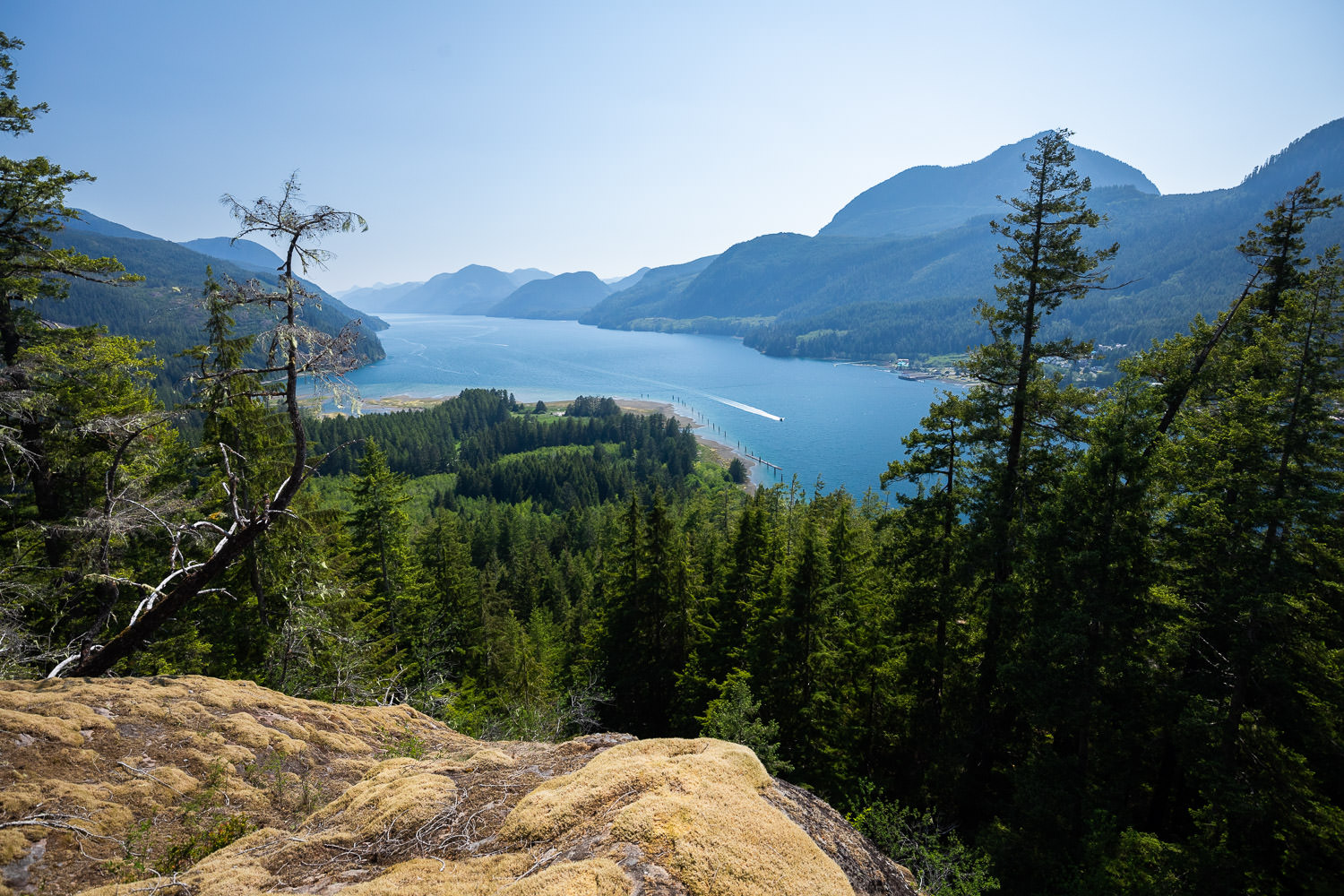
Now, here on the east coast of the island, on this bright afternoon, I visited a small patch of mossy rock on a steep hillside, pocket camera in hand.

From halfway down the hill. I didn't sit on the moss this time; it was soaking wet.

Staring into the sun. Glints off the water of Mirror Lake. The blue water is Echo Lake. The road below is a logging road.

Nearing the bottom. Dried, winter-bare branches of Scotch broom and oceanspray bush.

The broom is a pestiferous invasive species; I hate to see it settle in on this hillside. But it makes a nice lacey frill on the steep part of the hill, and in summer, when the moss is dry and brown, the broom paints the hillside in bright yellow.

Random shot as I walked. Somehow, this "speaks" to me.

Are those pussywillows at the bottom of the hill? I think they are!

I didn't go down to the road beneath, this trip, because where the climb gets really steep, the moss was soggy and very slippery. Leave that to summer days.

Lichens and moss from this spot, tomorrow.

(The links above ("Tahsis" and "high above the water" take you to a page with photos of the Tahsis hills.)
~~~~~~~~~~~~
Era un dia hermoso, no se podría desperdiciar. Regresando a casa después de hacer unos mandados. corrí a recoger la cámara y salí a prisa para visitar un sitio favorito en el bosque. Me apuré demasiado; descubrí al llegar a mi objetivo que traía la cámara vieja, que había estado tratando de componer. Por suerte, también traía mi camarita de bolsillo.

Cuando era niña, en la costa opuesta de esta isla, me gustaba sentarme afuera en la popa de nuestro barquito cuando íbamos al pueblo de Tahsis. Me gustaba ver como se deslizaban los bosques perennes, tan oscuros, tan secretos; el territorio de pumas y venados, allí nosotros éramos los invasores. En algunos sitios, muy por arriba del agua, el esqueleto de las montañas se descubría; roca pura, sin ni siquiera grietas que los abetos podrían abrir con sus raices fuertes. No era roca desnuda, en este rincón del bosque pluvial; aquí la roca llevaba un grueso cojín de musgos.

Una vez subí la montaña atrás de nuestra casa. Pasé por un bosque sin sendero alguno, un bosque de árboles perennes, los abetos de Douglas y Hemlock, abriéndose al pie de un despeñadero en un matorral denso de los arbustos Gaultheria shallon, y pasado este, llegué a donde el musgo dorado se bañaba por el sol. Subí hasta el borde del bosque superior, y allí me senté en el cojín del musgo. Desde allí me parecía que estaba yo sola en el mundo; nuestras pocas casas al borde del agua estaban escondidas tras los abetos. El sol nos calentaba; al musgo y a mí.

No me quedé mucho rato; nos habían inculcado bien que teníamos que estar fuera del bosque a las cinco de la tarde, aun en esos dias largos de verano; el atardecer y la noche eran propiedad de las pumas.

Ahora, aquí en esta costa del este de la isla, en esta tarde luminosa, visité unas rocas cubiertas de musgo en un acantilado, con la cámara de bolsillo en la mano.

Fotos:
  1. Vista desde la mitad de la bajada. No me senté en el musgo esta vez, pues estaba bien empapado.
  2. Mirando directamente hacia el sol. La luz brilla en el agua del lago Mirror (espejo). Lo azul es el lago Echo. El camino allá abajo es un camino de madereros.
  3. Cerca de este camino, con ramas secas de retama negra y de "espray de oceano", Holodiscus discolor. La retama negra es una planta nociva e invasiva; no me gusta ver como empieza a cubrir este sitio. Pero en invierno hace un encaje en el borde de la roca, y en verano, cuando el musgo está seco y color de café, llena el espacio de un amarillo brillante.
  4. Foto al azahar mientras caminaba. Por alguna razón esta vista me hace sentirme en casa.
  5. Sauces de gatito, o sea los botones peludos del sauce. Lo más distante que llegaba a operar la cámera; no bajé hasta el camino porque el último tramo del declive estaba muy empinado y el musgo empapado estaba resbaloso.
Mañana, habrá líquenes y musgos de este sitio.

(Los dos enlaces arriba te llevan a una página con fotos desde los cerros alrededor de Tahsis.)


Friday, August 05, 2016

At the bottom of the summit

The highways and roads crossing the north end of Vancouver Island wind along the bottom of deep valleys, dodging and zig-zagging around steep mountains, searching always for the lowest possible passage, the least likely to be covered in ice for half of the year. Water shows the way. The road follows twisty streams down in the V between hills. Driving, we get our shoulder exercise, left, right, left, left, right ... There are no straight stretches.

As the crow flies, from Campbell River to Tahsis, it's 100 km; by road, it's over 150.

I was surprised, driving back towards Gold River, by a summit sign, down there in the valley.

Bull Lake Summit, Elevation 586 m., 1922 feet.

And the hills loom far above the "summit". The mountains nearby, the Tlupana group, run around 1500 to 1600 metres, a good 1000 above this little lake.

I looked it up: this is the highest point on the road from Tahsis to Gold River. It's high enough to get snow in May.

We parked and climbed down to the shore, pushing through salmonberry canes and dodging mud patches. And the lake shore rewarded us:

Water lilies.

Buckbean, Menyanthes trifoliata, in the shallows. We were too late to see the beautiful, feathery flowers.

Another water-lover: gentian, probably King gentian, Gentiana sceptrum. 

These were growing right at the edge of the water, with their roots in soggy mud.

Another of the ex-mystery mushrooms, Turbinellus floccosus.

Floppy edged mushroom, with pretty fly. (On the left.) And, I think, a slime mold; the reddish ball on the right.

White gilled mushroom with assorted bugs.

Just a plain white mushroom, but I liked the face on the fly.

There was more to be seen; twinflowers, blue huckleberries, probably more mushrooms, but we had to hurry on. Suppertime, and we had forgotten to eat lunch. Gold River, 16 km away, called to us. But next time I'm by, I'll plan on getting my feet muddy. And even my knees.

Where we were this time.


Thursday, August 04, 2016

Better late than never

It seems strange to me now, back living on Vancouver Island after an entire adult life away, how much I missed of my surroundings, growing up, halfway in the bush as I was. I knew the berries, which to eat, which to avoid. I knew that the coiled tops of springtime ferns tasted of nuts, a good nibble as I followed the trail to school. I knew the taste of Douglas fir tips in the spring, and how to peel thimbleberry stalks for the first greens of the year, how to make pancakes with elderberry flowers in the batter. I waded in creeks lined with bleeding hearts.

I fished for "minnows" on the tide flats, never wondering what fish they grew up to be. I teased crabs and starfish, knew how to eat a clam on the beach, banging it on a rock to open it like the gulls did. I caught perch and red snapper from the wharf, and watched gulls fight over our leftover food, set out for the dog.

And I don't remember seeing mushrooms at all, ever. There were garden plots near two of our homes; there were daffodils and roses and some blue flowers that now I recognize as hydrangeas; back then, I didn't think to ask their name. The rest of the flowers and other plants in the area slipped by me, unobserved. And I never, ever saw a hermit crab or learned the names of the multi-coloured anemones on all the rocks.

Wasted opportunities. I'm glad that now I have a chance to fill in some of those gaps.

Piggyback plant, Tolmeia menziesii.

I always thought these were houseplants; now I learn that they are native to our west coast. This clump was growing at the campsite on the Leiner River.

It's growing on a moss-covered log.

The little plantlets growing at the base of the leaf will drop off and root in the soil beneath the parent plant.

False bugbane, Trautvetteria caroliniensis. Another native. From the Leiner River trail.

Two-leaved false Solomon's seal, Maianthemum dilatatum. I remember seeing these berries long ago, and knowing only that I shouldn't eat them. Leiner River trail.

Foamflower, Tiarella trifoliata. I missed this one on the trail, but it turned up in several of my photos. Very tiny, and usually only seen as spots of white on a thin stalk.

Silverweed, Argentina anserina. On the banks of a lake between Gold River and Tahsis.

We have a local silverweed here, that grows on the seashore; it's salt tolerant. A. anserina prefers inland soils.

Twisted stalk, Streptopus lanceolatus, with berries. Usually there is one per leaf. The extra one here looks like it will fall off, unripe.

This is another that I only knew as, "Do not eat." This one was on the banks of the Campbell River, just out of town, but they showed up in Tahsis, as well.

And this, I have trouble understanding; how did I ever miss seeing lichens in all those years? In a field by the Leiner River.

Lichen and nail on fencepost.

These photos taken here.


Wednesday, August 03, 2016

Verticality

Enough bending down to look at the duff dwellers. I stand up, stretch my back, and look up instead.

Trees, mountain, sky over the Leiner River. (Click for a better view.)

The photo is as shot. That was the colour of the sky at 2:45 that afternoon; blue and slightly pink.

Update: I found the photo, as shown on the blog, to be disappointing, not as I had seen it on my screen before posting. Clicking on it, however, gives me the photo as it should be. I checked a bunch of other posts, and found the same thing: Blogger dulls the photos, even though it keeps a decent copy hidden, unless you click on it. Why is this?

A Skywatch post.

Tuesday, August 02, 2016

Of pie and slug yummies.

Mom used to make a pie in the summertime; graham cracker crust filled with vanilla custard mixed with an assortment of berries picked that afternoon in the bush; huckle-, salmon- and thimble-berries, red and orange, juicy, seedy and a little tart, nuggets of taste and colour in the blandness of the custard.

I remembered those pies as I walked the Leiner River trail, carrying a huckleberry branch lopped off by the trail maker, picking and eating the ripe berries as we went. The bush provides.

My son asked about some of the mushrooms we passed: could we eat those? I recognized Russulas, which we had eaten up north. They tasted and had the texture of erasers, I told him, and he lost interest. But there were many others, food for slugs and bears, not for us, not without a specialist to pronounce them safe.

Collybia, I think. Possibly edible. With slug bites.

Typical clearing floor: evergreen twigs, needles, and cones, mosses, wild blackberry leaves, a huckleberry branch. And mushrooms. A slug has been eating a couple of them.

The same mushrooms, from ground level.

Something broke this one off.

Two unidentified mushrooms posing as siamese twins, with a wild blackberry twig growing through them.

Slug eye view. Same mushrooms. (Gilled bolete? Edible?)

On a disintegrating log. Unidentified. The cap of the one on the left has been nibbled on.

Strange, blobby polypores. Shelf fungi that forgot how to make shelves. (Maybe when the tree went from vertical to horizontal.)

Pretty yellow slug, a mushroom eater. One of many. This one's on our picnic table.

We're still here on the Leiner River trail.


Monday, August 01, 2016

Pink ghosts

When I was a very small child living in Tahsis, some sixty-mumble years ago, our house was one of a dozen or so along the Tahsis river bank. In front of us, the road and the river; behind us, nothing but empty tide flats, then the bush. Impassible bush, all intertwined salmonberry and salal, rotting logs and slippery moss.

We went over that way in the canoe once, past the tide flats and up the mouth of another river. When the canoe kept getting stuck in the reeds, Mom insisted that we turn back. People said there were horses over there, and apple trees; I only half believed them. There were none in Tahsis.

Now, of course, there's a highway. And walking trails cut through the bush, winding along the banks of the Leiner River. Easy going, in most spots. Someone had been through just ahead of us, hacking down the everlasting salmonberry canes; they can erase a trail in a few months.

But off the trail, the bush is still the same; tangly, dense, interlocked berry bushes; salmonberry, huckleberry, salal, thimbleberry. Where there's a bit of space, the evergreen ferns take over.

Under this mess of branches and leaves, we found several clumps of Indian pipe plants. Where I could scramble or climb close enough, I took photos.

Indian pipe plant, Monotropa uniflora, aka ghost plant, corpse plant. About 6 to 8 inches tall.

These plants, like the gnome plant, are parasites on fungi that in turn, parasitize trees. They have no chlorophyll, which makes other plants green. Usually they are white, with hints of black or pink. A few may be red.

These are more pinkish.

Flower heads. Each stalk bears one flower only. The flowers hang down at first, then stand upright once they are pollinated and are making seeds.

We passed a few plants that had been broken by the trail maker; they had quickly turned black.

In an abandoned clearing, I found an old apple tree. I didn't see any horses.

The Leiner River trail is just west of our campsite.


Sunday, July 31, 2016

Campsite mushrooms

The (free) campsite we stayed in just outside of Tahsis runs alongside the Liener River, in deep rainforest under Douglas firs and cedars. The only amenities offered are picnic tables, one per cleared site, and small fire pits, plus a couple of outhouses. We hadn't brought our own firewood, and soon found that all the fallen wood in the area, even bordering the river and road, where the sun occasionally reaches, is soaked through. We had to go into town to collect fire starter and driftwood.

The far side of the river; a dense wall of boundary plants, ferns, salmonberries, and thimbleberries, and beyond them, old evergreens, standing and fallen, moss-covered.

It's always dusk under the evergreens, and the mosquitoes are enthusiastic morning and evening. There is a distant smell of bear; old fish, ancient urine, leftover meals, stewed together in two-inch deep fur.

It's prime mushroom country, even in midsummer.

Polypore with a thick, whitish lip. On the side of a mossy log.

More shelf fungi on the end of a log. Conifer-base polypore and resinous polypore?

A white, oozy shelf fungus on well-rotted wood.

This tiny one was inside a stump. I couldn't get in to see the underside. Note the grey springtail on the edge, and in the centre of the dried evergreen needle, an even smaller globular springtail.

Lichen or mushroom? On a small twig I brought out into the light, resting on the grey picnic table. The mushroom is about 3/8 of an inch tall.

Looking down into the cup. One side has been knocked out.

Yellow slime mold, scrambled egg slime. On well-rotted log.

These are awkward critters to photograph. They grow in dark places; even though it was 11 AM when I took these photos, it was still twilight under the trees. And they don't respond well to flash; the colours change, even fluoresce. So it's handheld, wobbling on precarious, slippery ground, in the dark. And even so, my camera does better than my eyes. It manages to see texture; I didn't.

Scrambled egg, up close.

These were all taken at the same place as yesterday's lot:

GPS coordinates: 49.91553, -126.62502


Powered By Blogger