Showing posts with label crab carapace. Show all posts

Tuesday, August 29, 2023

Turtle? Butterfly? Neither.

 If I had seen this crab on the shore (and maybe I have), I wouldn't have recognized it as a crab. Just another piece of broken clamshell, unless it was moving. But in the aquarium, I got to look at it from the underside. And it is obviously a crab, but it seems to be wearing a borrowed carapace, too big for it, as if in imitation of the hermit crabs.

No, that's the carapace he grew himself. So wide it can hide all his legs and that fat right claw.

Cryptolithodes typicus, the butterfly or turtle crab.

Sometimes he is given the name, "umbrella crab", although this properly belongs to a relative. But the carapace does look umbrella-ish. He is also called, properly, the turtle crab, because he can hide completely under the carapace like a turtle does. Or he's the butterfly crab; the reason for that name shows up in the next photo. His Latin name means "typical hidden stone".

Other characteristics, those that differentiate him from the "true" umbrella, are the ridges on the edges of his abdominal plates and the knobby, stubby claw.

And here's a leftover molted carapace:

Butterfly crab carapace

I puzzled over this for a while. Was it a crab molt, was it a broken piece of something else; if it was a crab molt, what species? And it turns out it's the same species as the one above. They come in a variety of colours, from white (especially when young), to red (especially the males), to dull greys and browns. And they may be spotty or streaky or, as here, with the central portion a distinct contrast with the wings, which is what gives them the name "butterfly crab".

iNaturalist has many photos of this crab, showing the variety of colours and patterns. Check them out here.

They're an intertidal or shallow subtidal species, so I probably have seen them without recognizing them. Perfect camouflage.

A couple more crab photos, "normal" crabs, the ones I'm used to finding: see how the body fills out the entire space under the carapace, so the legs can never be hidden. These crabs have to depend on speed and shelter to escape predation.

Rock crab?

Help! There's an anemone after me!

~~~~~~~~~~~~~
Si hubiera visto este cangrejo en la playa — y tal vez sí lo he visto — no lo hubiera reconocido como cangrejo. Más bien parece un pedazo de concha de almeja roto, si no está en movimiento. En el acuario, lo llegué a verlo desde abajo. Y se ve claro que es un cangrejo, pero parece que, al costumbre de los ermitaños, lleva un caparazón prestado, demasiado grande para el cangrejito debajo.

Pero no; ese es su propio caparazón. Un caparazón tan ancho que puede cubrir todas sus patas y ese quelípedo derecho gordo.

Foto: El cangrejo Cryptolithodes typicus, el cangrejo "mariposa" o "tortuga".

A veces recibe el nombre de "cangrejo paraguas", aunque este nombre más bien pertenece a un pariente suyo. Pero de veras, el caparazón da la impresión de un paraguas. Más aceptados son los nombres "cangrejo tortuga", por la manera en que puede esconderse completamente debajo del caparazón, o "cangrejo mariposa", lo que se explica con la siguiente foto. Su nombre científico significa "piedra típica escondida".

Otras características, que sirven para identificarlo en contraste con el cangrejo paraguas verdadero; los bordes levantados de las placas de abdomen, y los quelípodos cortos y nudosos.

Foto: un caparazón abandonado después de una muda.

Este caparazón me dejó perpleja por un tiempo. ¿Era una muda de cangrejo, o un pedazo de otra cosa? ¿Si era una muda, de que especie? Y resulta que es de la misma especie que el primero. Aparecen en una variedad de colores, desde blanco (especialmente los jóvenes), hasta rojo (especialmente los machos) y gris o café, claro o oscuro. Y pueden tener manchas o rayas o como aquí se ve, con la porción central de un color diferente en contraste con el de las "alas". De donde recibe el nombre "cangrejo mariposa".

En iNaturalist hay gran número de fotos de este cangrejo, demostrando los diferentes colores y diseños. Haz clic aquí.

Esta es una especie que habita en la zona intramareal o en las aguas de poca profundidad, así que probablemente los he visto sin saberlo. ¡Camuflage perfecto!

Y un par de fotos más, estas de cangrejos "normales", los que acostumbro encontrar; ve como el cuerpo llena todo el espacio debajo del caparazón de manera que las patas nunca se pueden esconder. Estos cangrejos dependen de velocidad y la protección de piedras o hierba marina para escapar a los depredadores.

Foto:

  •  un cangrejo "roca"?
  • —¡Socorro! ¡Me quiere atrapar una anémona!


Friday, November 23, 2018

Unbeatable

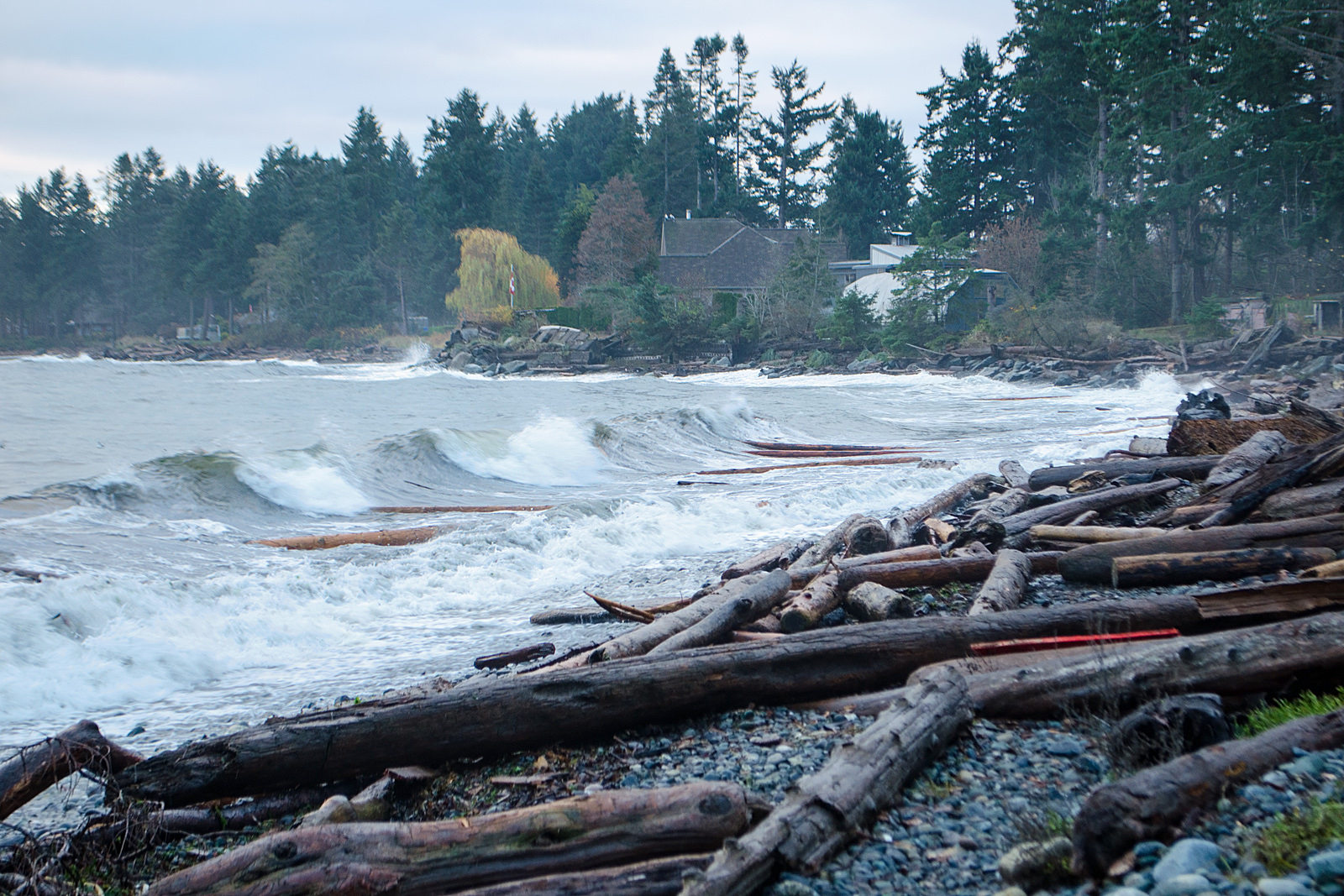
The waves were strong and relentless. Along the shoreline, they were picking up logs and hauling them out to sea, only to toss them back on the rocks with the next roller, like so many sticks from a game of pick-up-sticks.

Five logs on the way out.

With each wave, the stones on the beach rattled and rumbled, rolling down, being thrown back up. An unexpectedly high wave pulled the stones out from under my feet, tossing me back on my tail end in the wet. It was lucky for me that the stones felt soft, as they slid loosely in the surf. I was not hurt, much.

And coming back in.

And yet ... and yet ... Among the rolling stones, I find fragile pieces of shell, sea critters, even spider webs, holding their own against the pounding waves.

Molted carapace of a small kelp crab.

Soft sponge

So fragile! A piece of hydrocoral, tangled with seaweeds. Found half-buried in rolling stones.

Molted piece of crab belly plate.

And last, above the reach of the waves at the moment, but still within their spray zone, an old stump, torn and battered, and sheltering, among other things, a community of spiders.

These shells and stone were at my elbow height above the beach, and above the high tide line. Somehow they've been tossed up here, out of the reach of most waves. And if you look closely, there are at least two spider webs tying the stump together. I'm not sure, but I think there's a greyish spider in the centre of the main one. Do you see it?

I returned and saw under the sun, that the race is not to the swift, nor the battle to the strong, ... ; but time and chance happeneth to them all. Ecclesiastes 9:11, KJV (just because I like the KJV language.)


Saturday, January 10, 2015

Green and black

Shore crab carapace. No two ever alike.

He's a young male. His mate is a uniform dull green, about the colour of the background here.

I'll be busy for the next few days, and away from the blog.  Back Tuesday, I think.

Wednesday, June 25, 2014

Tangerine ghosts

At first glance, it looks like an orange. A peeled tangerine, lying there on the beach, caught on an old crab carapace, washed by the retreating tide.

But on closer inspection, it belongs where it lies; it's a part of the departed crab, left behind for the gulls and the water-line isopods.

When the crab molted, he took away his soft parts: legs and eyes, his brain, memories and all, his antennae, all his mouthparts, and his gills. Besides the hard "shell", he abandoned his stomach lining, his esophagus and shreds of his intestine.

The gills are different; he takes them, but leaves the outer casing, as apparently intact as the calcified parts. Older remains left on the shore are whitish and translucent, but fresh, they're - well, fruit-coloured.

"Ghost gills" on the half-shell.

A second crab molt; looks like the gulls already took a nibble.

A third molted crab on the same stretch of shore line.

A molted crab, from above, looks intact. But check out the eyes!

Eyestalks, lens, black pupil spot. But they're empty windows: the watcher inside is long gone.


Friday, April 15, 2011

Discarded finery

Scattered all along the upper levels of Crescent Beach this week, we saw dozens of these crab carapaces:

Helmet crab shell, in shallow water. About 2 inches tip to tip. They may grow to 4 inches.

At first, I thought there had been a die-off, and then I looked more closely. Each one was just the clean upper carapace, unbroken, with no legs or "innards" attached. So it was a general molt, which signals mating time. The crabs come up to the intertidal zone, and the males choose their mate and hold onto her until she molts. Females are not able to mate until they have a new, still soft, carapace.  Within a day or so, the shell has hardened, and the opportunity gone for this year.

We don't usually find these crabs (Cancer cheiragonus) live in the intertidal zone, so this is all the evidence of crabby romance that we will see.

A small collection of sun-dried shells, inside a larger Dungeness crab shell.

I love the textures of these crab shells, especially the pale yellow inner wall of the helmet crab on top. The shell of the Dungeness is quite different, sort of like a stuccoed wall. Click on the photo to see these full size.
Powered By Blogger