Showing posts with label hydrocorals. Show all posts

Sunday, February 28, 2021

Castaway

Here's another beach find.

As found, growing on a stem of red algae, with scraps of dead eelgrass.

My thumbnail gives the size. The entire colony is about an inch across. It is hard and does not bend.

Hydrocoral at home, in water. It's attached to a red-stemmed alga, unidentified.

Photos of living hydrocorals underwater sometimes show the miniature tentacles protruding from each pore, making the colony look hairy. This one was obviously dead; underwater, it remained inert. They grow in the subtidal zone; this one was cast up on shore after it's support was torn out.

It's a Cnidarian, Stylaster sp., possibly (?) S. californicus.

Hydrocorals are related to the anemones and jellyfish, hydroids and the true corals.
Close-up photos of hydrocoral show the minuscule pores containing polyps. Nonfeeding polyps (dactylozooids) are ringed by long tentacles with clusters of stinging cells. The tentacles protect the colony and catch prey. (California Diving News)

A small segment, broken off. It was attached to the stem of the red alga.

Zooming in with the microscope.

Stylaster sp. come in many colours, from red to purple to blue, pink or white. This one has tints of pink on the stubby tips.

~~~~~~~~~~~~~~~~~~~~~~~~

Algo más encontrado en la playa.

Primera foto: tal como lo encontré; crecía en una rama de alga roja, y llevaba envuelta unas hojas de hierba Zostera reseca. La colonia mide aproximadamente 2 cm. Es duro, y no se dobla.

Segunda foto: en casa, sumergido en agua. Es un hidrocoral, o sea, un falso coral duro. Las fotos de hidrocorales vivos, en agua, a veces muestran los pequeños tentáculos que salen de cada poro, haciendo que la colonia parece tener pelo. Este, en casa, estaba muerto; no quedaba nada dentro de los poros. Crecen en la zona bajo el nivel de las mareas, y este habrá sido arrancado de su sitio cuando las tormentas rompieron su base de alga.

Tercera foto: ya seco. Es un ejemplar del Género Stylaster, posiblemente S. californicus. Los hidrocorales pertenecen al filo de las anémonas, las medusas, los hidroides, y los corales.

"Fotos maximizados de los hidrocorales muestran los poros minúsculos, que contienen pólipos. Los pólipos que no comen (los dactylozoid) traen un anillo de tentáculos largos con grupos de células venenosas. Los tentáculos protegen la colonia y capturan alimentos." (California Diving News)

Cuarta y quinta fotos: un segmento roto, bajo el microscopio. Los Stylaster pueden ser de varios colores, desde rojo, color de rosa, morado, azul, o blanco. En este, se le puede ver un residuo de color de rosa en las puntas.


Friday, November 23, 2018

Unbeatable

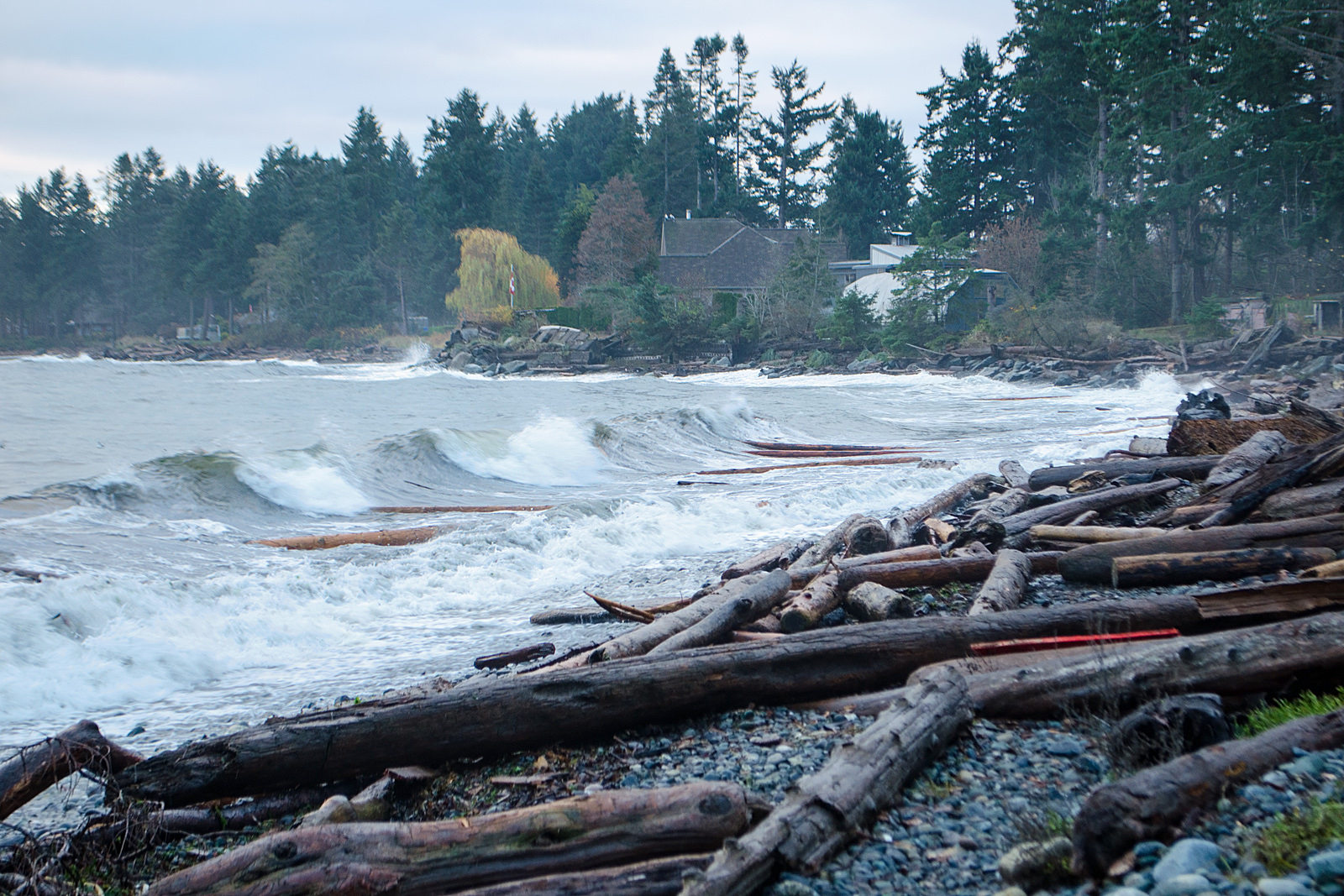
The waves were strong and relentless. Along the shoreline, they were picking up logs and hauling them out to sea, only to toss them back on the rocks with the next roller, like so many sticks from a game of pick-up-sticks.

Five logs on the way out.

With each wave, the stones on the beach rattled and rumbled, rolling down, being thrown back up. An unexpectedly high wave pulled the stones out from under my feet, tossing me back on my tail end in the wet. It was lucky for me that the stones felt soft, as they slid loosely in the surf. I was not hurt, much.

And coming back in.

And yet ... and yet ... Among the rolling stones, I find fragile pieces of shell, sea critters, even spider webs, holding their own against the pounding waves.

Molted carapace of a small kelp crab.

Soft sponge

So fragile! A piece of hydrocoral, tangled with seaweeds. Found half-buried in rolling stones.

Molted piece of crab belly plate.

And last, above the reach of the waves at the moment, but still within their spray zone, an old stump, torn and battered, and sheltering, among other things, a community of spiders.

These shells and stone were at my elbow height above the beach, and above the high tide line. Somehow they've been tossed up here, out of the reach of most waves. And if you look closely, there are at least two spider webs tying the stump together. I'm not sure, but I think there's a greyish spider in the centre of the main one. Do you see it?

I returned and saw under the sun, that the race is not to the swift, nor the battle to the strong, ... ; but time and chance happeneth to them all. Ecclesiastes 9:11, KJV (just because I like the KJV language.)


Thursday, October 18, 2018

Using all three eyes

The camera sees more - and less - than my eyes do. Flipping rocks along the shore, left-handed, with the camera in the right hand, finger on the shutter button, I disturb crabs, who scuttle quickly under the next-door stone. Flip another; crabs. Another; more crabs. One stops to threaten me, pincers raised. "Come on, see if you dare!" I turn the camera in her direction, and she changes her mind and joins her friends under shelter.

Another stone. More racing crabs. Once they're gone, I see slow movement; flatworms. The camera sees them, unless the light is just exactly right, as brown smears. My eyes see the movement, the merest hint of it, going in a different direction than the slither next to it, the next flatworm.

Whelk egg cases, spiral tube-worms, and flatworms on the underside of a stone.

Wosnesenski's isopods, one lying upside-down for some reason, showing off his 14 legs. And a pair of crabs.

Sometimes, there's a nano-second of flurry, a miniscule splash; a baby sculpin, an inch long, gone to ground, now invisible. Maybe the camera will see him; I won't. But I saw the splash.

Some animals are only recognized, in these surroundings, by their movement. I learn to see them; the merest rise and fall of a limpet under the seaweed gluing herself down to the rock while the light threatens her; the split-second flip-flip-flip of a gunnel, the shrinking of an anemone, the characteristic sideways scuttle of a miniature hermit - snail shells don't move like that without a hermit resident; the writhing of a polychaete worm becoming one with the mud underneath, the squirting of a clam retreating deeper into the mud. The camera never sees those.

Spiral tubeworms, flatworms (the light was right- look for the eyes!) and a limpet, still on the move. I don't know what that tiny thing with the striped back"bone" on the stony patch in the centre is.

My eyes miss the very tiny critters. My reading glasses are in my pocket; they get in the way when I look through the viewfinder, and the light is too bright to see the screen. So I point and shoot, looking for the green square that says the auto-focus has found something interesting. Or find a safe, non-painful (broken barnacles are sharp!) place to kneel so that I can get my head down a few inches from the stones and look through the viewfinder.

White shells, a sea of white shells; must be barnacles. The camera knows better. Waving seaweeds; no, the camera discovers tentacles or antennae. Or a mass of worms.

The camera saw these. I didn't.

This photo includes two masses of ribbon worms; the upper one is a knot of Paranemertes peregrina (p. means wandering), the purple ribbon worm, with a very purple body and a creamy belly; the orange ribbon worm, Tubulanus polymorphus; and the green ribbon worm, Emplecotnema gracile, with its green top and yellow belly.

The lower knot appears to be all green ribbon worms.


And there are three flatworms and a trio of crabs.


Sometimes things are easier; I find an underwater species tossed up to die on the shore. These I can pick up and move to a better background.

Unidentified species of hydrocoral. Notice the yellow "bud" at the tip of the branches.

Habitat for the critters found above. The stripes parallel to the shore are probably old glacier tracks on sandstone.

Powered By Blogger