Thursday, June 30, 2022

Questioning the snags

 Walking down a shady trail, stopping to look at old wood:

Still standing, barely.

If this snag could talk, it would have quite a story to tell. Did it snap off because it was rotten? Or did it rot because it was broken and dying? Who has been digging holes in it? Who has lived in those holes? I stand and stare, wondering.

Bare naked tree. Holding a tray full of moss.

This one, still standing tall, has lost all of its bark, top to bottom. Why?

Orange jelly on the cut end of a log. With shiny, fat beetles.

Crews were out as we passed by, cutting off logs that had fallen across the trail, creating new habitat for dead wood fungi.

I saw some interesting things on this walk, that made me return for a closer look today. And now I found something else, something that showed up on the photo, not to my eyes. So back I go tomorrow, with a lens and a flashlight. The woods are full of mystery!

~~~~~~~~~~~~~~~~~~~~~~~~~~~~~~

Caminando por el bosque, me detengo a mirar troncos viejos.

Foto #1: Un tronco que apenas se mantiene en pie. Si pudiera hablar ¿qué nos contaría? ¿Se rompió porque estaba podrido, o se pudrió porque el viento lo rompió? ¿Y quién le ha estado excavando? ¿Qué criaturas han hecho sus refugios en esos agujeros? Lo miro y quedo asombrada.

Foto #2: Este árbol, todavía con su altura normal, pero sin hojas, se ha desnudado; no tiene ni un poquitito de corteza. ¿Porqué?

Foto #3: En el extremo cortado de un troncón, surgen brotes de hongos, la jalea anaranjada, Dacrymyces chrysospermus. Algunos escarabajos, pequeños, gorditos, le rodean.

Mientras pasábamos, unos jóvenes estaban cortando troncos y árboles que habían caído sobre el sendero, creando así nuevos habitats para más hongos.

Vi algunas cosas interesantes en este paseo, cosas que hacían necesario otra visita hoy para mirarlas con más atención. Y ahora, veo otra cosa que no vi al momento, pero que apareció en las fotos. Mañana, si no llueve mucho, regreso otra vez, con un lente y una linterna de mano. ¡El bosque está lleno de misterios!

Tuesday, June 28, 2022

Promise

 And down in the Oyster Bay meadow, the summer show is beginning.

(The camera behaves sometimes, even in the half-light near sundown; it saw things better than my old eyes could.)

Purplish-red grass. Unidentified.

Gold star, Crocidum multicaudale; hare's foot clover, Trifolium arvense; and grass, unidentified.

And there will be apples. This year, there were no tent caterpillars.

I must come back soon, in full daylight.

~~~~~~~~~~~~~~~~~~~~~~~~~~~~~

En la pradera de Oyster Bay, ya empezó la exhibición de flores y frutas del verano. (Y la cámara es mejor que mis ojos; aun a la media luz cerca de la puesta del sol, vió lo que yo percibí a medias.)

Fotos:

  1. Pasto no identificado.
  2. Las flores de Crocidium multicaudale, de Trifolium arvense, conocido como pie de liebre, y otro tipo de poáceas.
  3. Y habrá manzanas. Este año, no aparecieron las orugas de la tienda, Malacosoma californicum.
Tendré que regresar pronto, a pleno dia. 


In the cool of the evening

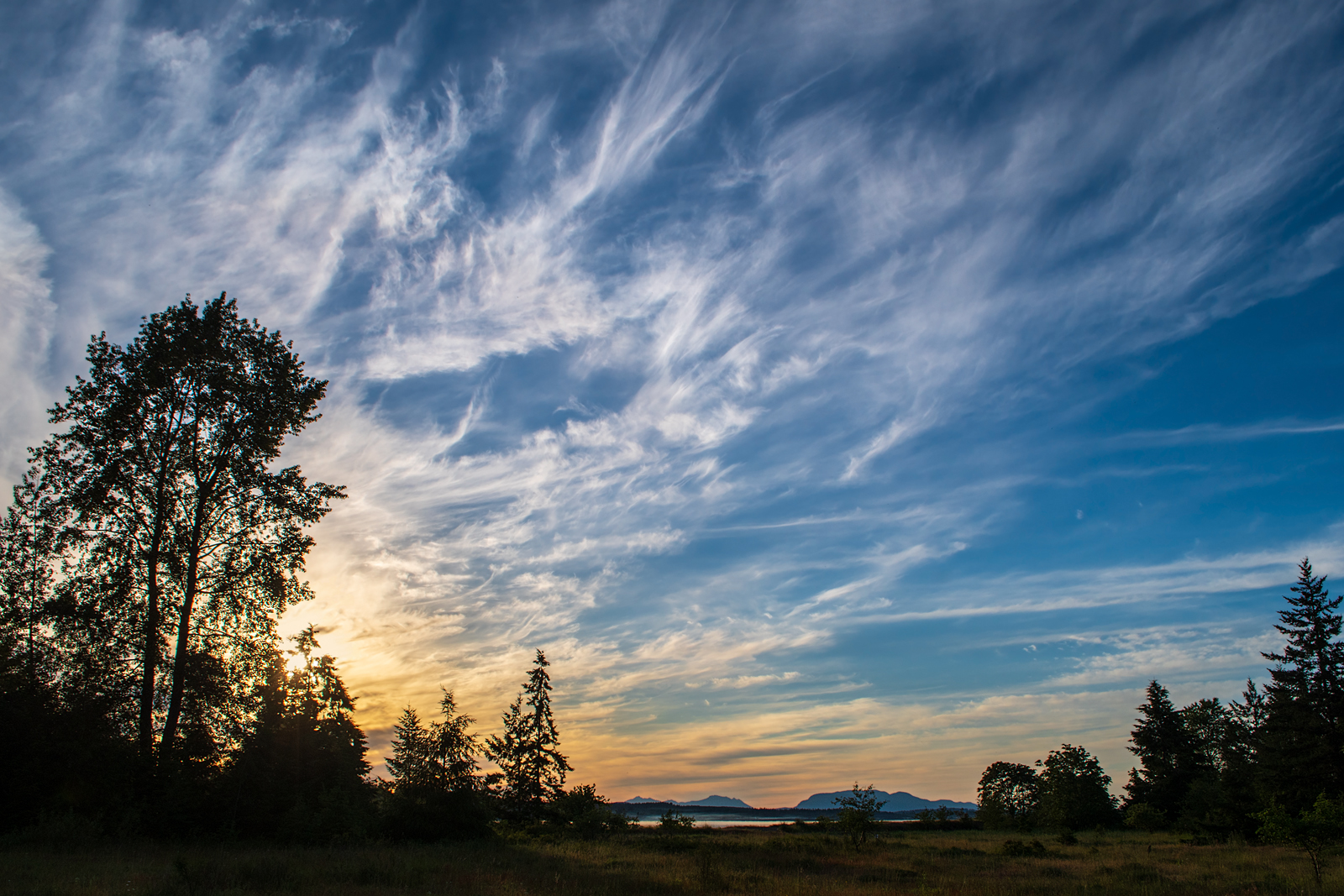
At the end of a long, hot day, an evening walk as the sun goes down hits the spot. I even had to wear a light jacket! Here's the sun setting over Oyster Bay, as it developed. 

From the parking lot, looking Northwest, over the meadow. 8:30 PM.

From the outer shore. More or less North-northwest. 8:43 PM.

8:52. Still walking the outer shore. Northwest by north

9:08. From the dike, looking over the inner bay. The tide is low, so there's mud. 

9:12. Turning my back on the sun, to watch the swallows chasing mosquitoes far above.


And the last gasp of the light. 9:20 PM.

And sunset, with no trees to shield the sun, was at 9:36 PM. that day. By the time I'd returned to the meadow, all that was left was a warm orange haze on the clouds.

Another Skywatch post.

~~~~~~~~~~~~~~~~~~~~~~~~~~~~~~~
Al final de otro dia caluroso, se antoja un paseo mientras se pone el sol. ¡Hasta me tuve que poner una chaqueta ligera! Aquí el final del dia visto desde Oyster Bay.

Fotos:
  1. Mirando hacia el noroeste sobre la pradera, desde el estacionamiento. A las ocho y medio.
  2. Saliendo a la playa exterior, miraba hacia el norte-noroeste. Las 8:43.
  3. 8:52. Volviendo un poco más hacia el oeste.
  4. Las 9:08, ya desde el dique, mirando sobre la laguna interior. Con la marea baja.
  5. Olvidando el sol por un momento, le volví la espalda para mirar las golondrinas cazando mosquitos. Las 9:12.
  6. Y ya mero desaparece el sol. 9:20 PM.
La puesta del sol oficial — si no hubiera árboles para impedir la vista — era a las 9:36 ese dia. Ya para cuando llegué otra vez a la pradera, lo único que quedaba era un tinte anaranjado en las nubes.


Sunday, June 26, 2022

Bench facing west

 Sit and rest a while. Watch the sun go down.

Big-leaf maples on the dike at Oyster Bay.

Sunset today, 9:34 PM. Sunrise tomorrow, 5:13 AM. But the sky turns pink an hour earlier. I love these long, slow evenings, the morning glow in my window.

A week from now, we will have lost 7 minutes of sunlight. The sun is moving south again.

A Skywatch post.

~~~~~~~~~~~~~~~~~~~~~~~~~~~~~~~~~
Siéntate, descansa un rato. Mira mientras se va a esconder el sol.

Foto: arces de hoja grande en el dique de Oyster Bay.

El sol se puso hoy a las 9:34. Y mañana amanece a las 5 con 13 minutos. Pero el cielo ya se tiñe de rosa una hora antes. Me gustan estas tardes lentas, y el fulgor mañanero en mi ventana.

Dentro de una semana, habremos perdido 7 minutos de sol. El orbe está en camino al sur otra vez.


Saturday, June 25, 2022

In a crabby mood

 My computer keeps crashing today. So I'm crabby. So is he:

Crab molt, Oyster Bay shore.

Back to work, arguing with a stubborn machine.

~~~~~~~~~~~~~~~~~~~~~~

Mi computadora y yo estamos de malas hoy; se me congela la máquina a cada rato.

En inglés se dice, cuando uno está de malas, que está como cangrejo. Así que aquí está un cangrejito que también estuvo de malas. Y ahora dejó su muda en la playa.

Y vuelvo a mi pleito con esta computadora.


Movers and sleepers

 One final look at the Willow Point low intertidal zone.

Tide still on its way out. Logs coming in. Rocks staying put.

There was an unusual number of logs on the move this afternoon. Many were already lying on the shore, ready to float off when the tide came in again. And the water was full of new arrivals. Washed down by a very high tide, or by a storm somewhere up the strait, maybe.

Also staying put; a purple starfish, and a few green urchins. Waiting for the water to come back.

~~~~~~~~~~~~~~~~~~~~~~~~~~~~~~~~~

Una última mirada a la zona baja intramareal de Willow Point. La marea está bajando todavía. Los troncones están llegando a descansar sobre la playa, como si fueran focas. Y las rocas, pues, las rocas se quedan donde están.

Había muchos troncos en el agua ese dia; no creo haber visto tantos antes. Muchos ya estaban secándose al sol sobre las rocas, listos para volver a flotar cuando subía la marea. Y el mar traía más a cada momento. Será que una marea más alta que las acostumbradas los habría arrancado de las dunas, o tal vez hubo una tormenta más para el norte.

Segunda foto: una estrella de mar morada y un grupo de erizos de mar verdes. Estos también se quedan donde están, esperando a que regrese el agua.


Thursday, June 23, 2022

Algae and not

Tide-pooling in the lower intertidal zone; the seaweeds, and seaweed look-alikes:

Masses of sea lettuce, Ulva spp., and faded kelp fronds.

In the upper intertidal zone, I find both of these, the sea lettuce and the kelp, but in pieces, washed up by the waves. Here, the sea lettuce is firmly attached to the rocks. It looks fragile, but pulling on a few blades, I find that not only do they not come loose, they don't break, either.

More sea lettuce, a red bladed alga, some brownish, feathery seaweeds, and I think those are pink branching hydrocorals.

The sea lettuce in the first photo had thin, long blades. This species has wide blades.

There are coralline look-alikes; coral leaf seaweeds, which are algae; the hydrocorals are animals. These have pink branches and whitish tips to each branch.

More of the same. With a purplish green sea urchin.

And another feathery brown algae. With sea lettuce, rockweed, bladed red algae. And a hermit crab.

At the very bottom of the exposed intertidal zone, assorted encrusting species.

It's hard to tell what these are. The pink and yellow bands are probably encrusting sponges. And then again, some could be encrusting bryozoans. The deep red could be more sponges, but Turkish washcloth, a seaweed, also has an encrusting phase. To be sure, you'd have to take a sample and examine it microscopically.

Identification is fun, but it's also a delight just to enjoy the patterns and colours, exposed here, oh, so briefly.

~~~~~~~~~~~~~~~~~~~~~~~~
Explorando en la zona intramareal más baja; algunas algas y cosas que se les parecen.

Foto #1: Grandes cantidades de lechuga marina, Ulva spp., y hojas de kelp, ya blanqueadas por el sol. En la zona intramareal alta, encuentro estos dos, pero en trozos, arrancados y aventados a la playa por las olas. Aquí, la lechuga de mar está bien fija en la roca. Parecen tan frágiles, pero si trato de quitar un manojo de la roca, no solo me resiste, pero ni se rompen las hojas.

Foto #2: Más lechuga de mar, pero de una especie diferente, una alga roja de hojas anchas, algas como pequeños arbustos, y hydrocorales color de rosa (también se conocen como corales falsos). La lechuga de mar en la primera foto tenía hojas largas y delgadas; la de esta foto tiene hojas anchas.

Hay algas que se parecen a estos hydrocorales. Pero los hydrocorales son animales. Tienen las ramas de varios colores y las puntas de las ramas son blancas.

Foto #3: Más de lo mismo. Con un erizo de mar verde, color violeta.

Foto #4: Otra alga en forma de arbusto. Con lechuga de mar, Fucus spp., otra alga roja de hojas anchas, y un cangrejito ermitaño.

Foto #5: En la parte más baja de la zona intramareal expuesta ese dia, una variedad de especies encrustantes.

Es difícil acertar a que especie estos pertenecen. Las manchas color de rosa y amarillas puede ser que sean esponjas encrustantes. Pero es posible que algunas sean briozoos. Las areas color de rojo fuerte también pueden ser esponjas. Pero hay un alga roja, la toallita turca, que tiene una fase encrustante. Para identificar alguno de estos con confianza, habría que tomar una muestra y examinarla bajo una lente fuerte o incluso un microscopio.

Es divertido tratar de indentificar estas cosas, pero también es un placer solamente mirar los diseños y los colores, que fueron expuestos aquí a la luz, por tan poco tiempo.


Wednesday, June 22, 2022

Can't see me, I'm disguised.

The camouflage fails when the seaweed is wet and the crab is not.

Kelp crab, Pugettia producta.

But he's wearing a sea lettuce hat. That should help to disguise him, right?

~~~~~~~~~~~~~~~~~

El camuflage no funciona cuando el alga está mojada y el cangrejo no lo está.

Foto: un cangrejo "kelp", Pugettia producta.

Pero lleva un sombrerito hecho de lechuga marina. Eso le servirá de disfraz, ¿no?

Tuesday, June 21, 2022

Sandpaper teeth

What makes holes in rocks underwater?

Water, of course. And critters: limpets, some clams, sea urchins.

Green sea urchins, Strongylocentrotus droebachiensis, alongside (and in) a crack in the rock.

Limpets have their teeth, reputed to be the strongest biological material on earth; piddock clams have thick, hard shells with grinding ridges on the bottom. But sea urchins? A sea urchin test is fragile. Pick one up, carefully, because it will break in your hand if you squeeze it.

And yet they dig holes in the rock. With their teeth.

Sea urchin test.

The sea urchin's hard parts are made mostly of calcite. In other words, chalk. The spines are single crystals of calcite, the test is magnesium calcite; even 5 tiny grinding teeth are made almost entirely of calcite. Soft stuff. On the Mohs hardness scale, it's a 3, just harder than talc and gypsum. The soft sandstone of our beaches is a 6 or more. So how does the urchin dig its hole?

Tide pool and rock holes. With green sea urchins.

I asked Google. It had a few answers for me.

First: scientists ... "have discovered that the urchins’ secret lies in a combination of ingenious design strategies. ... The scientists found that the sea urchins’ teeth contain crystals of magnesium calcite, which are smaller, harder and denser than those of pure calcite; they are concentrated at the grinding tip of the tooth, particularly in the tip’s center, where the most force is being exerted in the course of grinding. What holds these crystals at the center of the tip is a matrix of larger and softer calcite crystals. ... The presence of magnesium calcite crystals acts like sand paper that helps to grind the rock down.

They found that all the crystalline elements that make up the tooth are aligned in two different arrays, ... interlocked ..., just at the tip of the tooth where most of the wear occurs. The scientists believe that interlocking produces a notched, serrated ridge resembling that of a carpenter’s file. This ridge is self-sharpening: as the tooth is being ground down, the crystalline layers break in such a way that the ridge always stays corrugated." (From Science Daily)

Magnesium calcite has a hardness of 4 to 4.5 on the Mohs scale. So that helps, but it's not enough, it would seem.

But then: Michael Russell at Villanova University in Pennsylvania and his colleagues studied purple sea urchins (Strongylocentrotus  purpuratus), which live along the west coast of North America. ... In the lab, the researchers placed single sea urchins on flat pieces of soft mudstone, moderately hard sandstone and tough granite. After a year, they measured the weights of the rocks, how the surfaces looked, and how much the rocks were eroded.

The sea urchins had eaten holes in all the rocks, although they made slower progress on the harder ones. Field measurements showed that holes in mudstone were about 220 cubic centimetres, whereas holes in sandstone were 63 cubic centimetres and holes in granite were just 45 cubic centimetres. (NewScientist)

 And: A pit would be formed in medium grain sandstone in less than five years, while it would take more than a hundred years to form a pit in granite. (ZMEScience)

Well, that's better. Sandpaper teeth plus patience and persistence. And then there's this:

"Some of the largest and we believe oldest red sea urchins up to 19 centimeters in size have been found in waters off British Columbia, between Vancouver Island and the mainland," Ebert said. "By our calculations they are probably 200 or more years old." (OregonStateUniversity)

Sandpaper teeth, patience, and 200 years to work at it. That would do it.

~~~~~~~~~~~~~~~~~~~~~~

¿Qué cosa hace hoyos en las piedras debajo del mar?

Bueno, el agua. Y además, las lapas, algunas almejas. Y los erizos de mar.

Foto #1: Erizos de mar verdes, Strongylocentrotus droebachiensis, al lado y dentro de una grieta en la roca.

Las lapas tienen sus dientes, los cuales tienen la fama de ser el material biológico más fuerte mundialmente. Las almejas alas de ángel tienen conchas duras y gruesas con estriaciones en la parte inferior. ¿Pero los erizos? La testa de un erizo de mar es frágil; levanta una, con cuidado; si la aprietas, se deshace.

Pero de todos modos excavan hoyos en las piedras. Con los dientes.

Foto #2: Una testa de erizo de mar.

Las partes duras de un erizo de mar están hechas principalmente de la calcita. En otras palabras, la materia con que se hace la tiza con que escriben los niños. Las espinas son cristales únicos de calcita, la testa es de calcita de magnesio; hasta los cinco dientecitos son casi por completo calcita, carbonato de calcio. Material blando. En la escala de dureza de Mohs, es un 3, apenas más dura que el talco y el yeso. La piedra arenisca de nuestras playas tiene la dureza de 6 o más. Pues, ¿cómo entonces es que el erizo se hace el hoyo?

Foto #3: Poza intramareal y hoyos en la roca. Con erizos de mar verdes.

Le puse la pregunta a Google. Y me dió algunas respuestas:

Primero: Los científicos ... "han descubierto que el secreto de los erizos reside en una combinación de diseños ingeniosos. ... Los científicos descubrieron que los dientes de los erizos de mar contienen cristales de calcita de magnesio, los cuales son más pequeños, más duros y densos que los cristales de calcita pura; están concentrados en la punta pulidora del diente, particularmente en el centro donde se ejerce la mayor fuerza en la obra de taladrar. Lo que detiene estos cristales en el centro de la punta es una matriz de cristales de calcita más grandes, más blandos. ... La presencia de cristales de calcita de magnesio funciona como papel de lija para triturar la roca.

Hallaron que todos los elementos de que consiste el diente están ordenados en dos series distintas, ... entrelazadas ... justo en la punta del diente donde ocurre la mayor parte de desgaste. Los científicos creen que al entrelazarse, se produce una cresta dentada parecida al borde de una lima de carpintero. Esta cresta se afila por sí sola; mientras que el diente se desgasta, las capas cristalinas se rompen de tal manera que la crest siempre se mantiene dentada. (Science Daily)

La calcita de magnesio tiene una dureza de 4 a 4.5 en la escala de Mohs. Ayuda, pero no parece ser suficiente.

Pero: Michael Russel, de la Universidad Villanova en Pennsylvania, con sus colegas, estudiaron los erizos de mar morados, Strongylocentrotus purpuratus, los cuales viven el las costas del Pacífico de Norteamérica. ... En el laboratorio, colocaron erizos de mar, uno por uno, encima de piezas de lodolitas blandas, de piedra arenisca de dureza mediana, y de granito duro. Después de un año, midieron el peso de las rocas, vieron la apariencia de las superficies, y notaron en cuanto se habían erosionado las rocas.

Los erizos habían hecho hoyos en todas las rocas, aunque iban más despacio con las rocas más duras. Midiéndolas, se notó que los hoyos en las lodolitas llegaban a 220 centímetros cúbicos, mientras que los hoyos en la piedra arenisca eran de 63 cc. y los del granito de 45 cc. (NewScientist)

Y: Un buen hoyo se formaría en piedra arenisca en menos de cinco años, mientras que tomaría cien años para hacer el mismo hoyo en el granito. (ZMEScience)

Bueno, eso parece más posible. Dientes de lija, además de paciencia. Y luego, hay esto:

—Algunos de los más grandes, y creemos que los más viejos erizos de mar rojos, midiendo hasta 19 cm. de diámetro se han encontrado en las aguas cerca de Colombia Británica, entre la Isla de Vancouver y el continente — dijo Ebert. — Calculamos que tienen probablemente 200 años o más. (OregonStateUniversity)

 Dientes de lija, paciencia, y 200 años en que taladrar. Eso serviría.


Monday, June 20, 2022

Just chitons

Each stretch of shore has its own mix of critters and algae. On the Willow Point reef, I saw mostly green and red sea urchins, tons of ochre and leather sea stars, acres of encrusting bryozoans. Crabs and whelks and other snails. And limpets. There are always limpets, everywhere. And a fair number of chitons, huge and tiny.

Giant Pacific chiton, Cryptochiton stelleri.

These chitons are the largest species of chiton, worldwide. They may grow to 35 cm. long. This one was a big guy, about a foot long (30 cm.), maybe a bit more, measured against my shoe (27 cm.).

And a smaller one, about 18 - 20 cm. long.

I found several others, one exposed upside-down on the sand, his unprotected foot exposed to the sun's heat; I turned him over and covered him with seaweed.

And then there were the little ones:

Lined chiton, Tonicella lineata

These grow to about 5 cm. long. This one was smaller. When I picked up the stone he was resting on, being careful not to touch him, he fell off. Or let go on purpose. Here he is in the process of rolling himself up in a protective ball, like our familiar roly-poly wood bug. Afterwards, I nudged him back into the hole his stone had been in, out of the bright light.

Muddy buddies. Three lined chiton cuddled together in a sea urchin's hole. With a pair of snails.

More on sea urchins and their holes, tomorrow.

~~~~~~~~~~~~~~~~~~~~~~~~~~~~~~~
Cada tramo de playa tiene su propia mezcla de habitantes, tanto animales como algas y algunas plantas. En Willow Point, a la marea baja, encontré por su mayor parte, erizos de mar verdes y rojos, cientos de estrellas de mar ocre y "de cuero", hectáreas completas de bryozoos encrustantes. Y cangrejos de varias especies, lo mismo de caracoles marinos. Y lapas. Siempre hay lapas, dondequiera. Y un buen número de quitones, tanto grandes como chiquitos.

Foto # 1: El quitón gigante del Pacífico, Cryptochiton stelleri. Esta especie contiene los quitones más grandes del mundo entero, midiendo hasta 35 cm. de largo. Este ejemplar medía unos 30 cm. o un poco más, usando mi zapato (27 cm.) de regla.

Segunda foto: Un quitón un poco más chico, midiendo de 18 a 20 cm. Encontré varios otros, incluso uno que se había quedado barriga arriba sobre la arena, expuesto al calor del sol. Lo volví a su posición normal y lo cubrí de algas para protegerlo.

Y los quitones chicos:

Tercera foto: Un quitón rayado, Tonicella lineata. Estos llegan a unos 5 cm. pero este fue un poco más chico. Cuando levanté la piedra donde se hallaba, teniendo cuidado de no tocar al animalito, éste se desprendió y cayó al suelo. En la foto se ve que está empezando a enrollarse para su protección, a la manera de nuestros animalitos comunes del jardín, los armadilídidos. Después de sacar la foto, le empujé suavemente hacia el hoyo de donde salió, donde no le pegaba el sol.

Cuarta foto: Tres quitones rayados, juntitos en un hoyo hecho por un erizo de mar. Y dos caracoles marinos.

Mañana, más sobre los erizos y sus hoyos.


Friday, June 17, 2022

Running spots

I made it to the Willow Point reef today on time to catch the low June tide.  I have a bunch of photos to process, but I had to do this one first.

Where the sea lettuce grows over the rocks, walking is hazardous; it's as slippery as polished ice. I was walking slowly, carefully, keeping my eyes on the ground, trying to find bits of mud or stone to step on. Otherwise, I never would have seen this crab.

Well, really, I didn't see it; I saw the movement on the sea lettuce. I couldn't see what was moving, but I took photos anyhow. And look!

A tiny spotted crab!

Two things made it hard to see; first, the size. Those little round balls are the floats of sargassum seaweed. I fished one out of my tank and measured it; lengthwise, it measures 2.5 millimetres. That makes the crab's carapace about 8 mm. across the widest spot.

And second, the spots. It blends in nicely with the blotchy coral leaf seaweeds. And to add to the camouflage, the crab seems to be wearing a hat of green sea lettuce, like the kelp crabs so often do.

I can't find a match for this crab in my guide book.

~~~~~~~~~~~~~~~~~~~~~~~~~~~
Llegué hoy a la playa de Willow Point, a tiempo de aprovechar una de las mareas más bajas del año. Y ahora tengo muchas fotos que tengo que procesar. Pero tuve que hacer esta primero.

Donde la lechuga de mar, Ulva spp., cubre el suelo, caminar resulta peligroso; esa alga, mojada, es tan resbalosa como lo sería hielo pulido. Iba caminando despacio, mirando con cuidado cada paso, buscando algo de piedra o lodo para sostener los pies. Y por eso, llegué a ver este cangrejito.

O mejor dicho, no lo vi. Vi el movimiento encima de las algas. El movimiento nada más; no pude distinguir que fue lo que me llamó la atención. Saqué fotos a ciegas.

Foto: un cangrejito muy pequeñito, lleno de manchas.

Por dos razones fue difícil de ver. Primero, por su tamaño. Esas pelotitas a su lado son los flotadores del alga sargaso. Busqué uno en mi tanque y lo medí. A lo largo, mide 2.5 milímetros. Eso hace que el carapacho del cangrejo mide aproximadamente 8 mm. en la parte más ancha.

Y segundo, por esas manchas. Se confunde muy bien con las manchas del alga coralina. Y para camuflarse aun más, lleva un gorro de lechuga marina, a la manera de los cangrejos kelp.

No encuentro nada como este en mi libro guía.


Thursday, June 16, 2022

Showy

I stopped by our local (tiny) aquarium, and took a few photos, near the open door where the light was adequate. It is stocked every summer with local species, which are returned to their site of origin in the fall. 

And though all the animals are local natives, there were critters I have not seen before, all decked out in fiery colours:

Bright orange and red hermit. With orange antennae. In a large shell, and wearing a pink-tipped anemone.

I think this is a blackeyed hermit, Pagurus armatus. They are subtidal hermits, which may be why I have never seen them in the intertidal zone. They grow to 4.5 cm. long.

And then there's this one with red and white antennules. The same species, or another? 

Orange is a common colour for our subtidal hermits.

And a small community:

Orange, red, pink, and green, against a blue background.

The large tube on the right is the neck of a bottle, covered with encrusting sponges; a brittle star is inside, waving a couple of legs at us. It's probably the daisy brittle star, Ophiopholis aculeata; I do find these in our intertidal zone. There's another under the bottle. 

On the left, perched on a shell, there's a small orange tunicate, maybe a sea peach. Lower down, two anemones. On the stone, a a pink encrusting sponge. The two spiny spikes at the bottom may be the legs of a feather star.

And this I do recognize; there are hundreds of them on any local beach, near the bottom of the intertidal zone.

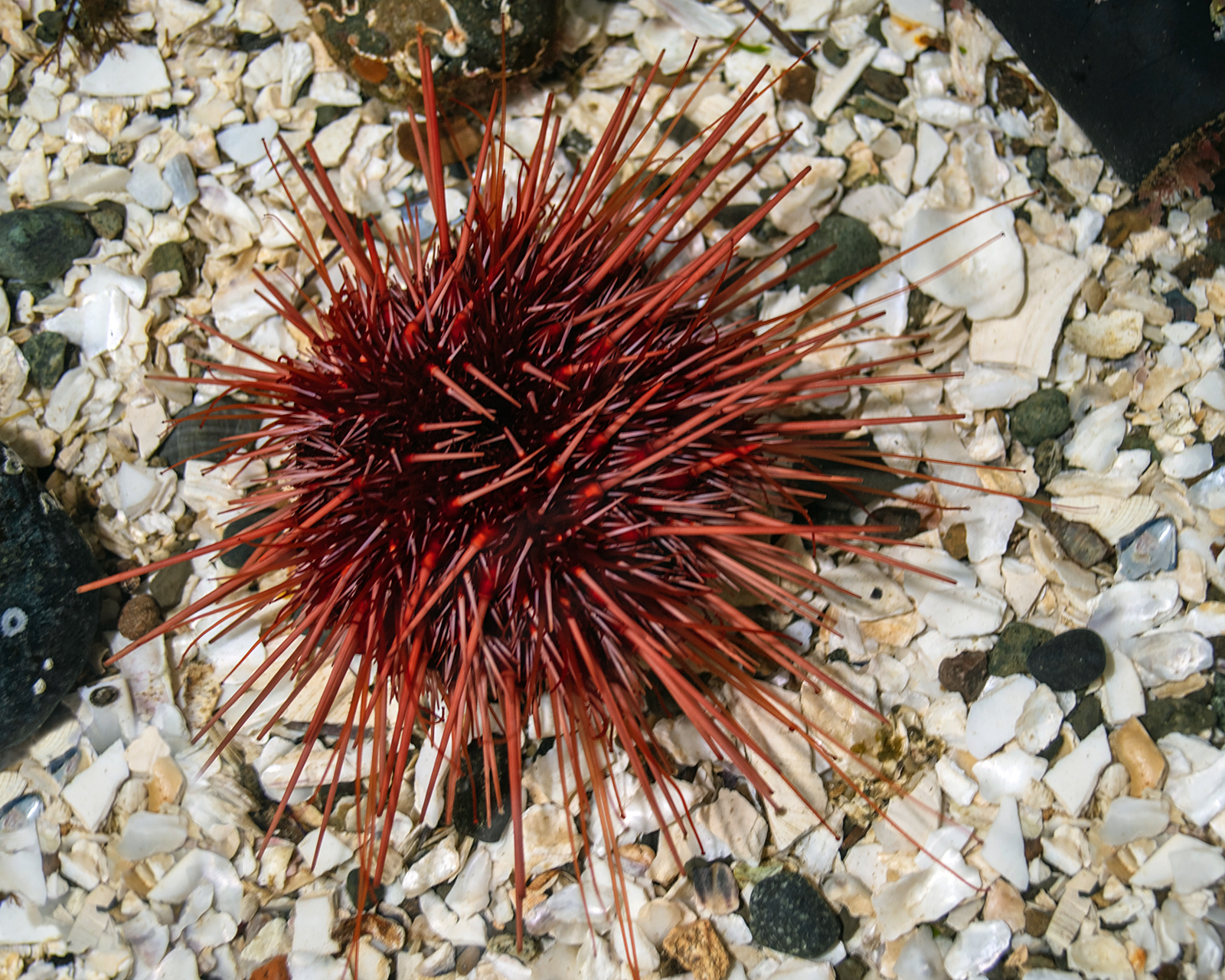
Red sea urchin, Strongylocentrotus franciscanus.

~~~~~~~~~~~~~~~~~~~~~~~~~~~~
Visité nuestro acuario local, muy pequeño, donde cada verano se llena de animales de nuestras playas y el mar, todos nativos a la región. En otoño, se vuelven a su stitio de origen y el acuario se mantiene cerrado todo el invierno.

Aunque los animales viven aquí cerca, había varios que yo no había visto antes, todos luciendo sus colores de fuego.

Foto # 1: Un ermitaño anaranjado con rojo, y con antenas anaranjadas, llevando de adorno una anémona de puntas color de rosa. Creo que es el ermitaño de ojos negros, Pagurus armatus. Estos son ermitaños que viven en la zona submareal, que puede explicar porque no los he visto. Son ermitaños grandes, que llegan hasta 4.5 cm. de largo.

Foto #2: Y este tiene anténulas con rayas rojas y blancas. No conozco la especie. El anaranjado es un color muy común entre nuestros ermitaños submareales.

Foto #3: Una pequeña comunidad. El tubo a la derecha es la boca de una botella, toda cubierta de esponjas encrustantes, anaranjadas, rojas, y cafés. Adentro hay una estrellita quebradiza, probablemente la estrella quebradiza margarita, Ophiopholis aculeata; si encuentro estas en nuestra zona intramareal. Hay otra debajo de la botella.

A la izquierda, pegada a una concha, hay un tunicado anaranjado; tal vez sea un "durazno de mar". Más abajo, dos anémonas. En la piedra, una esponja encrustante color de rosa. Y las dos patas espinadas al fondo pueden ser, tal vez, las de una estrellita plumosa.

Foto # 4: Esto sí que lo conozco; hay cientos de estos en cada una de nuestras playas, cerca del extremo inferior de la zona intramareal. Un erizo de mar rojo, Strongylocentrotus franciscanus.


Wednesday, June 15, 2022

Anatomy of a lantern

Another of the hitchhikers. Last October, a tiny green sea urchin came home with me, hidden in a fold of sea lettuce. He's been with me ever since, cruising around the glass walls, scraping algae off the oyster and clam shells, sometimes sleeping for days then rousing at a touch from a crab to hurry off to the far side of the tank.

Here he is, last October. He measured about 1 cm. across back then. This is the underside, showing the mouth and the 5 teeth.

The aquarium is not an ideal habitat for these urchins. They're a gregarious species, crowding together in their kelp beds. And they eat kelp, which is hard to come by for the aquarium. But this little one did ok for a while; over these few months he grew to 3 cm. across. And then he slowed down, lost his spines, and died. (He would have died if I had left him on the beach, tossed up above the tide line, so he had a few extra months.)

And within hours, the crabs and hermits, scavengers always, had cleaned out his test. I found it when I went to add more ice to the tank. And beside the test lay the entire Aristotle's lantern, still in one piece. I collected it quickly before the crabs took it apart.

I examined it under the microscope:

Aristotle's lantern, mouth side, showing the teeth.

The whole structure is called Aristotle's lantern, apparently because Aristotle first described it. It consists of 5 jaws composed of calcium carbonate plates, linked with muscular tissue. The whole apparatus is pushed outwards to feed, opening the central gap; the teeth scrape off algae or dig holes in rock to sleep in. Closed, the mouth works itself from side to side, chewing what it has bitten off.

And this is what it looks like from the inside:

Aristotle's lantern, from the base. I had to support this on a fluffy cloth to keep it upright.

The entire structure measured 8 mm., teeth to base. And about the same in diameter. I just checked it, where I had stored it, carefully protected from movement, hoping for a more accurate measurement, and each individual plate and tooth had separated themselves, now that the remaining muscle has dried up. No wonder I never see them on the shore!

~~~~~~~~~~~~~~~~~~~~~~~~~~
Otra de las criaturas que llegaron "de pilón" al aquario. En octubre del año pasado, un erizo de mar, muy pequeño, vino a casa escondido en un doblez de alga marina, Ulva spp.. Ha estado en el acuario desde entonces, dando vueltas por las paredes de vidrio, bajando a raspar algas en las conchas de ostiones al fondo, a veces durmiendo por unos dias, despertando a un empujón del cangrejo, y corriendo hasta el otro extremo del tanque.

Foto #1: Tal como lo vi en octubre. Medía como 1 cm de diámetro entonces. La vista es de la parte inferior, mostrando la boca y los 5 dientes.

El acuario no es habitat ideal para estos erizos. Son una especie gregaria que se amontonan en gran número en sus lechos de kelp. Y se alimentan principalmente de kelp, lo que es difícil mantener en el acuario. Pero este chiquito estuvo bien por un tiempo; en estos pocos meses creció hasta medir 3 cm. de diámetro. Y luego se puso triste, perdió las espinas, y falleció. (Hubiera muerto el año pasado si lo hubiera dejado allí en la playa, aventado por las olas arriba de la zona mareal, por lo menos tuvo unos cuantos meses más de vida.)

Y dentro de pocas horas los cangrejos y los ermitaños, carroñeros siempre, le limpiaron por completo la testa. La encontré cuando fui a añadir hielo al tanque. Y al lado de la testa estaba la linterna de Aristóteles, todavía entera. La recogí de inmediato antes de que los cangrejos la desbarataran.

La miré bajo el microscopio.

Foto # 2: La linterna de Aristóteles, el lado bucal, mostrando los 5 dientes.

Esta estructura se llama la linterna de Aristóteles, parece ser porque el filósofo fue el primero en describirla. Consiste en 5 mandíbulas hechas de placas de carbonato de calcio, ligadas entre sí con fibras musculares. El aparato entero se extiende hacia el exterior cuando el erizo come; se abre el espacio central y los dientes raspan el alga que come o hace hoyos en la piedra, donde el erizo se retirá a dormir. Cuando la boca se cierra, se mueve de un lado para otro, masticando su alimento.

Foto # 3: Y así se ve desde el interior. Aquí la tuve que apoyar sobre un textil espumoso para mantenerla derecha.

La estructura entera mide 8 mm. desde la base hasta los dientes, y más o menos lo mismo de diámetro. Cuando volví a mirarla, donde la había guardada, bien protegida para que no se rompiera, ya se habían separado cada placa y diente, ya que los músculos se han secado.

Con razón nunca veo estas linternas en la playa.


Tuesday, June 14, 2022

Hitchikers and their kin.

My little home aquarium is a self-sustaining habitat. (Well, with a lot of work on my part, but that's just maintenance, making up for the lack of the tides which keep their home clean on the shore.) It's always full of life. Because over the years critters keep appearing, sometimes coming in on seaweed brought in, groceries for the current residents, sometimes sandwiched between barnacles I bring home to keep the snails happy. And sometimes they just sort of appear, whether brought in as eggs or floating in the clean water I collected at the shore. I'm cleaning the tank, scraping off brown algae, getting rid of leftover crumbs, and I see a tiny shape, sometimes just a hint of movement, a crab-like walk, or a waving tentacle. Something new living in the tank.

And I have to keep up the maintenance because I can't abandon my tiny friends, not without carrying every single one down to the proper level of the intertidal zone and releasing it safely. 

Green isopods arrive clinging so tightly to rockweed that I don't see them, even while I'm rinsing it off before I anchor it in the tank.

Rockweed isopod, Idotea wosnesenskii. Showing up on a piece of red alga. About 4 cm. long.

A fourteen-legger. Notice the hooks at the tip of each leg. They cling tightly to the algae, so that even with strong wave action (or me harvesting it) they are not dislodged.

And growing up in the tank is a large community of tiny isopods.

Isopods on an oyster shell. The largest are about 5 mm long. 

A large one, captured on its own.

Whenever I take a shell out of the tank, I find it covered in these critters, all running about, always in a hurry. I don't know what species they are.

A mussel shell, holding two isopods, and a couple of amphipods (the curly ones). The isopods always lay flat.

And this: I first noticed it a month or so ago. It was stuck to the glass below the sand level, only the size of one of the isopods, and looked like a baby limpet from that point of view. But the shape was wrong; it looked oval, not circular. Even with a lens, that was all I could see, but I thought it might be a chiton.

Two weeks ago, it turned up, now recognizable, on an oyster shell. And today it was on a small rock, which I took out, still keeping it underwater, to get a photo.

Woody chiton, Mopalia lignosa. With two orange-striped green anemones.

As far as I can tell, he's a woody chiton. If so, he will grow up to 8 cm. long. Today, he 1.7 cm.

He was not pleased with the trip. As soon as I replaced him in the tank, he hurried back to the oyster shell. These are shy beasties, hiding on the underside of rocks and shells. There, he barely moves from one day to the next, just peacefully eating algae and diatoms; he especially likes green sea lettuce, Ulva spp.. Tomorrow is a low-tide day; if the weather holds, I'll go find a handful of the lettuce for "Woody". And some eel-grass for the hermits, kelp for the crabs, barnacles for the carnivore snails, and ...

And no telling what else will hitchhike in.

~~~~~~~~~~~~~~~~~~~~~~~~~~~~~~~~~~

Mi acuario casero es un habitat que se sostiene vivo solo. (Bueno, aparte de mucho trabajo de mi parte, pero eso es mantenimiento solamente, debido a la falta de la marea, que en el mar les mantiene su casa limpia.)  Siempre sigue llena de vida. Porque año tras año siguen apareciendo criaturas nuevas. A veces llegan escondidos entre las algas que traigo a casa para la comida de los residentes ya presentes; a veces se cuelan entre los bálanos que mantienen felices a los caracoles marinos. Y muchas veces aparecen como por magia, tal vez habiendo llegado como huevos o como el plancton que flota en el agua que traje desde el muelle.Estoy limpiando el tanque, raspando algas invasivas, aspirando restos de comida, y veo algo que se mueve, apenas el movimiento ya que el animal es tan pequeño; el movimiento lateral típico de un cangrejo, o el ondeo de un tentáculo miniaturo. Algo nuevo que ahora vive en el acuario.

Y tengo que seguir con el mantenimiento, pues no puedo abandonar a mis amiguitos, no sin llevarlos uno por uno al sitio adecuado de su zona intramareal.

Isópodos verdes llegan cogidos tan fuertemente al alga parda, Fucus spp., tan apegados que no los veo, ni cuando estoy enjuagando las algas antes de instalarlas en el tanque.

Foto: # 1, 2: Isópodo de Fucus, Idotea wosnesenskii. Visible sobre un alga roja. Nótense los ganchitos en cada una de las catorce patas; estos se agarran tan fuerte al alga que ni las olas ni yo al trasportarla logran despegar el animal.

Y han crecido en el acuario una generación de isópodos muy pequeños.

Fotos # 3, 4: Isópodos en una concha de ostión. Los más grandes miden aproximadamente 5 mm. de largo. Siempre que saco una concha cualquiera del tanque, la encuentro cubierta de un gran número de esto, todos corriendo de acá para allá, siempre con mucha prisa.

Foto # 5: en una concha de mejillón hay dos de estos isópodos miniaturos y dos amfípodos; estos son los que se doblan, haciendo medio círculo.

Y esto: lo vi por primera vez hace un mes o más, apegado al vidrio debajo del nivel de la arena. Desde ese punto de vista se parecía a una lapa chica, pero la forma era diferente. Con una lente de aumento lo examiné y pensé que tal vez sería un quitón juvenil.

Hace quince dias estaba, ya más grande, en una concha de ostión y si era un quitón. Y hoy lo encontré en una piedrita. Lo saqué del tanque, manteniéndolo siempre en el agua, y le saqué una foto.

Foto # 6: Un quitón "de madera", Mopalia lignosa, creo. Con dos anémonas.

Parece que si es un quitón de madera. Si es así, puede crecer hasta los 8 cm.; por ahora mide 1.7 cm.

No estaba contento con su viaje. En cuanto lo regresé al tanque se fue a esconder bajo la concha de ostión de nuevo. Estos son animales tímidos que se esconden en la parte inferior de las piedras y las conchas de mar. Allí, no se mueve mucho; se mantiene allí tranquilamente comiendo algas y diátomos. Le gusta la lechuga de mar, Ulva spp.; mañana, que va a ser un dia con marea muy baja, si el tiempo lo permite, voy a la playa a buscarle un poco de lechuga marina para "Woody", y algo de hierba Zostera para los ermitaños, kelp para los cangrejos, y unos bálanos para los caracoles carnívoros. Y ...

Y quien sabe que otra criatura se subirá de pilón.


Monday, June 13, 2022

Swimmer in a spotted coat

The sun was bright, the water smooth and clear. I was leaning over the rails of a ramp, counting starfish below the docks, when this big seal surfaced and took a look around.

So big! Harbour seal, Phoca vitulina

She — I think she's a she because she looks pregnant. But maybe she's just well fed. — she was big! Coming out almost underneath my feet, she looked longer (and fatter) than me. Over 160 cm, anyhow.

I had never noticed the long toes and their claws before.

She looked around for a minute, then rolled down and swam under the dock, into the dark green water. I waited, and she curved around, came back and came up for air again. Twice, three times. So graceful her movements, so smooth!
 
Third time up. After the first glance about, she kept her eyes shut. Possibly the sunlight was too much, unshielded by the water.

Side view, with a glimpse of the ear hole.

The perfect end to a great day.

~~~~~~~~~~~~~~~~~~~~~~~~~~~~~~~~~
Hacía sol, y el agua estaba tranquila y clara. Yo estaba apoyada en la baranda de la rampa que da al muelle, contando estrellas de mar en el fondo del agua, cuando esta foca grande salió de debajo de la rampa, y subió a la superfice a echar un vistazo.

Foto # 1: La foca, una foca moteada, o de puerto, Phoca vitulina. Muy grande.

Ella — se me hace que es hembra porque tiene el aspecto de estar embarazada. O tal vez, nada más ha estado comiendo muy bien — era, creo, más larga que yo, y más gorda, midiendo más de los 160 cm. aproximadamente, por lo menos.

Nunca antes había notado esos dedos largos y esas uñas en las aletas.

Miró alrededor por un momento, y luego dobló, se hundió, y desapareció entre el agua verde debajo del muelle. Yo esperaba, y al rato, regresó y subió a respirar otra vez. Y otra, y otra.

¡Tan elegante sus movimientos, tan suaves!

Foto # 2: La tercera subida. Después de la primera mirada, mantuvo los ojos cerrados. Tal vez el sol, sin la cortina del agua, era demasiado brillante.

Foto # 3: Se le ve el canal auricular detrás del ojo.

El final perfecto a un dia fabuloso.


Sunday, June 12, 2022

Under the donut shop

I took a short detour this afternoon, downtown, looping through a small dock area, peering between floats and under ramps.

Where the sun managed to reach, and where the waves stopped dancing, I caught a few glimpses of a vibrant community.

Plumose anemone, Metridium senile.

Back in the shade, there's a glassy bulb, possibly a tunicate. And a branch that may be a hydroid.

A small lion's mane jelly, Cyanea capillata

This was a youngster, only about a hands'-breadth across, and swimming actively, folding itself up, then opening again rhythmically.

Spreading out, heading under the wharf. With a green sea urchin.

On the bottom of a float (blue) and the pipes under a cabin.

So many critters! So many colours and shapes! I can't identify most of them, but there's a beautiful purplish feather-duster worm, limpets, orange and pink sponges, another plumose anemone, and something bright orange that may be the lips of a scallop.

And everywhere, there were tiny fish, breaking the surface so that it looked as if it were raining.

With the reflection of a donut shop.

Present, but too dark or too blurred by waves, hundreds of green sea urchins, mussels and barnacles, many orange starfish, a kelp crab and another two, too well hidden to identify, a fair number of chitons. And a kid fishing for shrimp. Who scared them all away.

Oh, and a big seal. Photos tomorrow.

~~~~~~~~~~~~~~~~~
Tomé un desvío corto esta tarde. Pasando por el centro, di una vuelta por un pequeño muelle, buscando entre los flotadores y debajo de las rampas. Donde alcanzaba la luz del sol, y donde las olas dejaban de bailar, llegué a ver señas de una comunidad vibrante.

Fotos:
1.  Una anémona plumosa, Metridium senile. En la sombra hay algo que parece un foco; posiblemente sea un tunicado. Y lo que parece una rama de árbol puede ser un hidroide.

2. Una medusa melena de león, Cyanaea capillata. Muy chica aun; apenas medía unos 10 cm. Iba nadando, estirándose y encogiéndose repetidamente.

3. Aquí está estirada. Con un erizo de mar verde.

4. Debajo de un flotador (azul) y en la tubería debajo de una cabaña. ¡Tantas criaturas! ¡Y de tantos colores y formas! No puedo identificar la mayor parte de ellas, pero se ve un gusano plumero color mora, lapas, esponjas anaranjadas y color de rosa, otra anémona plumosa, y algo anaranjado brillante que posiblemente sean los labios de una vieira.

5. Y dondequiera había un banco de pececitos, tocando la superficie del agua hasta que parecía que estaba lloviendo. Aquí están unos con los reflejos de una tienda de donas.

También hubo, pero escondidos en lo oscuro, o borrosos bajo las olas, cientos de erizos de mar verdes, mejillones y bálanos, muchas estrellas de mar anaranjadas, un cangrejo "kelp" y otros dos, sin poderlos identificar por estar bien escondidas, y bastantes quitones. Y un muchacho que pescaba camarones. Los cuales se habían hecho escasos.

Y también una foca grande. Mañana subo las fotos.


Powered By Blogger