Each stretch of shore has its own mix of critters and algae. On the Willow Point reef, I saw mostly green and red sea urchins, tons of ochre and leather sea stars, acres of encrusting bryozoans. Crabs and whelks and other snails. And limpets. There are always limpets, everywhere. And a fair number of chitons, huge and tiny.
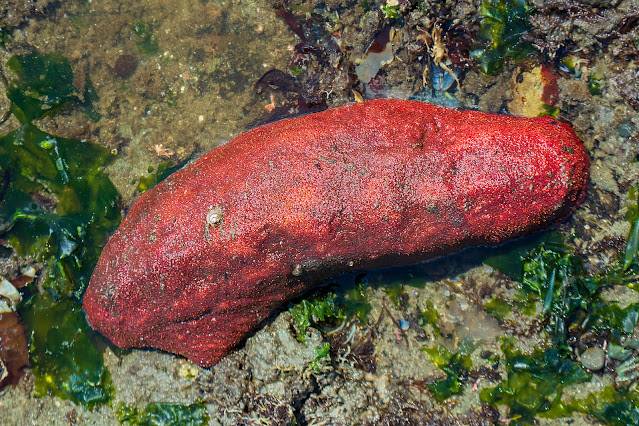 |
| Giant Pacific chiton, Cryptochiton stelleri. |
These chitons are the largest species of chiton, worldwide. They may grow to 35 cm. long. This one was a big guy, about a foot long (30 cm.), maybe a bit more, measured against my shoe (27 cm.).
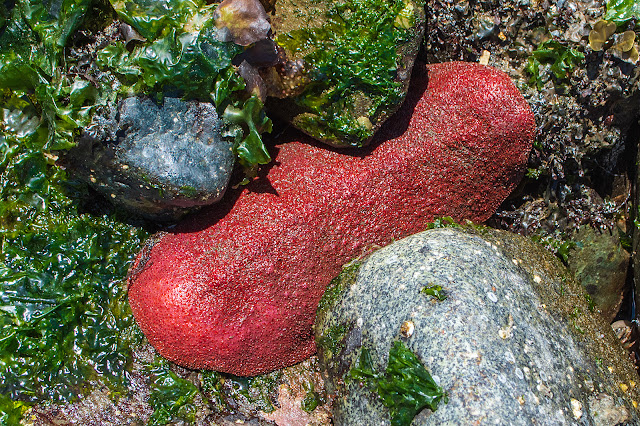 |
And a smaller one, about 18 - 20 cm. long.
|
I found several others, one exposed upside-down on the sand, his unprotected foot exposed to the sun's heat; I turned him over and covered him with seaweed.
And then there were the little ones:
 |
| Lined chiton, Tonicella lineata |
These grow to about 5 cm. long. This one was smaller. When I picked up the stone he was resting on, being careful not to touch him, he fell off. Or let go on purpose. Here he is in the process of rolling himself up in a protective ball, like our familiar roly-poly wood bug. Afterwards, I nudged him back into the hole his stone had been in, out of the bright light.
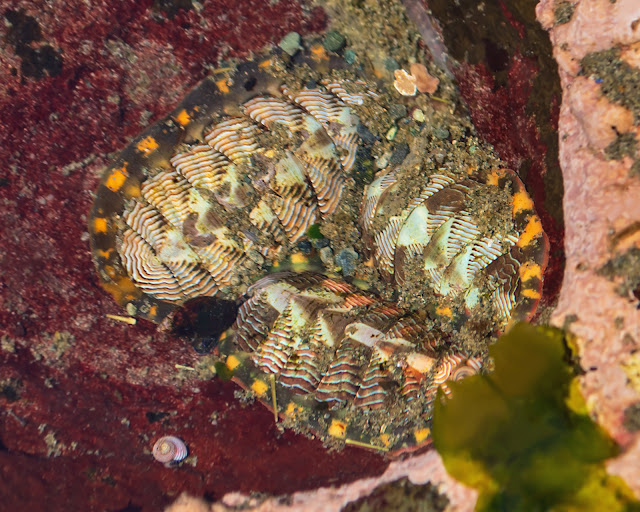 |
| Muddy buddies. Three lined chiton cuddled together in a sea urchin's hole. With a pair of snails. |
More on sea urchins and their holes, tomorrow.
~~~~~~~~~~~~~~~~~~~~~~~~~~~~~~~
Cada tramo de playa tiene su propia mezcla de habitantes, tanto animales como algas y algunas plantas. En Willow Point, a la marea baja, encontré por su mayor parte, erizos de mar verdes y rojos, cientos de estrellas de mar ocre y "de cuero", hectáreas completas de bryozoos encrustantes. Y cangrejos de varias especies, lo mismo de caracoles marinos. Y lapas. Siempre hay lapas, dondequiera. Y un buen número de quitones, tanto grandes como chiquitos.
Foto # 1: El quitón gigante del Pacífico, Cryptochiton stelleri. Esta especie contiene los quitones más grandes del mundo entero, midiendo hasta 35 cm. de largo. Este ejemplar medía unos 30 cm. o un poco más, usando mi zapato (27 cm.) de regla.
Segunda foto: Un quitón un poco más chico, midiendo de 18 a 20 cm. Encontré varios otros, incluso uno que se había quedado barriga arriba sobre la arena, expuesto al calor del sol. Lo volví a su posición normal y lo cubrí de algas para protegerlo.
Y los quitones chicos:
Tercera foto: Un quitón rayado, Tonicella lineata. Estos llegan a unos 5 cm. pero este fue un poco más chico. Cuando levanté la piedra donde se hallaba, teniendo cuidado de no tocar al animalito, éste se desprendió y cayó al suelo. En la foto se ve que está empezando a enrollarse para su protección, a la manera de nuestros animalitos comunes del jardín, los armadilídidos. Después de sacar la foto, le empujé suavemente hacia el hoyo de donde salió, donde no le pegaba el sol.
Cuarta foto: Tres quitones rayados, juntitos en un hoyo hecho por un erizo de mar. Y dos caracoles marinos.
Mañana, más sobre los erizos y sus hoyos.


