 |
| Up for air. |
Tuesday, January 31, 2017
Harbour seal
Three harbour seals were fishing in the Campbell River estuary. This one came close enough to show off the spots on his head.


Monday, January 30, 2017
Rainbow weighed down by gravity?
I've never seen this before.
At first, I thought there was a fire behind the hills of Quadra Island, before I noticed the colours. If you look closely, there's a mere hint of the rest of the rainbow above, merging into the cloud cover. There was no other end visible.
A Skywatch post.
 |
| Rainbow over Quadra Island. |
At first, I thought there was a fire behind the hills of Quadra Island, before I noticed the colours. If you look closely, there's a mere hint of the rest of the rainbow above, merging into the cloud cover. There was no other end visible.
A Skywatch post.
Sunday, January 29, 2017
Common goldeneyes
On the last blue water day, a half-dozen common goldeneye males were diving near Tyee Spit:
 |
| Two males. The head is dark green, appearing almost black against the light. |
 |
| Three males. No females were swimming with this group, although this is the time of year for pairing off. |
Saturday, January 28, 2017
More birds' nest fungi and orange pinheads
On another swing around Tyee Spit, I stopped to examine a log I'd looked at before, to see how the mini-mushrooms are doing after the winter freeze.
I looked over my photos carefully, searching for "eggs" (aka periodoles) outside the cups, but found none. After they've escaped, they will break up and release the spores, which would be too small for me to find.
 |
| Bird's nest fungus. All of them are full of "eggs". |
 |
| Ready to spill out. And one is escaping. |
I looked over my photos carefully, searching for "eggs" (aka periodoles) outside the cups, but found none. After they've escaped, they will break up and release the spores, which would be too small for me to find.
 |
| Orange jelly mushrooms. |
These tiny orange dots are speckled on many old logs. They are not witches' butter, nor a look-alike, Dacrymyces palmatus; these are a fixed shape, whereas witches' butter is a blob. And these are all about the same size, no bigger than a dressmaker's pin head; Witches' butter gets much larger. There is a short stalk, and the cap is flattish, becoming concave as it grows.
 |
| Zooming in. 1/3 of the way up from the bottom, and 1/3 from the right, there is one seen from the side, showing the stalk. |
Also present on this log, meriting another visit; tiny, dust-like greenish black fungi or lichen. Next time the sun comes out, I'll take a good lens down to examine them.
Friday, January 27, 2017
Comparing anemones
One basic capture and swallow system, three different styles.
No matter where I put "Metty's" shell, she moves back under the pump again. She likes that current. But she is extremely sensitive to touch and shrinks back into a lump if anything too big brushes her tentacles.
There are four of these in my tank. They spend most of their time on the oyster shells, near the sand and out of the strongest current. They get walked on all the time, and don't like it much, but never move to a "safe" place.
"Val" seems to like being jammed into a corner. She sticks to the glass underneath the sand, so has to put up with the weekly tank scrub, instead of being moved to a safe place. She doesn't seem to mind all kinds of action around her, even being mounded with sand; she keeps on feeding throughout the procedure.
 |
| A head full of hair. Metridium senile. |
M. senile adheres to rocks, boulders, man-made structures, pebbles and shells. It favours places where the current is strong. (Wikipedia)
No matter where I put "Metty's" shell, she moves back under the pump again. She likes that current. But she is extremely sensitive to touch and shrinks back into a lump if anything too big brushes her tentacles.
 |
| Pink fringe. Pink-tipped green anemone, Anthopleura elegantissima. |
There are four of these in my tank. They spend most of their time on the oyster shells, near the sand and out of the strongest current. They get walked on all the time, and don't like it much, but never move to a "safe" place.
 |
| Long, fleshy tentacles, very sensitive, sticky. Doesn't bother hermit crabs, but gives shore crabs a nasty sting. "Val", the burrowing anemone, Anthopleura artemisia. |
"Val" seems to like being jammed into a corner. She sticks to the glass underneath the sand, so has to put up with the weekly tank scrub, instead of being moved to a safe place. She doesn't seem to mind all kinds of action around her, even being mounded with sand; she keeps on feeding throughout the procedure.
Thursday, January 26, 2017
Teeth on the shore
Found at the tip of Tyee Spit:
This looked, at first glance, like fish bones; flexible bones, very thin, porous. I took it home and Googled "Salmon jaw", and there it was; a long jaw with a line of small teeth behind and large, hooked ones in front. The arrangement varies with the species of salmon; I couldn't pin this one down.
 |
| Jawbone, with intact teeth. 3 1/2 inches long. On a piece of driftwood bark for contrast. |
This looked, at first glance, like fish bones; flexible bones, very thin, porous. I took it home and Googled "Salmon jaw", and there it was; a long jaw with a line of small teeth behind and large, hooked ones in front. The arrangement varies with the species of salmon; I couldn't pin this one down.
 |
| Biting teeth from inside of jaw |
 |
| Same teeth, outside of jaw. The bone is very porous. |
Mature salmon eat smaller fish and invertebrates. The tooth arrangement seems to work for a quick capture and gulp style, with inward-turned hooks in front.
Wednesday, January 25, 2017
Windowsill meditation
Chia, looking peaceful and contemplative:
Cats are deceptive; five minutes before this photo was taken, Chia was speeding around the house attacking invisible rug monsters, claws slashing, teeth bared. Now, evidently, the monsters are vanquished. For the moment.
I wish our monsters were as easily taken care of!
 |
| It's a pose. |
Cats are deceptive; five minutes before this photo was taken, Chia was speeding around the house attacking invisible rug monsters, claws slashing, teeth bared. Now, evidently, the monsters are vanquished. For the moment.
I wish our monsters were as easily taken care of!
Tuesday, January 24, 2017
You are what you eat
Northern winters are tough on the little beasties that live at the intersection of sea and shore. Temperatures change, often drastically, in the course of a few hours. Storms toss whole colonies up on the beach, bury them in mounds of slimy, rotten eelgrass, drop logs on top of them. Cozy shelters in the seaweed are stripped bare; on the scoured stones, there is nothing left to eat, nothing to hide a scuttling crab from the myriads of hungry birds following the tide line.
My tank critters are spoiled. The temperature stays put; so does the water. Food drops from on high every day. There are no birds, and the cat doesn't relish getting wet.
But even here, winter brings its losses. I comb the beaches year-round, searching for salad fixin's and gym equipment for the hermit crabs. In summer, there are bright sheets of sea lettuce, tall stalks of eelgrass, some loaded with delicious hydroids and diatom fuzz, knobbly Turkish towels and washcloths, long, green hair, stubby rockweeds, and more. But in winter? Bare stones, washed-out shreds of unidentifiable weeds, stripped of anything edible. And tea-leaf black, dried eelgrass.
In earlier years, the tank in winter gradually lost all its greenery, until the hermits wandered about disconsolately on bare sand and stone. I supplemented their diet with human food, sheets of green algae meant for sushi wrappings. They liked that, but it fouled the water.
The last couple of winters have been different. A red sheet algae established itself in the tank, and now grows as enthusiastically as the land plague, Himalayan blackberry. I have to keep cutting it back with every weekly water change. But at least there's something fresh to eat, and somewhere to climb.
The change in diet has influenced the colours of some of the tank's residents. Red are redder, greens are browner. The colour of the shrimp's innards changes day to day, depending on his last meal; red today, transparent tomorrow.
And even the normally transparent copepods are striped with red and yellow. Look closely at the hermit above; there are a dozen copepods visible on his shell.
Most copepods have one red eye, a streamlined body, and a forked tail. The females carry their eggs around behind them; usually one pouch (Order Calanoida), sometimes two (Cyclopoida), one to each side. In the dark one at the lower left, the pattern is easy to see; red eye above, green bag beneath. The small, pale copepod at upper left may be a male of the Cyclopoida; his long, forked tail is just visible.
My tank critters are spoiled. The temperature stays put; so does the water. Food drops from on high every day. There are no birds, and the cat doesn't relish getting wet.
 |
| Grainy-hand hermit on the remains of a kelp holdfast. |
But even here, winter brings its losses. I comb the beaches year-round, searching for salad fixin's and gym equipment for the hermit crabs. In summer, there are bright sheets of sea lettuce, tall stalks of eelgrass, some loaded with delicious hydroids and diatom fuzz, knobbly Turkish towels and washcloths, long, green hair, stubby rockweeds, and more. But in winter? Bare stones, washed-out shreds of unidentifiable weeds, stripped of anything edible. And tea-leaf black, dried eelgrass.
In earlier years, the tank in winter gradually lost all its greenery, until the hermits wandered about disconsolately on bare sand and stone. I supplemented their diet with human food, sheets of green algae meant for sushi wrappings. They liked that, but it fouled the water.
The last couple of winters have been different. A red sheet algae established itself in the tank, and now grows as enthusiastically as the land plague, Himalayan blackberry. I have to keep cutting it back with every weekly water change. But at least there's something fresh to eat, and somewhere to climb.
 |
| Red algae is even trying to grow on the hermit's shell. |
The change in diet has influenced the colours of some of the tank's residents. Red are redder, greens are browner. The colour of the shrimp's innards changes day to day, depending on his last meal; red today, transparent tomorrow.
And even the normally transparent copepods are striped with red and yellow. Look closely at the hermit above; there are a dozen copepods visible on his shell.
 |
| Three females with eggs, one male; the rest, I can't tell. |
Most copepods have one red eye, a streamlined body, and a forked tail. The females carry their eggs around behind them; usually one pouch (Order Calanoida), sometimes two (Cyclopoida), one to each side. In the dark one at the lower left, the pattern is easy to see; red eye above, green bag beneath. The small, pale copepod at upper left may be a male of the Cyclopoida; his long, forked tail is just visible.
 |
| Drawing adapted from one by Jesse Cladgett. |
Monday, January 23, 2017
Where have all the critters gone?
Something's odd. The house this winter has been unusually critter free.* I have seen no sow bugs for a couple of months; they used to patrol my windowsills regularly. The big spiders that preyed on them are gone. I've seen three or four micro-dot spiders in as many weeks. No flies. No stray beetles. No crane flies, moths, or mosquitoes. Not even any of the Western conifer seed bugs that usually seek out warm houses for the winter.
Yesterday, I brought in a handful of soil from the garden, and examined it with a lens. There were no pill bugs. No spiders. No springtails, even.
Looking at that last paragraph, I said to myself, "That can't be right!" So I went out and collected another handful of dirt, and looked at it under a bright light with the lens and then the hand microscope. I found two slug eggs and one lonely springtail. No mites, no worms, no mini-spiders, no globular springtails, no sow bugs, no tiny snails.
I don't know what has caused this. Not the weather; inside, there's heat. Outside, it has been freezing and everything burrows down deep, but it's been warmish for some days now, and today the sun is shining on the soil I collected; it should be swarming with happy life.
I found my first spider** of the year, though. Yesterday, the 22nd.
*I checked my photos for last year, Dec. 2015 and Jan. 2016; I had spiders inside and out, including a batch of spiderlings, tiny snails, and a ladybug. And I remember chasing crane flies all over, but never getting a decent photo. I was feeding sow bugs to the mother of the spiderlings. The cat was busy tracking big, black beetles around the baseboards. So the critters were still here, still active even when it snowed.
**That is, first spider big enough for the camera to be able to see. It doesn't glom onto biological motion the way my eyes do.
Yesterday, I brought in a handful of soil from the garden, and examined it with a lens. There were no pill bugs. No spiders. No springtails, even.
Looking at that last paragraph, I said to myself, "That can't be right!" So I went out and collected another handful of dirt, and looked at it under a bright light with the lens and then the hand microscope. I found two slug eggs and one lonely springtail. No mites, no worms, no mini-spiders, no globular springtails, no sow bugs, no tiny snails.
I don't know what has caused this. Not the weather; inside, there's heat. Outside, it has been freezing and everything burrows down deep, but it's been warmish for some days now, and today the sun is shining on the soil I collected; it should be swarming with happy life.
I found my first spider** of the year, though. Yesterday, the 22nd.
 |
| Just a baby still. About 2 mm. long. |
*I checked my photos for last year, Dec. 2015 and Jan. 2016; I had spiders inside and out, including a batch of spiderlings, tiny snails, and a ladybug. And I remember chasing crane flies all over, but never getting a decent photo. I was feeding sow bugs to the mother of the spiderlings. The cat was busy tracking big, black beetles around the baseboards. So the critters were still here, still active even when it snowed.
**That is, first spider big enough for the camera to be able to see. It doesn't glom onto biological motion the way my eyes do.
Sunday, January 22, 2017
How very blue
My granddaughter reminded me, the other day, of this poem by Clive Barker:
A needed reminder in these troubling moments, to stop and look around, to celebrate the world we live in, even as it slowly cooks.
It's raining here again, and the sea and sky and distant mountains are back to their normal winter shades of grey, but there's blue sea on my hard drive.
I never know whether to shudder or laugh at this photo, a typical fall view of the Discovery Passage while the ocean rests between tide changes. It is a major shipping route, the most protected ("inside") way north, and barges pass by, loaded with consumer goods, several times daily. But the colours do jar.
* I don't quite agree with that "pleasures few" bit. Sea and sky and trees and lichen and birds and cats and ... and ... and. Not to forget fresh coffee and the first bite into an apple. Doesn't add up to "few".
Life is short
And pleasures few*
And holed the ship
And drowned the crew
But o! But o!
How very blue
the sea is.
A needed reminder in these troubling moments, to stop and look around, to celebrate the world we live in, even as it slowly cooks.
It's raining here again, and the sea and sky and distant mountains are back to their normal winter shades of grey, but there's blue sea on my hard drive.
 |
| Off Tyee Spit, last August. |
 |
| Shades of blue, with multicoloured boxes. September, 2016. |
I never know whether to shudder or laugh at this photo, a typical fall view of the Discovery Passage while the ocean rests between tide changes. It is a major shipping route, the most protected ("inside") way north, and barges pass by, loaded with consumer goods, several times daily. But the colours do jar.
* I don't quite agree with that "pleasures few" bit. Sea and sky and trees and lichen and birds and cats and ... and ... and. Not to forget fresh coffee and the first bite into an apple. Doesn't add up to "few".
Saturday, January 21, 2017
Criticism
Poem by my mother, Lorna Anderson, 1963
This is an hour to be critical,
To take selective tweezers, and to grasp
The public figure meant to represent us all:
Dissect his words, slice superfine his acts
And place them in the light of studied thought
As 'neath a microscope, and single out
This careless attitude, that shaded turn,
As tissues, cells and germs that bode disease.
This is not time for tolerance or love,
Nor gentleness or patience; it is time
For surgery, implacable and swift,
Or liberty be forfeit.
(Excerpt)
This is an hour to be critical,
To take selective tweezers, and to grasp
The public figure meant to represent us all:
Dissect his words, slice superfine his acts
And place them in the light of studied thought
As 'neath a microscope, and single out
This careless attitude, that shaded turn,
As tissues, cells and germs that bode disease.
This is not time for tolerance or love,
Nor gentleness or patience; it is time
For surgery, implacable and swift,
Or liberty be forfeit.
(Excerpt)
Friday, January 20, 2017
Treacherous footing
I've surfaced from a few days battling the flu, in time to watch disturbing news from down south. This photo from Oyster Bay seemed appropriate.
The whole tidal area within the breakwater is deep in reeking, sticky, foot-grabbing muck, treacherous underfoot even around the edges. The sign is unnecessary; the stink is off-putting enough. And yet ... and yet ... the birds love it; peeps of all sorts dash about, finding goodies in the ooze, cheeping happily; ducks, dabbling and diving, take over when the tide comes in; geese and gulls rest on the sand banks, and purple martins occupy the nest boxes. None of these are present in the photo, probably because of the dog out on the breakwater and another on this side of the water. But they'll all be back shortly.
 |
| The sign says "Tidal Flats unsuitable for walking". |
The whole tidal area within the breakwater is deep in reeking, sticky, foot-grabbing muck, treacherous underfoot even around the edges. The sign is unnecessary; the stink is off-putting enough. And yet ... and yet ... the birds love it; peeps of all sorts dash about, finding goodies in the ooze, cheeping happily; ducks, dabbling and diving, take over when the tide comes in; geese and gulls rest on the sand banks, and purple martins occupy the nest boxes. None of these are present in the photo, probably because of the dog out on the breakwater and another on this side of the water. But they'll all be back shortly.
Tuesday, January 17, 2017
Of mice and tree ID
Douglas fir.
I like Douglas firs; they're the only ones whose cones have these three-pronged bracts. And the cones stay on the tree year-round. Very helpful.
Legend has it that the bracts are the hindquarters and tails of mice hiding in the cone from predators. Tiny mice. (From Trees of the Northwest)
 |
| Cone with "mouse tails". |
I like Douglas firs; they're the only ones whose cones have these three-pronged bracts. And the cones stay on the tree year-round. Very helpful.
Legend has it that the bracts are the hindquarters and tails of mice hiding in the cone from predators. Tiny mice. (From Trees of the Northwest)
Monday, January 16, 2017


Sunday, January 15, 2017
Distant birds
Birds are warm-bodied. Warmer than we are; the average temperature of a bird is around 40 degrees Celsius (105 Fahrenheit). Ours is around 37.
So, while I'm shivering on the beach, bundled up in layers and fleeces, double socks and gloves, I marvel at them, resting placidly in icy water, sleeping or chattering among themselves, as if the water around them weren't 40 degrees colder than their bare feet.
That's a trick even better than flying!
I tracked this small flock down the beach. Each time I got within range, they lifted off and moved a few hundred metres further along the shore. And when I got to this point, I didn't even see the second flock, which waited until I reached the logs to startle me by taking off in a great hurry.
So, while I'm shivering on the beach, bundled up in layers and fleeces, double socks and gloves, I marvel at them, resting placidly in icy water, sleeping or chattering among themselves, as if the water around them weren't 40 degrees colder than their bare feet.
That's a trick even better than flying!
 |
| Looks warm. It isn't. |
 |
| A small flock of wigeons |
 |
| Wigeons, goldeneyes, and buffleheads, mostly in pairs. |
 |
| Black-bellied plover, non-breeding plumage. I think. I like their fan tails. (Click for full size.) |
I tracked this small flock down the beach. Each time I got within range, they lifted off and moved a few hundred metres further along the shore. And when I got to this point, I didn't even see the second flock, which waited until I reached the logs to startle me by taking off in a great hurry.
 |
| An earlier photo. One peep, not one of the flock, slightly fatter, sat on the rock until all the rest of the birds were well away. Mitlenatch Island gleams in the background; the sun seems to hit it more than it does us. |
Saturday, January 14, 2017
Ice on the shore
The combination of salt water and freezing temperatures produces some interesting patterns around the edges.
*Update: the "worm" would be a shipworm or Teredo, not a worm but a clam. It makes itself a long burrow, up to three feet long. Photo here.
These poor mallards! They were resting, some sleeping, in a tiny patch where the sun filtered through the trees. And I came walking along the beach, quietly, trying not to disturb them, but they woke up and hurried out into the water, out of my path.
When I returned, heading back to the car, there they were again, in that couple of square metres of sunlight, collecting warmth for the long, cold night. And again, I woke them and they swam away into the chilly sea. Sorry, y'all!
 |
| Damp wood, with ice crystals. Not snow. |
Wet, soft organics, like wood and seaweed, collect ice. Frozen wet stones beside them do not.
 |
| This peeled log has a sheet of ice where it is splashed with every wave. The inland side is ice free, although it is not as salty. |
 |
| Waterlogged stump, with "glaciers". |
 |
| This worm-carved bit of wood was drying out in a sunny patch. There's only a light dusting of frost at the bottom. The whitish layer inside a few of the once-tubes looks like part of a tube worm's protective coat. |
*Update: the "worm" would be a shipworm or Teredo, not a worm but a clam. It makes itself a long burrow, up to three feet long. Photo here.
 |
| An old kelp crab's carapace. Its colour (usually brownish green) has changed, probably due to exposure. The white ice tracks are where I removed frozen-on eelgrass. The red seaweed is firmly anchored, growing on the carapace. |
 |
| Shells and coralline seaweed act like stones, rejecting ice. There's ice in the cracks of the wood at lower right, and on a tiny sliver of wood above. |
 |
| Proud bit of log up where the sun shines, turning thumbs down at those silly, lazy logs just lying on the shore collecting ice. |
 |
| Catching a few rays. |
These poor mallards! They were resting, some sleeping, in a tiny patch where the sun filtered through the trees. And I came walking along the beach, quietly, trying not to disturb them, but they woke up and hurried out into the water, out of my path.
When I returned, heading back to the car, there they were again, in that couple of square metres of sunlight, collecting warmth for the long, cold night. And again, I woke them and they swam away into the chilly sea. Sorry, y'all!
Friday, January 13, 2017
Chilly!
The weather is off-kilter. Up north, they're having a heat wave. In Bella Coola, where I used to live, it should be double digits below zero (Celsius). Instead, it's raining. It's raining in Alaska! There are large areas in the Yukon and Northwest Territories, up by the Arctic Circle, where the temperature is above zero, in spots in the double digits.
And here, in the mild South country, it's freezing hard. Minus 7 here in Campbell River, -8 (Celsius) in Vancouver this morning.*
I went for a walk on the beach, looking for birds. I found ice.
I'll have more photos, and even a few chilly birds, tomorrow.
*The weather pundits say the trend is upward; we'll be seeing some of the ice melting next week.
And here, in the mild South country, it's freezing hard. Minus 7 here in Campbell River, -8 (Celsius) in Vancouver this morning.*
I went for a walk on the beach, looking for birds. I found ice.
 |
| A scrap of Turkish towel seaweed, with ice crystals. Not snow. For some reason, the stones resist the cold while the seaweeds freeze. |
I'll have more photos, and even a few chilly birds, tomorrow.
*The weather pundits say the trend is upward; we'll be seeing some of the ice melting next week.
Thursday, January 12, 2017
Purple or green?
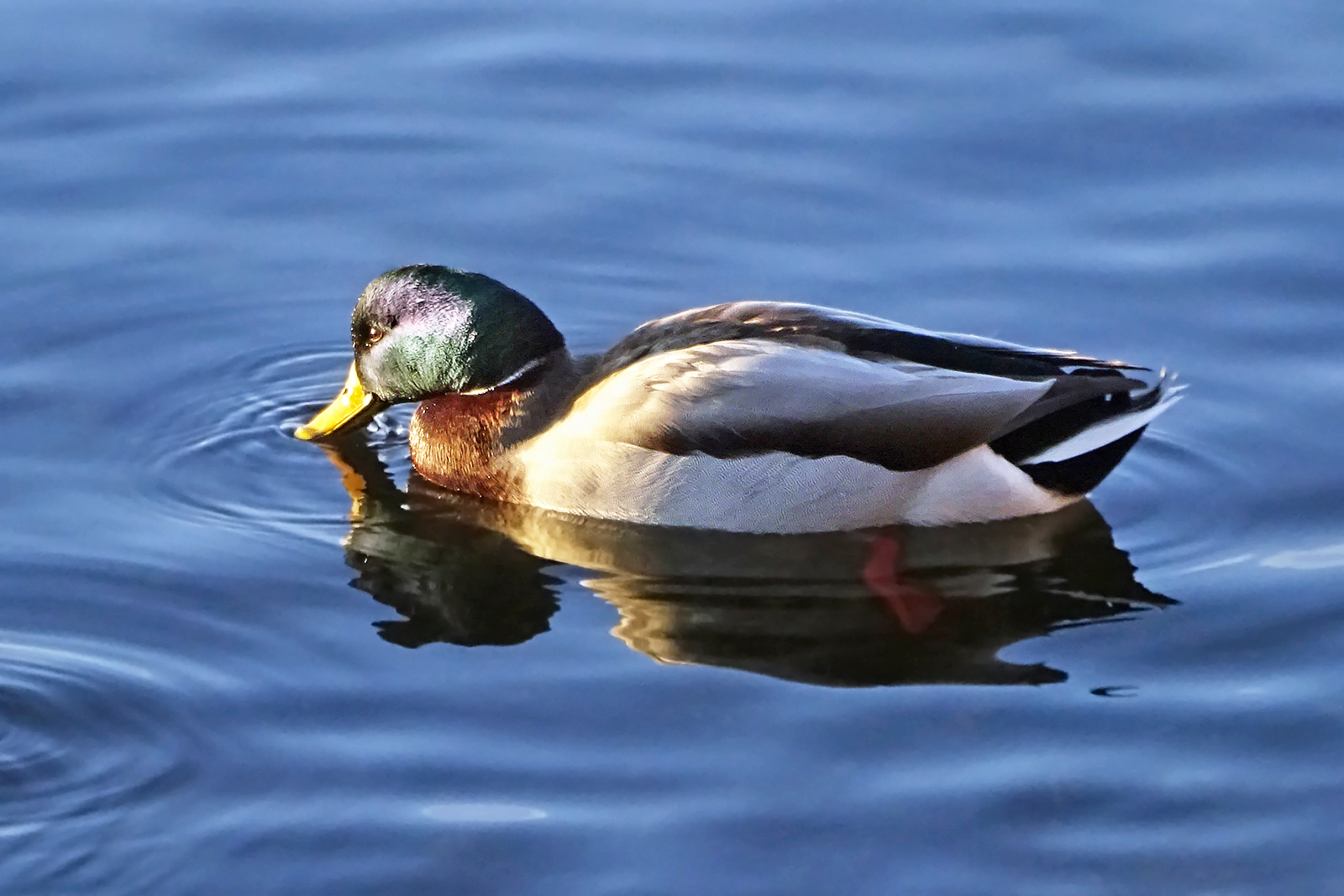
The male mallard has an iridescent green head.
 |
| Mallard, Campbell River estuary. Against the light, so the glow of the head is muted. |
And sometimes, a purple head.
 |
| This one is half purple, half green. |
I looked for an explanation of the colour shift, and found various theories:
- It's due to interbreeding with other species. And mallards are notorious for this.
- It's really just green, but it looks purple because of light interference and diffraction.
- Some mallards are just purple-headed. That's it. And why not? Just enjoy!
- The colour depends on the structure of the feathers.
An interesting discussion follows this photo of a strongly purple-headed mallard on Flickr. I have no theory, other than #3 above.
While we're on that shore, here's a sparrow, not shiny, not showy, but just happy, bouncing around in the weeds along the bank, finding goodies to eat.
 |
| Lots of yummy seeds among that broken, dried grass! |
Wednesday, January 11, 2017
It's cold out there
Ice on the Fraser River
(I removed a No Parking sign that the camera saw but that my eyes looked right past. The camera can't edit things out, but our brains do, routinely. So this is what I saw, even if the camera begs to differ.)
*Billy Miner Cafe.
 |
| Taken through a restaurant* window on my visit to the mainland last week. |
(I removed a No Parking sign that the camera saw but that my eyes looked right past. The camera can't edit things out, but our brains do, routinely. So this is what I saw, even if the camera begs to differ.)
*Billy Miner Cafe.
Tuesday, January 10, 2017
Stones or Turnstones?
Walking along a rocky shore in the winter, I am often startled when the rocks ahead take flight. As they speed out over the water, they become peeps with flashing wings. Among the rocks and rotting eelgrass, they had been nearly invisible.
 |
| Black Turnstone, winter dress. Against blue water, he is easy to see. |
 |
| Among the rocks, not so much. The colours match the white barnacle patches and the deep brown of old eelgrass. |
 |
| And from a bit of distance, they blend in to the background. There are ten turnstones in this photo. Do you see them? |
Monday, January 09, 2017
Mini-micro havens
It snowed again yesterday afternoon. Then the snow turned to rain. Our streets were black, then white, then black again. But just a few miles away, on the mainland, the black is bad news; there, it's black ice. And the snow keeps falling.
Closer to home, if I drive over the hill that borders the shore, I find snow, six inches deep, undisturbed, and frozen hard enough to walk on without leaving a mark.
Here on Vancouver Island, we live in a microclimate, its temperature and humidity determined by the encircling ocean currents, northbound from the warm North Pacific Current. Our summers are cool and wet, and our winters are usually mild (and wet; we don't tan, we rust.) Some years, there's no snow at all.
But microclimates have their own microclimates. Our shoreline strip is one. The backside of the hill is another. Forested areas have their own variants, depending on height of trees, direction of the slope, extent of logged areas, nearby rivers, roads and their traffic, and other circumstances.
And then there are the mini-microclimates. The warm zones around blades of grass, the wells at the base of stumps, hollow logs, even the ruts in old car tracks. Each imperfection in the surface shapes the wind currents, captures or blocks the sunshine, funnels off the rainwater. And in these mini-climates, plants and animals wait out the cold weather.
Each living plant affects its climate in various ways. It absorbs sunlight, which otherwise bounces off the surface of the snow. It deflects drying winds. And its own living processes produce a minimal amount of heat. Enough to melt the snow up against the branches, and provide cover for other small plants.
And there's another mini- or really, not so mini - microclimate, usually unseen. Underneath that frozen snow cover, the ground is protected from freezing winds, and stays just above freezing. And there, the little creatures wait out the winter, sleeping or burrowing deep into the warmish earth.
Back at home, a few of my spring crocuses are pushing through the wet soil, hidden in a mini-climate of their own between a wall and a staircase.
Closer to home, if I drive over the hill that borders the shore, I find snow, six inches deep, undisturbed, and frozen hard enough to walk on without leaving a mark.
 |
| New forest coming, under snow. |
Here on Vancouver Island, we live in a microclimate, its temperature and humidity determined by the encircling ocean currents, northbound from the warm North Pacific Current. Our summers are cool and wet, and our winters are usually mild (and wet; we don't tan, we rust.) Some years, there's no snow at all.
But microclimates have their own microclimates. Our shoreline strip is one. The backside of the hill is another. Forested areas have their own variants, depending on height of trees, direction of the slope, extent of logged areas, nearby rivers, roads and their traffic, and other circumstances.
And then there are the mini-microclimates. The warm zones around blades of grass, the wells at the base of stumps, hollow logs, even the ruts in old car tracks. Each imperfection in the surface shapes the wind currents, captures or blocks the sunshine, funnels off the rainwater. And in these mini-climates, plants and animals wait out the cold weather.
 |
| Baby Douglas fir and shrubs, each in its own warm well. |
Each living plant affects its climate in various ways. It absorbs sunlight, which otherwise bounces off the surface of the snow. It deflects drying winds. And its own living processes produce a minimal amount of heat. Enough to melt the snow up against the branches, and provide cover for other small plants.
 |
| An old stump in its own mini-climate, harbouring evergreen salal. |
 |
| Two more stumps. With lichen, salal, and bare twigs of deciduous shrubs. These will have an early start to their spring growth. |
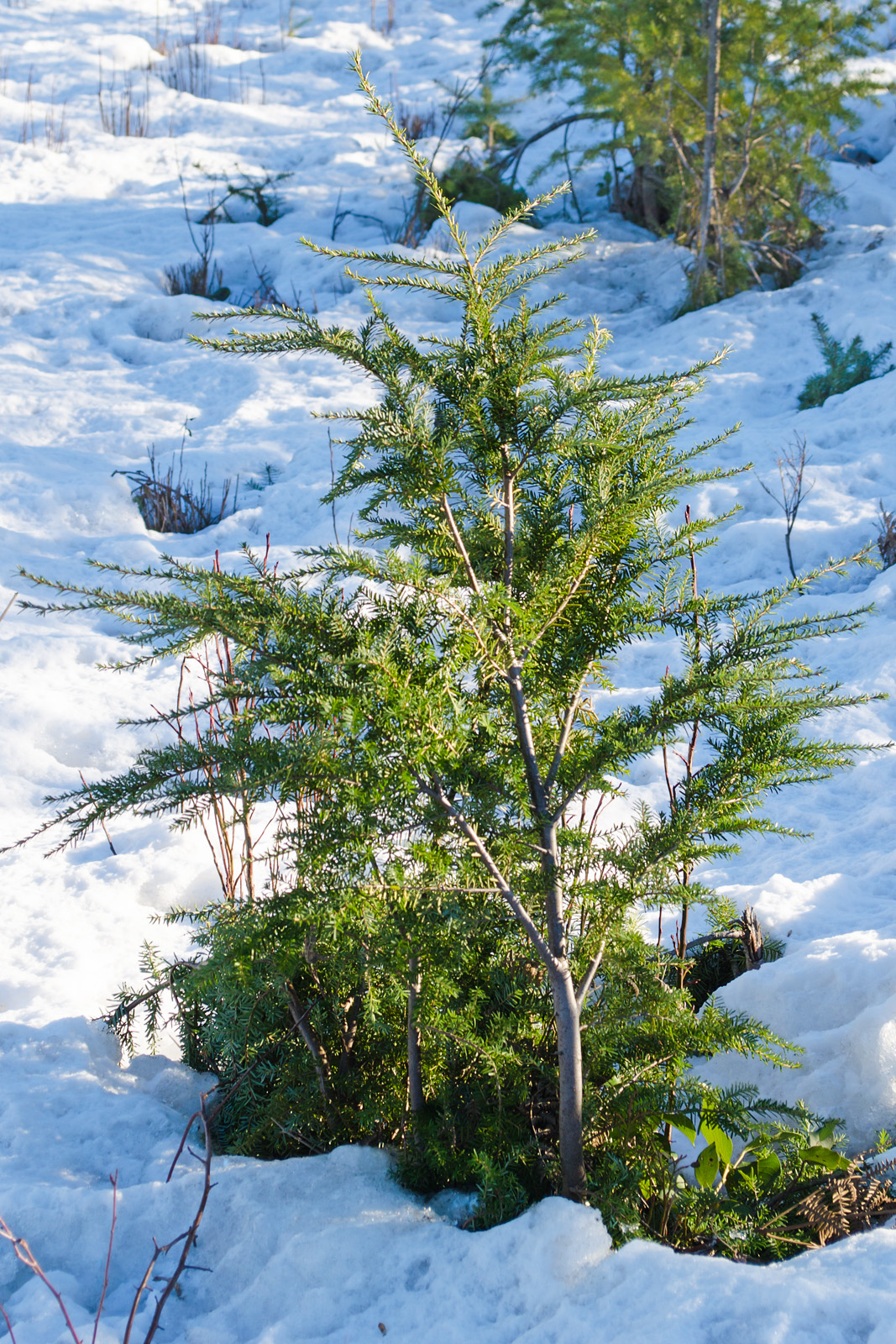 |
| A few small trees and shrubs share a warm spot. |
 |
| Even a rock can build a mini-climate. It absorbs more warmth from the sun than the surrounding earth, which is cooled by air pockets and seeping ice melt. The rock radiates this extra heat into the snow around it. |
 |
| Snow on the side of the road, tossed up by a snowplow. Even this can create a disturbance in air flow and sunlight. The lump itself, exposed to the wind, is frozen hard, but the sunny surface is slowly melting, making that icicle. |
 |
| A side road, unmarked on the map, with ruts and tracks of a dog or coyote, made before the snow froze hard. The forested and ferny areas are just warm enough to melt off the snow before it freezes. |
And there's another mini- or really, not so mini - microclimate, usually unseen. Underneath that frozen snow cover, the ground is protected from freezing winds, and stays just above freezing. And there, the little creatures wait out the winter, sleeping or burrowing deep into the warmish earth.
Back at home, a few of my spring crocuses are pushing through the wet soil, hidden in a mini-climate of their own between a wall and a staircase.
Subscribe to:
Posts (Atom)
