Saturday, July 30, 2022

Sun lover

We're fortunate, here on the island; when it's hot, hot, hot on the mainland, here it's just hot. My sweet peas are wilting, but the sunflowers are happy.

Sunflower dressed in flame reds and yellows.

The weather people still have a heat warning posted, but they're promising rain for the middle of next week. I hope they're right.

~~~~~~~~~~~~~~~~~~~~~~~~~~
Tenemos suerte, aquí en la isla; el interior de la provincia se está tostando, con temperaturas alrededor de 40°, mientras que aquí solamente hace calor. Hoy apenas llegó a 32°.

Mis guisantes de olor se están marchitando pero los girasoles se sienten felices.

Foto: un girasol, vestido en colores de fuego.

Los meteorólogos todavía han subido una advertencia de extremos de calor, pero para mediados de la semana, pronostican lluvia. Ojalá tengan razón.

Friday, July 29, 2022

Curiouser and curiouser

I haven't seen many bees this summer; one or two on my roses, one checking out the nasturtiums, and that's about it. I walked down a short path by the beaver pond, past daisies, fireweed, and St. John's wort, in profuse bloom. No bees. And then there's a patch of hardhack. Swarming with bees.

I was too slow to catch the bee on this one.

Pink reflections in her eye. Only the females have those pollen baskets on their legs.

So intent on her harvesting.

A honeybee with wings like deer's ears.

Blurry wings and dangling legs.

There were many bees on a friend's lavender, too. But not on all the other flowers in her garden. Curious. Why are they limiting themselves to a few specific plants this year? I've never seen this behaviour before.

And would this have anything to do with only 2 pears on a pear tree that usually bears bags full?

~~~~~~~~~~~~~~~~~~~~~~~~

Este verano he visto muy pocas abejas. Una o dos visitaron mis rosas; había una viendo mis capuchinas, nada más. El otro dia visité la laguna de los castores, entrando por una vereda donde florecían abundantemente las margaritas, las adelfillas (hierba de fuego), y hierba de San Juan; no vi ni una sola abeja en todas esas flores. Y luego siguen los arbustos de Spiraea douglasii. Y aquí era un hervidero de abejas, de varias especies, apurándose de una rama de flores a la siguente.

Fotos: Spiraea douglasii, con abejas. Menos la primera; se me escapó la de esta rama.

Hoy había muchas abejas en la lavanda de una amiga, también. Pero las otras flores de su jardín, ni una. Esto me parece muy curioso. ¿Porqué están escogiendo solo esas plantas ahora? Nunca antes he visto esto.

¿Y será por esto que el peral este año solamente lleva dos peras?


Wednesday, July 27, 2022

Wishing for winter

It's too hot for me. Two days ago I tried to go for a walk into the cool forest, heading for a lake at the bottom of a small hill. About 50 metres from the road, I had to turn back, already dizzy from the heat. The toasted moss on the rocks crunched under my feet like eggshells.

End of the hike.

The creamy flowers are Oceanspray, Holodiscus discolor.

~~~~~~~~~~~~~~~~~~~~~~~~~
Hace demasiado calor. Traté de escaparlo, bajando hacia un laguito entre el bosque. No lo logré; a los 50 metros, ya quemada y aturdida por el sol, tuve que desistir y regresar a casa. El musgo sobre las rocas, bien tostado, crujía bajo mis pies, haciendo un ruido como de cascarones de huevos.

Foto: hasta aquí llegué. El arbusto con flores color crema es Holodiscus discolor, llamado aquí rocío de mar, aunque es un arbusto de sitios secos.


Tuesday, July 26, 2022

Pale Amanitas

It seems to be Amanita season. With the hot, dry weather, most fungi have gone into hiding; still there, underground, but waiting for rain before they push their fruiting bodies (what we know as mushrooms) out into the light again. Not the assorted Amanita species; even in open fields, bathed in sunlight, they're still to be found.
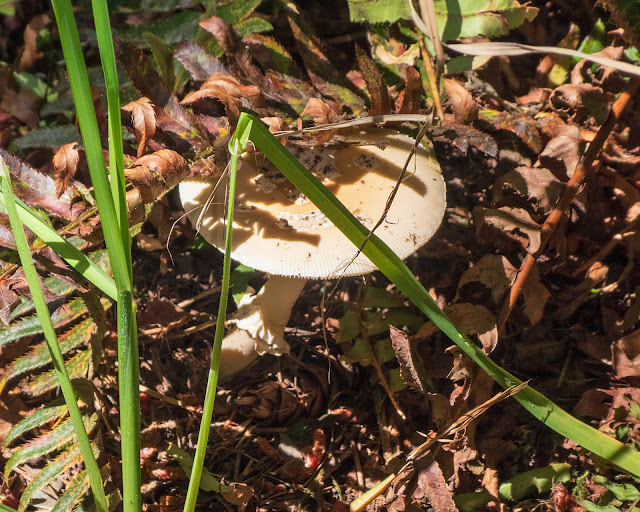
This one is in half-shade.

Most Amanitas, whether they're the Fly Amanita, the Panther, or most others, can be identified by two characteristics; the "warts" or "fly-specks", remnants of the universal veil it wore as a youngster; and the volva, the other end of the same veil, showing as a ragged cup at the bottom of the stalk. Often this can only be seen by digging into the duff at the base. The mushroom may also wear a skirt-like partial veil remnant further up the stalk, as in the photo above.
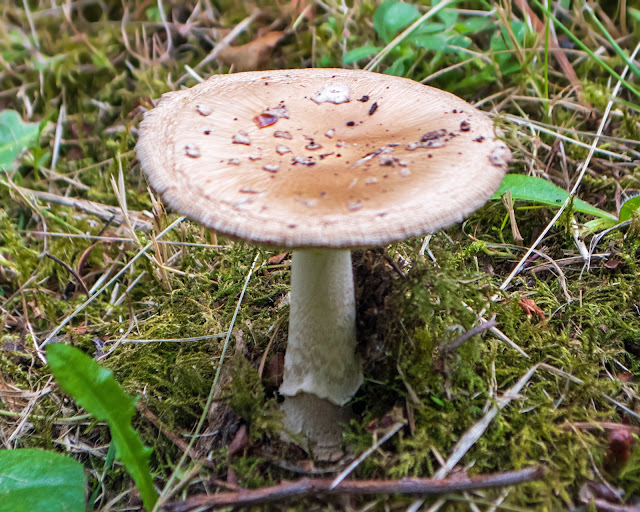
Warts, partial veil ring, and hints of the volva beneath.

Top view.

This is where it gets tricky: the poisonous Amanita, when still a button, disguises itself as a puffball, edible and delicious. Cut in half, the structure of stalk and cap appears; not a puffball.
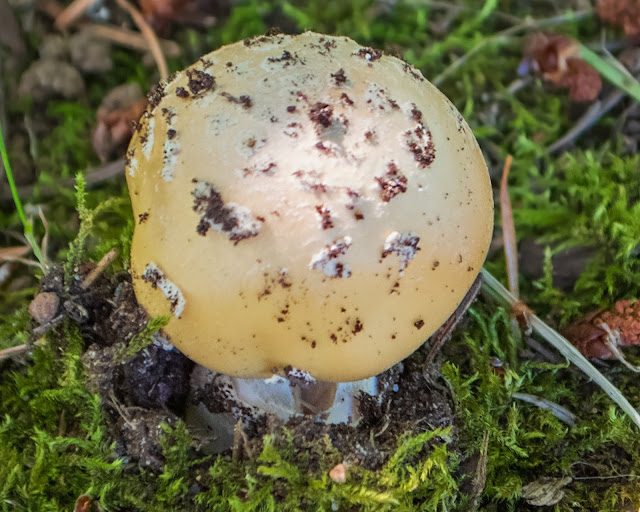
This looked like a dusty puffball until I pulled away the moss around the base. And there's the volva.

I used to eat mushrooms I found in the wild, especially puffballs. Not any more; the whole Amanita tribe is extremely variable, and has often been mistaken for edible mushrooms. Better safe than sorry.

~~~~~~~~~~~~~~~~~~~~~~~~
Parece que ahora es la temporada de las Amanitas. Ahora que hace calor, y que ya no llueve, la mayoría de los hongos están escondidos bajo tierra, esperando a que vuelve el agua, cuando de vuelta sus cuerpos fructíferos — los que nosotros llamamos hongos, sin tomar en cuenta la mayor parte del hongo, que vive en la oscuridad — saltarán a la vista de nuevo.

Pero no se esconden las Amanita; siguen apareciendo aun en terrenos abiertos, expuestos a pleno sol.

Foto # 1: Amanita, en media sombra.

La mayoría de los Amanita spp., ya sea la muscaria (la matamoscas), la Pantera, o casi todas las otras, se pueden identificar por dos características: en primer lugar, los restos del velo universal que lo envolvía en su primera etapa de crecimiento; algunos dicen que parecen fragmentos de algodón; con la edad y la lluvia a veces desaparecen.

En la base del estipe aparece de nuevo este velo, ya en forma de una copita que envuelve la base. Muchas veces éste solamente se puede ver si se retrae la tierra alrededor de la base.

Y a veces, no siempre, también quedan fragmentos de un velo parcial, en forma de una falda alrededor del tallo, tal como se ve en las primeras dos fotos aquí.

Foto # 2: Las manchas, el velo parcial, y casi escondido, la volva.

Foto # 3: El mismo hongo, vista desde arriba.

Estos hongos, cuando apenas son botones, se pueden parecer a los hongos polveras. Y los Amanita son tóxicos, mientras que los hongos polveras se pueden comer y son deliciosos. Se ve la diferencia, cortándolos por la mitad; en el centro, si es Amanita, se ven los indicios del estipe y sombrero.

Foto # 4: Este botón parecía hongo polvera, con fragmentos de musgo, hasta que le quité el musgo que escondía el pie, destapando la volva.

Hace tiempo, yo comía muchos hongos salvajes, sobre todo los hongos polvera. Ya no: toda la tribu de los Amanita es variable, en forma y color, y muchas veces se ha confundido con hongos comestibles, con resultados a veces trágicos. Más vale prevenir ...


Sunday, July 24, 2022

Cave dwellers

The more you look, the more there is to see ...

I've returned several times to look into those caves in the bark of the snags beside the river, zooming in as close as I could get, trying out a couple of flashlights, wishing for a battery-powered microscope.

The holes were made by woodpeckers digging for ants or grubs. And now I was looking for those ants. I found a couple of large ones and chased them up and down the trunk; they never stopped running.

Racing ant. With lichen and moss.

Zooming in closer, and enlarging the photos once I got them home, I found a busy community:

Floor and walls of one "cave".

The black oval looks like a pupa of some insect. On the next visit, it was no longer there. I searched all the holes I could reach, and found no others. On the left, those off-white globes may be slug eggs. And on the left, near the top, the popsicle on a stick is probably a slime mold. Lower down there are a few wearing pink.

Zooming in on that slime. Is the blurry white blob more of the same, in a different stage?

Springtails and a spider.

In a dark corner, small, black balls, much smaller than the slug eggs. There were many, but all in the most protected areas. Larger balls, a dark red, not confined to the dark, may be mites.

There's more!

And a piece of moss.

And I'll be back. With a better flashlight, maybe one I can strap to my forehead. And a decent hand lens.

~~~~~~~~~~~~~~~~~~~~~~~~~~~~~~

Entre más miras, más hay que ver.

Regresé varias veces a ese grupo de troncos "muertos" al lado del rio, acercándome lo más posible, tratando de alumbrar las cuevitas en la corteza con unas linternas de mano (sin mucha suerte), sintiendo la falta de un microscopio de pilas.

Las cuevas las hicieron los pájaros carpinteros, buscando hormigas u otros bichos. Y ahora, yo buscaba esas hormigas. Encontré unas grandes y las perseguí mientras corrían de un lado para otro en la corteza. Nunca dejaron de correr, ni por un instante.

Foto # 1: una hormiga, corriendo.

Haciendo zoom, y aumentando las fotos en casa, encontré una comunidad diversa.

Foto # 2: El piso y las paredes interiores de una cuevita. El paquetito negro parece ser la pupa de algún insecto. En la siguiente visita, ya no estaba, y aunque busqué por todos lados, no vi ningún otro.

Al lado izquierdo hay unas bolitas blancas; pueden ser huevos de babosas. A la derecha, arriba, hay algo que parece una paleta sobre su palo; creo que es un moho mucilanigoso; abajo hay otros, pero con un tinte de color de rosa.

Foto # 3: Haciendo zoom. Y la masa blanca en el hoyo ¿será más moho, pero en diferente etapa?

Foto # 4: Colémbolos, y una araña.

Foto # 5: En la sombra, se ven muchas pelotitas negras, mucho más chicas que los huevos de babosa.  Otras pelotitas, algo rojizas, y que no se limitan a la oscuridad pueden ser ácaros.

Foto # 6: Una comunidad diversa: las flechas apuntan mohos mucilanigosos, la pupa, colémbolos, las pelotitas, huevos de babosa, una araña (puede ser la muda), y algo con espinas.

Regresaré. Con una linterna mejor, tal vez una que puedo fijar en mi cabeza. Y una buena lente de mano.

Friday, July 22, 2022

Caves in bark

Three dead trees standing together are pock-marked, top to bottom, by small caves, pinhole-sized to a few inches across. And each cave has a floor of fine sawdust.

Ant housing development?

Zooming in. Caves behind caves.

Cave or tunnel entrance?

I've visited the trees several times, looking for residents. What I've found, so far, I'll post tomorrow.

~~~~~~~~~~~~~~~~~~~~~~~~~~~~~

Tres árboles muertos al lado del rio llevan una serie de cuevas chicas, desde unos milimetros hasta tal vez 10 cm de diámetro. Y cada cuevita tiene su piso cubierto de un aserrín fino.

Fotos: las cuevitas, rodeados de musgo.

He vuelto varias veces a este grupo de troncos, tratando de descubrir quienes son los arquitectos y los residentes de las cuevas. Mañana subo fotos de lo que he encontrado hasta ahora.

Wednesday, July 20, 2022

Mossy ice-cream cone

 It's still alive. It's heart is gone, but it stands strong.

Lower section of a hollow tree.

It stands on the bank of the Campbell River, just above the high water level. I think it's a cedar: it's hard to tell if the branches overhead belong to it or to the Douglas-firs around it. Some of those visible are cedar. And the tree is hollow as far up as I can see.

The living parts of a tree are all on the outer rim; the bark, the phloem, where food coming down from the needles flows to the rest of the tree, the cambium, where the growing cells are, and the sapwood, which carries water from the roots to the needles. As long as these survive, the tree continues to grow.

The central part, the heartwood, is dead wood. And when it is gone, the tree becomes a habitat for many other species. A hideaway, a food source, a shelter from the weather, a place to sleep, a maternity ward for small and large animals, a place for bats to hang up at night.

Ancient cedars often hollow out like upside-down ice-cream cones,... (From Ancient Forest Alliance)
~~~~~~~~~~~~~~~~~~~~~~~
No tiene corazón, pero sigue viviendo, sigue en pie.

Foto: un cedro con el centro vacío.

Crece a la orilla del rio Campbell, un poco arriba del límite del agua. Creo que es un cedro; es difícil saber si las ramas que se ven le pertenecen o vienen de los árboles alrededor. Pero creo que este es el cedro.

Y hasta donde puedo alcanzar a ver, no tiene corazón.

Las partes vivas de un árbol son las del exterior, empezando con la corteza, luego la floema, que lleva nutrientes desde las hojas hacia la madera y las raices; sigue el cambium, donde están las células que están en crecimiento; y finalmente la xilema, que lleva el agua desde las raices hasta las hojas. Mientras estas partes viven, el árbol siguie creciendo.

La parte central, el duramen, es madera muerta. Y cuando desaparece, el árbol se convierte en refugio para muchas especies, tanto plantas como animales y hongos. Es un escondite, un lugar para protegerse de la lluvia, un dormitorio, una sala de maternidad para animales grandes y chicos, un lugar donde los murciélagos pueden colgarse de noche.

"Los cedros antiguos muchas veces se ahuecan como si fueran un cono de helado boca abajo" (Del sitio Alianza de los Bosques Antiguos)


Tuesday, July 19, 2022

Rugged old wood

I've been looking at old tree trunks a lot lately. Just the trunks, live or sort of dead, the bark, the ravages of a long life, and the holes made by assorted critters. And some of the critters. Zooming in from a distance, to face to face, to with my nose in a hole and passers-by on the trail looking at me strangely.

Starting off at a decent distance: here are some trees from the slopes over Elk Falls. These are still green at the top.

Douglas fir. The bark develops deep fissures as it ages.

A closer look.

Holding down the slope.

Coming in closer. Lumps and cracks and mossy accents.

Reaching for the light.

Tomorrow; more bark.

~~~~~~~~~~~~~~~~~~~~~~~~~~

He estado observando los troncos de árboles viejos en estos dias. Limitándome a los troncos, la corteza vieja, las cicatrices que han dejado los años, las cavidades hechas por una variedad de animales. Y por fin, algunos de esos animalitos. Empecé a una distancia normal, acercándome cada vez más, viendo la corteza cara a cara,  y por fin con la nariz casi metida en los hoyos, y con los que pasaban en el sendero mirándome curiosamente. Ni modo.

Empezando con las fotos sacadas a una distancia normal: unos de los abetos de Douglas antiguos que viven en el bosque arriba de las cataratas Elk.

Mañana sigo con otras cortezas.

Sunday, July 17, 2022

Pink roses

This cool weather has been good for my little garden. These roses were planted two years ago; now the bush is as tall as me, and loaded with flowers.

An opening bud.

In full flower.

One thing not so good: I've barely seen any bees or other pollinating insects this summer. Worrisome.

~~~~~~~~~~~~~~~~~~~~~~~~
Este clima, no muy calurosa este año, le ha caído bien a mi jardincito. Apenas sembré estas rosas hace dos años, y ahora el arbusto es más alto que yo, y lleno de flores.

Fotos: rosas.

Una cosa no tan buena: casi no he visto abejas ni otros insectos polinadores este verano. ¿Efecto del cambio de clima? Me preocupa.


Saturday, July 16, 2022

Awkward

Mushrooms just don't think of my convenience. Sometimes they park themselves in corners and gaps between logs that make it impossible to see the essential details. Or even get a camera into the space. Like these:

One-sided mushroom on the side of a log. I think I see a stalk beneath.

Oh, my old bones! The contortions I put them through trying to get close to this one!

White, soft mushroom. Top view. Does it have a stalk? Gills or pores? I couldn't tell.

As far as I could reach with a hand and camera.

If I could have crawled down into the space between logs, I might have been able to identify these next ones as more of yesterday's Wood Woollyfoot mushrooms.

Is that a hint of yellow fuzz underneath? Or just pale green lichen?

But: never give up. Maybe putting the camera on a stick might work.

~~~~~~~~~~~~~~~~~~~~~~~~~~~~~~~
Los hongos no toman en cuenta las dificultades que causan sus sitios elegidos para nosotros. A veces se sitúan en esquinas imposibles o en espacios entre los troncos donde ni siquiera una mano con la cámara pueden entrar. Como éstos, por ejemplo.

Fotos:

#1: Un hongo que crece para un solo lado, en un tronco con musgos. No pude alcanzar a ver si tiene o no un tallo.

#2 y 3: ¡Ay de mis huesos viejos! ¡Cómo me torcí tratando de identificar este hongo! Un honguito blanco, suave, seco. ¿Tiene tallo? ¿Poros o laminillas? No pude ver.

#4: Estos pueden ser otros de los hongos "patas de lana" que subí ayer. Si me hubiera podido achicarme para caber en el espacio entre troncos, hubiera podido ver la base del tallo. Pero no.

No me doy por vencida. Tal vez si fijara la cámara en un palo ...

Friday, July 15, 2022

Banana and lemons

 Sometimes in the woods I meet deer. More often, it's slugs. Like this pretty youngster.

Pacific banana slug, Ariolimax columbianus, on a log end.

Good thing I stopped to look at him; on my way back to the trail, I saw these, that I had passed going the other way without noticing.

I think they may be the Wood Woolyfoot mushroom, Gymnopus peronatus. (Also known by a variety of scientific names.) I've never seen them before.

There was a fairly large gathering in the duff between the logs, all with that lemony fuzz at the base of the stalk.

The tallest of these was under 3 inches.

From my guide book:
"... this species is important in its ability to break down the upper 1.5" (4 cm) of leaf litter on the forest floor. The distinctive hairs on its stem makes it particularly easy to identify."
Thanks, little slug!

~~~~~~~~~~~~~~~~~~~~~~~~

A veces me encuentro con venados en el bosque. Pero con mucha más frecuencia, los animales que veo son las babosas.

Esta babosita, la babosa "plátano del Pacífico", Ariolimax columbianus, cruzaba el corte de un tronco. Bueno fue que me detuve a mirarla; en camino de vuelta al sendero, vi estos hongos, los cuales había pasado por alto antes.

Fotos: la babosa, y los hongos.

Los hongos son los "patas lanudas de madera," Gymnopus peronatus; también se conocen por una variedad de nombres científicos. Nunca los había visto antes.

En el suelo entre los troncos había bastantes. El más alto medía unos 6 cm.

Mi libro guía dice:

"... esta especie es importante por su habilidad de descomponer la capa superior (hasta 4 cm) de las hojas caídas en el suelo del bosque. Los pelos característicos en el tallos la hacen muy fácil de identificar."

¡Gracias, babosita!


Thursday, July 14, 2022

Odds and ends

Tidying up the June photo folders: There are distant birds, ...

Eagle in the mist. Oyster Bay.

Cormorant, ready to dive again.

... roadside flowers ...

Foxglove, with 4 spiders and a bug. Can you find them all?


St. John's wort. With glossy beetle. I love the "stiches" around the edges of the petals.

flowers with a leaf for identification purposes ...

False bugbane, Trautvetteria caroliniensis. I think.

Or maybe not.

... and a whole stack of tree trunk photos. But I'll leave those to their own post.

~~~~~~~~~~~~~~~~~~~~~~~~~~
Estoy organizando las fotos que saqué en junio y que no llegué a subir. Hay pájaros en la distancia, flores al lado del camino, y unas flores con sus hojas, para ayudar en la identificación. Y muchas fotos de troncos de árboles. Pero esas, las dejaré para otro dia.

Fotos:
  1. Un águila entre la neblina.
  2. Un cormorán listo para sumergirse de nuevo.
  3. Unas dedaleras, Digitalis purpurea, con 4 arañas y otro bichito. ¿Los puedes encontrar todos?
  4. Hierba de San Juan. Me gustan esas puntadas a las orillas de los pétalos.
  5. Trautvetteria caroliniensis. Creo.
  6. La hoja.


Wednesday, July 13, 2022

Watch the ears

I was bent down, looking at mushrooms on a log, when something made me look up. Not a sound, not movement; something, some nameless awareness of company. And there was a deer, just standing there a few metres away, watching me.

I'm the intruder here.

She stood there. I straightened up. She didn't move at first, then turned her head to get a better look at me. Listened. The only sound was the chatter of the river below us.

Watch her ears.

One ear for me, one for the trail.

We stood there for a long moment. She turned one ear away from me, then after a minute, picked her way gently, slowly among the logs and across the trail, stopping every few steps to look at me again. Then suddenly, she leapt and disappeared among the bushes on the river bank.

I heard nothing, not even her steps. But no sooner had she gone, than a woman came around the bend in the trail, where her ear had been pointing.

Two's company; three's a crowd.

~~~~~~~~~~~~~~~~~~~~~~~~~

Estaba agachada mirando unos hongos en un tronco, cuando algo me hizo levantar los ojos. No era un sonido; no oi nada, ni hubo movimiento, solo una sensación indefinida de no estar sola. Y allí estaba una cierva, a unos pocos metros. No se movía; nada más se quedó mirándome. Yo me enderecé. Ella no se movió.

Después de un rato, volvió la cabeza para mirarme mejor, y luego regresó a la postura anterior, pero ahora con una oreja vuelta para atrás.

(Observa esas orejas.)

Y ahí nos quedamos por un tiempo. Luego siguió tranquilamente su camino entre los troncos, y cruzó el sendero. Lentamente, volviendo a mirarme entre paso y paso. Y de repente dió un salto y desapareció entre los arbustos a la orilla del rio.

Yo no había oido nada, ni siquiera sus pasos. Pero apenas se había ido, una mujer apareció a la vuelta en el sendero, hacia donde la ciervita había apuntado esa oreja.

Monday, July 11, 2022

Georgia Strait panorama

"Well, I'm back."

Quoting from Samwise Gamgee. But he'd been places, done things. I've just been lazing around. Fighting off a bug of some sort, losing, then sort of winning. Nothing to worry about. I'm back.

And tidying up the last of the June photos in my files. And there's this: a panorama, taken from the outer shore of Oyster Bay, near sundown.

Georgia Strait. Campbell River on the far left, then Quadra Island, assorted islets and ahead and to the right, the mainland.

Tomorrow (fingers crossed) I'll haul the camera out of its hiding place and take it for a walk.

We're back.

~~~~~~~~~~~~~~~~~~~~~~~~~~~~~

"Bueno, estoy de vuelta." Lo dijo Samwise Gamgee. Yo también, pero él había viajado, tenía hazañas de que presumir. ¿Yo? Nada, flojeando. He estado enferma; no gran cosa, nada de que preocuparme, y ya está pasando. Estoy de vuelta.

Ya que no he salido con la cámara, estoy revisando las fotos olvidadas del mes de junio. Y hay esto: una foto panorámica sacada desde la playa exterior de la bahía Oyster Bay, cerca de la puesta del sol. Se ve, desde la izquierda, las primeras casas de Campbell River, luego la isla Quadra, algunas islitas, y después las montañas del continente.

Mañana, si todo va bien, saco la cámara a pasear. Estamos de vuelta.


Wednesday, July 06, 2022

Weepy

 A young polypore, oozing.

Probably a red-belted polypore, Fomitopsis pinicola. On a log.

I learned a new word: "guttation".

a term used in botany to describe the process by which plants excrete excess water through drops from their leaves. For some mushrooms this is so common that it is a reliable identification feature, while for others it is virtually unknown. (Why do mushrooms weep?)

The definitions I found always refer to plants, and then sometimes mention mushrooms.

Guttation is more well-known in some vascular plants. During the night, when the plant's transpiration system is shut down, pressure from excess moisture in the roots can force beads of sap out of special structures on leaf edges. (Read it and Weep)

Larger red-belted polypores usually are dry (except when it's raining). But in the smaller ones, I often see these droplets oozing from pores on the lower surface. 

In several polypores, such as Fomitopsis pinicola, the liquid produced can look so much like tears that you'd swear the fungus was weeping. ...

It's so often observed, particularly during times of rapid growth when temperature and humidity are favourable, that these beads of liquid can be a reliable macroscopic characteristic. (Read it and Weep)

That blog post, on Weird and Wonderful Wild Mushrooms, has many photos of weeping mushrooms and even slime molds. Go look! 

~~~~~~~~~~~~~~~~~~~~~

Foto: un poliporo, Fomitopsis pinicola, en un tronco.

Aprendí una palabra nueva: gutación.

Es: una palabra usada en la botánica para describir el proceso por el cual las plantas excretan un exceso de agua por medio de gotas exudadas de las hojas. Para algunos hongos este es tan común que sirve como una característica fiable para su identificación, mientras que para otros raramente se observa. (¿Porqué Lloran los Hongos?)

Las definiciones que hallé siempre se refieren a las plantas, y a veces pasan a mencionar los hongos.

La gutación es mejor conocido en algunas plantas vasculares. Durante la noche, cuando el sistema de transpiración de la planta no está en operación, la presión de humedad en exceso en las raices pueden producir gotas de salvia que salen de estructuras especiales en las superficies de las hojas. (Leelo y Llora)

Los poliporos más grandes casi siempre están secos (cuando no está lloviendo, claro). Pero en los más chicos, muchas veces veo estas gotitas en la superficie inferior.

En varios de los poliporos, tales como Fomitopsis pinicola, el líquido que se produce puede parecerse tanto a las lágrimas que jurarías que está llorando el hongo....

Tanto se observa, particularmente durante las épocas de crecimiento rápido y cuando la temperatura y la humedas son propicias, que estas gotitas de líquido pueden ser una característica macroscópica firme. (Leelo y Llora)

Ese post, en el blog "Weird and Wonderful Wild Mushrooms" tiene muchas fotos de hongos con lágrimas, además de algunos mohos mucilanigosos llorosos.

Tuesday, July 05, 2022

Hard at work

Moving right along ...

Between the flower and the seed, there is a seed factory. I found these, mostly still green, along the river trail, where two months ago (That long ago? Time just races on!) the ground was carpeted in white and pink.

Trillium ovatum. Three leaves, three sepals, three sections of the seed pod.

Another trillium, bowed under the weight of the growing seeds.

Three trilliums in this gathering.

The trilliums were easy to identify. Then there was this:

Lone seed pod.

These were everywhere; there's one up above alongside a trillium. The stems, leafless, spring out of the moss, with no branches, nothing but the stem and this pod, from about 5 cm to 7 cm long. I had to ask for help, but it was so obvious once I was pointed in the right direction. Two months ago, the flowers were everywhere, springing out of the moss on tall stalks, with only a few basal leaves showing. Pink fawn lilies!

Almost ripe.

Another set of three. Developing seeds.

And among the ever-blooming ones, there is the Siberian miner's lettuce. It will flower as long as there is shade and occasional rain, making seeds as it goes. The flower is tiny, the seed pods tinier.

Inset: enlargement of flowers and seed pods.

~~~~~~~~~~~~~~~~~~~~~~~~~~~

Entre la flor y la semilla, se interpone la fábrica de semillas. Encontré estas cápsulas de semilla, todavía verdes, en el sendero al lado del rio, donde hace dos meses —¿Hace tanto? ¡Cómo vuela el tiempo! — el terreno llevaba una alfombra de colores blanco y color de rosa. 

Fotos:

  1. Un trilio. Tiene tres hojas, tres sépalos, en flor, tres pétalos, pero ahora, tres cápsulas combinadas donde crecen las semillas.
  2. Otro trilio, doblado bajo el peso de las semillas en desarrollo.
  3. Y tres trilios juntos.
  4. Era fácil identificar los trilios. Pero luego, están estos. Estaban por todas partes; hay uno con el segundo de los trilios. Los tallos saltan de entre el musgo sin hojas; nada más un tallo alto con la única cápsula encima. Mide de 5 a 7 cm de largo. No los pude identificar y tuve que pedir ayuda. Y luego al recibir una sugerencia, ¡era tan obvio! Hace dos meses, las flores cubrían el suelo aquí, levantándose altas de entre el musgo, con una que otra hoja en la base. Lirios de cervato, Erythtonium revolutum.
  5. Una cápsula casi madura.
  6. La misma, mostrando sus tres semillas.
  7. Y entre las flores que siguen floreciendo, están las lechugas de minero, Claytonia sibrica. Seguirá floreciendo mientras haya sombra y algo de lluvia. Las flores son miniaturas y las cápsulas de semilla aun más. En la foto, la inserción es un zoom de unas flores y sus cápsulas.

Powered By Blogger