Sunday, February 10, 2013

A clammy aphrodisiac

It was going to be a busy day, and I was rushing in the morning to get ready. But whatever the rush, the critters need to be taken care of.

In a quick pass, I checked the water level, added ice (more on that, later), and dropped in a chunk of frozen clam, still on the quarter shell, for the day's meal. Ten minutes later, holding my morning coffee, I looked to see how they liked it. Each little piece of shell had a hermit on it, busily carving it up.

Another ten or so minutes; breakfast was on; I checked the tank while it cooked. Now the largest section of clam had one hermit and five Nassa snails, gathered from their usual hiding places under the sand.

Before I left, I had time for one more stop. The hermits were still at it. No sign of the snails, at first, but when I looked around the tank, there they were, six of them, all happily mating. Seems that clam meat is a love potion.

Nassa, alone again.

There was a row of fresh, creamy eggs on the eelgrass tonight.

(I hooked up the macro lens this evening. This was one of the first experimental shots. Very shallow depth of field, and I should be using a tripod for these. Hard to manage, when the snail won't stop snailing. I like the bokeh.)

Saturday, February 09, 2013

It's about time!

I've taken the plunge; went out and bought myself a "real" camera. I've been having trouble making up my mind. Every camera I've looked at has seemed better, in some ways, than the last, and I finally just chose almost at random.

I got a NikonD7000, with two lenses, one for macro and one for the beach. I haven't even unpacked the macro lens yet, but tonight I had to walk around the house, taking sample shots while I figured out the basic controls. There's going to be a lot to learn with this one.

Here's a quick shot of a difficult corner in my place; awkward lighting, a variety of textures, etc. And I forgot to dust first, or even to straighten up the fabric. I took out one glare spot and resized the photo.

My favourite Japanese broken pot, Mexican sample of embroidery, and my melted wire "dragon".

Wrong lens; that should have been a macro shot. And I'll need to tweak some settings. But for a first trial, it'll do.

I took a photo of the aquarium from halfway across the room, with the tank lights off. And got, hidden in the depths of the eelgrass, a recognizable face shot of one of the mid-sized hermits. Wow!

Friday, February 08, 2013

Rescue operation

They line up along the shore, all these busy housing developments, piled higgledy-piggledy among the rotting remains of their gardens, their tenants struggling to cope with the sudden changes in the weather, the drafty walls, the loss of food sources. Some move out; others have no place to go. They're doomed. Once in a great while, they are rescued on time.

Laurie keeps finding me bull kelp holdfasts, full of stranded critters. I can only bring so many home; there's not enough time to examine them all, nor can I save more than a few of the dispossessed. Last week, I picked two of the freshest (but they were already disintegrating in my hands) and brought them home to see who was still living there.

Worms, of course; the almost microscopic snaky threads; a few polychaetes, already dead, which I fed to the hermit crabs, a special treat; and a purple ribbon worm, Paranemertes peregrina.

The underside is a paler brownish colour. The worm was about 4 inches long, although he wasn't too enthusiastic about untangling himself to be measured.

The species name, peregrina, means travelling, so this worm is also called the wandering worm, or the restless worm. It's a predator that wanders about hunting for smaller worms among rocks and mud.

There were several snails deep inside the maze, hard to dig out without dismantling the walls. A couple of dead barnacles. A very small clam, alive and active, now delving happily in my aquarium bottom. Circular patches of bryozoans. And amphipods, of several species; the common beach hoppers, squatters in the abandoned hallways, and some very large, brown amphipods, twice the size and more of the ones that live in the eelgrass.

And on the topside of one of the holdfasts, there were two fat, solid-looking, yellow, bagel-shaped things. Egg cases, probably, although it seems early for them. They were about 2 mm across. I left them in the aquarium while I tended to other things, then went back two days later to take their photos. Alas! All that was left was a large mass of transparent jelly, fraying and dissolving into the water even as I looked it over.

A couple of handfuls of eelgrass, roots and all, were more productive. On the blades themselves, I found many limpets, a couple of very small mussels (one survived), green amphipods, bryozoans and just a few little containers that seemed to be holding eggs.

Round, fat, crystal vases with scalloped rims, some still holding a few white egg masses. On rotting eelgrass. What will come of these? I'm holding them in their own little cup; so far, they seem to be alive.

I always check eelgrass roots for skeleton shrimp. There are usually a few, even in winter; this time, they included the largest one I have ever seen. They grow up to about an inch and a half; this one was half that.

A female, carrying young in her green brood pouches.

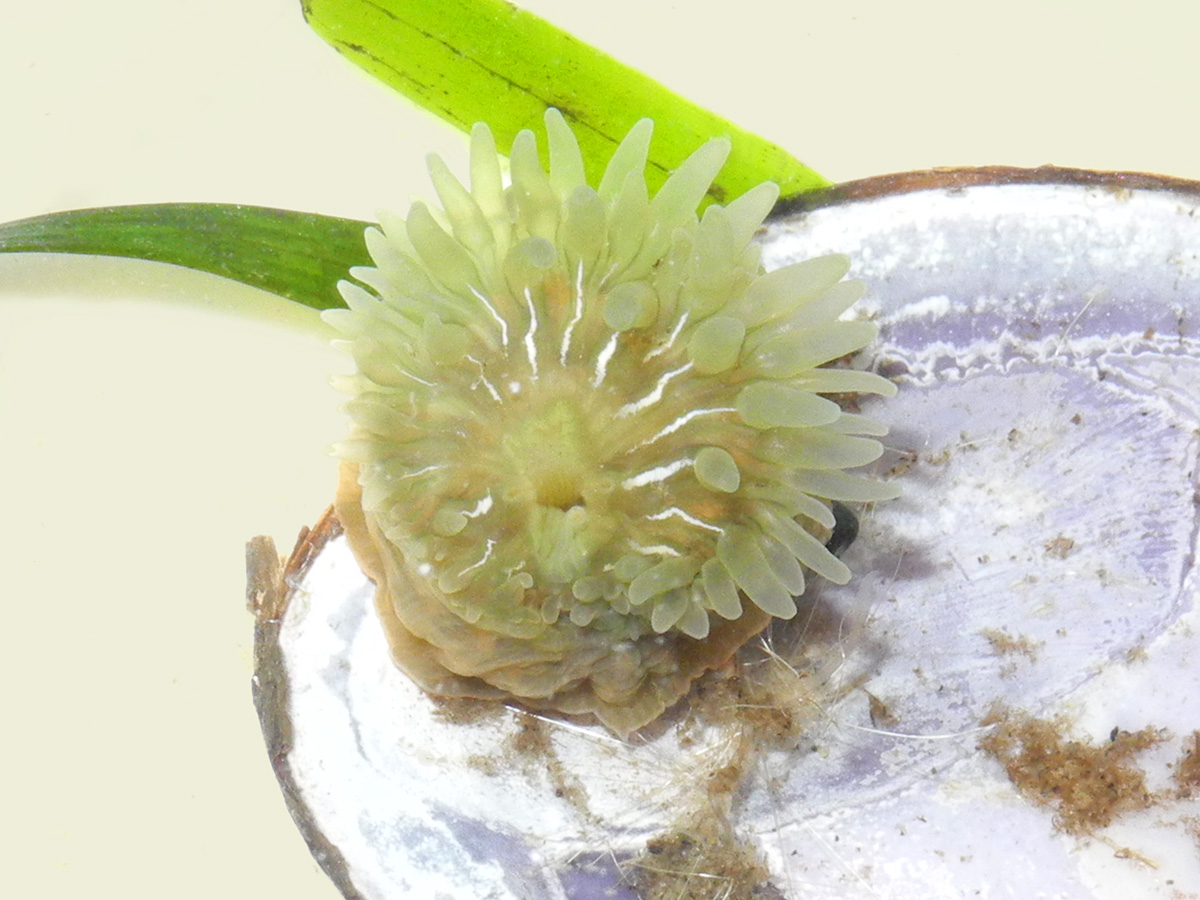
Anemones, when they don't approve of their surroundings, often up anchor and slide or even float away. My burrowing anemone has worked her way about a foot along the floor of the aquarium to a spot she likes. Other anemones just let the water carry them whither it will. So when I found three small, green anemones, probably the orange-striped anemone, in the bag of eelgrass and holdfasts, I couldn't be sure where they had been attached. These do like the upper intertidal zone, so they were probably on the eelgrass.

The largest one, found first. I settled him down on a clam shell, and he seemed pleased with that, but once in the tank, he left it and climbed up the wall to just under the water surface. There he remains, for the time being.

Bottom disc. The orange striping is visible. About half an inch across.

The other two were much smaller, and have been eelgrass hopping, not yet finding blades to their taste. They will, but it has to be their decision; for critters without a brain, amazingly, they still manage to have their own ideas.


Thursday, February 07, 2013

Homebodies

It may be a mistake to think of a given beach as "the beach", at least as far as its small residents are concerned. They don't live there, in the way we live in the Lower Fraser Valley, but are free to travel or move house to any part of the world, with little inconvenience. (Always excepting Antarctica or the sea bottom, of course.) The intertidal critters live in small communities, sometimes never leaving their underside of a rock, or the line where stones give way to mud, for example.

Barnacles and periwinkles, and probably a crab or two.

Mud snails are relatively mobile. We have watched them as the tide retreats, just above the water line, hurrying down in pursuit of the disappearing shelter of the waves. They're not fast enough, and after a futile chase of a few minutes, they bury themselves in the sand to wait for conditions to improve. I sometimes follow their trails from exit hole to new retreat; they manage to cover about 10 of my paces, but rarely in a straight line, so they're not too far from home when they stop.

Hermit crabs scuttle about, sometimes covering quite a distance, compared to their size. And I have seen them, caught in the current, rolling, rolling, out with the tide, until they find some strand of eelgrass to grab onto before they get nabbed by a passing fish.

The other day, walking on the bare sand, I picked up every snail shell I saw, and examined it. Every one, every single one, without exception, held a hermit crab. If a hermit borrows the shell from a snail that died and was eaten, then the hermits and snails should be found in the same general location, I reasoned. But I saw no snails where there were hermits.

Maybe the snails had dug themselves into the sand when the tide went out. So when I picked up a hermit in a snail shell, I dug in that area, scooping out the sand and water wrist deep. Each time, I found clams, clams, clams, clams. No snails. Not one.

So the hermits, at least, have travelled some distance from their supply of homes.

All this is well and good; a barnacle or a mussel on a rock is basically set for life; a starfish in a crevice at the mid-tidal zone will still be there next week or month, a snail circles around the bits of beach that feel comfortable.

Double holdfast

But what of the poor critters that settle down in a perfect spot, sheltered, climate-controlled, well supplied with food and company, only to find their home uprooted and tossed on some inhospitable shore, exposed to air and light and flies? What of the subtidal residents of bull kelp holdfasts, or the eelgrass root dwellers?

Ma Nature is so unfair!

Wednesday, February 06, 2013

Thoughts on a January beach

The tide comes in, the tide goes out. Six hours rising, six hours falling, and repeat forevermore. The intertidal zone lives to this rhythm. But there is still a longer, slower beat on the dry/wet/dry sands; summer and winter, similar to our land-based seasons, but oh, so different in the doing.

We are more familiar with the summer beaches; they're friendlier, on our terms. The tidepools are warm, sand softens and drifts to a consistency suitable for sunbathing on, splashed clothing dries quickly on our backs in the warm breeze. In the tidepools, crabs scuttle and small fish dash about; periwinkles bake on the rocks, sunbathing without tanning.

If you're paying attention to that sort of thing, you'll notice the variety of seaweeds brought in by the tide, or growing in the tidepools. Sea lettuces, broad, narrow-leafed, stringy in abundance. Fine, feathery red miniatures. Brown fuzz on the eelgrass. Fresh yellow-green strings, purple Turkish towel, deep green rockweed, red sheets of algae fading in the sunlight to candy pink. Glowing blades of kelps, all kinds: smooth, crinkled, ribbed, feathered; short, long, super-long.

Come winter, it all changes. The wind is cutting, coming ashore from its long stretch with no windbreaks. Sometimes it howls as it attacks. It is no longer possible to wade in tidepools without good, warm protection. And don't fall in! Not if you're not fond of pneumonia!

January beach

But for the small permanent residents of the zone, things change even more. Sure, the water is cold; at least it stays at the same temperature or thereabouts, day in and day out. No more cold currents pouring into bathtub-warm tidepools, bringing sudden chills. It's chilly always.

But the intermittent storms, even the ones that miss the beach entirely, the inland rainstorms, the snow on the mountains, melted in a brief warming; they all bring in sudden influxes of fresh water, changing the salinity of their homes, interfering with the functioning of their body systems, geared to a high salt environment. Runoff from the land brings pollution, both natural (mud and silt and bits of vegetation) and man-made (machine oil, detergent, solvents, you-name-it). Food doesn't taste the same. Storms at sea rip up forests of giant kelp and eelgrass, and dump them to rot in deep mounds along the beach. Logs get tossed up, then washed away again, only to be beached elsewhere.

The small critters take shelter. Those that don't become sustenance for wintering birds, the peeps, especially.  On the Boundary Bay beaches, all we see in our persistent rock-flipping, sand-digging, beached-eelgrass-rolling are the Asian mud snails (though not in summer numbers), a few shore crabs, periwinkles (not sunbathing now; hiding in warm(er) crevices), the occasional limpet, and a multitude of tiny hermits.

January beach, with eagle and gull

And there is no sea lettuce, not even, by January, sea lettuce brought in by storms from friendlier shores. No red algae, no fuzz, no strings. Bare sand, bare sand, bare rocks. Here and there, at low tide, we find some freshly torn up eelgrass, tied in knots and left to be swept inshore with the next tide, or a scrap of browning Turkish towel. Along the upper edge are those mounds of eelgrass and kelp, now long past their sell-by date, stinking, celebrated by hordes of tiny black kelp flies.

Did I mention before that my critters love sea lettuce? I did. So I've been walking the water's edge, searching, searching, doubling back to see if I missed anything, picking up every scrap of fresh greens I find. My critters are lucky if I come home with a few square inches of half-shredded lettuce. Sometimes I don't manage even that.

Nothing to see here but the gull

But there's still life! There are always eelgrass roots, exposed when the eelgrass was swept from its bed. And there are those amazing kelp holdfasts, slimy and pungent in their decay, but each one still a little world.

I seem to have run on; the latest finds will have to wait until tomorrow.

Tuesday, February 05, 2013

Homegrown Gordian knot

What will we find here?

Two kelp holdfasts knotted, then grown together. Impossible to untie.

Answers tomorrow. Tonight, I'm barely awake.

Monday, February 04, 2013

Crows in love

It's pairing up time, again.

"It's just you 'n me, babe ..."

"... against the world out there."


Saturday, February 02, 2013

Is there a duck doctor in the house?

This Northern pintail has a damaged wing. Walking, he drags it on the ground; I didn't see him fly, which may be problematic. Swimming, he's ok.

The wing drags a bit in the water, but he steers fine.

He's fortunate to be at the Centennial Beach duck pond; there is plenty of cover in the reeds, food on the ground and in the water, and good company. Even females and nesting sites. What more could a duck want? (A duck doctor, maybe?)

We've been busy all week with various things, doings good and good-but-no-fun and one no-good-very-sad day, but we did manage the beach today, and the sun broke through the fog a few minutes after we'd ventured out into the grey mist. So kind of it! And we made some exciting finds, too!

Tomorrow's another of those days. This one promises to be a treat, but I may be too exhausted to blog when I get home. See you Monday, at least, then I'll start playing catch-up.


Friday, February 01, 2013

Happiness is a wet dog

I've been cleaning out and organizing my old hard drive, and I found this series of photos from three years ago. We love to watch dogs on the beach; they express their delight with every muscle and ripple of skin, and this black and white hound was more exhuberant than most.

Pausing momentarily, to pose

Running and laughing

Sand flying

"Hey, I'm a hound! Watch me track that clam!"

Found a friend!

"Oh, joy! Oh, bliss! Watch me dance!"

Even his tongue is flying!


Thursday, January 31, 2013

Wednesday, January 30, 2013

Hermie gets a makeover

When they eat, they scatter the crumbs. They don't clean their plate; they don't tidy away leftovers. That's SEP*. They abandon their houses, walking off with nary a backward glance. Occasionally, they strip off their old clothes and drop them on the ground. Then they climb to high places and sit there, all undressed.

No wonder they get into trouble!

Another of my hermit crabs molted this afternoon. I found his discarded body armour floating in the current, and looked for the ex-owner.

Sure enough; he's resting on the top of a clump of sea lettuce.

He's one of the hairy hermits. The hair isn't usually so apparent. Now, it's new and just stretching out. And he has no jacket on.

While he's walking around in the altogether, we get a chance to count legs. A hermit has 5 pairs of legs, including the pair that serves as pincers. Two more legs on each side are used for walking. The fourth pair, easily seen in this photo, is used to move in and out of the shell he borrows. The fifth pair is smaller, barely visible here. It is used to clean the gills and to remove wastes.

Visitor.

At the very tip of the abdomen, a pair of curvy uropods works as an anchor inside the shell.

As long as the hermit stays aloft, in my tank, he's fine. If there were any fish, he wouldn't be; he'd be a fine lunch. Here, once he goes down to search for a new shell, any crab that he meets will eat his soft abdomen. I kept an eye on him; when he climbed down, I chased out my one crab and put him in a bowl to keep him out of mischief. (I gave him a piece of fish as compensation.)

Hermie took his time choosing his new shell; so many styles and patterns!

He was slow; the crab had to stay in solitary for three hours. While I was watching, I noticed something else in the tank:

Six pearly eggs!

Spring is definitely on it's way, and the snails are ready for it. One of them laid these eggs. I don't know which; there are four species of snail in this tank; the invasive mud snails, a bunch of pretty little Nassas, several periwinkles, and some really tiny, pointy snails that I haven't been able to identify yet. These last are smaller than the eggs, so they're not the parents. Any one of the others could be.

Bonus; the teeniest of all the hermits, like a half grain of rice, even with the shell on.

And Hermie finally decided on that fat white whelk shell.

*Somebody Else's Problem. See Douglas Adams.

Tuesday, January 29, 2013

Failed rescue attempt

For a few days, I hosted a pair of small clams that I found abandoned high and dry on the beach, probably dropped by gulls, then left because they didn't break. The treatment had been too much for them, though; they didn't survive.

But they tried their best. Here's one, showing his teeth.

With a hermit almost small enough to enter that tunnel.

A clam has two siphons, which it extends up to the top of the sand to feed. (This clam did not burrow into the sand, a sign that it wasn't feeling all that well.) Water enters through the one towards the front, away from the hinge, (the incurrent siphon), food and oxygen are filtered out, and the waste water is pumped out through the rear siphon (excurrent).

Since the clam is a filter feeder, straining out microplankton and organic "dust" from the water, the hermit crab is in no danger; he's not going to be sucked in by the gentle current the clam generates.

Nor will he be bitten by those "teeth" around the opening of the siphon.

I couldn't find a name or a function for these tooth-like structures.


Sunday, January 27, 2013

Name this thingie

It took me a while to figure out just what Laurie had taken a photo of. And he sees faces in it that I can't.

What do you see?

Snail with a chimney? Sheepdog house?

Over on Fertanish Chatter, Bill has been posting photos of tree bark, asking the same question. He's on #9 already; this one's easy, some of the others, not so.


Fog and winter sunlight

A collection of photos from two January afternoons on the White Rock and Semiahmoo beaches. (Same beach, opposite sides of the pier.)

Sunshine, fog, and the gulls flying ...

White breasts all in a row

More wing than gull

This little girl brought back memories. I was her, so many years ago. She moved along slowly, on hands and knees, examining each spot carefully. Once, she jumped up and ran to show her mother something she'd found. A minute later, she was back, searching through the stones again.

At one point she opened her arms as wide as possible, as if to embrace the whole marvellous beach. I know what she meant.

Kindred spirit.

Crow on a log. Some of the brush keeps its red colour all winter.

From the Semiahmoo beach, a hint of sunset, with birds flying into it.

The afternoon train, between the promenade and the actual beach.

Eagle, far overhead. Another golden juvenile?

Bald eagles, very annoyed. They were sitting on the rail by the railroad, and the train chased them off.

Late afternoon fog creeping in, slightly tinted by the setting sun.

I lived just up the hill a ways from this beach the year I was 11, back when the dinosaurs were still roaming about. I loved it then, I love it now; but more so on foggy days like this, with the gulls calling.


Saturday, January 26, 2013

Just because

Laurie liked this photo. It's a tiny limpet on the glass wall of the aquarium, pushing up against the surface tension of the water.

The limpet is about 1 mm, lengthwise. The mouth end is down, and it's chomping away at algae on the glass. One of the antennae is visible.

Friday, January 25, 2013

Arrows pointing backwards and wavy letters

In January, when the water is too cold for wading, and the wet stones and sand are cold enough to cause a bone-deep ache in rock-flipping and sand-digging fingers, we behave more sedately than usual, walking upright on the sand, hands in gloves and pockets, eyes peeled for what we can see without stopping and getting chilled.

Sand, water and sky. Patterns in blue and grey. Laurie usually looks up to the sky and the distant snowy peaks. I'm more likely to watch what's in front of my feet.

Duck footprints. Probably mallards. Three toes, and distinct webbing.  Ducks toe in, which makes them waddle.

A duck has four toes; three facing forward, webbed, and a fourth, called a hallux. It faces backwards, is small and higher up on the leg. Sometimes it leaves a mark on the footprint. More often, it doesn't.

Gull tracks. The tip of the hallux left a mark in this wet sand. The footprint is about twice the size of the duck prints above, and the webbing isn't as marked. Like ducks, they toe in.

Heron tracks in soft sand. I don't know what makes those dotted-line furrows.

Heron track with my big boot for measurement. About 6.5 inches. (The heron's foot, not mine.) These are big birds.

Heron track on hard-packed sand. He drags that rear toenail. There is no webbing; the heron is not a swimmer.

Something different; check this out!

Just sand, sculpted by the tide.

But: this was flat, flat beach. Very flat; I want to emphasize this. But look at the photo from a bit of a distance; to me, it looks hilly. From a few steps back, the hills grow into small mountain ranges. And sometimes, when it catches my eye suddenly, I see what looks like letters among the lines. I can't read them; they morph into different shapes with the slightest head movement. (If I'm looking for them, I don't see them.)

What do you see?


Powered By Blogger