Thursday, January 31, 2019

Hideaways

Miniature white mushrooms hiding in cracks in tree bark:

Pure white balls, pinhead to marble size.

These are a bit larger, and stalked. Growing under roots on a nurse stump.

Zooming in on others on the same roots. They burst through from the inner "meat" of the roots; note the broken end, where no bark impedes their growth.

These grow in clusters from bottom to top of a deep crack in the bark.

And where the bark is long gone, these side-stalked tan mushrooms force their way out.

I've tried and failed to identify these beauties.

Wednesday, January 30, 2019

What are these?

Upside-down mushrooms? With the hyphae out in the open?

Or something else? A slime mold, maybe?

They are tiny: compare to the size of the moss at the end of the stick. They were on broken twigs on the ground under the shelter of old logs.

 More. Most were like this; radiating spikes bursting out of the twigs.


Monday, January 28, 2019

Cat's tongues, Electrified tails, and Oregon hat decor.

It's a while since I've seen cat's tongue fungus, and never more than one at a time. This week, on the Canyonview trail, there were many, mostly on the back side of mossy logs.


Cat's tongue, Pseudohydnum gelatinosum. AKA quivering spine fungus, white tooth jelly, etc. The moss, I think, is Electrified Cat's tail. To go with the tongues.


On another log. I like the delicate scalloped edges. The stalk often extends to the side, towards the woody base.

Red-belted polypore, Fromitopsis pinicola, wearing a hat decorated with Oregon beaked moss.

Orange jelly, on a very wet log. It hadn't been raining, but this forest is very damp, and takes days of sunshine to dry out. Note the tiny, dark blue buttons; probably early lichen settlers.

Sunday, January 27, 2019

Canyonview Trail

It's mushroom season. On a short (very short: I've been rather sick over the Christmas season, and still haven't got my strength back); ... a short walk along the Canyonview Trail beside the Campbell River, I took well over 100 photos, mostly of mushrooms, mostly tiny. I'm working now on processing and possibly identifying them.

Meanwhile, here's the trail itself:

A well-travelled trail. It's a few minutes from downtown, easy walking, with good parking at several points along the trail. Cedars, Douglas firs, hemlock, Bigleaf maples, red alder, ferns, more ferns, moss. Moss everywhere. More moss. And mushrooms.

Light and dark. The sunlight shines on the far side of the river; here, we're in permanent shadow.

When I was a kid, I would have called this a good climbing tree. Many, nicely separated branches, soft padding on each branch in case you slipped. Getting too old and stiff now, but I can still dream.

Where the sun shines through, each mossy trunk and branch is outlined with yellow-green.

At river's edge, the remains of an old stump hosts mosses and lichens. And - do you see it? - a baby huckleberry shrub.

Not a drowning buffalo/unicorn.

Thursday, January 24, 2019

Huckleberry spider

Our red huckleberry, common in our deep rainforests, is evergreen, after a fashion. It sheds its leaves in the fall, like the rest of the deciduous plants, but the stems and branches stay bright green all winter. And now, with the warm winter that we're having, they are deciding it's spring already, and sending out bright pink buds.

Huckleberry shrub, Canyonview trail

Zooming in to see the pink buds.

Moving around the bush, looking to find a less busy background, I almost put my nose through a spider's web.

Long-legged trapper.

I haven't seen many spiders, or insects, either this winter, although I've been searching for them, so I was glad to see a spider, and I hope she's had better luck with insects than I have.

Blurry; she's noticed me, and is pretending to be a bit of twig or dry pine needle twisting in the wind.

And maybe it will be safer over here on the branch.

I had frightened her, so I backed off and went my way. At least I hadn't broken her web.


Tuesday, January 22, 2019

An assortment of nurse stumps

An old stump is a great spot for a growing sapling; it lifts it above the light-hogging mosses and ferns, it provides nutrients and good drainage.

Nurse stump with two trees, well established.

But some young trees are more ambitious. Here's one that chose a tall tree as a nurse stump:

There's plenty of sunlight up here! Tall snag with youngster, beside the Campbell River canyon.

Zooming 'way in: this young tree seems to be thriving up there, even in mid-winter. (And no, that's not a rabbit.)

And here are a couple of newborns, just getting settled in:

Evergreen on a nurse stump, a dozen and a half needles, about 2 inches tall.

Same stump, another seedling. Cute, isn't it?


Layers upon layers

The trunk of an old deciduous, lichen-covered tree sprouted orange flower look-alikes.

Orange crispy, on a lichen-covered deciduous tree, Tyee Spit.

I've walked past this tree dozens of times, and never noticed these before. They are quite noticeable, even from a distance.

I touched them; they're hard, dry, firmly attached to the tree. Not jelly-like at all. A dry witches butter. It had been a couple of days since it rained.

These two clumps are about an inch and a half across.

These are much smaller. The front one looks like its pushing its way out from inside the bark.

The fungus grows parasitically on the mycelium of wood-rotting corticioid fungi in the genus Peniophora. (Wikipedia)

The Peniophora are crust fungi that infect and decompose wood. Looking at photos, I realize that I've seen them without paying enough attention. So basically, the witches' butter is a parasite on a parasite.

So, naturalists observe, a flea
Has smaller fleas that on him prey;
And these have smaller still to bite 'em,
And so proceed ad infinitum.
(Jonathan Swift, 1667 - 1745)


Monday, January 21, 2019

Blue

A blue morph snow goose. I don't think I've seen one before, except maybe (probably) in the middle of one of those flocks of thousands of honking, flapping, swarming whites. This one was feeding peacefully on the lawn at Tyee Spit.

The paler geese are probably juvenile whites.

Sharing the lawn, eclipsed by the showier geese, three wigeons watch me.

Saturday, January 19, 2019

Winter greys and tans, with a spot of purple

The sun came out and dried up the morning's rain. The wind died down; the waves forgot to pound the shores. Mallards chattered among the grasses at the edge of the Campbell River estuary.

At the bird blind, I met a couple of gulls.

Looking towards the city, hidden between the wetlands and the hills.

This gull allowed me to come up close. Gull guano feeds the abundant lichen on the rail.

And this gull kept his distance. He seemed to think I might try to steal his delicious crabmeat. I got the shell, and gave it to a duck.

Distant mergansers, against the light.

Beautiful purple-headed mallard.


Friday, January 18, 2019

End of the trail

Two more photos from the Hoomak Lake trail:

Tree remains in the lake. With lichen.

And this:

Why, people? Just why?

A mere hundred or so steps from the end of the trail and a trash bin, someone tossed this bottle as far into the forest as they could. I had to stumble and crawl over logs and moss to retrieve it and take it to the bins.

Why? It wasn't carelessness; that was a purposeful toss. At least it wasn't plastic, but still ...

Thursday, January 17, 2019

Not a pretty picture

I didn't know this.

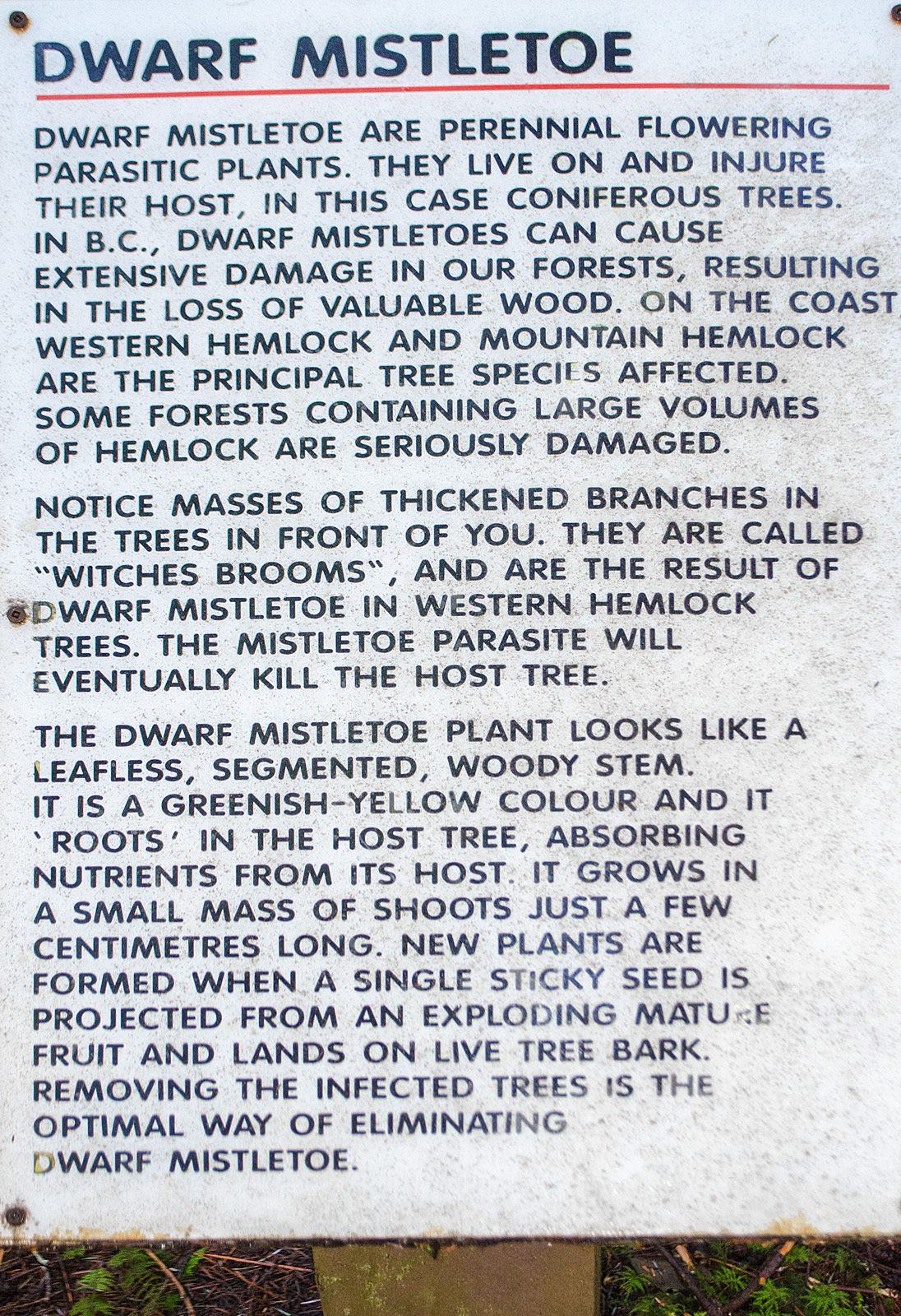
Hoomak Lake sign: Dwarf mistletoe

Legend: Dwarf mistletoe are perennial flowering parasitic plants. They live on and injure their host, in this case coniferous trees. In BC., dwarf mistletoes can cause extensive damage in our forests, resulting in the loss of valuable wood. On the coast western hemlock and mountain hemlock are the principal tree species affectd. Some forests containing large volumes of hemlock are seriously damaged.
Notice masses of thickened branches in the trees in front of you. They are called "witches brooms", and are the result of dwarf mistletoe in western hemlock trees. The mistletoe parasite will eventually kill the host tree.

This was written 20 years ago. The poor tree in front of me as I read the sign is long dead.

Legend, continued: The dwarf mistletoe plant looks like a leafless, segmented, woody stem. It is a greenish-yellow colour and it "roots" in the host tree, absorbing nutrients from its host. It grows in a small mass of shoots just a few centimetres long. New plants are formed when a single sticky seed is projected from an exploding mature fruit and lands on live tree bark. Removing the infected trees is the optimal way of eliminating dwarf mistletoe.

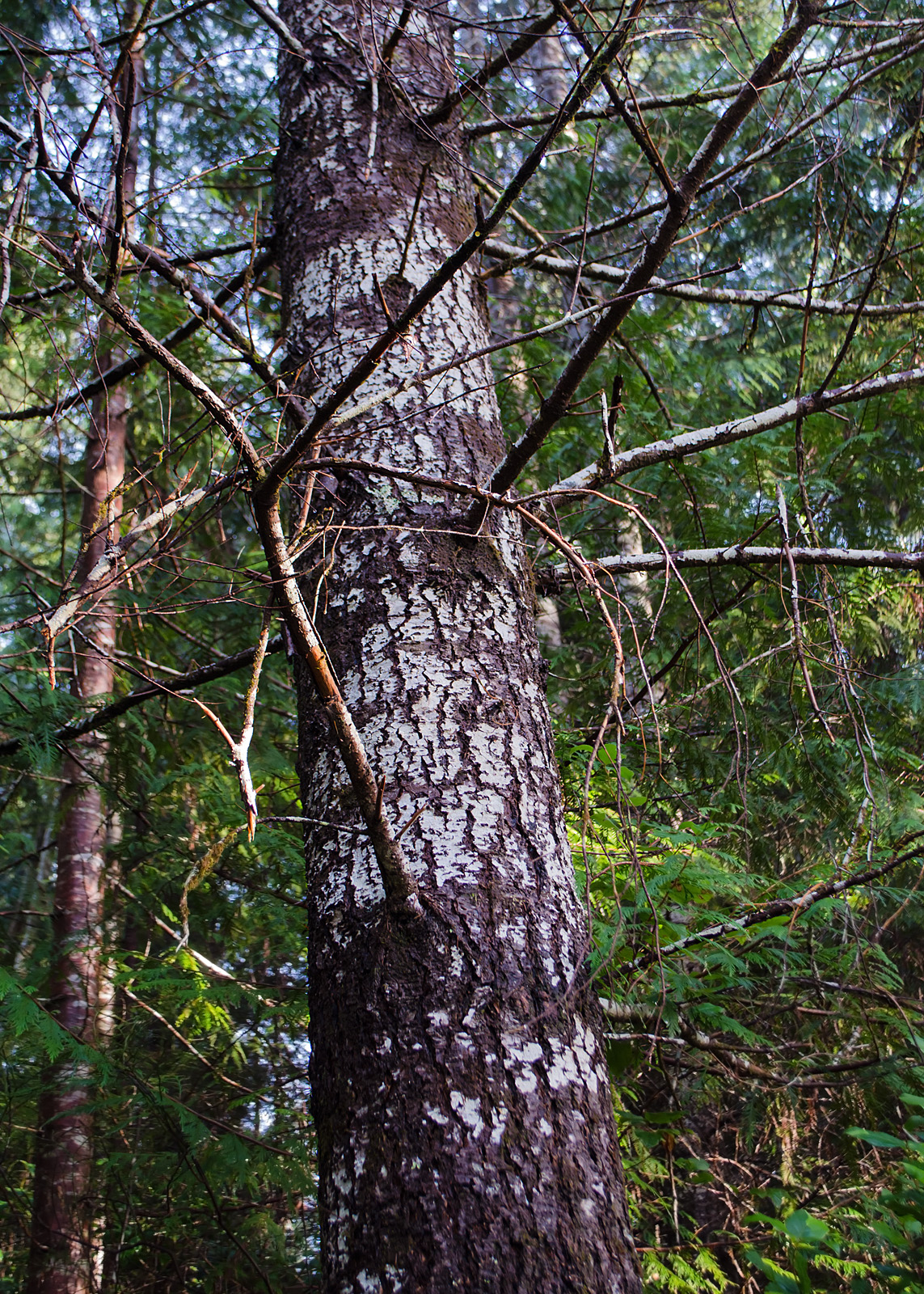
And here's that infected tree.

Not a pretty picture.

I have seen trees like this before, and wondered briefly what chewed them up, out here in the forest where no machinery wanders. I never looked too closely; just shuddered and went on my way. Now, I paid more attention, and came home to study up on it.

Look at the photo above: you can see the short stalks of the mistletoe. They sprout directly from the tree bark, and almost, but not quite look like part of the tree. Also note the fat branches. The root system interferes with the normal growth of the branches. These thick branches are weakened, and easily broken (in a wind storm, for example).

Fat branch and "brooms".

The balls of deformed branches plus a tangle of mistletoe are called brooms. (Not my idea of a witches' broom, which is designed for speed. Not these.) They don't appear until the tree has been infected for several years; at first, the mistletoe lies hidden beneath the bark.

The mistletoe damages the tree in other ways; it absorbes its nutrients, primarily carbohydrates, from the tree sap. And it can somehow extract water from the tree xylem even in times of extreme drought. The tree above the mistletoe infestation is starved and thirsty, and dies off.

I have looked at these and said "How ugly!" I have thought they spoiled the forest. I cringed at the sight.

I was wrong. I've been too stuck on my limited human ideas of beauty. These witches' brooms are valuable wildlife habitat. My "Wildlife and Trees" guide mentions fishers, martens, flying squirrels, black-backed woodpeckers, marbled murrelets (endangered), and spotted owls (ditto) as species which roost or nest in the shelter of these knots.

Dwarf mistletoes may contribute in various ways to biodiversity - by creating openings in the forest following tree death, by providing nesting sites in the 'brooms' and by providing food for a range of vertebrates and invertebrates. There can therefore be some conflict between the requirements of forest exploitation, and environmental concerns. (Plantwise Knowledge Bank)

E-Flora BC has several good photos of dwarf mistletoe on live hemlock. Here's one. Next time I see one of these trees, I'll stop and examine it closely, to get a good look at the mistletoe.


Wednesday, January 16, 2019

Signs along the trail

On the Hoomak Lake trail, I found the interpretive signs interesting. I"ll include a few among my photos of the sights along the trail.

Sunlight on the top of a mossy log in a patch of salal.

Brief history of the site.

Legend: Reforestation History
Welcome to the Hoomak Lake trail. This site was logged in 1959 and slash burned in 1960. Since there was inadequate natural forest regeneration, Douglas-fir seedlings were planted in 1968-8-69. A white pine blister rust infestation had destroyed much of the natural young western white pine trees. In 1984, the site was juvenile spaced and pruned. ...

"... slash burned in 1960." After a site is logged off, the remaining broken timber and branches become a fire hazard, so the slash is piled and burned as prevention. The cleaned area then is colonized by fireweed, which provides shelter for early tree seedlings.

The white pine blister rust is similar to the (probable) rust I found on the Ridge Trail a few weeks ago. It can spread rapidly through a forest, killing the trees.

Western White Pine cone.

These cones can grow up to 30 cm. (12 inches) long. I don't know what those white patches are; they were hard and dry, and firmly attached to the cone.

Tree species on this site.

Partial legend, written in 2000: This area contains Douglas-fir, western redcedar, western white pine, western hemlock, and red alder trees.

Ferns growing on a well-rotted log. The duff is mostly pine or hemlock needles, dead ferns, and a few alder leaves.

Forest Succession

Legend (again, written in 2000):
An old forest will most often contain trees of various ages and sizes - from young to old, short to tall. Some species, such as western hemlock and western red cedar, can grow in low light conditions. Douglas-fir, on the other hand cannot survive under the shaded canopy of the tall trees.
Notice the different levels of tree heights in the forest around you. (Note: I craned my neck here. The Douglas firs are 'way up there in the sunlight.) The biggest and tallest trees in sight are Douglas-fir trees. They are the original or "pioneer" species, growing natural or planted before the ground was shaded by other vegetation. Pioneer species are the first species to grow back on a disturbed site.
Around you are numerous short, little western hemlock trees. They will eventually grow taller and take over from the pioneer species, ultimately being the tree species that exists on this site - the "climax" species - until the next disturbance. This process is called forest succession.

The "little" western hemlocks from 20 years ago are now tall, thin trees.

Once established, saplings in full light may have an average growth rate of 50–120 cm (20–47 in) (rarely 140 cm, 55 in) annually. (Wikipedia)
20 inches a year for 20 years: 400 inches or 34 feet, plus their year 2000 height; the trees are now nearly a third grown.

I didn't know this:

Sunscald

So Douglas fir that grew up in shady woods can get sunburnt. I can relate.

Legend: The damage on the Douglas-fir beside you is called sunscald. When such a thin-barked young tree is suddenly exposed to intense direct solar radiation, the high temperature can kill live tissue (cambium) below the bark. In this instance, juvenile spacing ... created openings that allowed sunshine into the previously shaded young forest.
... Trees that have grown up exposed to direct sun have usually developed a thicker, insulating bark.

White patches on trunk.

This is the tree that was beside the sign. Whether it is the one the sign referred to, or that one has long turned into duff, I can't tell.

Mushrooms on fallen tree.

These mushrooms were soft, jelly-like, from white to tan to pinkish. The leaves on the ground around them are red alder.

Something else I didn't know, tomorrow.

Powered By Blogger