Thursday, August 30, 2018

Greedy!

The apples on the tree outside my bedroom window are ripe and dropping on the ground. I've collected several bowlfuls for eating, made a batch of applesauce, and baked a few with oatmeal crumbles. The compost bin is full of apple cores, and the house is full of fruit flies.

I've trapped many, but there are always more. And now my corners are full of tiny spiders getting fat on fruit flies. I appreciate their help.

Fruit fly on the kitchen wall.

A few of the apples, with the few fruit flies that didn't leave when I approached.

Fruit flies on a blemish on an apple.

A small cross spider, Araneus diadematus, has built herself a web in a handy location (for me) just at eye level by the kitchen entrance, and seems to be a bit bigger every day. I caught her two days ago with a mouthful of fruit fly:

She's so handy I can even measure her without disturbing her. She's 7 mm long today.

 I've set up a fruit fly trap, which did reduce the airborne population a bit, but then I decided to feed my friendly cross spider. I took off the lid an inch away from her web, and two fruit flies hit the web immediately. Instantly, half a second or less later, Little Miss Patience, here, had dashed across the web and caught one of the flies. As expected.

What surprised me was that now, with her fangs full of fruit fly, she dashed to the other end of the web and grabbed the second fly, then returned to the centre carrying both of them. Which she tied up in one little bundle and settled down to eat.

A veritable feast; a two-fruit-fly taco!

When I came back a few hours later, there was no sign of the flies. The web was clean and repaired, and LMP was sitting in the centre, waiting again.

And the rest of the flies from my trap were loose; they're even perching on my computer screen as I work.

I wonder; if I gave her three flies, would she catch all three together?

Wednesday, August 29, 2018

Booted up

Echeveria. Just because.

Seen on a friend's back deck

Delicate flowers

Five-pointed bracts

Three colours on one stem! I think these are Portulacea sp.


Tuesday, August 28, 2018

Morning visitor

Why it's never a good idea to leave dishes in the kitchen sink overnight. Because in the morning, you'll have to chase this guy around and under dirty dishes.

Sowbug hunter, in a clean, dry sink.

I gave him a dishrag to help him climb up the slippery walls, and he showed his appreciation by posing for me.

He's just under 2 inches, toe to toe.

Tegenaria domestica, again. Harmless, except to sowbugs.

Monday, August 27, 2018

Leggy

On the underside of an old garden stool.

Harvestman and spider webs.

Sunday, August 26, 2018

Saturday, August 25, 2018

Carrot carrot

aka Daucus carota (literal translation), Queen Anne's Lace.

Seed pods, looking like miniature hairbrushes. Each pod contains two seeds.

The flowers are white, on pinkish stems, but the central flower is often a deep purple. Here, with a busy ant, out of focus.

Another flower head. No purple centre flower, another ant.

Found at Eve River Rest Area, south of Woss.

Friday, August 24, 2018

Old favourite

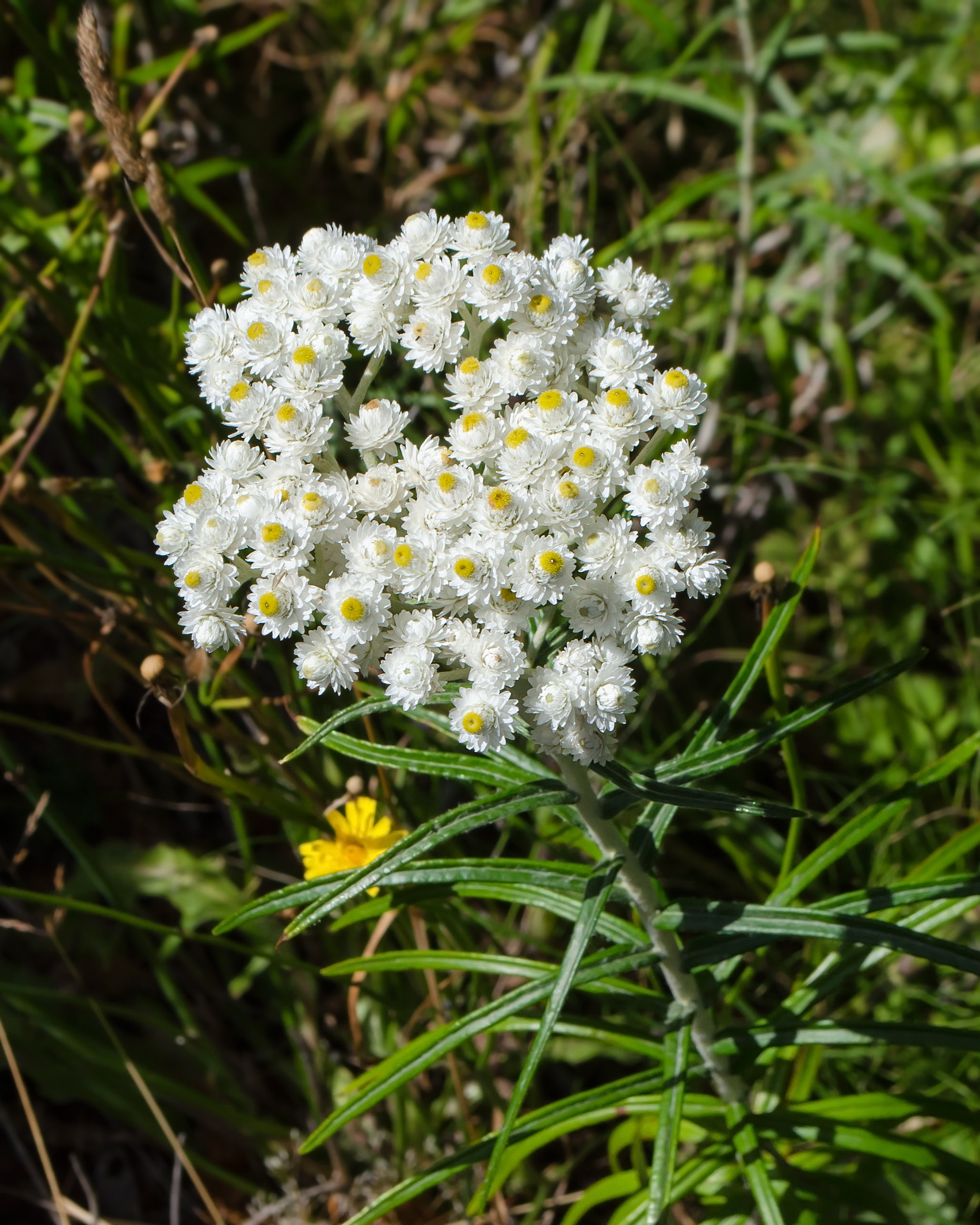
Roadside pearly everlasting:

aka Anaphalis margaritacea. Perennial, in two meanings of the word.

I have an old photo of my Mom, taken after a hike through the coastal bush. She's carrying a bouquet plucked on the trail; salal leaves, Indian paintbrush, and pearly everlasting. It's a sampling of the different terrains her hike took her through; deep shade, wet cliff faces, mossy thickets for the salal, damp meadows and tidal marshes for the Indian paintbrush, and then, coming out into the sunlight and dry, stony slopes, the pearly everlasting.

Mom, 1955, Ferrer Point

Pearly everlasting was one of her favourites; mine, too. It holds its shape and colour as it dries, and lasts for years. (That's where it got its name.) In the long, wet, grey winters on the wet coast, that handful of everlasting was a reminder of the summer past, the warm summers to come. A vase on my bookcase holds last years bouquet, still looking fresh; this year's crop is drying, hanging upside-down on a hook in my hallway.

It grows thickly at this time of  year on gravelly roadsides, dry hillsides, and even bare rock:

Everlasting and its shadow, on a rock face.

Wednesday, August 22, 2018

It's on fire

The rainforest is burning.

Current BC Wildfire Service map, Aug. 22, 2018

Large areas of the province's wildfires are raging, with many areas under evacuation orders. The mid-province fire zone is dry country, prone to fires, burnt off only last year; this year, the fires feed on dry sticks left behind from previous fires.

But the coastal areas, our Vancouver Island neighbourhood, is rainforest. Rainforest with no rain. I counted 50 small fires in the northern part of the island on the map, with the Zeballos fire under an evacuation notice.

Most of the fires are started by lightning. I watched, once, years and years ago, as we sat under a tarp in our campsite, sheltering from the pouring rain. On the mountain face (Nusatsum) across the valley from us, lightning struck; immediately an answering flare shot up, a tree bursting into bright flame. And then, almost as quickly, the flame shrunk and died, sputtering out under the deluge.

This year, there's no deluge. The fires catch and grow, crackling through oily evergreen branches, jumping to the next tree, and the next.

We're breathing smoke. The sun is a pale orange, when it's visible. The moon turned up tonight, a pale yellowish shape in the haze.

On the Lower Mainland, an air quality alert is in effect. Older people, children, people with asthma and other lung complaints, etc. are warned to stay inside, out of the smoke.

Over here on the island, I'm staying inside, near my air scrubber. My throat hurts.

Coastal communities will see a gradual improvement in air quality beginning Thursday as Pacific air moves onshore. While the trough will deliver enhanced mixing of the atmosphere and even a chance of showers, the forecast rainfall amounts will do little to abate the current wildfires. Communities downwind of wildfires will continue to experience high concentrations of fine particulate matter and poor air quality for the foreseeable future. (East Van Isl. alert)

Rain! We need rain! Real rain, drenching, soaking, persistent rain, BC rain!


Tuesday, August 21, 2018

Northern lupines

Near the north end of the island, the lupines are just going to seed. Down here in Campbell River, the pods are black and hard, and mostly empty already.

This is probably the Arctic Lupine, Lupinus arcticus*.

The green pods look like woolly caterpillars up close:

Very fuzzy!

A few plants still are producing flowers.

* Nootka lupines** grow this far south (but not as far down as Campbell River), but the stalks are taller, up to about 1 m. tall. These were under two feet tall.

** Bears like to eat the roots of Nootka lupines. So do some of the First Nations people; the Nuxalk roast them or steam them in pits.

Monday, August 20, 2018

Looking back, looking up

It was long ago. Long, long ago. Our car had a wide ledge behind the back seat, with the rear window slanting down over it. It was my bed when we were travelling. I lay there watching the tops of the trees slide by, watching the night settle in, turning the greens into blacks against a blue-black sky.

Looking back. Campbell River, 76 km.The overpass is a logging road.
 
Dad slept during the mornings, then drove through the afternoon and night. We averaged, back then, about 300 miles a day, crossing and re-crossing the continent on two-lane highways. My brothers slept on the back seat, Mom nodded off in front. I watched the sky and the tree line.

Bridge over a creek

A few years later, Dad drove a '34 Dodge. The back-seat ledge was too small, and I was too big by then, anyhow. I sat behind Dad, leaning forward against his seat, (no seat belts in those days!) watching the road while he drove. In the blue distance, a glow in the sky meant we would be passing a town, a moving light was a car coming our way. There weren't many of those.

The trees lose their upper greenery in the winter storms.

Down the west coast, the skyline featured hills clad with evergreens. Then there were the flats through Arizona and New Mexico; here I watched the heat shimmers over the road, and the scrub bushes sprinkled across the dry land. Cotton fields down the Mississippi, urban sprawl up the east coast. I missed my treetops.

Sky and spikes over Rooney Lake (down in the valley)

I grew up, drove my own cars, watched the skyline up and down the continent; rocky hills in Mexico, green jungles in Guatemala, towering mountains in Oregon, beckoning glaciers in the north country; here the glow on the horizon at night was the northern lights.

Dropping into the Woss valley. The town is surrounded by tall peaks, 1600 m (5250 feet) and higher. I don't know which ones these are.

Time runs on. I'm back more or less where I started. And I drive with one eye on the treetops and the mountains ahead. They draw me on, around the next bend, over the next hill, deep into the valleys; I want to stop to look, to delight in the view, but the road holds me in a hypnotic grip.

Snags, tall trees, and a logging truck warning.

I drove to Woss for coffee and a sandwich a couple of days ago. Three hundred kilometres round-trip. An expensive sandwich. The ever-changing skyline made it worth my while. Nearing Woss, I stopped several times to take its photo.

Down, down, down. The valley is deep.

As long as the hills stay green, I can drive forever.

Criss-cross skies. Contrails and blowing clouds.

A Skywatch post.

Saturday, August 18, 2018

Elephant Rock

I'm calling this cliff "Elephant Rock".

Seen on Hwy. 19, south of Woss.

Terry Pratchett lives!

A Skywatch post


Friday, August 17, 2018

Nursery

Life goes on ...

When a tree dies, it comes alive, more so than in its life.

Living trees are made up of about 5% living tissue, but when certain species die, they become literal garden beds of new life. These otherwise “dead” trees contain five times more living matter than when they were growing upright. (Garden Collage magazine)

And its useful life can extend as long as its "live" growth period. A 100-year-old tree dies; then it invites in a host of other organisms, and stands or lies there for another 100 years, gradually disintegrating. By the time it finally disappears, it may have nurtured a small forest of its own.

In any old stand of trees in our rainforest, we find nurse logs in different stages of decay and re-incarnation.

An old forest giant. I estimated it from a distance at about 2 - 3 metres diameter. Our Douglas firs have been known to reach up to 15 feet across.

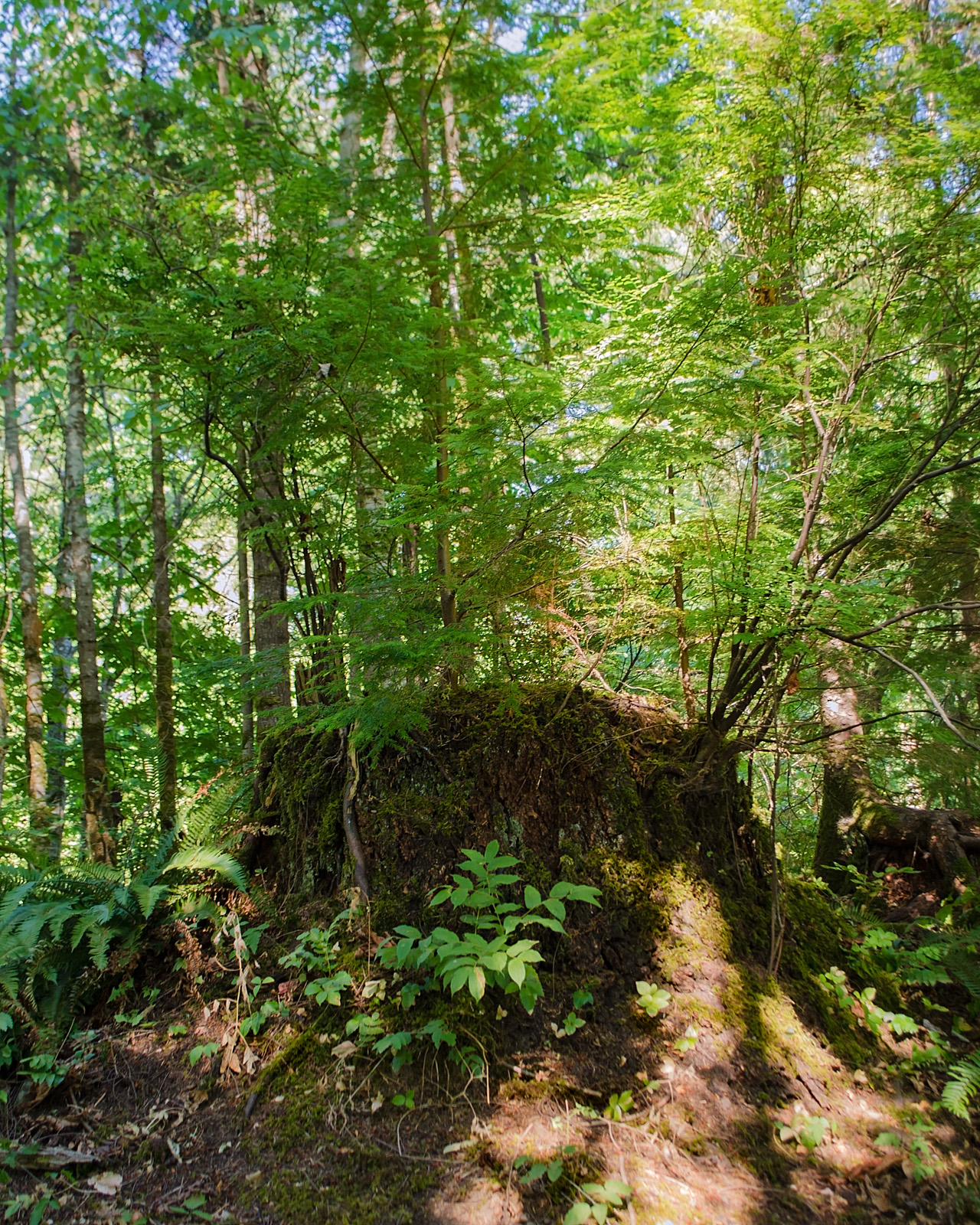
This old stump supports several small trees, maple and fir, growing from the top, plus a few huckleberry bushes and a layer of moss. On its flanks, ferns, red-berry elder and salal have taken root, as well as the ever-present moss. 

The old stump lifts seedlings above the undergrowth into the light and retains a more consistent level of moisture, winter and summer, than the forest floor. In deep forest, they may provide almost the only suitable habitat for huckleberry bushes, which need air and light.

Look to the right; there's another old nurse log, mostly gone by now; the tree grown out of it has extended its roots over the edge and down into the soil. They will support the new tree on stilts even when the nurse has disappeared.

Another, much smaller, second- or third-growth stump supports three new trees. Their roots encase the old stump, by now too fragile to hold the weight on its own. Other residents: moss and a large colony of spiders.

Three more firs on a badly-decayed nurse log. The one in back is just getting started, with its top dressing of moss, where seeds will find the perfect planting bed, warm, moist, and sunlit.


Wednesday, August 15, 2018

Past their sell-by date?

Hard-working trees:

Woodpecker snack bar. Also ant, beetle, spider hideout and winter quarters. Future nest site (under construction).

Critter bridge, creek dam, flotsam collector. Will likely host huckleberry bushes where the sun can reach them, next year.

Sunday, August 12, 2018

By water's edge

The trail along the south side of the Campbell River is well advertised and busy, leading from just north of the townsite to Elk falls and the popular suspension bridge just below the hydro facility. On a warm weekend, foot traffic is dense with joggers and runners, chattering groups, serious hikers in boots, fisher folk coming and going from their favourite holes, and walkers like me.

I chose the almost unmarked trail along the north shore. I met no-one, heard nothing but bird calls, creaking tree branches, and the constant murmur of running water.

The hillside is steep and the trail rises and falls. At times, there is a view over the river, 'way down there, to the hills and mountains beyond.

Or the path drops to follow a stream down in the valley.

Mossy maple, towering overhead.

Quiet pool in another stream: river water taking the long way down to the estuary.

Another creek, not the main river bed.

Sunlight through trees casts green lights on the water. Another shallow creek.

In case you needed a snack; where there's water and sunlight, there are bound to be blackberries.

A ray of sunlight makes shadow patterns on a rock.


Saturday, August 11, 2018

Shallow Campbell River

When its hot, the river calls ...

The Campbell River, from a logging bridge. Zoom in; there are three fishermen and a rubber dinghy upriver. The river is quite shallow here, as it widens and spreads into a maze of creeks below the canyon.

The dinghy approaching the bridge, bouncing and splashing as it comes. Keeping cool.

And now, looking downstream. More fishermen; behind the trees are another half-dozen.

From what an avid fisherman tells me, nobody's catching any fish at this time of day, but the water is cool and the river is peaceful.

Above the river, on the bridge, the sun was baking my head and shoulders. I crossed and hurried into the bush. Photos tomorrow.


Friday, August 10, 2018

Dreaming of icebergs

It's too hot. Too #$@&%*! hot.

Granted, for the rest of the world, we have it good here in Campbell River, but it's all what you're used to, and what you have ways to cope with.

Today, it reached 31 degrees Celsius here. We're lucky; over on the mainland, not too far away, and north of here, in Lillouet, it was 38 today. The weather people have put out heat warnings; stay cool, people!

In BC, it used to be unusual to find air conditioning in homes. In 2001, only about 10% of households were air conditioned. In the last few years, that percentage has gone up to 34%, and growing. (Report by BC Hydro)

I looked up the historical records for Campbell River, and found these graphs:

Averages and maximums, 1981 to 2010, a few blocks from my house, just above the high tide line.

August is the hottest month, and in those 30 years, the maximum temperature was 23.3 degrees.

Going back further, 1961 to 1990. Maximum for this period: 22.4 degrees.

I grew up in this climate. No wonder I'm feeling the heat!

(In the middle of the stuffy night, I drowsily consider a move to Nunavut. [Photo by Clare Kines] [On Twitter]  Where the icebergs float in the bay, and the permafrost is just that: permanent. Come morning, I change my mind; it's too hot to think of packing.)

Powered By Blogger