Showing posts with label Ferrer Point. Show all posts

Saturday, June 22, 2024

A ghost unmet

 Lurching off-topic for a moment:

Four years ago (Was it that long? Time just flashes by!) I wrote a series of posts about summers spent on Ferrer Point, in an abandoned WWII radar station, back in the early 1950s.

Here's a list:

Today, someone working on a history of the area asked me for some more information, and wondered if I had any other photos of the site. (Yes, a few.) And digging through old file boxes, I found something else; a black, fuzzy paper album page, torn and falling out of an album I'd carried around since I was little, with an old, faded newspaper photo of Zeballos glued on it. (Population, these days: 107, back then, a few more, not many.)

Zeballos Hotel and Hammond Grocery, Zeballos

I cut this out of the newspaper in 1986, but the photo dates back to the 1940s or maybe '50s. It's a bit newer-looking than the way I remember it, in 1955. And check out that cool car! Brought in by boat; there were no roads to Zeballos in those days. Even today, it's 40 kilometres of gravel off the paved highway.

About Zeballos: I wrote about this, too: View from the Zeballos dock.

Oh, the ghost? She was still around when I was there. Susie Woo was a laundress for the hotel, and died in her room there, in the 1940s. People said she kept coming back and moving things around. I never met her, though. 

Zeballos is still on the list of BC's Haunted Spots. There's a more recent story, here: "A Haunted Tale ..."

Must. Go. Back.

~~~~~~~~~~~~
Cambiando de tema por un momento:
Hace cuatro años — y parece que fue ayer — escribí una serie de posts hablando de los veranos que pasaba en los años de mediados de la década de medio siglo 19, en un campamento en lo que había sido un puesto de vigilancia de radar durante la Segunda Guerra Mundial, ya abandonado. 

Aquí hay una lista de la serie:

Hoy un arqueólogo que estudia la historia de este rumbo, me pidió más información y preguntó si tenía otras fotos del sitio. (Si algunas.) Pero buscando entre papeles viejos, encontré algo más; una página de un album viejo, que he guardado desde que era niña, una página de papel grueso, negro, con los bordes desbaratados. Y pegado en esa página, una foto vieja, cortada de un periódico, mostrando el hotel y una tienda en el "pueblo" de Zeballos. (Población ahora: 107 almas, en aquel entonces, algunos pocos más.)

Foto: la página del album, con la foto de Zeballos; el hotel y una tienda de comestibles. La leyenda dice — Una foto vieja del hotel Zeballos, el hogar del espectro que siempre regresa, Susie Woo.

Había cortado esta foto del periódico en 1986, pero la foto viene de los años entre 1940 y 1950 más o menos. Se ve un poco más nuevecito que cuando yo lo veía, en 1955. ¡Y mira ese coche modernísimo! Lo trajeron en barco; en esos años no había ruta sobre tierra para llegar al pueblo. Aun hoy, el camino es de grava; 40 kilómetros de grava a partir de la carretera pavimentada. 

Acerca de Zeballos: describí algo de su historia: View from the Zeballos dock. (Vista desde el muelle de Zeballos)

Y el espectro? Seguía en el pueblo cuando yo visitaba. Susie Woo fue una lavandera que trabajaba en el hotel, muriendo allí en su cuarto, en la década 1940-50. La gente decía que seguía allí, moviendo cosas en la noche. Yo nunca la ví.

Zeballos sigue en la lista de los sitios embrujados de Colombia Británica. Y hay una historia más reciente, aquí: "A Haunted Tale ..."


Monday, November 23, 2020

View from the tower. And burnt bras.

 One more.

Nuchatlitz Inlet, from Ferrer Point radar tower, looking north.

(Note for family: Dad took many photos including women with short, curly hair in the foreground, always facing away from the camera. I don't know what Mom thought of this; she wore her hair pulled tightly back into a roll at the back of the neck, a pre-war style. In the 1960s, she cut it short and let it curl naturally. And burnt her bra, a child of the times. In the 1970s, in the era of the granny dress, she toured Europe, braless, in a dress sold as a nightgown. I bet her grandkids never knew that!)

~~~~~~~~~~~~~~~~~


Una foto más. La vista, mirando al norte, desde la torre de radar en Ferrer Point. Se ve la ensenada de Nuchatlitz y lo que es hoy en dia el Parque Provincial Nuchatlitz.

(Una nota de interés para la  familia: Mi papá sacaba muchas fotos donde incluía a mujeres con el pelo corto, rizado. No sé lo que pensaba mi mamá de esto. Ella llevaba el pelo bien estirado para atrás, enrollado en la nuca, un estilo que venía de los años antes de la Segunda Guerra Mundial. En la década de los sesenta, se cortó el pelo, dejándolo caer libre, con sus chinitos naturales. Y se quemó su sostén; era hija de sus tiempos. En los años 70, la época del vestido "abuelita", viajó por Europa, sin sostén, en un vestido que se había vendido como bata de noche. ¡Se me hace que sus nietos no sabían esto!)


Sunday, November 22, 2020

And there was no coffee

A world forgotten. 1954. Out on the fringes. Things were ... different, then. Easier. More difficult. Closer to nature. Or not. Less stressful. More stressful. It depends where you're looking. 

Loading the cat.

The "cat" was our only motorized land vehicle; we had no roads to use others on. It was ancient, even then in the early '50s, held together, so they said, with baling wire. Here, the guys are loading it onto a raft to be towed out to Ferrier Point, where they would use it to haul the wagon full of supplies (also on the raft) up the hill to the campsite. At the end of the summer, it would be rafted back to Esperanza hospital again.

Look closely at the boxes in back: case lots of Pacific canned milk, Campbell's soup. There would be bags of potatoes and carrots, maybe even onions. Cases of canned vegetables, peas, peas and carrots, corn. A barrel of powdered milk, boxes of rolled oats. Canned meat and fish. Canned pears and dried prunes. Tea and cocoa powder. Flour and sugar for the once-weekly pancake breakfasts. The copper barrels, I think, were for drinking water.

That was what we ate at camp. It wasn't so different back home; the boat came once a week with perishables such as bread (white, often moldy: we cut off the green and ate the rest), celery and apples, meat and eggs; around Christmas, oranges and tangerines.

It wasn't so much that we were out on the edges; the depression and the war was still fresh in memory, and my parents talked about sugar rationing, ersatz coffee, the All-you-can-eat-for-5cents buttermilk that was Mom's main meal of the day when she was in nursing school. We were not allowed to complain about stale powdered milk.

Ferrier Point: off-loading.

There was no dock at Ferrier Point. The boat anchored in deeper water in the centre of the bay, and everything was rowed in to the beach. The raft was towed in until it hit sand, then the cat was unloaded on planks. A bit of water wouldn't hurt her, as long as the motor stayed dry.

Some things were more primitive at camp. We had no electricity; at home sometimes we did. There was always power in the hospital, but at home we often used coal oil (kerosene) lamps and candles. There was no running water. At home we had cold running water, hot and cold in the hospital.

Getting water for camp from a creek on the far side of the bay.

Wood chopping detail. We used wood at home for heating and cooking. At camp, it was only for the cookhouse stove. That's the cookhouse in the background.

At home and at camp, we kids had chores. At camp, it was washing dishes, peeling potatoes and carrots (How I hated that! I was never good with the peeler and there were so many, many potatoes!), cleaning the cabins. Once that was done, we were free.

Chores done. Waiting for morning crafts and lessons. Mostly staff here.

On the right, you can see the side of the big canvas tent my parents lived in for the summer. It was not like today's lightweight, colourful, waterproof tents; heavy, always dark inside, with an unforgettable smell compounded of hot oil, sun-baked shoes, cooked dust, a hint of creosote, and age.

There were two tents; the rest of us bunked in the 4 wood cabins.

The little shed at the left was the candy shack. Every afternoon, they opened it for half an hour, and we could buy chocolate bars and boxes of jelly beans and raisins for 5 cents each.

There are things no photo can record. The scents: old tent, fresh-chopped wood, salt, evergreen needles, hot candle wax. The sounds: the murmur of waves on the shore, the whisperings of the firs overhead, rustling of dried grasses, creaks of hinges, clatter of the big tin tubs we used (outside the cookhouse) for washing dishes, slap of bare feet on wood steps.

The peace.

(Aside: Dave, I know you're reading this. You're in the skiff in the first photo. Recognize anyone in the others?)

The rest of these old photos are people photos. I'll return to 2020 now.

~~~~~~~~~~~~~~~~~~~~~~~~~~~

Un mundo olvidado. 1954. En los márgenes de la "civilización". La vida era ... digamos, diferente en aquel entonces. Más fácil. Más difícil. Más cerca de la naturaleza. O no. Con más  estrés. O menos. Depende de hacia donde mires.

El tractor oruga era el único vehículo que operaba en tierra que poseíamos; no había caminos para otros. Ya para entonces, en los años 50, era anticuado; lo mantenían en operación, decían, con alambre.de embalaje. Aquí, lo están subiendo al raft para llevarlo al campamento, donde lo usarían para subir el vagón con la comida y otras necesidades al sitio del campamento. Al final del verano, lo llevarían de vuelta al hospital de Esperanza.

Mira las cajas en el fondo. Cajas enteras de leche enlatada "Pacific". Cajas de sopa de Campbell's. Habrán bolsas de papas y de zanahorias, tal vez cebollas. Cajas de verduras enlatadas, chícharos (guisantes), chícharos con cubos de zanajoria, maiz. Un barril lleno de leche en polvo. Cajas de avena. Carne y pescado enlatados. Latas de peras, ciruelas pasas secas. Thé y cacao en polvo. Harina y azúcar para el desayuno semanal de hotcakes. Los barriles de cobre, creo, eran para el agua potable.

Eso es lo que comíamos en el campamento. No era tan diferente en casa; el barco llegaba una vez por semana con los comestibles perecederos tales como pan (blanco, muchas veces enmohecido; le cortábamos lo verde y comíamos lo que quedaba.), apio y manzanas, huevos y carne; en la temporada navideña, naranjas y mandarinas.

No era tanto que estábamos tan lejos de la civilización; tambien, la época de la depresión económica y la Segunda Guerra Mundial seguía fresca en la memoria de nuestros padres. Hablaban de la escasez de azúcar, del café "ersatz" (falso, fingido), de la leche agria que vendían a 5 centavos para todo lo que podrías tomar que era la comida principal del dia de mi mamá cuando estudiaba enfermería. No se nos permitía quejarnos de leche en polvo, aunque ya era bien pasada de su fecha de venta.

No había muelle en Ferrer Point. El barco que nos traía se anclaba a media bahía donde había suficiente agua, y de allí nos llevaban a la playa en barquitos de remos. Arrimaban el raft hasta que se atoraba en la arena, y bajaban el tractor sobre tablas. Un poco de agua no le causaría ningún daño mientras el agua no llegaba al motor.

Algunas cosas eran un poco más primitivos en el campamento. No teníamos fuerza eléctrica; en casa, sí, a veces; en el hospital siempre. En casa muchas veces, y en el campamento siempre, nos arreglábamos con lámparas de keroseno y con velas. No había agua de la llave en el campamento. En casa, agua fria de la llave; en el hospital, agua fria y caliente.

En el campamento tenía que llevar un barquito a un riachuelo para conseguir agua.

En casa, y en el campamento los niños y muchachos teníamos quehaceres. En el campamente eran limpiar nuestras cabañas, lavar los trastos, y pelar papas y zanahorias. (Yo odiaba esa última tarea; nunca había sido hábil con el pelador, y ¡había tantas, tantas papas!) Pero una vez terminado todo eso, andábamos libres.

En la última foto, puedes ver la tienda de campaña en que pasaban el verano mis padres. Una tienda a la antigua, hecha de lona. No era nada similar a las tiendas de la actualidad; pesada, siempre oscura por dentro, con un olor inolvidable compuesto de aceite quemado, zapatos tostados por el sol, polvo horneado, un poco de creosota, y pura vejez.

Había dos tiendas; los demás dormíamos en cabañas de madera.

La estructura a la derecha era la tienda de dulces. Cada tarde se abría por media hora y podíamos comprar barras de chocolate, cajitas de "Jellybeans" o de pasas, todo por 5 centavos cada una.

Hay cosas que ningúna foto puede mostrar: las aromas: lona vieja, leña recién cortada, sal, las agujas verdes de los árboles, cera de velas caliente. Los sonidos: el murmullo constante de las olas allá abajo en la playa, el susurro de los abetos, el crujir de las hierbas secas mientras caminábamos, el chillido de visagras viejas, el estrépito de las tinas de hojalata en que lavábamos los trastes afuera de la cabaña de cocina, el "slap, slap" de pies descalzos sobre los escalones de madera.

La paz.

Saturday, November 21, 2020

Out on the edge of the world

Vancouver Island sits off the west coast of Canada. Nootka Island sits off the west coast of Vancouver Island. Only the Queen Charlottes, to the north, take Canada further west. Looking straight west from the west coast of Nootka Island, the closest land is just north of Japan, 7,000 km. away.

Shortly after Japan attacked Pearl Harbour, during World War II, the Canadian and U.S. governments, jointly, established a radar station on a peak on the farthest west point of Nootka Island, tasked with watching for submarine and air activity in the northern Pacific. Barely three years later, the war having ended, the site was evacuated.

A few years later, the staff at Esperanza Hospital, some 30 km away as the crow flies, if ever a crow flies in a straight line, about 4 hours away by boat, as we measured distance, were permitted to use the abandoned facilities for a summer camp for kids from the surrounding communities, Tahsis, Zeballos, Nuchatlitz, Ceepeecee, Yuquot, and floating logging camps. And us, at Esperanza and Hecate, of course. I spent most of the summer here for several years; Dad was camp director, Mom the nurse. We arrived early, stayed through several batches of kids, stayed to close down the camp at the end. Summer, to me, meant Ferrier Point.*

The Point itself is surrounded completely by water, making it its own island. On the "inside", in a deep bay, is the sandy beach from yesterday's post. The inlet cuts across to the far shore, the "outside" along a narrow tidal creek. Everywhere else, the shore faces open water; on the west, 7,000 km. of open water.

The west end of the tidal cut between the Point and Nootka Island. A camp outing.

On the rocks. "That's Japan, over there," we used to say, ignoring the fact of a round earth. We did know better, but it was fun to imagine.

The view from the radar tower, looking southeast. The "lagoon". The island was densely wooded; still is, even as the rest of the islands are logged off.

From the campsite, looking north, past the "Ocean Spray" cabin. There was a short trail going down to this shore, a narrow strip of pebbles where we sat around a campfire and watched pounding waves. We were told never to set foot in the water, no matter how quiet it looked; there was a dangerous undertow and it would drag us down and away. We behaved. We all knew the power of the sea.


Google maps: Ferrer Point. Looks like some sort of eared beast. The lagoon is the eye. the mouth cuts the island off from Nootka Island.

The old buildings are gone now, the board road across to the tower crumbled into the earth, but occasional visitors still show up. And in the waters around the point, the fishing is excellent.

*We called it Ferrier Point; today's maps say Ferrer, but the campsite is still labelled as Ferrier on Google maps.

~~~~~~~~~~~~~~~~~~~~~~

La isla de Vancouver queda al oeste de la masa continental de Canadá. La isla Nutka está situada al oeste de la costa de la isla de Vancouver. Solamente las islas Carlotas, al norte, se sitúan más al oeste, entre las tierras canadienses. Mirando desde el punto más occidental de la isla de Nutka, la tierra más cercana es Japón, a unos 7.000 kilómetros al oeste.

Poco después de que el Japón atacó a los EE. UU. durante la Segunda Guerra Mundial, los gobiernos canadiense y estadounidense, en conjunto, establecieron un sitio de observación con una torre de radar en el punto más al oeste de la isla de Nutka, con el propósito de observar actividades submarinas y por aire entre Canadá y Japón. Apenas tres años más tarde, al terminar la guerra, abandonaron el sitio.

Unos pocos años más tarde, los encargados del hospital en Esperanza, unos 30 km. de distancia como vuela el cuervo (si es que los cuervos alguna vez vuelan en linea recta) o como lo medíamos los habitantes de la región, a unas cuatro horas por barco, fueron permitidos a ocupar el sitio para campamento de verano para los niños de las comunidades cercanas, como Tahsis, Zeballos, Nuchatlitz, Ceepeecee, y Yuquot. Y nosotros en Esperanza y Hecate, por seguro. Yo pasé la mayor parte del verano aquí por varios años. Mi papá sirvió como director y Mamá fué la enfermera del campamento. Llegábamos temprano, nos quedábamos mientras venían y se iban varios grupos de niños, y nos quedábamos a limpiar el sitio al final del verano. Para mí, el verano significaba el Ferrier Point.*

Ferrer Point está completamente rodeado de agua, lo que lo hace también una isla. En el lado "de adentro", como lo llamábamos, queda la playa arenosa que subí ayer, en una bahía larga que corta hacia las rocas en el "exterior" por medio de una especie de rio sujeto a la marea. En toda la costa aparte de esto, la isla mira hacia mar "abierto", en el oeste, hacia 7.000 km. de mar abierto.

Las fotos: caminando hacia el exterior. 
En las rocas, mirando, decíamos, a Japón sin mencionar que la tierra es redonda y no se puede ver más allá de las nubes.
Desde la torre, mirando al sudeste; la laguna. Toda la isla estaba cubierta de bosque denso; aún hoy, sigue igual, aunque en el resto de nuestra isla la industria forestal ha dejado grandes espacios vacíos.
Una vista desde el campamento, mirando hacia el norte. Hay un caminito hacia el borde del mar aquí; una playa angosta de piedras redondeadas por el agua. Aquí no nadábamos, ni siquiera nos mojábamos los pies; el mar aquí nos podría agarrar y llevarnos rapidamente al fondo. Nos portábamos bién; todos sabíamos el poder del mar.

*En el mapa de hoy, el lugar se llama Ferrer Point, pero en aquel tiempo, lo llamábamos Ferrier. El mapa Google mantiene este último nombre unicamente para el sitio del campamento.

Friday, November 20, 2020

Sand delvers

Here's another of those 1950s photos, offered as an explanation of why I still flip rocks and dig through seaweed on the beach. I came by it honestly, trained from early childhood.

Mid-tide, Ferrer Point, 1954

I don't think I was in this group of kids. I would probably be over by the rocks, or wading out to where the crabs hid. I saw my first chiton on those rocks.

Location of this beach, and the towns from the previous post.

If you Google "Ferrer Point" and zoom 'way in, you can see people still walking on that sand.

~~~~~~~~~~~~~~~~~~~

Esta es otra de las fotos que sacó mi papá en los años 50. Y tal vez muestra el porque me paso horas en las playas volteando rocas y levantando algas marinas; me acostumbré a ello muy niña. En la foto, un grupo de niños busca almejas y hace castillos de arena en la playa de Ferrer Point. No creo que yo esté en ese grupo; estaría más bién allá cerca de las rocas, o vadeando hasta donde los cangrejos corrían. Encontré mi primer chiton en esas rocas.

En el mapa se ve la Isla Vancouver, la Isla Nutka, donde se halla esta playa, además de los pueblos que mencioné en el primer post sobre estas fotos.

Si gugleas "Ferrer Point" y haces zoom a lo máximo, podrás ver gente gozando de esa misma playa en estos dias.

Wednesday, June 26, 2019

Goat's beards and creambush

The woods and hillsides are softened this month with large sprays of tiny white or cream flowers.

Holodiscus discolor, aka Ocean spray creambush, or ironwood, against a background of the cliff face below Elk Falls.

Goat's beard, Aruncus dioicus. Beside the trail, Elk Falls. Also known as "spaghetti flower".

When I was a kid in summer camp at Ferrer Point, on the west coast of Nootka Island (to the west of Vancouver Island), one of the cabins had a signpost: "Ocean Spray Cabin," it said. I always wondered about that; the cabin was at the top of a long, steep hill down to the hidden beach below, a beach not suited for swimming, where the waves rolled in from the open ocean. But they rolled, they didn't spray, and anyhow, the spray would never, ever reach anywhere near the cabin. So the name didn't make sense to me.

It wasn't till decades later that I discovered the plant that gave the cabin its name. By the time we arrived for camp, the flowers would have dried on the branches, so I hadn't noticed them. My interests at the time were the edible berries in abundance in the forest; huckleberries, salmonberries, thimbleberries, salal. (It was long ago, before the invasive blackberries had made their appearance.) Tiny dried flowers were not on my radar.

The alternate name, ironwood, refers to the hardness of its wood. First Nations peoples used it for a variety of tools, including halibut hooks, bark scrapers, and as pegs for carpentry, before nails were available.

Why the goat's beard, which kind of, sort of, looks goat's beard-y enough, is also called "spaghetti flower" is a new wonderment.

Friday, August 24, 2018

Old favourite

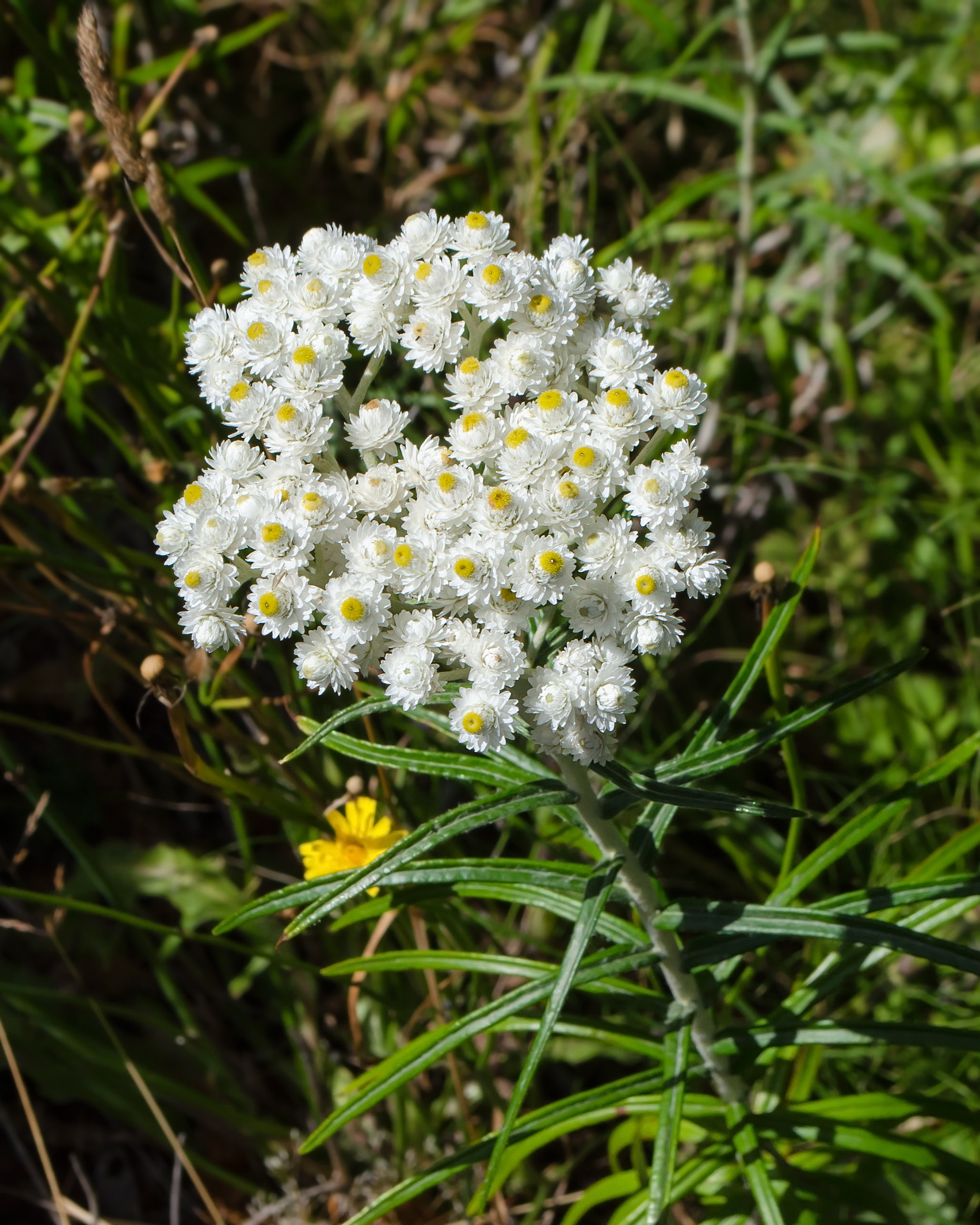
Roadside pearly everlasting:

aka Anaphalis margaritacea. Perennial, in two meanings of the word.

I have an old photo of my Mom, taken after a hike through the coastal bush. She's carrying a bouquet plucked on the trail; salal leaves, Indian paintbrush, and pearly everlasting. It's a sampling of the different terrains her hike took her through; deep shade, wet cliff faces, mossy thickets for the salal, damp meadows and tidal marshes for the Indian paintbrush, and then, coming out into the sunlight and dry, stony slopes, the pearly everlasting.

Mom, 1955, Ferrer Point

Pearly everlasting was one of her favourites; mine, too. It holds its shape and colour as it dries, and lasts for years. (That's where it got its name.) In the long, wet, grey winters on the wet coast, that handful of everlasting was a reminder of the summer past, the warm summers to come. A vase on my bookcase holds last years bouquet, still looking fresh; this year's crop is drying, hanging upside-down on a hook in my hallway.

It grows thickly at this time of  year on gravelly roadsides, dry hillsides, and even bare rock:

Everlasting and its shadow, on a rock face.

Powered By Blogger