Thursday, November 17, 2011

Living in glass houses

...you don't get no privacy.

It was 10 PM, so I went to turn off the aquarium lights. As usual, I looked in to see how things were going; everybody happy? No disasters, no panics? All was calm.

But in the back, half-hidden beside the pump, a pair of crabs were getting ready to mate. I went for the camera.

A tangle of legs. Ma Crab's back. He's underneath her.

It's hard to mate when you're encased in a rigid shell. Crabs have to wait until the female molts; when her new outfit is still soft and pliable, there's a brief window of opportunity, not to be wasted. Her consort, finding her in the process of opening up, grabs her, belly to belly, and holds on until she backs out of the old shell. This may take several hours, or even days. He may even help her with the process; mainly, though, he's making sure he's at hand when the moment comes, and that no other male gets her. (Not a problem for him in the aquarium; there's only one other male, still too young, but he's not taking risks.)

Since his last molt, Pa Crab has been ready, swaggering about with full-size pincers, often frightening the smaller female. Not today; this morning she was hanging around near him. Now, she has allowed him to embrace her tightly. In the photo above, you can see his legs, the striped ones, (hers are spotted) hugging her. Both of them hold their pincers up and away from the body, claws open. They move about, slowly, getting comfortable. After a bit, they squirm down underneath the pump, where they are more private.

I don't know how long it will be until they mate.

Sculpted curves and "teeth" of the female's carapace. Two of her pincers, one of his.

Tuesday, November 15, 2011

Our daily art, Part Three

Part One, Part Two

The story continues:


Reading over the letters from F, I decided that he can tell the story much better than I could; who better than the one who lived it? So this will be a guest post, taken from his messages and chat sessions, with his permission. My comments in italics.

The story starts in mid-October. He and about 100 other artisans had been moved to an alley near the Plaza Tapatia and the Degollado Theatre, leaving the main plaza open. Guadalajara would be hosting the PanAmerican games, starting the 14th of October, and continuing for 2 weeks. The city was in a celebratory mood, but there were still a few last details to be taken care of before she showed her face to the world.

Thursday, Oct. 10, 2011

Ate breakfast, and then spent what money I had on materials, and went to work. Sales were snail-slow, but it was only 12:30, and afternoons are when most of the fish bite.

“Huele a lluvia” (It smells like rain.) I told my neighbour, Pipa*.

”Si, va a llover”.

There were no clouds, and the minutes passed. Thunder, and then, without enough time to cover our stands with plastic, black clouds surround us and from the sky flows a torrential river of rain. Plastics now covering our stands, we take shelter wherever we can. And it rains, and the minutes pass and they become hours and the rain never stops. And then as suddenly as it began, it ends, the clouds have disappeared and the sky is clear in the fading light of dusk.

All of the possible clients have now gone, and all our stuff is wet.

That night, I lay out all my stand on the bed to let things dry. I´ve managed to sell about 30 pesos and buy myself a light meal and a ½ litre of milk.

Friday, Oct. 11, 2001

I wake up hungry, and a little late. Everything is dry so I pack it up and go to work. It rained again during the night, but the pavement is bone dry and the sun is glaring.

When I arrive at the plaza, pushing my little dolly, it is empty, save a few passers-by. And an army of civil servants in red shirts, with groups of police in strategic locations. With their steely glares, they tell me that it doesn’t matter if I’m hungry, I’m no longer allowed to work.

I begin to look for the others in the most likely spots, and find them lined up at the side of the Teatro Degollado, with small white plastic sheets on the pavement. So I join them in line.

70 families of Artesanos had been given a place to sell, and as we were a few blocks from the Plaza Tapatia, we had been told we would not be disturbed during the PanAmerican games. Obviously, someone had not told us the truth. Someone had decided that we would be seen by tourists, and that was not the image they want of their shiny new PanAmerican Guadalajara. Funny thing is, tourists, as well as the locals, want to see us. If not, they would not be our clients.

We were offered no alternative except to go find another way to make money for the next month. We could talk once the city was not crawling with international press, but until then, we were not able to work.

(They try, anyhow.)

It is around 1.30 pm. We place some merchandise on our white plastic sheets. Not very much, because we know it can be taken away. And we wait. Some of us manage to sell a bit. I manage to get enough for breakfast. Not all were lucky that day.

And then 3:00. They come. The army of red shirts, and a platoon of bicycle cops.

A few months ago, a few days before I came with my 7 diaries, there had been violence and more than a dozen of our compañeros had been beaten and jailed.

We are nervous and tense. We make a barrier in front of our plastic sheets. Some hold hands. Tension. We want no violence, but we will not back down. They have taken away our right to earn our food and keep.

We began to chant: “¿Quienes somos? Artesanos. ¿Que queremos? Trabajar. ¿Como nos tratan? Como delinquentes.” (Who are we? Artisans. What do we want? To work. How do they treat us? Like criminals.)
Fortunately, the press has arrived, and most of the public, local and international, are on our side. We are fighting for a just cause. There will be no violence. At least not today.

The civil servants stand in front of our stands, blocking the public from our make-shift stands. And the bicycle cops watch in small groups off to the side.

At first, it is fun. The public loves us and joins in our chants. Drummers come. It feels more like a party than a protest. We are hungry. We are fighting a just war. We will not back down.

But the days have worn on. And the violence has come. We are tired and hungry. And our stands have been diminished. On the 21st, we protested with drums and whistles in front of the Presidencia. We are fighting a just war. We will not back down.

We have finally been given a place to sell within the Plaza Tapatia but it is somewhat hidden and has been used as public bathroom for quite some time. We are cramped, three people to a stand. But at last, we have a cease fire. We sell enough to barely survive.

We do not want hand outs.

All we want is to be able to work, as we had been doing, and at least have the opportunity to have our families well fed, and to struggle with dignity for whatever dreams we may have. We are fighting a just war. We are Artesanos. We will not back down.

(Somehow, they hang on.)

November 5, 2010

Yesterday, from 11:30 til 7:00, I sold 10 pesos. Can’t even buy a coffee with that. Around 4:00 PM, I find a guy that owes me some money, and get enough out of him to buy me breakfast. I share it with Lupe, a good loyal friend, and Estela; it is their breakfast, too. They have not sold anything yet, either.

At 7:30 PM. I am in the Plaza Liberación, with my mochillas in a line with other artesanos. There’s a group of inspectors, we all chat, and at 8:00, their shift is up, and they begin to leave. Down go the mantas, and we begin to display our wares. There are many artesanos and sales are slow. I sell 40 pesos worth. At 11:30, I buy two hot dogs and a cup of coffee, and go home to write; I am dead tired and just fall asleep instead.

Today, I have been displaying my stuff since 11:00 am; it is 3:00 pm. Still haven’t sold anything yet. Paco is off drawing on the pavement and playing marbles with the kids and he is happy. He asks me when I’m going to eat, because he’s hungry. “When I sell something.”

“And if you don’t sell?”

“I don’t eat.”

Estela has sold 30 pesos and comes with some tacos around 3:30. Paco also brings some. Under a puesto, sitting in a circle on the pavement, Estela, Lupe, Paco and I share breakfast together. At the end of the day, between us, we have sold 40 pesos. I go off to Liberacion, and stand in line. Paco has gone. Between the 3 of us, we manage to sell 200. Tonight, we will eat. I get home at 12:30.
...

A couple of weeks ago, Consuelo asked me “¿Como te va?” (How's it going?”)

”So-so. How about you?”

“I haven't sold anything. Nor has my grandma.”

Its 5:30 PM.”¿Have you eaten?

“No”

I reach into my pockets and buy her breakfast. Consuelo is Mixteca, from Oaxaca. She is 10 years old. That night, I was hungry, but I think that there is justice in that.

The hunger is real. Poverty is an extreme form of violence.
...

Usually, this is not our reality. Before 10/11, we were doing quite well. We were rarely hungry, our stands were growing and in our pockets there was usually a little more than enough to meet our simple needs.
...

It has been a long 2 weeks. My stand is half the size it was and except for my efforts, I have no way to invest in material. The weight I had gained is now gone and when I reach in my pockets, I find them empty.

Artesanos, since time immemorial, have worked in the plazas of Mexico’s cities. That is one of Mexico’s “charms”. If we try to sell artesanías in stores, or markets, we can't pay the rent. People don’t buy artesanías in stores; they buy them in city plazas. That’s how it always has been done here in Mexico.

We draw people, and the business that are in the area,are usually very happy that we are there. The only one that seems to be having a problem with that is City Hall. And they gave us 10/11.

We don’t sell now for the following reasons:
  • We are hidden behind trees, away from the flow of passers-by, cramped beside an abandoned building under the archways, where there is still a residual aroma of human urine. 
  • We have all just received a three week sh*t kicking that has left us battered and exhausted. We are hungry and our puestos are decimated. 
Personally speaking, my puesto before 10/11 was worth more than 35,000 pesos. I had built that from an initial investment of 3000 pesos only 2 months ago. I had just had an order that would earn me 2000 pesos in 3 days work. If I felt hungry, I ate. There was always enough money for that.

Now,I’d be lucky to get 3000 pesos for my puesto if I sold it all. I have material. But I don’t have the essentials. I can’t work my material without the essentials.

My puesto is visually not appealing. It’s been through a war. It has been trampled on and bleached by the sun. It needs lustre. It needs the essentials.

The order that would earn me 2000 in 3 days went out the window because it was from a compañero who had wanted diaries and today, he’s just as jodido as I am.

Please remember us in your prayers. I am not a religious man, but i do believe that there is a power in prayer.
Thank you.

There's more. What's more, there's hope. Continued, soon.


*Names have been changed to protect the vendors and their children.

Our daily art, Part Two

Part One, Taxco, 1990s.


Part 2: Fast-forward to another time and place: Guadalajara, Jalisco, summer of 2011.

Guadalajara! Pearl of the West, Mexicans call her. She is the second cultural centre of Mexico, where modern architectural wonders rub shoulders with impressive colonial buildings housing museums, theatres (Teatro Degollado, for example), universities, and cathedrals surrounded by parks and plazas. It is home to mariachi music, colorful costumes, dance. I'm sure you've heard of the Mexican Hat Dance, the Jarabe Tapatío; it comes from Guadalajara.

And, of course, there is folk art and handcrafts, traditional and modern. I collect pottery from Tonalá, once a village, now part of the expanding city. At the various markets, you may find leather work, huaraches, blown glass, embroidered textiles, baskets (of course); objects in clay, wool, corn husks, wood, stone, metal. I remember being entranced by delicate, tiny baskets and bowls made of woven gum, the chicle that chewing gum is based on.

Turtle, from Tonalá, Guadalajara

Along Devil's Alley, beside the Plaza Tapatía, (photo, with artisans) a small group of wandering artisans set up their humble stands. Their customers are the busy throngs that pass that way coming and going from the Cathedral, the subway, the shops and offices around the plaza. They have been selling on these streets for as long as anyone can remember.

Let me tell you of the life of the artisans in their own words:
One sunny morning about 2 months ago (August), when the sun sparkled on the wet pavement after an early morning rain, I arrived at the Plaza de los Dos Templos. On top of a small wooden crate, I placed 7 amate diaries I had made the night before. I took out a box of crayons and a marker, and I was ready to begin. That day, my job was easy. All I had to do was draw flowers and butterflies and a lot of stars.

It was the first day of an artisan market near the heart of the downtown core. I drew fairies and cats. An hour passed, and two 6-year-old girls came to my stand and asked me why I spoke funny and why my finger was crooked, and about a thousand questions more. And then, they sat down on the sidewalk. Between them, the little basket where my crayons were. Their intentions were obvious.

But it was a good omen. If kids stop to look at what you make, it means good fortune to come. At the end of the day, there were about 12 kids drawing and making paper airplanes and I only had 1 diary left. And that night I made 15 more.

And, yes, good fortunes did come.

I worked day and night, and my stand grew and so did my stomach. And everytime I reached into my pocket, there was always enough for my simple needs.

And the weeks passed ...and then ...
Business was good, there was promise of better; Guadalajara was expecting an influx of about 1 million tourists for the PanAmerican games in October. The small profits from daily sales could be safely invested in materials for future work; the simple box “puesto” could be enlarged and beautified. One could dream.

But, as F. says, “... and then...”

To be continued tomorrow.

Patiently waiting

I'm waiting for the continuation of yesterday's post to be fact-checked, and permission given for a quote.

Meanwhile, here's a gull, also waiting.

"Well? Where are the treats?"


Monday, November 14, 2011

Our daily art

Something different ...

Years ago, on the narrow stone and mud steps that make up many of the “streets” of Taxco, in Mexico, I met a little girl, about 9 or 10 years old. She was sitting at the edge of one of the drier and wider steps, painting on sheets of bark paper, amate, that she kept on the step above her. Finished paintings were stored by her feet on the next step down.

She showed me her work, glowing with pleasure and pride; street scenes, as she saw them. She followed no pattern. Each painting was unique, although certain motifs were in all of them; the people she knew, doing the work she was familiar with, the flowers that overhang every roof and fill every empty corner, the blazing sun above everything.

Taxqueña's Mexico. Paint and crayon on bark.

Detail. Men with vegetables for market, straw-thatched adobe houses.

I bought one; so did the other people with me. Ten pesos I paid, if I remember correctly. I should have paid more, but that is what she asked, and I didn't bargain, at least.

Is this art? Primitive art, maybe? Some would say yes; that little girl wouldn't recognize the term. She painted. That was how she brought home money that would buy her family that day's supper. But there's no doubt but that she loved what she did, that she put her whole being into it, that it expressed the colour, bustle and beauty of her home town.

Taxco is a tourist town. Many of the roofless artisans, the ones without the funds for a shop, sell their work around the public plaza in front of the cathedral. But down towards the market under a roof made of cotton sheets and rope, down, down, down all those steep, slippery steps, where the people of the town buy their daily food, these handicrafts, these “artesanías” are needed, too. There are the clay pots, mugs and bowls; the paper hangings to celebrate family and national occasions; the baskets (I bought one of these, big enough to pack the bean and rice pots I also took home); the hand-woven rebosos; the stick and reed chairs, painted in cheerful colours; and yes, the occasional small painting to decorate the walls.

Men come to market with heavy bundles of pots on their backs, or tied onto burros dwarfed by the load. Women carry smaller loads, but all, even the children, come burdened. All of them are involved in the production of their stock. Staying alive is serious business.

Every town in Mexico has its equivalent, a handful or a small crowd of artisan/sellers with their wares spread out on boxes or cloths in some convenient place where people pass by. If you've been a tourist, you've seen them, maybe bought something pretty to take home at what seemed like a ridiculously low price.

I have a story to tell about a group of artesanos caught in one of our modern dilemmas.

To be continued, tomorrow ...

Sunday, November 13, 2011

Bloggers in the rain

Let it rain! Who cares?

We were to meet Margy, who blogs at Powell River Books Blog, at Steveston, whatever the weather. When we set out, it was pouring; the highway was treacherous, with deep puddles on the curves, but by the time we got to Richmond, the rain was just a drizzle, though the wind was chilly.

The coffee shop where we met was crowded. The people all looked like locals, casually dressed, relaxing, waiting out the rain like us. We drank coffee and refills, chatting as if we'd known each other for a long time. Which we had, via our respective blogs.

Margy told us a wonderful story about collecting water (foul-smelling!) from the bottom of Powell Lake, untouched since before the last ice age. She has blogged about it, here, but missed out the best part. Which I'm not going to tell; it may be in her husband's book, "Up the Strait". Or not; in which case, I hope Margy blogs about it. I haven't read this book, yet. I have another, "Up the Lake", on Kindle, and I'll be ordering more.

The rain eased off and the cafe emptied. We bundled up and ventured out into a fine sprinkle of rain, and went shopping; the marine store down a block, and a tea and gift shop half a block further. Then, the rain having almost stopped, we wandered down to the pier to look at the boats. There was a juvenile swan right by the wharf, begging for food; an unusual sight. And further down, a loon swam placidly until I brought out the camera. Then he dived, and came up, first in the almost-black shade of a boat, then far out in the water.

Just a hint of colour in a grey scene on a grey day. The loon is underwater.

Margy's a comfortable sort, easy to be with, patient as we dawdled buying teas, cheerful even when the rain started up again and the wind was bitter.  I was the one who finally wimped out; I'd forgotten to bring gloves and my fingers had gone numb. We completed the circuit back to the cars, and said our goodbyes, hopefully not for long.


Detail of the harbour. The loon is in the dark shadow of the black boat.

On the way home, it was raining so hard that twice I missed my turn, not seeing the street signs. So we ended up coming home via Westminster Highway, narrow and slow, but mercifully free of pools and flying spray.

A Skywatch post.


Saturday, November 12, 2011

Red and gold, with blue mountains

(This is a repost of Thursday's post that I deleted, fixing the blog.)


Fall colour in Vancouver.

I took this through the window today from Laurie's doctor's office, 9 floors above the street. We're looking northwest. Granville Street Bridge is straight ahead, Granville Island in front of and beneath it, the edge of the downtown core on the right across False Creek. The Cypress Mountain ski slopes are just visible under the clouds. And out in English Bay, a half-dozen ships are waiting to load or off-load.


Thursday, November 10, 2011

Frazzled nerves

What a day! Last night, Google put a big red warning sign on the blog; it had been infected with malware. I've spent the night and all day today, trying to find and eradicate the source of the problem. I think I must have got it, because Google now says they do not detect any malware. (Big sigh of relief!)

A hawk named Google? (Vacant lot, this summer)

In the process, however, I deleted several widgets, most of my blogroll, most of the blogs I follow, all my followers, and a few links in specific posts. Somewhere in all of it, the deceptive link got removed; I stopped deleting then, but I'd lost most of the blogs I love to read. I'll re-load the blogroll, with the few links I still have.

Could I ask you a favour? If you don't show up on the blogroll, and you know you should, could you please drop me a line here in the comments, or by e-mail (wanderinweeta at gmail dot com)? Thanks!

I've enabled moderation for comments for now. Sorry about that, but I just want to insure against re-infection. I'll figure out how to killfile the offender as soon as I can, and then I can go back to normal.

Sad remains.

I should be thanking Google, too. I would hate to have gone on merrily handing out copies of whatever bug I'd contracted. Thanks for warning me, Google! And thanks to you people for your screen shots and suggestions.

 Now, off to install widgets again ...


Wednesday, November 09, 2011

A few big birds

Tidying up the computer, I found a few birds I'd meant to post and forgot. These are from mid-October.

Black-crowned night heron. We saw him return from an errand, and he hadn't had time to fade into the background yet.

Young swan below the Westham Island bridge. Black bill, buff and grey plumage.

Black and white; swan and sunlight on water.

Peaceful, but alert. A resting mallard at Reifel Island.


Tuesday, November 08, 2011

One-track mind

I'm too tired to think, maybe even to finish this before I fall asleep. The past few days have been exciting and a bit tense. All good, and I'll have the story for you as soon as I get it all sorted out, but now I can hardly keep my eyes open.

So I hope you'll forgive me if I'm a bit silly tonight.

On the White Rock railroad track, last week:

A sliver of golden hillside, reflected.

Down at ground level, this way, I remembered ... Sixty years or so ago, I put a copper penny down on that track, just ahead, around the bend. The train flattened it so that there's just a hint of lettering left. The trains went faster, in those days; the experiment, repeated now, nets me a squished penny, still identifiable.

I just went to look. After all those sixty years of peregrinations, packings and unpackings, I still have the penny.

A more conventional view. Looking east, towards the pier.

Looking west. Someone has lit a bonfire on the beach.

And now, goodnight!

Monday, November 07, 2011

Photo shy

Far down the beach, in the long afternoon shadows below heaps of dead eelgrass, this blue heron was fishing. As we approached, he moved away, almost invisible at times against the dark background. We finally caught him in a sunlit stretch, as he flew to the far side of a log pile, stopped to see if we still followed, then flew away for good.

From this angle, he has an oddly misshapen body.


Back to his usual sleekness.


Sunday, November 06, 2011

November colours

It's changeover time; neither winter nor summer, but with bits of both. When and where the sun shines, it's warm, even too warm. Step into the shade, and you start to shiver. One minute, I'm wearing a tuque and gloves, the next, I'm shedding my sweater.

Down at the beach, the water is an icy blue, and numbs my toes in an instant. (Yes, I went wading today. I had to get fresh sea water for my critters. The sacrifices I make for them! I hope they appreciate it!)  Ice clouds float high in the sky; beneath them, between cold sky and cold water, Mount Baker flaunts her fresh snow cap.

Mount Baker, November 5.

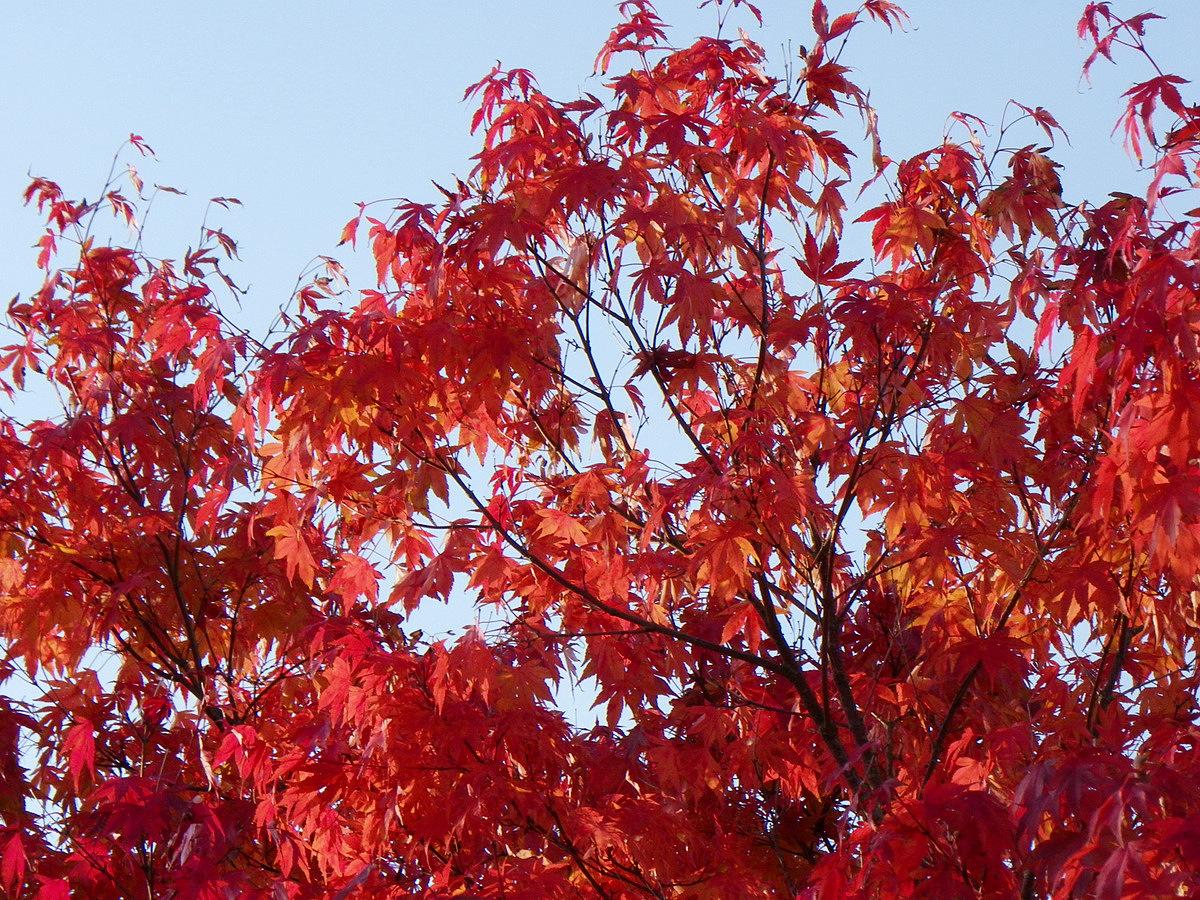
The trees rebel, turning cool green leaves into flames, red, yellow, orange. I feel warm, just looking at them.

Cottonwood, Centennial Beach.

Summer is still with us, in bits and pieces.

From the pale warmth at the center of a hawkweed seed head...

to the miniature sun of a marigold among the weeds. White Rock beach.

Evergreens, maples and cottonwood, Cougar Creek Park.

Varied thrush, Cougar Creek.

Fallen big-leaf maple leaves, glowing in the setting sun.

Cottonwood and willow. Duck pond, Centennial Beach.

Dying reeds, reflected in the duck pond.

This afternoon, I was surprised to find these flowers still going strong in a boulevard at Beach Grove.

Strawberry tree fruit. It's edible, but I haven't tried it. The birds will eat these.

Let it freeze! There are red maples in the parking lots!


A Skywatch post.

Saturday, November 05, 2011

Clown-face spider

It's an odd year for spiders. Most of those I've been finding around here are very small, and most are ones I haven't seen before.

BugGuide suggests choosing an identifying name; I called this one "Clown face spider". Once I get an ID from them, I'll update the post.

The "face" is on the back, not the head, but still ...

The spider is about 1 1/2 millimetres long. I think I see eight eyes here. And since the pedipalps (only one visible) have no club ends, she is probably female. Or very young.

Update: BugGuide identifies it as a juvenile False Black Widow, Steatoda grossa. Possibly male, but definitely young.
The bite of this spider can produce symptoms that are similar, but much less severe than those of a black widow bite. In some cases blistering may form at the site of the bite along with physical discomfort that lasts for several days.
I wonder how big it has to be before it can actually bite through human skin. BugGuide has a photo of one that grew to 7 mm. (about 1/4 inch) by 8 months old. A mature female looks like a black widow without the red mark on the belly. I'll keep a lookout for these now.

Friday, November 04, 2011

Curly cap

It's mushroom season again. We found this one in the weeds beside the road at Cougar Creek park.

Curled cap, I'll call it, since I can't identify it.


Thursday, November 03, 2011

A multi-species community

These are a few of the larger intertidal critters from the aquarium, photographed in the course of a tank census:

Three different shells; from right to left, Nassa snail, Asian mud snail, and barnacle.

Barnacles usually live attached to rocks or other solid materials. When they break off, the base gets left behind and the barnacle dies. Occasionally, one detaches from the rock without breaking. This one has most of the base intact, so it is still alive and feeding. Look closely to see the pale tentacles at the mouth.

The Nassa shell, on the right, has several round holes drilled through it, the work of a carnivorous snail, such as a whelk. Once the hole penetrates the flesh, the whelk injects paralyzing and digestive enzymes, which dissolve the snail inside. Often, once the shell is vacant, I discover the tentacles of worms waving from these holes.

Rockweed isopod, about an inch long. The flash makes the red seaweed glow in neon reds. Under normal lights, it is a bit paler than the burgundy Turkish towel that the isopod is feeding on.

The second isopod. Look closely; on the back, it is carrying a small shelled animal, probably a limpet.

Head of a polychaete worm, out looking for a meal. They rarely leave the sand completely, and retract almost instantaneously at any disturbance..

One of the round algae-eating periwinkles, with an amphipod taking a short break.

At least four species of snails live in my tank: Nassas, mud snails, periwinkles, and the tiny lacunas; these last may be so small that even with a lens, I am hard put to determine whether they are snails or sand grains until they move. Their eggs often come home with me on blades of eelgrass.

Underside, through the glass, of a very small anemone. 

This anemone sat for weeks on a stone, and then went wandering about. It has now hidden itself. I have never seen that "petal" effect on the base before.


The youngest crab, raised in the tank from babyhood. 

And my new mascot, found in a thrift store. $0.50; I couldn't resist.


Wednesday, November 02, 2011

Mussels are evil.

They are so deceptive, just sitting there, opening their mouth a bit sometimes; otherwise, just sitting. Looking harmless and innocent.

They're not.

Let me backtrack a bit here. My little aquarium is recovering nicely from the summer disaster, becoming the biodiverse environment that the animals are accustomed to. The crabs are as calm, now, as crabs get; the big anemone is feeding more often than not; the snails are plowing through the sand and polishing the walls. I have provided a variety of seaweeds for food, gym equipment, and shelter: sea lettuce, turkish towel, rockweed, eelgrass and kelp. A few tiny greenmark hermits and a pair of big isopods moved in with the last batch of seaweed. There's at least one polychaete worm in the sand. Green amphipods zip busily about.

And then there are the water cleaners. The barnacles (lots of those) and a handful of mussels.

The biggest mussel, Mytilus trossulus, on a scratchy bed.

With his mouth open, filtering the water. One of the tiny hermits watches.

Mussels are filter feeders; they don't need to move about, although they do at first, until they find a place that suits them. Then they lie there, letting the current bring them food. They capture plankton, other microscopic life, and floating leftovers from the crabs' meals or decomposing seaweed. A mussel can scrub up to two and a half litres of water per hour per gram of body weight. That's the contents of my whole small aquarium, given the handful of mussels working there.

The problem - and I never considered it in that light before - is their habit of choosing a spot and tying themselves down. A mussel excretes a liquid that hardens immediately on contact with the water, producing strong hairs, called byssal threads. At the tip of each thread is a dot of glue. Where it touches, it holds.

(Young mussels use these to "walk"; they extend a thread, let it stick and reel it in, pulling themselves up to the contact point. Then they dissolve the connection, let the thread float free, and produce another.)

These threads are incredibly tough. They are made up of a core of collagen, coated with a harder protein bonded with iron ions, (NPR), and may have the tensile strength of five of our Achilles tendons. A mussel will attach itself with 50 or more threads, enabling it to bond to rocks and other mussels. Anchored like this, it can't be swept away even by stormy seas.

The threads have another use, too. Like all creatures, mussels have predators; starfish, birds, crabs and some fish. And whelks, those voracious hole-drillers. Tying themselves down to the rocks and in large groupings helps to protect them from the birds and crabs, but whelks will attach themselves to the shell, drill into the meat and dissolve it. To stop them, a mussel will throw out a few threads, entangle the whelk, and anchor it to the rock, where it will starve to death.

I was looking for hermits, counting them to see if they had all settled in ok, when I noticed a small Nassa snail jabbed into the sand upside-down, point buried. Odd.

When I looked next, it was still there, but had moved slightly. Still alive, then. But why was it in that position?

It was jammed against a stone, still upside-down the next time I looked. In the morning it wasn't moving, so I decided to investigate; I reached in and picked it up. It came along with the stone and the mussel on top, tied down securely. When I broke the threads that held it and left it alone, it woke up and hurried away (at top snail speed). Probably hungry.

I collected all the mussels and examined them. They had glued down another snail and one of the hermits. This would not do!

Well, I can use thread, too. In a double piece of cheesecloth, I wrapped the whole clump, and tied it in a loose net. There! They have water circulation, but the snails and hermits can't get through to them.

Small handful of mussels, with two attached stones and a clamshell. More mussels have been added since, as I found them.

Biological filtration unit. Netted mussels, in the back of the tank.

So far, this has worked. Hermits pick at the cheesecloth, but then walk away, untethered.

Nassa snail, cleaning the glass.

Freed Nassa, still wearing the remains of the byssal threads and a pebble caught in the glue.

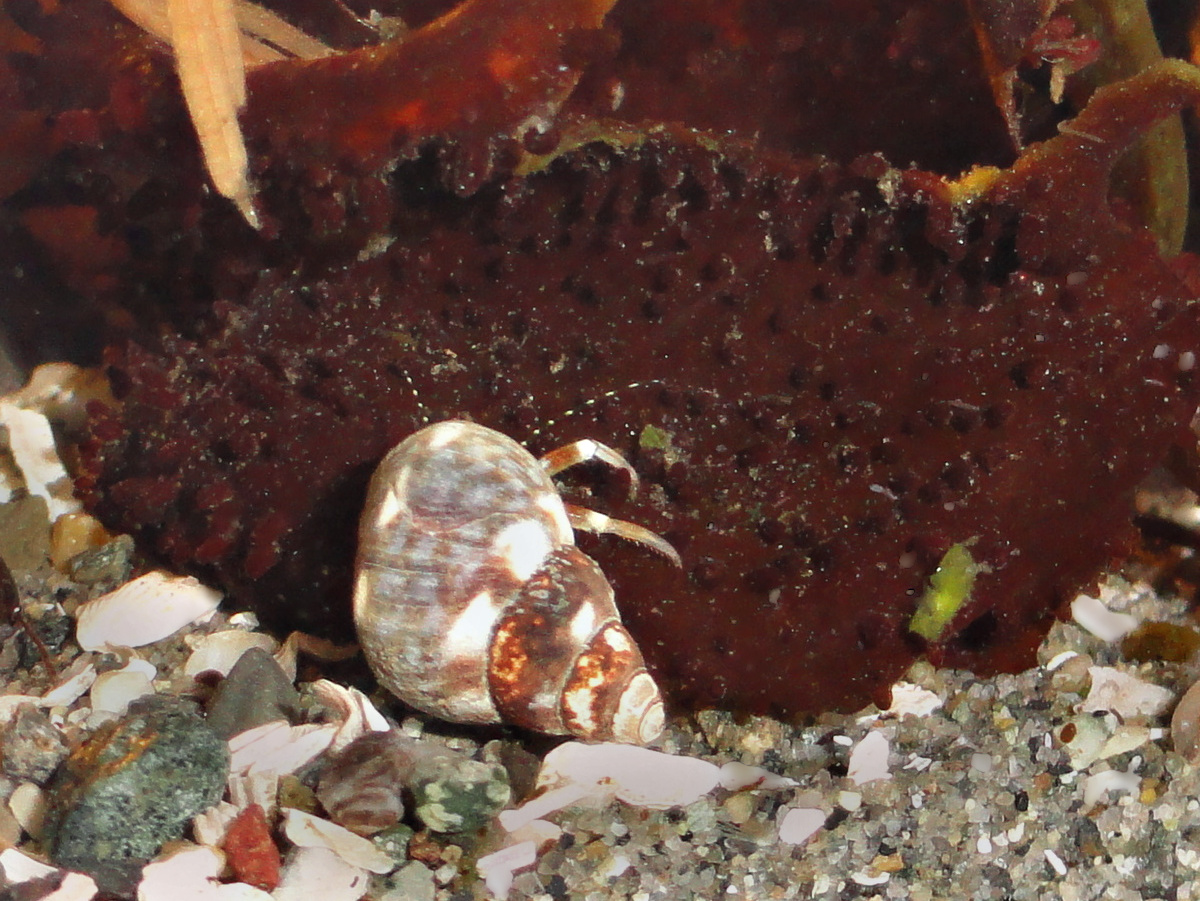
Greenmark hermit, now safe from the clutches of the mussels.


Powered By Blogger