Saturday, December 31, 2011

That's it? 2011 is over?

Where did the time go?

"Amazing!" he says; "I'm gobsmacked!"
(This is the strangest chickadee photo I have ever seen.)

Happy New Year, everyone! May it bring more joys than troubles, may your new wrinkles be laugh lines, and your store of good memories be overflowing!

Friday, December 30, 2011

A remedy for the grumpies

"Still raining!" This is the common greeting around here, these days. Yesterday was the eighth straight day of the stuff. Drizzly, cold, constant rain. And the weather people are promising us another two weeks of it before the first sunny day. In which I no longer believe. It is going to rain all winter, every single day; I'm sure it is. Bah!

That's the greyness speaking. Snow, at least, reflects and whitens the light; rain drowns it. At three in the afternoon, it was too dark to read outside. And we couldn't see the red colouring on the finches; all the birds looked drab grey and muddy black.

I needed to remind myself of sunshine; it exists, even here, even at the tail end of the year. Really. These photos, from the White Rock beach, barely nine days ago, prove it.

Orange dog carefully walking a log.

Common  goldeneye male.

Hello!

Mount Baker, reflecting the light. Look for the two eagles.

Robin's heart on a rock

By the railroad track two rabbits hid in the wild rose thicket until we had passed.

Red canoe and pink sky

Bare branches with crow's nest, turned red-brown by the sinking sun.

The rose hips are plentiful this year.

Folds in a sandstone rock.

Laurie sees a face in this log; I see a sleek otter curled up to sleep inside the scar.

A Skywatch post. 

Thursday, December 29, 2011

Three questions and four lousy photos

I love unanswered questions; the search for answers leads down so many interesting paths. Hoppy, my so-far unidentified spider, is proving to be a good source of intriging mysteries.

She hadn't been moving much for a few days, and there were no more fruit flies in her cage. I decided to do a bit of cleaning for her, and see if her cousin was still there. (Maybe she wasn't moving because she's been digesting a good-sized relative.)

So I took off the lid under a good light, and removed her pine branches. She had been sitting on one, but when I looked, she was nowhere to be found. I examined each twig and needle under a lens; she can blend into the surroundings, but her legs always give her away. I couldn't find her.

I cleaned the box, brushed it out, wiped down the sides, turned it upside-down and shook it, brushed again. I even took a paintbrush to tiny crevices around the edge. No Hoppy. I did find two really tiny jumping spiders, on a Douglas fir twig. Hoppy's cousin wasn't anywhere to be seen.

So she was lost. I didn't understand how; I'd been so careful.

May as well put the pine and fir twigs back, with the jumping spiders. I'd find them some food tomorrow.

The greenery was arranged, and the jumpers deposited on top. I was just about to put on the lid (a sheet of plastic wrap), when there was Hoppy, sitting on the rim, in plain sight. Where she had been, I have no idea. (Mystery # 1) I chased her inside, and wrapped the top securely.

Mystery # 2: Besides the spiders, I have added, as food, two carpet beetle larvae, and a dozen or so fruit flies. A few springtails and a red mite came in with fresh pine twigs. Nothing else. So why, when I cleaned out the box, did I find a half-dozen tiny carcasses with fragile, spotted wings? (1b) How did they get in? And (2b) what are they?

Big-eyed skeleton, with spotty wings and the remainder of spider webs.

The head and thorax look complete, but the abdomen is sadly shrunken, sucked dry. 

Pretty patterns, big eyes, humped thorax.

They're about the size of the fruit flies, but seem to have 4 wings. Flies have only 2. The antennae look short and stubby, like those of fruit flies, but they seem to be broken off. Nose to wing-tip, they're just slightly more than 2 1/2 millimeters long, under a tenth of an inch. I've spent a few hours on BugGuide, without finding a match.

Mystery # 3: I just looked up from the computer and saw Hoppy out hunting. She's hungry, I see. And while I watched, a couple of live flying critters ran up the walls and across the top. Where did they come from? I just cleaned that place and examined everything that's in there!

Definitely 4 wings. And long antennae.

So what are these? Wasps, maybe? Were they hiding in the pine bark or buds? What do you think?

The photos are not good, but I'll send them in to BugGuide, anyhow. At least the wing pattern is fairly clear.

UPDATE: Thanks for all the good tips you sent me (in the comments, and via Twitter). These are barklice, probably Ectopsocus californicus, of the order Psocodea. According to Wikipedia, they live in dead leaves on tree branches and leaf litter. On Bugguide, some plants were named: oak, willow, holly. Mine were found on live twigs of pine or Douglas fir, probably the fir.

An excellent pair of photos is here, on BugGuide.

How I love the web! I get to pick the brains of the best of the best!


Wednesday, December 28, 2011

Back-door diner

It's been raining steadily since Sunday, and it will keep it up all week, according to the weather people. It was too wet to feed my birds on their usual tray. They don't appear to mind, but to me, it doesn't seem right to pile seed in a puddle, so I put a couple of handfuls of sunflower seed on a broken chair by the door and the small stuff around it on the dry ground.

Then I stood a couple of feet away, at the door, with a camera.

The juncos, assorted sparrows, and towhees didn't appreciate this; they stayed out on the lawn until I'd given up. But chickadees are supremely self-confident; they sized up the situation, decided I was inoffensive enough (anyhow, they were quicker than any lumbering old human) and then went to work hauling the goodies out to the cedars to be shelled and eaten.

Dropping in

"Hello up there!"

"What's for dinner?"

"This one's a good size."

"Thanks! Bye, now!"

You're welcome, little one.


Tuesday, December 27, 2011

His heart's in the right place

'Tis the season to be wacky ...

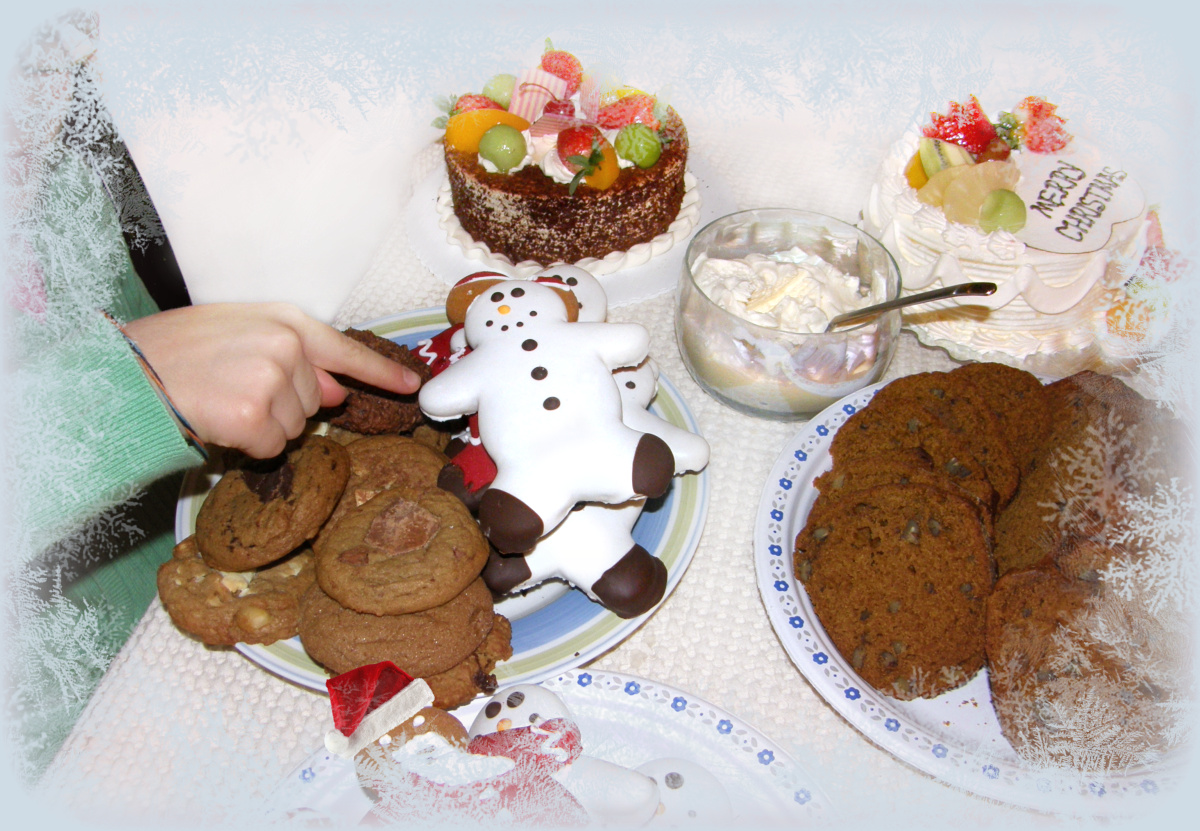
Ginger Santa

Found beltless, hatless, and beardless in the bin at the supermarket. He begged to come home with me. Would have held out his arms to me, if he'd had any.

For Clytie; look for the heart, where it's supposed to be.


Monday, December 26, 2011

Under a summery blue sky

Bare branches ...


Reflected in the ice on the birdbath:


This was a few mornings ago; now it's warm and rainy. I foretold it correctly - a grey-green Christmas.

But green is good, right?

A Skywatch post.

Sunday, December 25, 2011

It's not easy, being little

Thirty people in a small house that's crowded with a dozen, all ages from toddlers to great-grandparents, all talking at once in three or four languages, mountains of gifts, a half-dozen musical instruments all in use (but separate tunes), the traditional groaning board: it all adds up to a great Christmas Eve family party. But there are a few difficulties along the way.

Lost in a forest of legs.

Past her bedtime.

Mine, too. Goodnight, all! I hope your festivities are as happy-making!

Friday, December 23, 2011

Feliz Navidad!

Two more days until Christmas! Somehow I missed the solstice, and the days are getting longer already! (Well, by a minute or so.) I may not get a chance to log on in the next day or two, so I'll take this opportunity to wish you all; family, friends, fellow bloggers, readers:

The very merriest Christmas ever!

"I want that one!" Christmas, 2009

May your celebrations be full of loving people and happy surprises!


Thursday, December 22, 2011

Empty beach

Yesterday morning dawned clear and cold; there was ice on the birdbath again, but by noon the sun had banished it and the breeze was warm. A perfect day to go to the beach.

We hadn't been to White Rock since the day after the storm, back in November, the day I had collected the water that I believed had poisoned my aquarium. It was time to put unhappy memories behind us. We went to our usual spot on the White Rock beach.

A calm, sunny day. Setting sun warms the brown goldenrod heads.

We watched the train go by, I fed another bag of dry bread to shrieking gulls, we watched a kayaker or two. Then I went to the spot where I'd collected the last bottle of water, and started flipping rocks just below the high tide line. I wanted to either discard or confirm my conclusion about the water. Had the animals here suffered the same fate as mine at home?

There were no crabs under any of the rocks I flipped. No hermit crabs. No snails. No limpets. No worms. A few of the higher intertidal amphipods that always swarm on the bottom of these rocks. Just a few.

I walked west, flipping a few more rocks after every couple of steps. Nothing was alive but the amphipods.

I had covered about 150 metres when I found one tiny limpet and an anemone. A bit farther on, there were two limpets, one mussel, and a very small snail, small enough to have washed in after the tides had cleaned the area.

After this, the population of amphipods was denser. Then I found three more limpets, and one miniature hermit. No crabs, though.

Just before the 300 metre mark (measured on Google, at home), one of the stones sheltered a handful of baby crabs, about 1/4 inch across the back. That was reassuring. And a couple of dozen steps further on, I up-ended a large rock, and startled a crowd; too many crabs to count before they scuttled off, a half-dozen small hermits, a mediium periwinkle snail, and a number of black "pinhead" snails, like crawling grains of coarse sand, and under, over and around them all, a mass of slithering amphipods. Yay!

From here on west, just off-shore, a flock of goldeneyes were diving for supper. There had been no birds near the dead zone, except the gulls that mobbed me for my bread, and left as soon as the bag was empty.

So it seems that I was correct: something in the water was probably the culprit. Next time, I'll search in the opposite direction, to see if I can estimate the size of the affected area.

Rocks at the shore, and Common goldeneye.


Wednesday, December 21, 2011

A comfortable moth

In a discussion on The Bug Geek's blog, about our attempts to photograph lively insects, sometimes "cheating" by cooling them in the fridge or with ice packs to slow them down (which I resort to almost always), Ted MacRae wrote, "I’ve yet to take (or see) a photo of an insect that has been cooled (by whatever means) that doesn’t somehow look “off.”"

I've been thinking about that. So when Laurie brought me another small moth, I decided to keep it comfortable at room temperature.

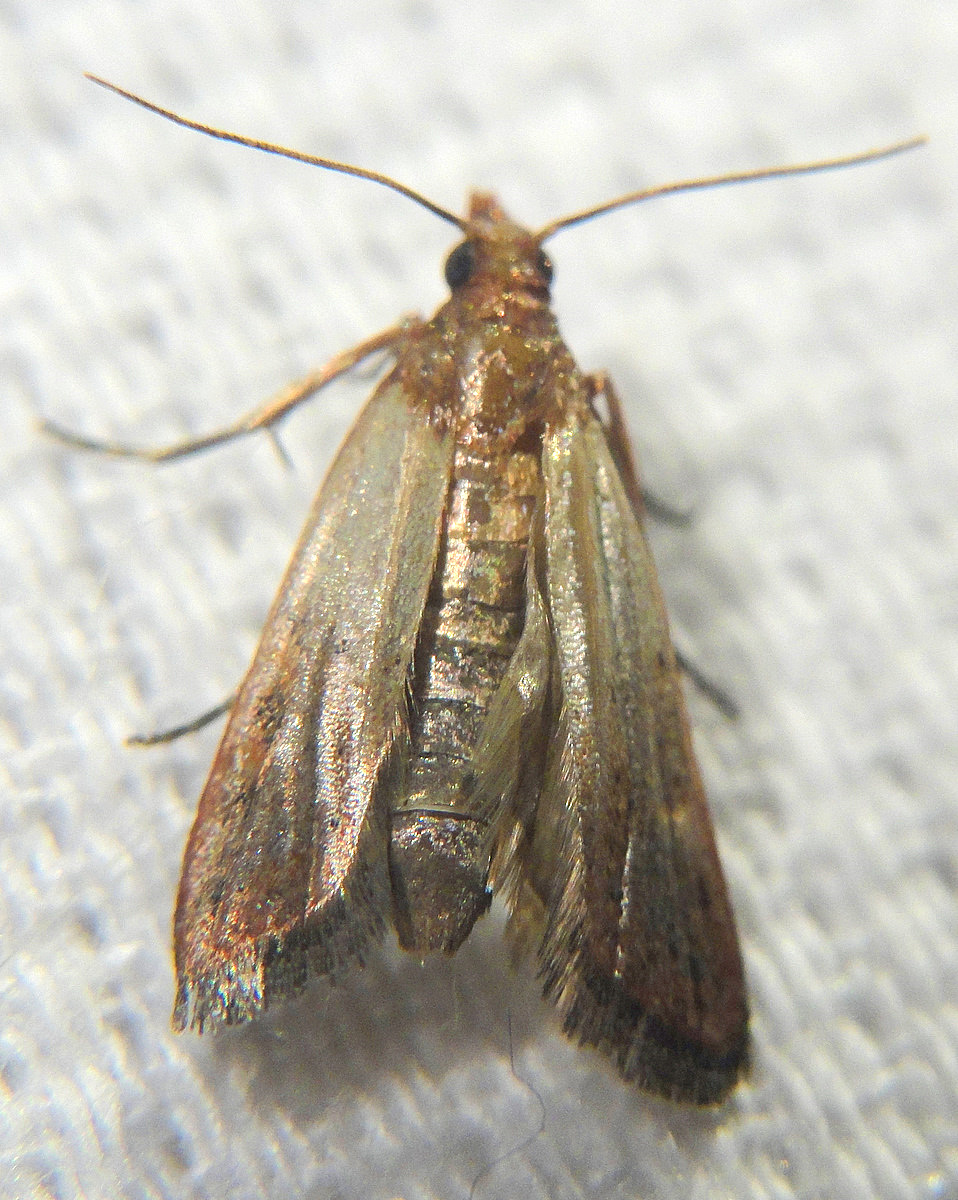
Found in a bag of bird seed.

The moth was very small, smaller than the usual bird seed moths I see, a dull greyish tan, with brown and yellowish accents. I left him loose on my desk, after a brief resting period under a pill bottle to calm him down. As he walked around, slowly, spending a bit of time grooming himself, I followed with the camera.  He didn't seem to notice, but after a bit, he wandered off to the edge and flew away.

The colour seems different depending on the angle of the light.

I was surprised by the photos; his colours show up much more vividly than I had expected. Was it because he is warm enough? Does a cold insect get pale, like we would do?

Quite a shiny little critter.

The discussion also touched on the substrate; a natural substrate may work better, both as a natural background, and as a way to keep the insect feeling comfortable. I had used the white cloth to set my camera's white balance, and the moth walked onto it from my desk, so we went with that. Next time, maybe I'll use a layer of bird seed for these moths, since that's where they show up.

And patience. Or "brutal persistence," as Ted put it. Very important. I can do that, usually. But an unfettered insect, with the use of his wings; can he be patient? Not this guy: it was barely three minutes from the time I took the first photo before he'd had enough, and flew away.


Monday, December 19, 2011

Sorry; no post yesterday nor today. I was attacked by a monstrous migraine. It's gone now, but I am very slee...

py. Nodded off, there. I'm going to bed. Good night!

Sunday, December 18, 2011

Heartless

All spiders make silk, but not all make webs. And of the web-builders, not all use the webs for catching prey. I've been watching Hopalong and her friend, the small yellowish spiders that came in on pine tips, to see what she does with her silk. They hide out among the pine needles during the day, then start wandering around in late evening, mostly going up one needle, down the next, back and forth, sometimes venturing out to the glass of their container. I can't see any signs of a web, just individual strands here and there. Pathways or glued traplines? I couldn't tell.

I have provided fruit flies for their meals, which get eaten, but I have not seen how they were captured. Some spiders wait until the prey gets caught in a web, then harvest it at their leisure. Some dash out at the first tug and leap on the insect before it escapes. These spiders depend on their sense of touch to identify the vibration caused by the struggles of their captives; their eyesight isn't necessarily sharp, or may not even be used.

Some build traps or funnels and catch insects and other prey that fall in; again, eyesight is not too important for this.

Hunting spiders use their eyes. They either lay in wait or wander about, leaping on prey that they have seen.

So which method does the Hopalong tribe use? They're wanderers, but they don't seem to be all that visually oriented. I have watched a fruit fly walk right in front of one, without the spider even turning to watch, as a jumping spider would.

Yesterday, I brought in a couple of fresh pine tips, hopefully carrying assorted springtails for snacks. I put them in the container quickly, then examined them through the glass. Something moved. Springtail? No; another spider, then another, very tiny. I left them where they were; the two already there seem to be getting along fine. Two more shouldn't be a problem.

Tonight, Hoppy (#1 or 2) was wandering about on the glass, crossing paths with fruit flies and a red mite, without reacting to them. The largest of the two new spiders turned a corner and met her almost face to face. Nothing happened. Then, as they passed each other, the tips of their legs touched briefly. Instantly, Hoppy wheeled and leapt on the smaller spider; the struggle was brief, and she settled down to eat.

Hopalong has Junior for supper.

The smaller spider is the same species.

So there are two questions answered; these spiders are leapers, not trappers. And they hunt by feel, not by sight.

And they have no inhibitions about eating their relatives.

And this is for Clytie: the shield that joins the legs is shaped like a heart.

Saturday, December 17, 2011

A sad post

I've been putting off writing this post, procrastinating in the futile hope that it will go away. It never works, does it?

November 26, three weeks ago: In the aftermath of the storm system that blew over most of BC, we went down to White Rock beach to see what had blown in. Just logs and broken plastic, it seemed. I wrote about it here.

I collected some fresh seawater for my critters in the tank at home; only about one litre, since I'd forgotten my regular 2 litre bottle. The water was dirty, with bits of eelgrass, wood chips, sand and muck, all whipped up by the crashing waves. It didn't matter; at home, as I have done before, I filtered it well, then let it sit for a few days for the fine silt to settle out.

The next week, as usual, I replaced 2 l. of the old water in the tank with new, including the latest beach collection.

All seemed well for a day or two. Then one morning, I noticed that my female crab was having difficulties. She stood on her head, with the hind legs swaying in the water, spread out. It took her a long time to right herself, but then she seemed ok. Until the next time I checked on her, when I found her caught upside-down in some seaweed. Something was wrong. (And she was in berry after their recent mating!)

The other two crabs seemed fine. But the big anemone was writhing and contracting oddly, making himself into a series of balls, then flat, then one ball with a pin-head tip, then a wide tip balanced on a pointed base, never opening tentacles to feed. A smaller anemone had disappeared entirely; so had the eelgrass isopods. I couldn't see any limpets, nor any pairs of amphipods waiting to mate. And the snails, those indestructible nasas and mud snails, were lying about, half out of their shells.

I hurried to change as much of the water as I could for freshly-prepared artificial seawater, adjusted for just-right salinity and temperature.

The next day, the anemone was worse; only a few snails were moving. Three clams were holding their siphons well out of the sand, about an inch high. I've never seen them do that before. And the big male crab was lying paralyzed, with legs stretched out and up, towards the back. The female was upside-down more often than not. The little male had disappeared.

I did what I could; removed everything to a "hospital" container with fresh water and clean stones, twice; watched and hoped. For a while, it looked as though the male would recover, but no, he relapsed. The snails died.

When the little male (that I had raised from crab babyhood) floated belly-up, too, I gave up. I drained off the water and replaced it with alcohol. They died quickly.

The baby, with anemone, in happier days.

What had happened? I have gone over and over each step of those days; the only source of whatever killed my tank would have been the water from the White Rock beach, where I have always collected water. And the only difference there would have been the after-effects of the storm. Was it contaminated rainwater from the city on the hill above the beach? Or something brought in by the wind and waves? I don't know.

(My previous die-off, not as complete, was caused by local pollution, blown in from next door. There was no sign of that this time, and the symptoms and species attacked were different.)

We have seen, on occasion, areas of the beaches we visit where large numbers of dead animals lie half-buried in the sand. (May, 2008, baby sand dollars, for example.) There are spots where dying clams lie thick on stinking mud; patches where we find no live animals at all, no matter how many rocks I flip, or how much sand I filter through. Sure, the areas recover, often, at least in part. Or become hosts to new forms of life, like the invasive mud snails that now cover much of the Boundary Bay beach on the Tsawwassen side. Sometimes they don't; years ago, Mom used to tell me of a beach on Vancouver Island where she could not find anything alive. It seemed impossible, back then; now not so much.

I have emptied and cleaned the tank and all the equipment, and hidden them away. I moved the furniture around so that the gap where they were doesn't show. I dumped everything previously alive in the garbage; I would normally bury it in the garden, as fertilizer, but I can't take the risk of poisoning the many animals that live in my soil. The sand will be spread, well washed first, in the most gravelly, polluted area of the vacant lot.

In the spring, I'll probably have the courage to start again. For now, I'm grieving.

I originally started bringing home beach invertebrates to learn something from them. More than just how to identify them, I wanted to know how they lived, how they interacted with other animals. I was even privileged to learn something about how they think, to see them show a reciprocal curiosity, watching me through the glass, responding to what I was doing. What kills them, how they suffer and die (that anemone's tortured contortions still break my heart!) is also something I have unhappily begun to learn.

It has made me very aware of what I buy, what I use and discard; it all enters the environment; it has the potential to do much damage. We can't turn back the clock; we've fouled our nest already, but at least I can keep from adding more poison to it.


Friday, December 16, 2011

A few more birds at sunset

Coot with a blond streak

Low, reddish light wreaks havoc with body shapes and feather tones.

Mallard on ice, with reflected office building.

Reifel Island,  December 9th.

Thursday, December 15, 2011

Catching the red eye

This black crowned night heron was sleeping soundly in a tree by the Reifel Island warming shed, but I made too much racket, and he opened a bloodshot eye to glare at me.

Sorry about that. I'll go away quietly now.

His scientific name, Nycticorax nycticorax, translates as "Night raven night raven";  repeated twice, emphasizing that he really, really appreciates being left to sleep in the daytime. He works the night shift, hunting the same grounds as our great blue herons do in daylight, catching frogs, fish, crustaceans and other small animals.

He's not a raven, but got the name, doubled, because his call is like a crow's. Listen to it here. (Cornell "All about Birds")

From Cornell's "Cool Facts":
Young Black-crowned Night-Herons often disgorge their stomach contents when disturbed. This habit makes it easy to study its diet. ...
Adult Black-crowned Night-Herons apparently do not distinguish between their own young and those from other nests, and will brood chicks not their own.

Wednesday, December 14, 2011

Brainy dust

I was sweeping the kitchen floor, when a speck of dust escaped from under my broom and ran for cover. Not fast enough; I was faster.

"Dusty", running still, under glass. She's about 1 to 1.5 mm long, not counting legs. It's hard to measure a critter that won't stop running.

Smithsonian Science posted an article yesterday, entitled "Brains of tiny spiders fill their body cavities and legs, Smithsonian researchers discover." They measured the brains of nine species of spiders, of all sizes, giant to pinhead size, like Dusty, here.
As the spiders get smaller, their brains get proportionally larger, filling up more and more of their body cavities. ... “The smaller the animal, the more it has to invest in its brain, which means even very tiny spiders are able to weave a web and perform other fairly complex behaviors,” said William Wcislo, staff scientist at the Smithsonian Tropical Research Institute. “We discovered that the central nervous systems of the smallest spiders fill up almost 80 percent of their total body cavity, including about 25 percent of their legs.”
I am amazed, but this does help to explain the ability of such a tiny bit of life to hunt, build webs, and escape dangers like my broom. I'm trying to imagine these legs, full of brains down to the knees. And brain surrounding the heart and lungs, the digestive system and muscles.

When she lost half a leg, did she lose IQ points?

Until I had time to photograph the spider, I kept her in a plastic container, 1 inch tall by 1 inch diameter. She spent her time building a messy web; when I opened the container, I found her hanging upside-down in the center, hoping to catch some lunch, no doubt.

I moved her, took photos, and released her to go back to work patrolling corners for dust mites and other invisible (to me) beasts.

A while later, I found a carpet beetle near the bedroom window, and dropped it into the same container without thinking. (I may not be as smart as a spider.) When I went to look at it, I found the poor beetle all tangled up in sticky web.

Carpet beetle, cleaned up. He's almost 3 mm. long.

Walking on the bottom of a leaf. Note the hooked claw.

Tuesday, December 13, 2011

Holes in the water

We stopped on a shady curve in the trail at Reifel Island, where a mixed flock of ducks, dabblers and divers together, rested in a shallow, muddy little bay. I tossed in duck seed, and they splashed, up-ended, dived, collided, and occasionally fought, each after his preference.

Northern pintail, coot, and mallards.

I was surprised at how well the water seemed to hold its shape, sometimes bubbly, sometimes in a slow upwards splash, sometimes leaving depressions and outright holes in the surface, even after the ducks had moved on to the next handful of seed. Could the mud content and the temperature, just this side of freezing, have anything to do with it? Or were our cameras faster than usual? Or have I just not been noticing?

Scaups and mallard rear ends.

When the divers went down, they carved out a hole for their head and made another for the feet, rolling from one to the other. (Look closely at the duck in the middle, above.) In our photos, several of these double holes show up with no diver visible at all.

I'll have to watch the water more closely next time; maybe that's the way it always is, and I've been distracted by the ducks themselves.

Monday, December 12, 2011

Mute swan, on water, on paper

Last month, I posted a photo of a mute swan at the Westham Island bridge:


One of my readers, the artist Elva Paulson (Elva Field Notes), loved his pose, and did a painting based on it, which she posted on 100 Paintings Challenge. We (Laurie and I) love it!

Isn't he beautiful?

To see more of Elva's sketches and paintings, visit her blog, or the Challenge blog. (8 other artists post there, too. The challenge refers to the goal of posting 100 paintings in a year. Elva is on her second 100.)


Sunday, December 11, 2011

Talking sandhills

One of the hoped-for highlights of any visit to Reifel Island is meeting some of the sandhill cranes. This Friday, we found five, three together on the office lawn, and two near the outer edge of the Sanctuary.

In the shade of the office building. Probably the  year-round resident pair.

The Reifel Island website has a helpful, up-to-date page on the sandhills.

If there are just three birds, there is a very high probability you are looking at our resident pair and this year's young.

Laurie took this next photo between the rails of the fence:

This would be the youngster, or colt, born last May. His forehead is showing some red now, but it is still spotty. Compare it to October's photo.

By the outer path, we found another two small cranes, but these have the full red adult forehead. The young adults congregate with groups of other 1 to 5 year-olds, until it is time to find a mate.

"Is that a bag of food I see?"

By November, numbers generally drop to just our resident pair plus a select small group of visiting birds (less than 10 usually) that then spend the winter together. In the spring our pair chases out all other cranes, including their own young from the previous year, and defend the 300 hectare Sanctuary as their territory.
.
"It is! Gimme!"

These two cranes were more talkative than any I have met before. Every minute or so, one or the other would open a wide beak and let loose with a long, rattly squawk, sounding rather like a heavy barn door with very rusty hinges.

"Thank you! More, please!"

Listen to the call. (All About Birds, Cornell.) The youngsters' voices were not quite so resonant as this.

Powered By Blogger