Monday, May 31, 2010
Sunday, May 30, 2010
Sleepy bee
My granddaughter brought me an armload of pink rhododendrons to decorate my kitchen table. Later in the evening, I found this bumblebee crawling around on the floor underneath. He must have come in with the flowers. Good thing Jess didn't notice, or she would have dumped the lot.
This is a bumblebee, possibly a red-tailed bumblebee, Bombus melanopygus. There is a fly, Merodon equestris, common locally, that looks very much like it, but the eyes are close together in the front of the head, and the antennae are short, barely there. The fly has one pair of wings; bees have two; here you can barely see the rear wings as a darker area underneath the front pair.
I have another of these bumblebees in a collection of different bees and bee mimics from two years ago, here. And more bee info, here.
The bee was lethargic; good for photography, but the lights and the action were cutting into his sleep time. When he started to wake up, I took him outside and left him in a flowerpot out of the rain. In the morning, he was gone.
Posted by
Susannah (Wanderin' Weeta)
at
2:29 AM
4
comments
Links to this post
Labels: bumblebee
Saturday, May 29, 2010
Blue streak
This photo almost got trashed, but then I noticed the blue dash:
Do you see it, towards the upper right? The swallows were zipping everywhere over the water, but I couldn't even aim the camera at them; they were gone already. Laurie caught this one by accident.
How fast do swallows fly, I wondered. So have other people; and helpful obsessives* have taken it upon themselves to answer the question.
Jonathan Corum calculated the speed of a European swallow at 11 meters per second, or 24 miles an hour. (Go look over his calculations; they're beautiful, as well.) A commenter revised that down to 20 miles an hour; still plenty fast, if it's swooping by your head. And Wikipedia gives an overall average (all swallows) of 30 - 40 km/h for catching insects, and 50 -60 for travelling. (From 19 to 37 miles per hour.)
For comparison, a hummingbird travels at about 25 -30 mph, and dives at up to 60. An eagle flies between 20 - 60 mph, and dives at up to 100 mph. So the swallow is actually fairly slow, but their swooping, winding, back-and-forth style makes them hard to track, even by eye.
*I can relate.
Posted by
Susannah (Wanderin' Weeta)
at
2:19 AM
4
comments
Links to this post
Labels: flight speed, Reifel island Migratory Bird Sanctuary, swallows
Friday, May 28, 2010
Question
Posted by
Susannah (Wanderin' Weeta)
at
2:43 AM
5
comments
Links to this post
Labels: Canada geese, geese, Reifel island Migratory Bird Sanctuary
Thursday, May 27, 2010
Family tree
At Westham Island Bridge, a pair of eagles has maintained a nest for several years. This year, again, there are two chicks:
A couple of photographers were there with their massive digiscopers. I had to fight off an attack of envy. Short-lived, fortunately.
Posted by
Susannah (Wanderin' Weeta)
at
2:28 AM
1 comments
Links to this post
Labels: eagle's nest, eaglets, Westham Island
Wednesday, May 26, 2010
Spider in a hurry
This tiny spider wandered across the kitchen counter.
I had to photograph him in a pill bottle because he was so active. And fast! He's a male, and looking for a female, going by the swollen pedipalps.
I learned something, looking through BugGuide to see if I could identify him; male spiders often become emaciated while they're looking for a mate, because they don't take time to eat. The abdomen shrinks and shrivels. This guy was skinny; from the side, the belly is flat.
I released him outside the door and he raced away. Good luck, little one!
Posted by
Susannah (Wanderin' Weeta)
at
3:29 AM
7
comments
Links to this post
Labels: male spider
Tuesday, May 25, 2010
"fiittingly to the center"?
Spam. I liked it when I was a kid. The canned meat variety, that is, sliced and fried until it was crispy around the edges, or chopped and bubbling in a corn and red pepper casserole. (My tastes have changed, or it has. Nothing can fix it these days.)
The non-meat variety, the kind that comes in my e-mail, I can't tolerate. Not then, not now, not ever.
The past few weeks, the blog has been spammed. Every day or two there is a new comment, in Japanese, on a particular post. It doesn't contain links, like the "!Buy Gold!!!!" or p**n ones I often get, or the hopeful "You have a nature blog, so you'll want to help me sell my natural whatevers" kind; this one is just a name and text.
I had it translated yesterday. I couldn't understand it very well, but it was something about "diagnosis". On a post about mushrooms?
Today's post translated thusly: "In order fittingly to the center frame million betting odds horses expected Yasuda Kinen 60th 2010!" Maybe someone's been eating the mushrooms.
So, I'm sorry, but I have had to turn on word verification on comments for the time being. If this is a real person, he'll get through, and be deleted manually. If not, the problem will clear up and after a while I'll return comments to normal.
Posted by
Susannah (Wanderin' Weeta)
at
1:18 PM
2
comments
Links to this post
Labels: spam
A bit of colour
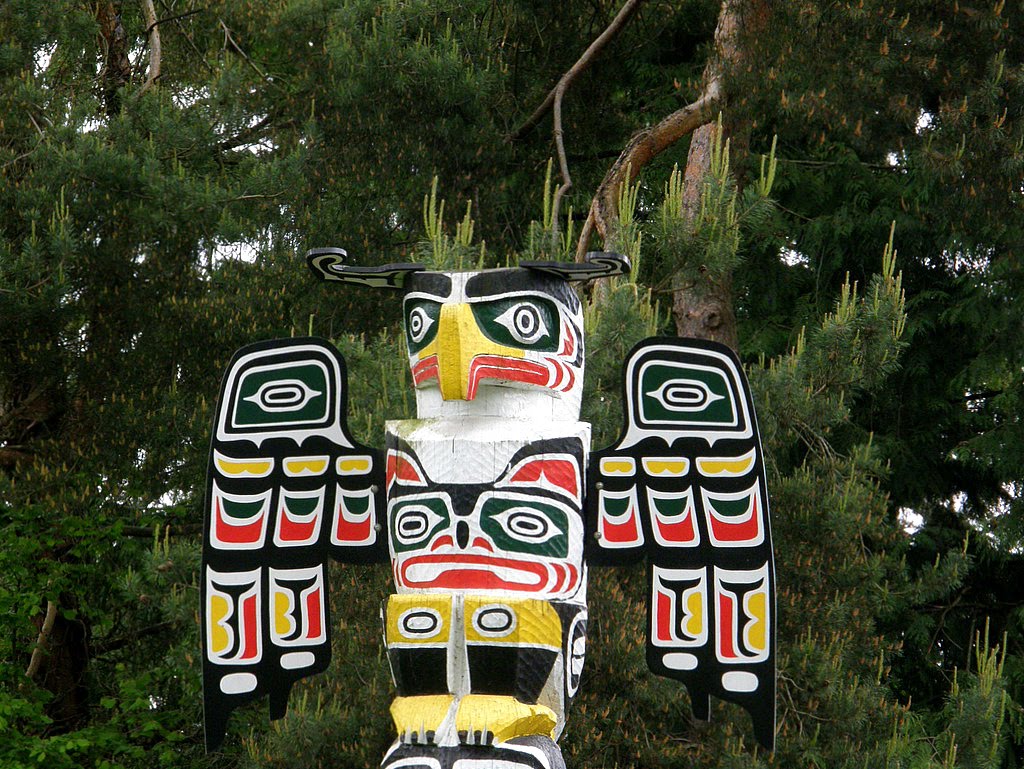
Victoria Day celebrations, Queen's Park, New Westminster: we spent the morning in the annual antique fair, bypassed the amusement park (noisy!), stopped to look at goats and a calf in the children's petting zoo, and loaded ourselves down with purchases at the craft fair in the Arts Council building. I stopped at the door to take a few photos; yellow, sunny things, since the day was on the grey side.
And Laurie bought me a dish festooned with Van Gogh-style sunflowers, orange and red.
Posted by
Susannah (Wanderin' Weeta)
at
3:33 AM
3
comments
Links to this post
Labels: laburnum, Queen's Park, totem poles
Monday, May 24, 2010
Another Manky Mallard
I don't think I've ever seen an orange-tailed mallard before. But here is one:
A few of the other male mallards in this flock had a slight orangey tinge to their tails, but not to this extent. I've been wondering what combination of parent birds would result in this "Manky Mallard".
Posted by
Susannah (Wanderin' Weeta)
at
3:33 AM
2
comments
Links to this post
Labels: hybrids, mallards, Reifel island Migratory Bird Sanctuary
Sunday, May 23, 2010
Two more birds from Reifel Island
This week will be a busy one. We are heading north the next week, up the Sunshine Coast again, and over to Vancouver Island for a couple of weeks. What with tying up loose ends around here, shopping and packing and making arrangements, blogging will be brief until we're settled on the island.
For today, two small birds:
And now, off to bed. Busy day coming up.
Posted by
Susannah (Wanderin' Weeta)
at
1:56 AM
1 comments
Links to this post
Labels: birds, hummingbird, Reifel island Migratory Bird Sanctuary, swallows
Saturday, May 22, 2010
No privacy these days. Might as well be on Facebook.
Wood ducks are shy creatures. We turned down a sheltered path on Reifel Island, surprising a gaudy male; he slid off into the water, turned a corner and disappeared before we had taken a half-dozen steps. Laurie, coming around the back way, snuck up on him and caught him floating motionless in the shadow of the bushes.
Later, from a trail like a green tunnel, where we were the ones hidden from view, we watched the action across the water:
Posted by
Susannah (Wanderin' Weeta)
at
1:47 AM
4
comments
Links to this post
Friday, May 21, 2010
Whatever works, works
In one of the outermost ponds of the Reifel Island bird sanctuary, a small mixed flock of peeps were feeding.
Posted by
Susannah (Wanderin' Weeta)
at
2:47 AM
2
comments
Links to this post
Labels: bird behaviour, birds, peeps, Reifel island Migratory Bird Sanctuary, sandpipers
Thursday, May 20, 2010
Rainy day carnivals
The wind is howling in the back yard, tossing branches and stripping the petals off my London Pride. It's been raining off and on, and will probably keep it up for a couple of days; they're promising us thundershowers. It's a good time to stay inside and read some good blogging. Good thing my favourite carnivals are up:
I and the Bird #125 is on Twin Cities Naturalist. Kirk reads the latitude numbers and leads us from 37° South, in Australia, to 50° North, in Germany. (I'm there, at 49° North.)
The Moth and Me #11. Ted, of Beetles in the Bush, brings us fifteen beautiful moths. Well, thirteen, and two bag moths. None of mine, unfortunately; the moths just aren't showing up around here yet. Except for the tiny Indian Meal moths that I'm feeding to a spider.
House of Herps #6, appropriately on Philly Herping. Snakes, turtles, lizards, mudpuppies, and did I mention snakes? Rattlers!
And the newest of the carnivals; An Inordinate Fondness #4. A road trip, searching for beetles, Jason driving.
Thousands of miles and ...
"Did everyone go to the bathroom? I don’t want to have to stop in fifteen minutes."
Posted by
Susannah (Wanderin' Weeta)
at
3:11 AM
3
comments
Links to this post
Labels: An Inordinate Fondness, carnivals, House of Herps, I and the Bird, The Moth and Me
Carpe clam*
Carpe, from the Latin, means "gather":
Or "seize":
Or "enjoy":
Horace wrote, "Carpe diem quam minime credula postero" – "Seize the day, trusting as little as possible in the future." Or to put it in the vernacular; don't count your
Posted by
Susannah (Wanderin' Weeta)
at
2:27 AM
3
comments
Links to this post
Labels: gulls, White Rock
Wednesday, May 19, 2010
Pink umbrella
White Rock Beach, Saturday:
Low tide. White Rock pier in the background, and beyond that, Kwomais Point.
Posted by
Susannah (Wanderin' Weeta)
at
2:07 AM
5
comments
Links to this post
Labels: beaches, umbrellas, White Rock
Tuesday, May 18, 2010
Green nudists
I missed it again. I've been hoping to catch one of my hermit crabs in the process of molting, but no luck. I wish they'd notify me when they start feeling itchy!
This afternoon, two hermits molted. I checked on the tank in the evening, and there were the two sets of legs and two carapaces abandoned on the sand. A bit of searching turned up a small one high up on the sea lettuce, and a larger hermit hanging on an eelgrass leaf towards the floor. And both of them were naked; they hadn't got around to finding new shells yet. I ran for the camera.
The smaller hermit was well camouflaged, but this little guy was in the open, right by the glass. And he was showing off his shell-clutching legs:
Hermits are decapods; they have ten "legs". Of these, only 6 are walking legs. The first pair is tipped with pincers, one large and one small; the second are clawed legs; the third pair has no claw. The last two pairs are reduced to hooks that hold the borrowed shell. Three of these legs are visible here, sticking out at almost right angles from the abdomen.
The abdomen is soft and unprotected. While the hermit rests after the molt, he is vulnerable to predation or accident. When a second hermit came along, this one left the eelgrass, scuttled across a sand dollar test, and hid underneath. When I checked a quarter of an hour later, he was safely settled into a nice shell, bigger than the one he'd left behind.
Now, four hours later, the little one high in the sea lettuce is still resting without a shell. He must feel safe there, a green coiled youngster wrapped in silky green seaweed.
Posted by
Susannah (Wanderin' Weeta)
at
2:18 AM
3
comments
Links to this post
Labels: aquarium, decapods, hermit crabs, intertidal invertebrates
Monday, May 17, 2010
Soggy sunflower
We caught the lowest tide I've seen yet this year, at -2 ft., in Semiahmoo Bay, and managed to walk almost all the way to the border marker in the channel there.
Down at the very edge, we found this sunflower sea star:
It's the first one I've seen for many, many years. They used to hang around under our dock up on Vancouver Island, and sometimes had over twenty arms and were close to a couple of feet across. We kids would tease them with ropes until they grabbed one, then we'd haul them to the surface. They always let go the instant they hit air, and sunk slowly to the bottom again. Even in the water, and not fighting us like the fish did, they were heavy.
This is a young one, with 15 arms, and about 8 inches across. (They start off with five arms and add more as they mature.)
It was still alive, but looked pretty miserable, all sagged into the eelgrass. Their bodies are so soft that they need the support of water. It wouldn't be out of the water for long, though; the tide was due to turn and the waves were a couple of steps away.
Posted by
Susannah (Wanderin' Weeta)
at
2:18 AM
1 comments
Links to this post
Labels: low tide, Semiahmoo Bay, starfish, sunflower sea star
Sunday, May 16, 2010
Smells like carrots
It's going to be a good year for carrots. The wild ones, anyhow*; on Reifel Island, they're plentiful and already knee- to waist-high.
Don't look like carrots? But they do; like garden carrot plants magnified and gone to seed. These are biennial plants, just like our domestic carrot, which is a subspecies of this ancestor plant. The first year, they produce leaves and roots. The second year (but by then we've harvested and eaten our tame carrots) they produce stems, flowers and seeds. The wild carrots' stems can reach a couple of metres tall or more; we saw one on Reifel a couple of years ago, flowering well over our heads.
"Wild carrot" is too tame a name for it, though, so it has been called Birds Nest Weed, Bishop's Lace, Bees' Nest, and Devil's Plague, depending, I think, on whether the emphasis was on its ability to out-reproduce, out-endure, out-elbow garden plants, or on the beauty of the flower and seed heads. We know it here as Queen Anne's Lace, which suits it. The flower head, or umbel, would make a good pattern for the lace that Queen Anne was accustomed to wearing as a half-collar. (See the series of photos in this Wikipedia article, starting here.)
The flower heads start as a disorderly green clump, slightly indented in the centre. As the flowers open, the clump opens out into an umbrella shape, each one made up of many smaller "umbrellas", or umbels.
Once the flowers are pollinated, the umbrella folds in upon itself again, this time more neatly, making a pretty green cup, or nest, which tightens down until it's almost a ball. When the thousands of seeds ripen (they turn purple, then brown), it opens up again and scatters them far and wide.
(Fertile garden carrots do this, too, but the next generation from those seeds will be woodier and less flavourful than the parents. They're reverting back in the direction of the original stock.)
The seed heads often break off, and roll in the wind, spreading seeds as they go. Or the bristly seeds snag passing animals or human clothing and hitchhike to new areas. They'll grow almost anywhere; in disturbed ground, roadsides, clay, open fields, or your carefully-tended vegetable garden. Once it's in the garden, it will take years of constant weeding to eradicate it; then you'll start calling it the Devil's Plague.
It's welcome on Reifel Island. The birds eat the insects they attract, and later on, the seeds. And the other local plants are well-equipped to hold their ground. In the second and third photos above, the leaves of the equally-tough Himalayan blackberry are mingling with the lace leaves. I don't know which will end up in possession of the patch.
Wikipedia, and many other sites, warn us about the danger of mistaking Poison Hemlock for Queen Anne's lace, and they are similar plants. But they are not identical; the Lace has bracts (those spiky collars) around the base of the large flower umbels; hemlock has them only on the upper umbels. The stems and leaves of the Lace are hairy, and it smells like carrots.
I found a site with a beautiful series of photos of Queen Anne's Lace, from macro- to microscopic views. Go see!
*Update and correction: I just found out that my info was correct, but the photos weren't. The photos we have are of cow parsnip, which is similar but not identical. Queen Anne's Lace does grow here, but the leaves are different; they are more carrotty, and don't have those "wraps" on the stems. And it will not grow as tall as the cow parsnip.
I'm not so sure about the last photo. It has the characteristic "bird's nest" shape of Queen Anne's Lace, and was from some shorter plants, I think on the North Shore. The leaves aren't visible, but the sharp bracts at the base of the flower are.
You can compare the two plants on E-Flora BC, here (cow parsnip) and here (Queen Anne's Lace).
Thanks, Huckleberry!
Posted by
Susannah (Wanderin' Weeta)
at
3:26 AM
7
comments
Links to this post
Labels: identifying weeds, Queen Anne's Lace, Reifel island Migratory Bird Sanctuary, weeds