Showing posts with label totem poles. Show all posts

Friday, January 07, 2022

Snow and two cultures

The wintry weather continues. It snowed again Wednesday night and most of Thursday, piling another foot of snow on top of the leftovers from the last snowfall.

I love the look of untouched snow. I stopped by the museum to see theirs.

Parking lot and totem pole.

The museum sits on a steep hill, as does much of Campbell River. The parking lot, an outdoor display area, a picnic table, and the totem pole are on the slope above the building. From the main door, on the level of the parking lot, but now well above the grounds, we look down on the highway beneath, a small park on the far side, and the water, at the bottom of another steep drop.

View from the main door. Sequoia Park, the Torii gate, the channel and Quadra Island across the water. And a snow-laden bench.

The Torii gate was a gift from the people of Ishikari, Japan, in 1993, to commemorate 10 years as "sister cities". They have a totem in exchange from our local carver, Bill Henderson, who carved the totem in the parking lot. The one in Ishikari sits in front of their City Hall.

The Ishikari totem, photo from Google maps.

Back to the museum: also from the front door platform.

Another of those lopsided trees. This one looks like it broke, then grew a new tip. The totem at the right sits on the shore, looking over the channel. The bird on top is a Thunderbird, now wearing a white snow coat.

And another of the parking lot and totem, because I couldn't choose only one.

I like the snow cones on the light fixtures.

~~~~~~~~~~~~~~~~~~~~~~~~~~~~~

Sigue el invierno. Otra vez cayó la nieve, toda la noche del miércoles, y la mayor parte del dia el jueves, acumulando otros 25 cm. de nieve encima de lo que quedaba de nevadas anteriores.

Me encanta mirar la nieve nueva, todavía sin tocar. Fui al museo para verla en sus alrededores.

Fotos:
  1. El estacionamiento y un poste tótem. El museo se sitúa en una ladera empinada, como mucho de esta ciudad. El estacionamiento, una area de exhibición de maquinas de la industria forestal, una mesa para picnic, y el tótem se ubican en la ladera arriba del edificio.
  2. Desde la puerta principal del museo, al nivel del estacionamiento, pero en este lado del edificio bien arriba del terreno, miramos para abajo hacia la carretera, un parquecito al otro lado, y el agua, esta al pie de otro declive escaparado. Se ve en la foto el parquecito Secuoya, el portón Torii, el mar, y la isla Quadra al otro lado. Y un banquito para sentarte, pero no ahora ya que está lleno de nieve.
  3. El portón Torii fue un regalo de parte del pueblo de Ishikari, en Japón, instalado en 1993, para celebrar los 10 años como pueblos hermanos. En cambio, la ciudad de Campbell River les entrego un poste tótem tallado por un artista local, Bill Henderson, el mismo que hizo el tótem que adorna el estacionamiento. El que está en Ishikari queda en frente de su Ayuntamiento. La foto es de Google maps.
  4. Regresando al museo. Esta foto también muestra la vista desde la plataforma en frente de la puerta principal. Otro árbol torcido. Parece que se rompió, perdió las ramas superiores, y siguió creciendo hacia un lado. A la derecha, otro tótem mira hacia el mar. El pájaro encima es un "Thunderbird", pájaro del trueno, ahora llevando una cobija de nieve.
  5. Y otra foto del estacionamiento y el tótem, porque no me pude decidir entre las dos. Me gustan esos conos de nieve encima de los faroles.


Sunday, August 28, 2011

"Since the beginning of time"

Just a few turns of the highway north of Powell River, the First Nations village of Sliammon lies strung along the shoreline. The Sliammon (Kla ah men) are a Coast Salish nation whose territory when the white man arrived included sites from Saltery Bay north to Sarah Point, at the gateway to Desolation Sound, with a population of some 20,000 people.

They have inhabited this area for at least two thousand years*, and their middens and village sites are found up and down the coast. (*Their website says
The Kla ah men people have inhabited this region since the beginning of time.
which I think may be a slight exaggeration.)

Sliammon townsite, from its wide beach. The Catholic church in front was rebuilt after it burned down in 1918. The homes are much more recent.


Their history since the coming of the white men has been, like that of so many other aboriginal peoples, a mournful recital of losses, from the first epidemics of European diseases, to the expulsion from many of their home sites, to the persistent and systematic attempts to eradicate their culture and language, leaving them at present with a population of about eight hundred. Only in the last few decades has there been a resurgence of hope and activity; they are now permitted to keep their children at home, to have local schools, to celebrate their cultural heritage, and to direct their own lives as adult Canadians.

In 2009, the "Sliammon First Nation raised a 30 foot totem pole to honor their family and friends that have passed on before us." (Sliammon Treaty Society) As far as I can tell, that would be this one:


It faces out to sea, from just above the high tide line.

The Coast Salish peoples were not major totem pole builders, and I'm not familiar with their symbolism. From bottom to top, I see an unidentified head, two killer whales, a winged turtle with suns carved into the wings, and a majestic, tragic face.

Detail: crying turtle with outstretched wings.

Is he carrying a turtle, or a fish?

Grief and endurance personified.

Tuesday, May 25, 2010

A bit of colour

Victoria Day celebrations, Queen's Park, New Westminster: we spent the morning in the annual antique fair, bypassed the amusement park (noisy!), stopped to look at goats and a calf in the children's petting zoo, and loaded ourselves down with purchases at the craft fair in the Arts Council building. I stopped at the door to take a few photos; yellow, sunny things, since the day was on the grey side.


Laburnum in a field of English daisies.


A bigger laburnum.


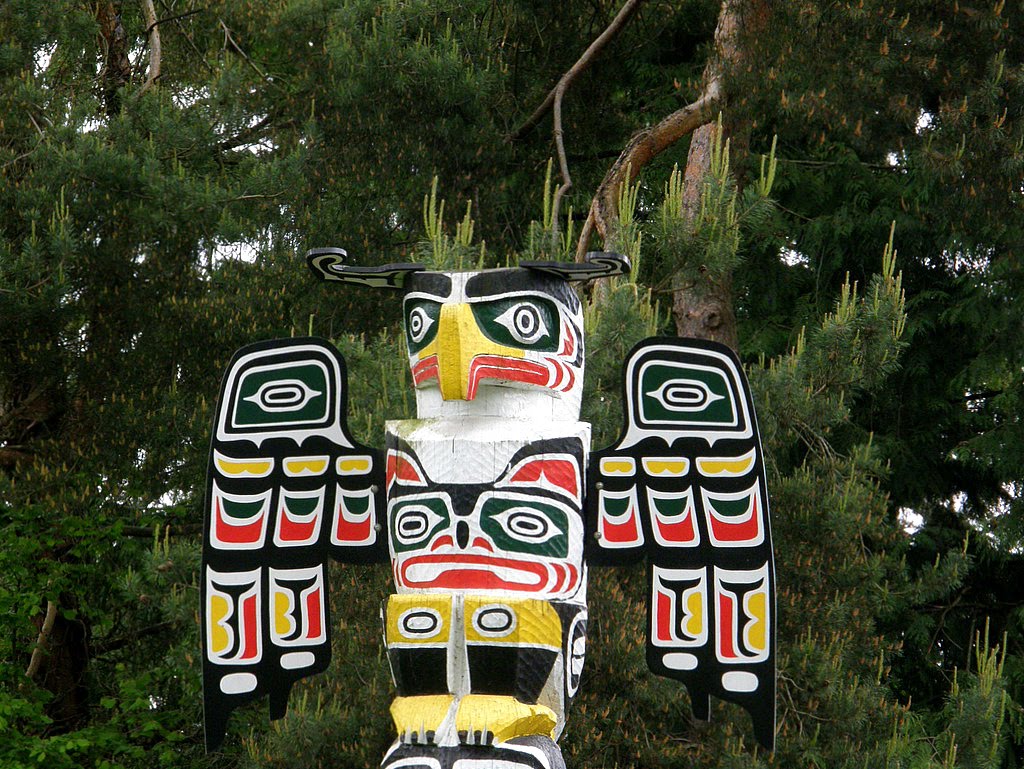
Salish totem pole. Top to bottom: thunderbird, killer whale, bear. Man on phone for scale.


Thunderbird.

And Laurie bought me a dish festooned with Van Gogh-style sunflowers, orange and red.

Saturday, June 09, 2007

Good Planets are Hard to Find

... Aren't we lucky we found this one?

“When you realize how perfect everything is you will tilt your head back and laugh at the sky.”
Supposedly said by the Buddha.
Here are some morsels of that perfection that arrived in my mailbox this week:

From Yankee T., a glorious magnolia blossom from her local Botanic Garden.

I don't know what it is about magnolias; they are so ... blatant, I think would be the word. Strong, heavy, sturdy-looking, but so impermanent; like a loud shout of laughter. The buds look like individual flames, flaring joyously up from the bare branches.

C. Corax saw this catbird singing a Leonard Cohen song, one morning on the way to catch the bus to work. "It definitely made me smile!" she writes.

All I can say about life is, Oh God, enjoy it!
Bob Newhart
We attribute human-like attributes and ideas to our animal neighbours, sometimes correctly. I wonder what this alligator lizard (Elgaria coeruleus) is smiling about?
Contributed by Celeste, of Dzonoqua's Whistle. More details on her blog.

Here's the lizard, in all his slithery length. (Click on the photo to get the full benefit.)
In all things of nature there is something of the marvelous.
Aristotle
I asked Laurie what made him smile. He remembered this photo from some years back: a sassy little widgeon confronts a bigger mallard who tried to grab the crumb he wanted. She seems quite taken aback. The little white dots in front are bird food that I was tossing while Laurie snapped away. At Reifel Island bird sanctuary.

More disruptions in avian affairs; seagulls ignoring a "Danger -- Keep Off the Ice!" sign. Queen Elizabeth Park, Vancouver.
Good sex, ours or someone else's, always brings a smile. Robin of Dharma Bums caught these two in the act last week.
Laughing is the sensation of feeling good all over and showing it principally in one spot.
Josh Billings
Poles; totem poles, Maypoles, poles for the birdmen of Papantla, and more, feature in the celebration of the beauty of our earth. Kim Herdman sent a totem pole from K'san village, topped with a man in a decidedly western-looking hat and suit.

And a telephone pole from Strathcona, Vancouver, from my collection: I labelled it "Post No Bills".
Wrenaissance Woman says, "goldfinches hanging upside-down to feed always make me smile."

Cherish all your happy moments: they make a fine cushion for old age.
Christopher Morley
One final photo; a few years back, in the bright sunlight after a heavy snowfall, we went out for a walk by the river. This little dog had been enjoying every moment of his own walk.
And to quote another celebrity; "Th-th-th-that's all, folks!"

Next "Good Planets" will be up June 23, in two weeks. I'd like to suggest a couple of concepts to play with, two opposites; fragility and durability. Do you have photos that speak to either or both of these ideas? Send them along!

But do feel free to send other photos of our "good planet" that you would like to share. Send them to me, at susannah AT dccnet DOT com, by Friday the 22nd.

~~~~~~~~~~~~~~~~~~~~~~~~~~~~~~~
Quotations from here and here.

P.S. C. Corax posted a wonderful and apposite poem in the comments.

Thursday, January 04, 2007

Back-Alley Totem Poles

I never tire of prowling Strathcona's streets and alleys. It's a section of Vancouver where quirkiness is almost a requirement for residency.


I have admired these "sculptures" for some time, but they didn't seem to be quite photogenic enough. On this visit, they were.

What the difference is, I don't know. Maybe the wall has been painted; was it plain white last time I saw it? I don't remember. Or maybe it is just a trick of the light. The full summer sun does tend to wash out colours and erase shadows.

So here they are, early morning, a few days before Christmas, between bouts of bad weather.

Laurie calls them totem poles. Could be. Let's see; our First Nations people put up totem poles at their doors to say:

"This is who we are; these carvings symbolically show what we stand for."
Additionally, Natives felt they had special rights to claim a link to the super-human beings they depicted on their poles. These special links included: being "descended from ...." or having recently "encountered ..." or having received "a gift from ...".
Some poles embody one-of-a-kind stories or unusual symbols. These stories or symbols are known in their entirety only to the pole's owner and the carver of the totem pole.

So there could be a bear figure atop a beaver, a frog, a wolf, a whale; all telling a story of events in the lives and ancestry of the inhabitants of the home or tribal land.

Northwest Pacific Coast Native stories involve the easy transformation of animals into humans or vice versa, or the transformation of supernatural beings into humans.They involve whole villages of Salmon or Whale people who live happily in underwater cities; powerful beings who live deep within whirlpools in the ocean, smelt copper, and periodically change into Frogs; wild creatures who steal children, try to eat them, are caught, burned and transformed into Mosquitos; giant Thunderbirds who swoop down from the sky and snatch up giant Whales to eat for dinner; Wolves who, at night, change into bony, yet attractive Ghost People, and Wolves who grow tired of hunting in packs on the land and change into hunting packs of Killer Whales.

I wonder what these two totems tell of? "Grandpa was a shape-shifter (transformer)"? A member of the "Resistance"? Electrified bowling balls? Or just a fascination with shapes and textures?

Another totem; this one not a pole, but a carving into a wooden door on a ramshackle boathouse in Delta, half-way between Mud Bay and Crescent Beach. How authentic its design is, I don't know. I took a course, once, too long ago, where we studied the different types of tribal designs in this area, and the figures involved. Alas, I have forgotten most of it. So I can't even identify the figures any more. I think that top creature with the red ears must be an owl. ... Or is it a hawk? Alack, alas! *


The bottom half seems to be a mirror image carved by a second person, not quite as confident as the original, coloured top section. It makes a most impressive door, however.

~~~~~~~~~~

* Sonny, in the comments, says it's probably a hawk.

Powered By Blogger