It is now January 1st, 2008. In New Zealand.
We've still got 20+ hours to go of the old year here.
And it is the Year of the Rat, in the Chinese scheme of calculation. But not until February 7.
Set your watch.
Monday, December 31, 2007


Sunday, December 30, 2007


Saturday, December 29, 2007
Captured by a meme, again
This end-of-the-year meme has been going around the blogosphere, and I thought I wouldn't catch it. But I guess I'm not immune, after all.
The instructions say to take the first sentence of the first post of each month, and post them. But I do have a mind of my own (if ever so weak), and I chose another sentence, instead, of the designated posts.
So here goes the list:
It's been that kind of a year.
The instructions say to take the first sentence of the first post of each month, and post them. But I do have a mind of my own (if ever so weak), and I chose another sentence, instead, of the designated posts.
So here goes the list:
- January 1, 2007: Recently we spent a couple of nights at my daughter's house in Strathcona, house- and cat-sitting. (First Post of 2007)
- February 1: Oh, for the talents of a cat! Who can sleep any time, any place, any position. (Why is it...)
- March 1st: (With a tint of pink. Some hanky-panky with flamingos back in his ancestry?) (Beacon Hill Park)
- April 1, April Fools' Day: Lemon jelly slime. (Or maybe Witches Butter, a mushroom.) (Two Slime Molds)
- May 1, MayDay: A red-headed woodpecker shouted out from a tall cottonwood; although we looked from all angles, we couldn't see him. (Just a Peaceful Walk)
- June 1st: Except, of course, for the roar of waters, the crashing of rock, the ping! of splitting ice. And probably the howl of wind. (A Terrible, Stark Beauty)
- July 1, Canada Day: Beside the road, a young bear was grazing in a bed of clover. (Home again, Home again, Jiggety-jog)
- August 1st, BC Day: (I don't touch jellyfish with fingers; one never knows if they sting.) (Remembering King Canute)
- September 1st, Labour Day weekend: A photo post, so here's one of the pics.

- First of October: The next day, I noticed a green caterpillar nibbling on the tiny yellow flowers at the tip. (Astounding!)
- November 1, Mexican Day of the Dead: Head decor, this Hallowe'en. (Three Horns and an Axe)
- And December 1: But aren't they great? I especially like the big curly one. (Mushrooms at the Quay)

It's been that kind of a year.
Friday, December 28, 2007
Circus of the Spineless #28
This month's CotS is up, at Christopher Taylor's blog, Catalogue of Organisms. Something to read as we unwind from the mad rush of the last week or so.
And the most beautiful, astounding, amazing butterfly of them all. Would you believe transparent? Go see!
And the most beautiful, astounding, amazing butterfly of them all. Would you believe transparent? Go see!
Still recovering from the festivities...

Red goes with my dress!

Turkey with mole sauce, Frijoles de olla, Mexican rice, farmer's cheese, tortilla.
Yum!
Thursday, December 27, 2007

Wednesday, December 26, 2007
Nice; a white Christmas!
The day started off with rain, but ended with snow.


And in between, we got a hand-made, hand-delivered Christmas card.


And in between, we got a hand-made, hand-delivered Christmas card.

That's Laurie on the left, me on the right. A very accurate likeness. (Except for a few minor details.)
Tuesday, December 25, 2007

Monday, December 24, 2007
And a merry Christmas may it be!
My grandmother (1888 - 1975) made this, long, long ago. I have hung it up every Christmas since I inherited it.

It is old felt, with sequins and wool stitching, each letter different. The white felt has long since turned brown with age, and the sequins have lost much of their colour; some has run into the felt. But I love it; I can "see" my Nana, still young, sitting in the sunroom off her upstairs bedroom in Toronto, cutting and stitching. Oh, so long ago!

It says "Christmas" and "family" to me, good food, warmth, memory and laughter. May you all have that kind of a Christmas!

It is old felt, with sequins and wool stitching, each letter different. The white felt has long since turned brown with age, and the sequins have lost much of their colour; some has run into the felt. But I love it; I can "see" my Nana, still young, sitting in the sunroom off her upstairs bedroom in Toronto, cutting and stitching. Oh, so long ago!

Detail of the letter "R".
It says "Christmas" and "family" to me, good food, warmth, memory and laughter. May you all have that kind of a Christmas!
Sunday, December 23, 2007
Darkest day of the year
That was yesterday, at the winter solstice.
This is cool: a site I ran across calculates, for any location, the actual times of sunrise, sunset, and length of daylight. (Look up your own, on Sunrise, sunset, daylight in a graph.)
It gives the time for sunrise today at around 8:00 AM. Sunset is shortly after 4:00 PM. Around 4:15, by my clock.
And the daylight only lasts about 8 hours. 1/3 of the day. No wonder people suffer from SAD around here!
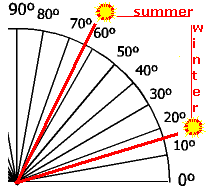
I didn't know this: at mid-summer, the longest days of the year, the sun is at its highest. But it is never directly overhead here, even then. The graph gives its maximum angle at 65 °: straight overhead would be 90 °. In winter it goes down to 16 ° from the horizon. At its highest point.
 No wonder even our sunny days are chilly!
 The photo is from an afternoon around this time last year, at 4:30 or thereabouts, at the White Rock Pier. And in a drizzly rain, of course.
This is cool: a site I ran across calculates, for any location, the actual times of sunrise, sunset, and length of daylight. (Look up your own, on Sunrise, sunset, daylight in a graph.)
It gives the time for sunrise today at around 8:00 AM. Sunset is shortly after 4:00 PM. Around 4:15, by my clock.
And the daylight only lasts about 8 hours. 1/3 of the day. No wonder people suffer from SAD around here!
I didn't know this: at mid-summer, the longest days of the year, the sun is at its highest. But it is never directly overhead here, even then. The graph gives its maximum angle at 65 °: straight overhead would be 90 °. In winter it goes down to 16 ° from the horizon. At its highest point.
 No wonder even our sunny days are chilly!
 The photo is from an afternoon around this time last year, at 4:30 or thereabouts, at the White Rock Pier. And in a drizzly rain, of course.
Friday, December 21, 2007
Mexican Christmas dinner menu and recipes
My family blends a variety of traditions, from around the world. So our get-togethers are rather unpredictable. Since I was giving my son tips on cooking the meal (he's the chef in his house), I also promised you recipes from this year's Christmas menu: Mexican.
First, the menu.
Next, a recipe or two: Mole Poblano, old style, and my style.
Mole is a traditional Mexican dish, served primarily at Christmas, Day of the Dead, weddings and other celebrations. The name, "Mole", is derived from the word "moler", to grind, and refers to the chiles, peanuts, chocolate and other spices that are ground together into a fine paste. Different regions of the country have their own interpretation of it, giving us green mole, red mole, Oaxacan black mole, etc. But the one my family is most familiar with is the version from the central state of Puebla, "Mole Poblano".
The dish probably derives from Aztec times, when chocolate was not restricted to dessert and sweets, but other legends have been passed along purporting to give its origin. (See below.)
The recipe for Mole Poblano:
(More or less as the older members of the family would make it. My tips in red, short-cuts in blue. A super-fast version at the end.)
Ingredients for 12 servings:
Cook the turkey. (May be done earlier. Or use leftover baked turkey, simmered briefly in a good broth. Keep the broth; you will be using it.)
Mole sauce:

Super-fast version; don't tell anyone if you did this. Buy Mole Paste. It comes in 8-oz jars or glasses. Get the chocolaty-brown kind. Liquify it by stirring in, bit by bit, your turkey broth, over low heat. Keep adding broth and paste alternately until you get as much as you want. (For a few people, a couple of tablespoons of paste is enough.) Add a teaspoon or so of cocoa powder, the same amount of sugar, and a couple of tablespoons of creamy peanut butter. Adjust liquid, simmer for a bit more. Add your turkey, heat through. You're done! Pretend you slaved all day over the stove.
How did anyone ever come up with this recipe? Well, they told me this story ...
Way back, in the 17th century, in a monastery in the colonial city, Puebla de Los Angeles (City of the Angels), young brother Pascual worked in the kitchen. Being the youngest, he was assigned the lowliest duties, washing and chopping and fetching. And they kept him hopping!
Not that he minded; he was a cheerful, bouncy boy, and hopping was to his taste. So much so that they called him El Bailón, the Dancer.
One day the whole monastery was in an uproar; the Archbishop was coming to the city and would be visiting the monastery. The brothers were cleaning and polishing, airing rooms and practicing their music. In the kitchen, all hands were busy, peeling, chopping, grinding, tasting, stuffing, frying. Pascual was appointed the task of seeing to the wide cazuela, as wide as his arm was long, where a couple of whole turkeys simmered in a delicately-flavoured broth. His job was to fan the charcoal flames under the pot and occasionally to give the broth a stir. He felt deeply honoured by this; elated, too. He sang as he worked, and danced with the rhythm of his fanning.
Alas! He was too excited; in one of his triumphant waves of the long wooden spoon over the pot, he hit a rickety shelf on the wall above the stove. It tipped and shook.
And all the spices, the ground chiles, the chocolate for the archbishop's evening drink, the chopped nuts and seeds, the stale bread cubes and the sugar pilones that were kept on that shelf, slipped, slid, and tumbled into the pot. Disaster!
He did his best to fish the biggest pieces out, but the pot was so big, so wide, the broth so hot, the turkeys so much in the way, that all he could find were bits of chile stem and a few nuts. When the head cook looked his way, he was lost. He was banned from the kitchen, sent to scrub tiles in the back patio while the cooks tried to rescue the meat.
Impossible. The archbishop was at the gates. They did the next best thing, strained the new sauce and presented it with a flourish and desperate hopes.
And the archbishop was enchanted; he pronounced this "mole" the best dish he had ever tasted!
So Pascual, all these years hence, is now called upon by every Mexican cook, as she starts her grinding and toasting for the Christmas meal; "San Pascual Bailón, guide my hands!"
Note; recipes for Mexican rice, beans, and Café de Olla on request.
And now, I've made myself hungry; I'm off to get a spicy snack.
First, the menu.
- *Mole poblano de guajolote: Turkey in Mole Sauce.
- Arroz rojo: Red Rice
- Shredded Lettuce Salad
- Frijoles de olla: Mexican Stewed Beans.
- Café de olla: Cinnamon-Spiced Coffee
Next, a recipe or two: Mole Poblano, old style, and my style.
Mole is a traditional Mexican dish, served primarily at Christmas, Day of the Dead, weddings and other celebrations. The name, "Mole", is derived from the word "moler", to grind, and refers to the chiles, peanuts, chocolate and other spices that are ground together into a fine paste. Different regions of the country have their own interpretation of it, giving us green mole, red mole, Oaxacan black mole, etc. But the one my family is most familiar with is the version from the central state of Puebla, "Mole Poblano".
The dish probably derives from Aztec times, when chocolate was not restricted to dessert and sweets, but other legends have been passed along purporting to give its origin. (See below.)
The recipe for Mole Poblano:
(More or less as the older members of the family would make it. My tips in red, short-cuts in blue. A super-fast version at the end.)
Ingredients for 12 servings:
- 1 turkey, cut in serving-size pieces, browned in oil, then simmered with the onion and garlic in salted water to cover until cooked.
- 11 ancho chiles ("wide" dried chiles, a dark red/brown colour; relatively mild, fruity)
- 6 mulatto chiles (same as ancho, but almost black. Use ancho if you can't find them.)
- 5 pasilla chiles (same colour as the "mulattos", but long and skinny. Make sure you get all the seeds and veins out, if you want your mole to be mild.)
- 4oz. almonds
- 4oz. peanuts
- 8oz. sesame seeds
- 2oz. pumpkin seeds
- 1 ounce sweetened dark chocolate
- 6 allspice
- 6 cloves
- 1 cinnamon stick
- approx. 10 tomatillos (or tomatoes, even canned)
- 2 med. onions
- garlic to taste
- 3 corn tortillas
- 1 slice stale white bread
- oil for frying (They always say lard; oil is better for you. Don't use olive oil; the flavour clashes.)
Cook the turkey. (May be done earlier. Or use leftover baked turkey, simmered briefly in a good broth. Keep the broth; you will be using it.)
Mole sauce:
- Toast the sesame seeds on a griddle.
- In a frying pan, with a little oil, toast the bread and remove from pan; toast the tortillas. Remove.
- De-seed and de-vein the chiles. Use disposable gloves, or wash your hands thoroughly afterwards. (You'll thank me for this tip.)
- Briefly fry the chiles together with the pumpkin seeds, peanuts, almonds, and spices. Grind them in a blender together with enough broth to allow good mixing, but not enough to make the purée liquid. (Short-cut: on the stove-top simmer unblended chiles, etc., in enough broth to cover. Add bread and tortillas. When soft, cool, and blend. Then go on with the tomatillos.)
- Toast tomatillos on the dry griddle until skin blisters (theirs, not yours); remove the skin. Add to blender, with another onion and garlic to taste.
- Add toast and tortillas. Blend thoroughly.
- Return to heat and slowly mix in one quart of your turkey broth. Thicken over very low heat, stirring continually to prevent sticking. Add more broth, as needed, to make a thick paste, about the consistency of heavy gravy.
- Add the chocolate, broken up. Stir until completely melted and mixed in.
- Add the turkey, stirring well. Let sit on very low heat, stirring occasionally, until thick. Do not allow to burn. (Cheat: simmer in the oven, unlidded, at 300 deg. or thereabouts.)
- Remove from heat. Serve on a plate with Mexican red rice. Garnish with toasted sesame seeds or chopped onion, if desired.

Many hands / light work.
Super-fast version; don't tell anyone if you did this. Buy Mole Paste. It comes in 8-oz jars or glasses. Get the chocolaty-brown kind. Liquify it by stirring in, bit by bit, your turkey broth, over low heat. Keep adding broth and paste alternately until you get as much as you want. (For a few people, a couple of tablespoons of paste is enough.) Add a teaspoon or so of cocoa powder, the same amount of sugar, and a couple of tablespoons of creamy peanut butter. Adjust liquid, simmer for a bit more. Add your turkey, heat through. You're done! Pretend you slaved all day over the stove.
~~~~~~~~~~~~~~~~
How did anyone ever come up with this recipe? Well, they told me this story ...
Way back, in the 17th century, in a monastery in the colonial city, Puebla de Los Angeles (City of the Angels), young brother Pascual worked in the kitchen. Being the youngest, he was assigned the lowliest duties, washing and chopping and fetching. And they kept him hopping!
Not that he minded; he was a cheerful, bouncy boy, and hopping was to his taste. So much so that they called him El Bailón, the Dancer.
One day the whole monastery was in an uproar; the Archbishop was coming to the city and would be visiting the monastery. The brothers were cleaning and polishing, airing rooms and practicing their music. In the kitchen, all hands were busy, peeling, chopping, grinding, tasting, stuffing, frying. Pascual was appointed the task of seeing to the wide cazuela, as wide as his arm was long, where a couple of whole turkeys simmered in a delicately-flavoured broth. His job was to fan the charcoal flames under the pot and occasionally to give the broth a stir. He felt deeply honoured by this; elated, too. He sang as he worked, and danced with the rhythm of his fanning.
Alas! He was too excited; in one of his triumphant waves of the long wooden spoon over the pot, he hit a rickety shelf on the wall above the stove. It tipped and shook.
And all the spices, the ground chiles, the chocolate for the archbishop's evening drink, the chopped nuts and seeds, the stale bread cubes and the sugar pilones that were kept on that shelf, slipped, slid, and tumbled into the pot. Disaster!
He did his best to fish the biggest pieces out, but the pot was so big, so wide, the broth so hot, the turkeys so much in the way, that all he could find were bits of chile stem and a few nuts. When the head cook looked his way, he was lost. He was banned from the kitchen, sent to scrub tiles in the back patio while the cooks tried to rescue the meat.
Impossible. The archbishop was at the gates. They did the next best thing, strained the new sauce and presented it with a flourish and desperate hopes.
And the archbishop was enchanted; he pronounced this "mole" the best dish he had ever tasted!
So Pascual, all these years hence, is now called upon by every Mexican cook, as she starts her grinding and toasting for the Christmas meal; "San Pascual Bailón, guide my hands!"
~~~~~~~~~~~~~~~~~~~
Note; recipes for Mexican rice, beans, and Café de Olla on request.
And now, I've made myself hungry; I'm off to get a spicy snack.
Thursday, December 20, 2007
Like tiny Christmas trees
For quite a few years, we lived across the Fraser River, in the Burnaby/New Westminster area. We formed the habit, first separately and then together, of going down the hill to the Burnaby Fraser Foreshore Park, and following the trail along the riverbank.
In those early days, the space between the river and the main road was taken up by old farms, "weed" trees, and swampy mixed bush. There was a small "improved" area at the foot of Byrne Road, with lawn grass and picnic benches; for the rest, the main attraction was the river itself, the old cottonwoods and their bird population, and for me (and the birds), the berries; salmonberry, blackberry, serviceberry, and the occasional thimbleberry.
As for birds, the sparrows and chickadees kept up a constant chatter all year round. Robins patrolled the lawns, seagulls, geese and mallards the river. We watched goldfinches, great blue herons, buffleheads, the occasional woodpecker, once a kingfisher. On the other side, a pair of eagles had a nest, easily visible from our vantage point.
That was then. This is now.

Earth-moving machinery moved in in the last years of the old millennium. The farms were eradicated, the bush scraped away, the creeks filled with gravel and sand. The whole strip along the shore, for miles, is now industrial park.
But our benevolent government did try to soften the blow to the environment; in their bumbling bureacratic way, they widened and gravelled the trails, built cement and metal viewpoints, added signs, telling us about the "habitat" they were creating. To do this, they stripped the soil and bush from another segment of the remaining green belt, and built ponds and waterways to contain and control the creeks.
And the industries moved in across the widened road.
I remember being there one winter around the time we moved to Delta. A large pond, its edges bare mud sloped down from the road to the water's edge, and adorned by a sign proclaiming the "reclamation" effort, and those ratty orange webs they use instead of fences, was showing a bit of greenery at one end; a few reeds in orderly lines, obviously planted. A half-dozen buffleheads were diving there for something; there was hope for the future.
We don't get over there now as often as we did, but there is progress. The grass has grown; the ponds softened with a mix of vegetation. Dragonflies dance over the top. In one, we occasionally see frogs, or heron stalking them.
This spring, the frog pond had been colonized by a plant I hadn't seen before. Attractive enough; like an oversized moss growing underwater, leafing out just above the surface. Very pretty. We photographed it.
I was disappointed not to see any frogs or herons, this time. No dragonflies, either. Just the green, quiet pond.

Two days ago, on the UBC site, Botany Photo of the Day, I found this new plant. Myriophyllum aquaticum, a.k.a. Parrot feather, or Brazilian water-milfoil. And yes, it is beautiful; a commenter loves it because it looks like Christmas trees. But it is deadly.

Daniel Mosquin, of PotD, writes,
No good news there, either. It possibly (not likely, looking over my photos) could be another, similar species, Eurasian watermilfoil, also invasive.
And worse; both these plants are dreadfully difficult to eradicate. Dawnh writes, on the forum,
People use these plants in home garden ponds, in aquaria, in decorative plantings. Once trashed, if they are not completely destroyed, they can enter the water system and spread, growing so enthusiastically that it can block drainage canals, and even has been known to cause flooding.
Dawnh continues:
There is a modicum of hope; scientists are experimenting on various biological controls. I can just hope that, when they find one, that it doesn't turn out to be as detrimental to our local fauna and flora as this beautiful invader.
In those early days, the space between the river and the main road was taken up by old farms, "weed" trees, and swampy mixed bush. There was a small "improved" area at the foot of Byrne Road, with lawn grass and picnic benches; for the rest, the main attraction was the river itself, the old cottonwoods and their bird population, and for me (and the birds), the berries; salmonberry, blackberry, serviceberry, and the occasional thimbleberry.
As for birds, the sparrows and chickadees kept up a constant chatter all year round. Robins patrolled the lawns, seagulls, geese and mallards the river. We watched goldfinches, great blue herons, buffleheads, the occasional woodpecker, once a kingfisher. On the other side, a pair of eagles had a nest, easily visible from our vantage point.
That was then. This is now.

Earth-moving machinery moved in in the last years of the old millennium. The farms were eradicated, the bush scraped away, the creeks filled with gravel and sand. The whole strip along the shore, for miles, is now industrial park.
But our benevolent government did try to soften the blow to the environment; in their bumbling bureacratic way, they widened and gravelled the trails, built cement and metal viewpoints, added signs, telling us about the "habitat" they were creating. To do this, they stripped the soil and bush from another segment of the remaining green belt, and built ponds and waterways to contain and control the creeks.
And the industries moved in across the widened road.
I remember being there one winter around the time we moved to Delta. A large pond, its edges bare mud sloped down from the road to the water's edge, and adorned by a sign proclaiming the "reclamation" effort, and those ratty orange webs they use instead of fences, was showing a bit of greenery at one end; a few reeds in orderly lines, obviously planted. A half-dozen buffleheads were diving there for something; there was hope for the future.
We don't get over there now as often as we did, but there is progress. The grass has grown; the ponds softened with a mix of vegetation. Dragonflies dance over the top. In one, we occasionally see frogs, or heron stalking them.
This spring, the frog pond had been colonized by a plant I hadn't seen before. Attractive enough; like an oversized moss growing underwater, leafing out just above the surface. Very pretty. We photographed it.
I was disappointed not to see any frogs or herons, this time. No dragonflies, either. Just the green, quiet pond.

Two days ago, on the UBC site, Botany Photo of the Day, I found this new plant. Myriophyllum aquaticum, a.k.a. Parrot feather, or Brazilian water-milfoil. And yes, it is beautiful; a commenter loves it because it looks like Christmas trees. But it is deadly.

Daniel Mosquin, of PotD, writes,
Attractive as it is, it can form a thick layer at the water surface, blocking light from penetrating deeper into the water body. Subsequent population declines in microscopic algae lead to an eventual withering of invertebrate and fish populations.Not good news. I asked about this, wanting to confirm the ID, and Daniel wrote on to the invasive plants forum. (See the comments on the PotD page.)
No good news there, either. It possibly (not likely, looking over my photos) could be another, similar species, Eurasian watermilfoil, also invasive.
And worse; both these plants are dreadfully difficult to eradicate. Dawnh writes, on the forum,
The bad news is that it is a really nasty aquatic invasive that spreads quickly and seriously alters the physical and chemical characteristics of lakes, ponds and streams. It shades out algae that serve as the basis of the aquatic food web. And it's prime habitat for mosquito larvae.How did it get here? Easy. It usually does not propagate by seed; most plants here are female. But it's like the invasive blackberry; a small piece of the rhizome, dumped in the water, will take root and grow. Chopping it down won't get rid of it; all those little pieces spread out and become new plants.
People use these plants in home garden ponds, in aquaria, in decorative plantings. Once trashed, if they are not completely destroyed, they can enter the water system and spread, growing so enthusiastically that it can block drainage canals, and even has been known to cause flooding.
Dawnh continues:
It's also very difficult to control. Its deep rhizomes make mechanical methods a short-term bandaid at most. Some herbicides do work to control (but not eliminate), and can also affect native aquatic flora and fauna. And that control comes at a cost: In Washington, the Longview Diking District estimates that it spends $50,000 a year on parrot feather control in drainage ditches.Locking the stable door.
The hope is that an effective biocontrol will eventually be found for this species. In the meantime, we can all help prevent the spread of Myriophyllum aquaticum by ensuring that we don't dump our aquatic plants or aquarium plants into local water sources.
There is a modicum of hope; scientists are experimenting on various biological controls. I can just hope that, when they find one, that it doesn't turn out to be as detrimental to our local fauna and flora as this beautiful invader.
Wednesday, December 19, 2007
One More Week
... until Christmas. And already, I am too tired for words.*
Instead, go on over to A Local Naturalist's blog; he took my snow theme and elaborated on it, with some great info about hoar frost. And photos, too.
*(A Mexican Christmas dinner this year; recipes anon.)
Instead, go on over to A Local Naturalist's blog; he took my snow theme and elaborated on it, with some great info about hoar frost. And photos, too.
*(A Mexican Christmas dinner this year; recipes anon.)
Tuesday, December 18, 2007
Snow Crawler
Just because it's winter, and cold. But the snow is last year's.

Off to bed with me, gathering oomph! for a shopping spree tomorrow. (Last of the presents, I hope.)

A snow bug.

Footprints and -- buttons?

Footprints and -- buttons?
Off to bed with me, gathering oomph! for a shopping spree tomorrow. (Last of the presents, I hope.)
Monday, December 17, 2007
I have been sleeping on the job...
... I promised, long ago, to post 5 science-related links per week. I've been remiss; the last one was six weeks ago. No excuses, either.
Getting back on track, here's the mid-December edition of "Weekly Five", including some I've been saving for a whole month; you may have seen them already elsewhere. Or maybe not.
Getting back on track, here's the mid-December edition of "Weekly Five", including some I've been saving for a whole month; you may have seen them already elsewhere. Or maybe not.
- From "Snail's Tales", How to be a Better Wildlife Photographer. I don't think I'm prepared for this much dedication, though.
- From Neurophilosophy, under the category, "Art", A Clockwork Beetle. Has to be seen to be believed. More dedication.
- Speaking of dedication, how about this? From YouTube, a couple of incredibly determined squirrels. Watch it all the way to the end; the second squirrel has a sweet tooth.
- This is what I want for Christmas. Thanks for the help, PZ.
- For birders in Washington State and across the border in the BC Lower Mainland, a handy reference. Good pics and info.
- I'm catching up; this one is barely a week old. From Catalogue of Organisms, A Choir of Zoraptera, or "angel insects". These are so cute! (Your mileage may vary.)
- One more. I have often been startled into wakefulness just when I was finally drifting off to sleep by a sudden jerking of my arms or legs. It worried me; I thought, sometimes, that it might be a sign of something wrong in my brain, a mini-stroke, perhaps.
Turns out it's common and harmless. Jake, on "Pure Pedantry", explains it. (If the technical language in the quote seems too difficult, just scroll on past; it gets unwrapped afterwards.) It seems, inventing a very simple analogy here, that it is the "click" of a switch flicking in your brain, turning your muscles from "on duty" to "standby". Nice to know; next time, I won't lie awake worrying.
Sunday, December 16, 2007
My favourite Christmas recipe
A departure from my regular fare, but ... it's Christmas!
Long ago, when I had a tree like this, and a family to feed, I used to make spiced crabapples every year for an addition to the Christmas table. The red colour matured in the jars, and made a very festive show. Besides, they are delicious!

The recipe I used was similar to this one, although I left out the allspice, put the cinnamon and cloves right in the jar with the crabapples, and put them up in 1/2 pint jars.
My recipe:
Fill with boiling syrup to 1/2 inch from top of jars; cover with scalded lids and put screw bands on firmly. Process in a boiling water bath* for 20 minutes, lift and cool.
Check and clean lids, leave bands on loosely.
You're done! And aren't they pretty? Label them nicely, tie a pretty ribbon around the neck, and you've got an addition to your hostess-gift basket.

*Boiling water bath: big pot, with lid, preferably canning pot, but any nicely lidded pot will do. Put a rack in the bottom, or otherwise protect the jars; I used left-over jar rings and lids on the bottom of pots without racks. Heat water to a simmer, add jars upright, using tongs. Cover the lids with one more inch of boiling water. Put the lid on the pot, and bring to a boil. Boil for 20 minutes.
This works for all high-acid fruits.
Long ago, when I had a tree like this, and a family to feed, I used to make spiced crabapples every year for an addition to the Christmas table. The red colour matured in the jars, and made a very festive show. Besides, they are delicious!

The recipe I used was similar to this one, although I left out the allspice, put the cinnamon and cloves right in the jar with the crabapples, and put them up in 1/2 pint jars.
My recipe:
- As many crabapples as you can pick. I had these small red ones, but larger yellow crabapples or quinces do up well, too.
- A syrup made in the proportion of 1:1:2 -- 1 cup of water, 1 c. white vinegar, 2 c. white sugar.
- Cinnamon sticks, one or two per jar.
- Whole cloves, to taste.
Fill with boiling syrup to 1/2 inch from top of jars; cover with scalded lids and put screw bands on firmly. Process in a boiling water bath* for 20 minutes, lift and cool.
Check and clean lids, leave bands on loosely.
You're done! And aren't they pretty? Label them nicely, tie a pretty ribbon around the neck, and you've got an addition to your hostess-gift basket.

*Boiling water bath: big pot, with lid, preferably canning pot, but any nicely lidded pot will do. Put a rack in the bottom, or otherwise protect the jars; I used left-over jar rings and lids on the bottom of pots without racks. Heat water to a simmer, add jars upright, using tongs. Cover the lids with one more inch of boiling water. Put the lid on the pot, and bring to a boil. Boil for 20 minutes.
This works for all high-acid fruits.
Saturday, December 15, 2007
Two birds and a cat.
... not together, mind you; I just decided to post a few photos I like.


Seagull, at White Rock Beach, enjoying a breeze.

Sasha, taking in the view in comfort. (She's 15; she deserves a soft perch.)

Hawk (Red-tailed?), also at White Rock Beach. Mid-November.

Sasha, taking in the view in comfort. (She's 15; she deserves a soft perch.)

Hawk (Red-tailed?), also at White Rock Beach. Mid-November.
Friday, December 14, 2007
Poor shivering junco!
We are having crazy weather. They keep telling us, day in and day out, that it is going to rain, and it doesn't. But on the brightest, driest days, it freezes hard. Today it was warmer, and raining steadily. We went shopping and the rain stopped. Good. But coming out of the second store, we found that it was snowing. 10 minutes later it was raining again. Back at home, one of the cars in the parking lot was topped with several inches of snow. The rest of us were rain-washed.
Looks like whoever's in charge of booking our weather-makers has been doing his scheduling with a dart board again.
This photo was taken during the snowstorm we had a week and a half ago; a fuzzy photo due to the falling snow. A junco huddles under the rhododendron, looking wet and cold.

Looks like whoever's in charge of booking our weather-makers has been doing his scheduling with a dart board again.
This photo was taken during the snowstorm we had a week and a half ago; a fuzzy photo due to the falling snow. A junco huddles under the rhododendron, looking wet and cold.

Thursday, December 13, 2007
What do you see here?
From time to time, we find unexpected faces peering at us from clouds, from puddles and leaf patterns, from rocks and lichen.
(I have blogged before about some of these: see the Jesus rock, an alien spaceship, and quite a few more.)
A couple of weeks ago, I almost stepped on this figure on the beach. I see a pilgrim; hooded, bearded, in a long traveler's robe, leaning on a sturdy walking stick.

A sign? A talisman for the long road ahead? A visitation? A wandering monk? A Saint of some stripe? A wizard strayed from the LOTR? A figure for a Nativity scene? Good old Joseph himself? Or a Buddhist arhat?
Should I put him on a high shelf and light candles to him, bring him fruit and flowers, or just rub his hood for luck?
Ah, me! For those actions to bring any benefit, one must believe. And I don't. I think it's a piece of driftwood, molded by waves and rocks, turned into a pattern by my meddling brain. Pareidolia, they call it. I'm out of luck.
So I'm happy to have met him, and he can sit on my table for a while and later go to join the oddities on my shelves. But I won't light candles for him.
Here's another face I found. This one, I couldn't bring home. It was a water stain on the ceiling tiles of a coffee shop washroom. Luckily, my camera rides comfortably in my purse.

A girls face in pink and brown. Lots of hair floating in the breeze. Just the thing for a ladies' washroom!
(I have blogged before about some of these: see the Jesus rock, an alien spaceship, and quite a few more.)
A couple of weeks ago, I almost stepped on this figure on the beach. I see a pilgrim; hooded, bearded, in a long traveler's robe, leaning on a sturdy walking stick.

A sign? A talisman for the long road ahead? A visitation? A wandering monk? A Saint of some stripe? A wizard strayed from the LOTR? A figure for a Nativity scene? Good old Joseph himself? Or a Buddhist arhat?
Should I put him on a high shelf and light candles to him, bring him fruit and flowers, or just rub his hood for luck?
Ah, me! For those actions to bring any benefit, one must believe. And I don't. I think it's a piece of driftwood, molded by waves and rocks, turned into a pattern by my meddling brain. Pareidolia, they call it. I'm out of luck.
So I'm happy to have met him, and he can sit on my table for a while and later go to join the oddities on my shelves. But I won't light candles for him.
Here's another face I found. This one, I couldn't bring home. It was a water stain on the ceiling tiles of a coffee shop washroom. Luckily, my camera rides comfortably in my purse.

A girls face in pink and brown. Lots of hair floating in the breeze. Just the thing for a ladies' washroom!
Wednesday, December 12, 2007
Deep valleys. Tiny lichen.
On Rock, Paper, Lizard, A Local Naturalist posted a quiz, consisting of photos of the trunks of 6 trees for us to identify. Laurie and I got 2 1/2 right. Can you do better? Go check it out.
Bonus question: What is this?
(Notice that I'm more helpful than ALN; I give you the trunk, a close-up, the growth pattern, and needles.)
Can you identify this one?

Thick, ridged bark, and a straight stretch for the sky.

Close-up of the bark, near ground level.
See the tiny green and white specks on the bark? Two kinds of lichen, getting a foothold.
Bonus question: What is this?
(Notice that I'm more helpful than ALN; I give you the trunk, a close-up, the growth pattern, and needles.)
Can you identify this one?

Thick, ridged bark, and a straight stretch for the sky.

Close-up of the bark, near ground level.
See the tiny green and white specks on the bark? Two kinds of lichen, getting a foothold.
Tuesday, December 11, 2007
Someone likes orange!
I've been looking at this house by the White Rock waterfront for a few years. We finally walked over to get a closer look.

They keep it freshly painted, always. And always the same colours.

The objects in the windows change with the seasons, but the colour scheme remains.
We didn't get a decent photo of the chimney up top; it is made of brick, and each brick is painted yellow, orange, or green. It looks like life-sized Lego, but the wrong colours.

They keep it freshly painted, always. And always the same colours.

The objects in the windows change with the seasons, but the colour scheme remains.
We didn't get a decent photo of the chimney up top; it is made of brick, and each brick is painted yellow, orange, or green. It looks like life-sized Lego, but the wrong colours.
Monday, December 10, 2007
Sunrise, sunset. And pigeons.
We tend not to notice pigeons, living in urban areas. They are always underfoot, like stray bits of windblown paper; they sit on ledges of old stone buildings and smear them with white droppings, they beg at the open-air tables around coffee shops. Beautiful or not, they are considered a nuisance; the only ones delighted to see them are the three-year-olds chasing them at the quay.
And Laurie, who definitely is not three years old. And now me; his enthusiasm is catching.
Did you ever watch a flock of them flying on a windy day? They indulge themselves in elaborate aerial maneuvres; a warm-up of circles and figure-eights, a sprint down the river and back, wings flashing in the sunlight. Soon, the large flock will split in half, each contingent veering off in a different direction, swirling, dipping and soaring. Then suddenly, the two half-flocks will spin towards each other and merge, head-on. You would expect a crash or two, a pigeon falling out of the sky, but, no, they twist and turn, merging seamlessly. And then they're off, racing around the tallest building, getting up speed before they divide, to do it all over again.
For the last 5 or 6 years, Laurie has been documenting a different behaviour, first in Burnaby, and now here in Delta.
Almost every morning and evening throughout the years, a group of pigeons has gathered on a wire in an open spot, to watch the sun rise and set. (We imagined other reasons; waiting to be fed, no evidence for that; "report", as nurses do, before going on shift -- nah; "morning devotions", ditto. Watching the sun it is.)
They gather sometimes well before dawn, and often at the first hint of sunset. As soon as the sun is full down, they leave, but they hang around longer in the mornings, sitting quietly, almost reverently. Very little fidgeting, no billing and cooing. Just sitting, it seems, meditating (Om...) on the light and colours. They mostly sit facing the position of the sun at the moment; sometimes in the evening, both the western and eastern skies are lit up; at those times, some sit one way, some another.
Here, just above the church parking lot next door, about 50 - 60 pigeons meet. After the festivities are over, they leave, to spend the day, probably, around the malls to the north and south of us. Wherever it is, we don't see them around here. Except at these times.

Of late, I've noticed one seagull joining them. But he sits on the church steeple.
And Laurie, who definitely is not three years old. And now me; his enthusiasm is catching.
Did you ever watch a flock of them flying on a windy day? They indulge themselves in elaborate aerial maneuvres; a warm-up of circles and figure-eights, a sprint down the river and back, wings flashing in the sunlight. Soon, the large flock will split in half, each contingent veering off in a different direction, swirling, dipping and soaring. Then suddenly, the two half-flocks will spin towards each other and merge, head-on. You would expect a crash or two, a pigeon falling out of the sky, but, no, they twist and turn, merging seamlessly. And then they're off, racing around the tallest building, getting up speed before they divide, to do it all over again.
For the last 5 or 6 years, Laurie has been documenting a different behaviour, first in Burnaby, and now here in Delta.
Almost every morning and evening throughout the years, a group of pigeons has gathered on a wire in an open spot, to watch the sun rise and set. (We imagined other reasons; waiting to be fed, no evidence for that; "report", as nurses do, before going on shift -- nah; "morning devotions", ditto. Watching the sun it is.)
They gather sometimes well before dawn, and often at the first hint of sunset. As soon as the sun is full down, they leave, but they hang around longer in the mornings, sitting quietly, almost reverently. Very little fidgeting, no billing and cooing. Just sitting, it seems, meditating (Om...) on the light and colours. They mostly sit facing the position of the sun at the moment; sometimes in the evening, both the western and eastern skies are lit up; at those times, some sit one way, some another.
Here, just above the church parking lot next door, about 50 - 60 pigeons meet. After the festivities are over, they leave, to spend the day, probably, around the malls to the north and south of us. Wherever it is, we don't see them around here. Except at these times.

Misty dawn, from the balcony. Two tightly-packed rows, facing east.

Another dawn, a warmer day. One row left; some have already gone about their day's labours.

Supper time for us, still a bit early for a fall sunset. But there are already three rows waiting. Facing east, mostly; they seem to know where the first colour will show.

Blue skies. Facing west. First congregants, about half an hour before the light show begins.

Another dawn, a warmer day. One row left; some have already gone about their day's labours.

Supper time for us, still a bit early for a fall sunset. But there are already three rows waiting. Facing east, mostly; they seem to know where the first colour will show.

Blue skies. Facing west. First congregants, about half an hour before the light show begins.
Of late, I've noticed one seagull joining them. But he sits on the church steeple.
Sunday, December 09, 2007
Sorry, no post today...
... I've been reading the riot act to my computer all day. And saying uncomplimentary things about Bill Gates.
Somehow, my start menu got corrupted. And it's all his fault. I know that. Because I wouldn't delete the wrong thing by mistake, now would I? So there!
It's working now; all I have left to do is clean up the greasy rags and put away the pipe wrench.
See you tomorrow!
Somehow, my start menu got corrupted. And it's all his fault. I know that. Because I wouldn't delete the wrong thing by mistake, now would I? So there!
It's working now; all I have left to do is clean up the greasy rags and put away the pipe wrench.
See you tomorrow!
Saturday, December 08, 2007

Friday, December 07, 2007
In which Grandma Weeta proves ...
... once again, that she's a pushover.
The evidence? Nap time:

Little Miss Attitude

Attitude, redux

Want the ball, kitty?

Now give it back!

Now what's she doing?

Look, kitty, I put all of Daddy's socks under the sheet!

I can so kill those socks!

You mean I can get up now?

Such a relaxing nap! I feel fresh as a daisy!

Yay! Up an' at 'em!

Well, I don't know about you two, but I'm ready for a nap.
The evidence? Nap time:

Little Miss Attitude

Attitude, redux

Want the ball, kitty?

Now give it back!

Now what's she doing?

Look, kitty, I put all of Daddy's socks under the sheet!

I can so kill those socks!

You mean I can get up now?

Such a relaxing nap! I feel fresh as a daisy!

Yay! Up an' at 'em!

Well, I don't know about you two, but I'm ready for a nap.
Thursday, December 06, 2007


Subscribe to:
Posts (Atom)
